Home » Jazz Articles » Interview » Skinny Vinny: The Answer to Everything
Skinny Vinny: The Answer to Everything

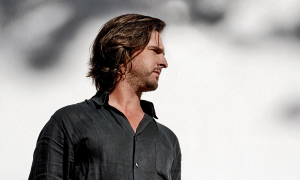
 Skinny Vinny, from left: Joshua Jefferson, Andrew Eisenberg
No, Skinny Vinny doesn't have the answer, but they aim to please—if your pleasure is difficult, minimal improvised dissonance. Which, for many it is. And for many more, it is a pleasant surprise from a genre that isn't their cup of tea, or weapon of choice. But the duo is not about duels, or combat.
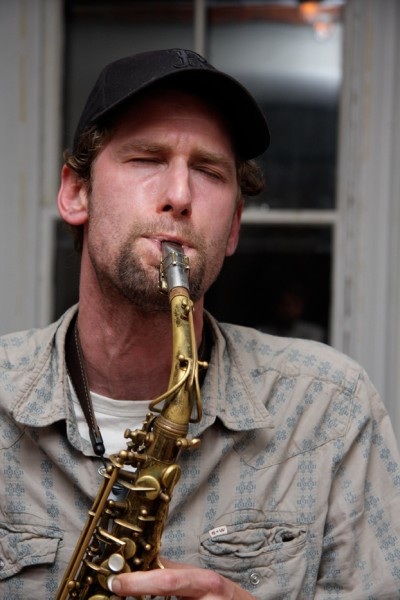
Joshua Jefferson is its alto saxophonist, and bass clarinetist. His deft reflexes and coordination make him a master of what could be called "protective mimicry," if he were not so original. His playing may evoke meadows rife with wildlife, the long trill of a hermit thrush underscored by the bellow of bullfrogs—or, the roar of a crocodile splashing into the Everglades of his native Florida.
A quick study, he has developed his remarkable technique in a short period of time, having picked up the sax in his early twenties, taking lessons from Bhob Rainey of Nmperign. He is also a very fine collagist, drawing inspiration, in both his visual and sonic art, from Marcel Duchamp. He is uncannily adaptable. As a musician he jumps in and out of projects, his own and others, assimilating their conceptual nature and vigorously sharpening it. These projects, centered in the Boston area, combine and recombine with many of the same members overlapping in each.
Combining, recombining, collage, mimicry, camouflage—these are Jefferson's leitmotifs, keeping him always on the move and lookout for new connections, new ways of presenting the new music, new ways of relating to an audience, however limited that may often be—and spurring fellow musicians to keep looking forward and incorporate the next bend or wrinkle in whatever's coming down the pipeline.
Take Skinny Vinny, with Eisenberg on their self-titled, self produced 2009 CD: Jefferson opens with his eloquent chirps and squeaks. Eisenberg mimes the mime, eking a sax-like squeal out of a cymbal with a violin bow. Eisenberg further abstracts this, as if processing it through a computer, yet it is all acoustic. In turn, Jefferson himself mimes this electronic vibe: the rapport and repartee evoke mechanical and electrical sounds of, say, an apartment or enclosed public space, random plumbing clunks, or electrical currents.
This keenness to environment, in this case urban, brings us full-circle to the meadows and glades we heard Jefferson conjure at the beginning. Eisenberg is Jefferson's equal in this power to let a dialogue deconstruct into its environment, and back. Following is what they had to say about that dialogue, in dialogue with me.
All About Jazz: Andrew: what's your musical background? Are you a late bloomer like Josh, or did you study when younger?
Andrew Eisenberg: Never studied music, ever. I've been involved with many different types of music for a very, very long time, and as soon I got out of high school and into college I was very much into electronic music, '94, '95,'96.
AAJ: Now would this be like electronica, or more like Morton Subotnick?
AE: Subotnick came later.
AAJ: So this would be like The Orb?
AE: Techno, ambient, different derivations of all that. Philadelphia was full of it. It was fantastic...I was going to school there, at Drexel. I didn't finish though, but I gave it a little bit of a shot. I got very much wrapped up in the music scene there, and very much into making art, but there was never any music school.
In '97-'98, I was still very much into electronic music, but I started—there was a crossover at that time with making art, and I started making sculptures out of television sets, and leaving them on. And I was using record players and broken records, and I was playing with a friend who made improvised music out of little analog synthesizers. I was starting to get very much into that but I was definitely on the electronic music tip. I didn't get hip to the sound—I didn't get introduced to the new sound [of improvised music] until '99.
I went to the High Wire gallery in Philadelphia, and Toshi Makahara was playing—and I knew there was an art show, and I was expecting an art show. And I walk in and there's two guys—there's some drums but there's two guys standing at the windows. And they open up the windows and they stick their heads out, and they scream out, "Hey! Hey!" and mind you, we're like on the third floor, and I have no idea what's going on. I know it's not an art show. Everyone's staring at these guys. They scream at people for a while and they try and invite people in. They were just screaming! and it went on and then finally one of them started playing, they both started playing, one went back to the window. There was this Norwegian guy and Toshi Makahara. It was a fantastic duo. And then fifteen minutes later, I was like, "Wow." I'm not sure exactly what I just saw, but that really piqued my interest.

I lived there for a couple more years and started to get into percussion. But it wasn't until I moved to Baltimore that I started "playing." There was a great scene there. They had shows like twice, three nights a week. At the Red Room and at other spots there was improv going on. I wanted to make it. I wanted to play, and at that point I started to get into playing.
AAJ: Did you buy a drum set?
AE: I started with bucket drums, and bits of trash, and pots and pans—it's always been that. I still used some electronic, I still had a television, white noise and whatnot. But never a kit. I acquired, someone gave me drums once, like three pieces, and this weird tie-dye kit. I did buy some drums and I tried to play it, but that was many years later and I don't use any of those pieces anymore. I came at it from pots and pans and trash and it's evolved into pieces, but I play backwards. I don't know how to play the kit—I play as if I'm lefty although I'm righty, I play without one of the sticks, just one hand. My left foot kicks the kick-drum, my right foot keeps the time, and nothing talks! I'm always baffled when I see a "real" percussionist and how they do it. It just seems uncomfortable.
AAJ: It seems like a radical transition to go from electronics to acoustic, organic drums. Is that a political or conceptual statement?
AE: My tastes changed a lot. There was a very easy line to start. If you start in techno and electronica, and that sound—
AAJ: There's a beat to it.
AE: There's a beat, but it's also very DIY. It's a very small scene. And I always wanted to be on the edge. I was always trying to find what the fresh sound is. And somewhere in the late '90s, techno started to get "dirty." There was more and more improvised music. I remember a group called Pole, Microstoria, they were leading something of the experimental sound. From there the crossover was more happenstance than anything else. It seemed like the most immediate way for me to get in was to be percussive with it. The physicality of it took over, where with electronic music I was trying to, even though it was a very physical thing for me, it wasn't as fulfilling as what I do now: shake and beat on things.
AAJ: Josh, what got you into experimental music?
Joshua Jefferson: I was just lucky enough at the time to be renting half of Andrew's studio space, at the Piano Factory, and it was just the right time to be around Jules [Julius Vasylenko], and Andrew, and a couple of other people. And I was exposed to what Andrew was doing, he played with this guy Travis and this other guy Josh, in a band called Junior Science. And at first I didn't actually like it! I didn't get it. I just thought they were being silly, they were stupid.
AAJ: What music did you like back then?
JJ: The sax sound, the jazz sound—I always liked jazz. But the improv, it was different. Andrew wasn't playing what he's playing now, he wasn't playing drums. So I was around people who were playing improvised music, and I found a clarinet at a thrift store, an antique shop. I started pulling on Andrew's sleeve to play together, and we did.
AE: The first night you got it!
AAJ: That's an interesting idea, being fresh on an instrument with nothing ingrained in you, it's just a fresh approach.
JJ: That's something Andrew and Jules always remind me of, that fresh approach that's not related to anything except the individual, expressing that pure essence, it's not filtered through school or institutions, it's completely unbound. That kind of energy or that kind of perspective is always what's best about improv. But I wasn't around free jazz. My tastes slowly grew.
AAJ: You both started as artists. Josh, you do collages, and Andrew, you're conceptual.
JJ: At the Museum School where we both met, I was doing mostly printing and drawing, and Andrew—well you were doing the TVs then.
 AE: Where Josh is 2D and flat (and in no was is flat a negative thing), I would have concepts of time and space...I took sound classes when I was there. I was very much into dada and fluxus, into performative events and making sounds. There were sculptures but everything was instillation. We were very different, we are very different artistically. I don't practice—I worked myself into a corner. I kept taking the concept of art, and breaking and breaking, and I still can't pick it back up...I never had what Josh has: beauty, in the two- dimensional fine-art sense. That was never my passion. It was never what I wanted to do...There's a soapbox—that's what art is; and you get up on the soapbox and you say something. And you want to make it efficient and compact, or you want to make it funny—I've never had the beauty thing. I never had that level of aestheticism. I've always thought too much about it.
AAJ: What I like about your duo, is that you [Andrew] pick up on what Josh is doing—
AE: Or vice versa.
AAJ: You're like Echo and Narcissus. Josh is like Narcissus and Andrew, you're Echo.
AE: We've been playing together for so long. We've done this thing where we used be able to hit it in bits. And we played out and introduced it here and there, but now we've got that hitch, whatever it is, the Skinny Vinny thing. It's fluid at this point in time. I don't know who's leading half the time, and neither of us probably is.
JJ: We even had a piece for awhile where we said, "Now I lead and then you lead." But it's usually whatever works.
AE: The transitions are nonexistent.
JJ: If he's doing something that's happening I'm going to be there, and vice versa.
AAJ: Would you be the concrete one, and Andrew the conceptual?
JJ: Interesting. I never thought about it like that. It's not really how I think it is, though.
AAJ: Well you do the collages.
JJ: Yeah, tangible-hard copy type of thing.
AE: Well in music, it's different. It's my first inclination—and this is from fluxus and dada—this concept of now and live, and this is what I'm going to make and this is the art that I'm making right now and it can only happen right now, because this is the time that I'm making it. That live aspect, I find that where— I think we've been making nicer sounds. We've honed the instruments and they give us nicer things, but at the end of the day it's about the moment, and that's where we get off.
JJ: I don't think we can compare our visual art to our music.
AE: Maybe in our choice of instrument.
JJ: Yeah, but it's a different part of the brain. I think both of us come to art in a different direction, and we both come to music in a different direction. I just think that in music we're more coinciding...Musically we have a language that's going in the same direction.
AE: We may have started that way. Josh played the clarinet, he wanted to play jazz, he wanted to play straight —and I wanted to play conceptual, but at some point we diverged to where we are now, where we are comfortable.
AAJ: You do have a real rapport. You listen to Josh and then Josh listens to you, and there's a real, nice back- and forth you have. And it blends seamlessly, too...But do you see any working or conceptual or mental relation between your visual art and your music?
JJ: I think generically you could say I play collage music. But when you really listen to it, it's really not that abstract or collage-y. The line, it's not straight, but it's really not that abstract.
AAJ: What is your process? How do you prepare a piece?
JJ: Well with my visual, I build things up and I deconstruct it...If you think of our musical history through the duration of a timeframe, it's been like a collage. As opposed to the actual moment. The timeframe of our development is, we put something together, we deconstruct it, and there's pieces of all these influences. Every time we play, I think it's the two of us just communicating the best way we know how.
AE: I think some of my art---at some point I was making some pieces, having some sort of performative event make sound. A lot of that informed what I do now...We played in a trio with [bassist] Ryan McGuire and we would work on things and talk about compositions, and he would introduce these concepts that we had no idea—
JJ: Yeah, we were the dumb art kids.
AE: We understood it from our means of understanding it. And I think what I learned from my art—now we're playing improv and there's a direct line—I couldn't have got where I am now without starting where I was...There's a John Cage piece from the late '50s that I heard around '02, for prepared piano, and it was gorgeous, gorgeous, gorgeous. My line comes through that. But right now this is the only game in town. I can't make art. I'm done with it.
'Cause music, what I'm doing musically, is it. It's live, it's now—there's no galleries. You play and that's it. It's done, and I'm gonna get to do it again real soon.
AAJ: Could you give a history of the evolution of Skinny Vinny?

JJ: Jules Vasylenko was out of town, in England. We had a trio with him, Boston Lamb & Veal. This was 2002. We thought he would be mad at us for playing together without him. There was also Vinny van Gogh, there was No Band, there were other projects...There was Dilettante, with Ryan McGuire, and Skinny Vinny came back when Dilettante started to fade. Then we decided to kick up the duo. We went to Toronto, and Baltimore. So this reincarnation? 2007.
JJ: We met at Museum School. I actually had a chess club. This is how I met him. I had a chess club at school, and I got the school to give me some money and to buy boards and little cheap-ass clocks, and I was playing speed chess with people, and I had a few people come at me, three of four, and then Andrew came down once. And I played him and I was very strict, "You can only use one hand," and I was yelling at him for using two hands. We became friends from there.
AAJ: Chess opens up a lot of boxes. Marcel Duchamp, for example...When you play together, is that anything like a chess game?
JJ: Sure.
AE: Once we get into the hustle, it's real quick. We school ourselves on getting stoned and playing speed chess, over and over and over again. By the time we started making music together, it's hurry up and go.
AAJ: So the chess came first and then the love...
AE: Yeah, the first time I met him—
JJ: We didn't get along.
AAJ: Is there any competition between you when you play?
JJ: I don't think we could play if there was.
AE: We need each other.
JJ: Even with credits, we're like, "Who goes first?"
AAJ: So what actually goes on, from a musician's point of view, in your duo?
AE: We've developed enough of a language that, when we sit down and play, we're just trying to feel each other out, feel the room and make it happen. We have our language, not to say we're done with developing it.
AAJ: Listening to the room, that's a good thing.
AE: We make some sound, how does the room react to it, how did Josh react to it, now where do we go, where do we go...In a weird sense, we're kind of always looking for the way out. You want to say just enough, you want to phrase it right—but when things land, get ready to let go.
JJ: Less is more, for sure.
AAJ: In seeing you, and watching your videos, like the one you did in Northampton, last February [2009], the audience was really getting into it, shouting out for "Freebird," and it was very serious music you were playing and you have to listen carefully, but there's a real sympathy—
AE: Yeah, there's a physicality that may be serious, but you can see the way we're moving and the sounds we're producing that we're into it—and you look around, and the audience is getting into it, even if they don't know what's happening.
AAJ: And there's humor to it.
JJ: Yeah, absolutely. Sometimes it's hard to sound that way without being pretentious. It's a weird line.
AE: That physicality—I think that humor does a lot for me. We play heady, conceptual music. You've got to sit down, take it apart. It's not easy listening. But I think our attention to the moment, our attention to playing it live—I remember the Northampton show. The kids were bopping there heads. We're playing screaming, high-pitched tones—they were into it! Those shows were big! They'd never heard the sound before.
JJ: That goes along with energy, physicality and energy. I think that brings a certain instinctual awareness. You know it's now.
AAJ: Do you have any kind of musical theory behind what you do?
AE: We're into psychoacoustics. We will play all our sounds in a search for different ways to make our tones beat against each other and collide and make that kind of weird third tone in your ear.
JJ: Making your brain wiggle.
AE: We look out for that... You put two tones next to each other, they get out, and they kind of fluctuate.
JJ: We don't write about it our talk about it, we just call it.
AAJ: Would you call it intuitive or instinctual? Would those labels be accurate?
JJ: Sure, absolutely. We learn it through exploring it. It's always been exploratory and trying to abstract that sound enough where it becomes—in you. It's in your head.
AE: We feel it 'cause we made it ourselves, and we've made a lot of mistakes and we've owned those mistakes, and made them happy things or good things...I think we each hear a sound and we play, and maybe it's a little different from what we hear, but we keep moving that target and I think we've covered a heck of a lot of ground.
AAJ: Now do you plan anything ahead, or is it all spontaneous, your performances?
JJ: No, we definitely plan stuff before. We have pieces, but they're—
AE: Loose concepts.
AAJ: How do those come about, the pieces?
JJ: From just playing and listening to each other and going, "That works." We'll play and we'll go, "I like what you did there, and that worked when you did that there," and we'll go, "Let's call that the 'Gordon' piece, and I'll know what he means when he says that. And that might be like seven or ten different notes and four different measures of things, if you wrote it out, but we don't write it out.
 Joshua Jefferson with Duck That, from left: Jefferson, Steve Norton, Angela Sawyer
AAJ: So you do have a process.
JJ: There is a process, but it's not written out. It's all verbal, and it's all felt, it's all heard. On our new album (we're in the process of mixing it), each one is a piece. Maybe one or two are free...We have structures. He'll say, "Play the 'Window' piece," and I know what he'll do. He'll do a specific thing, and I'll do a specific thing.
AAJ: Literally the "Window" piece, where Andrew scrapes a window...
AE: In practice, we invent these things, though...It's always different how we play things, how we start it, how we end it, live. But there's always that—Josh does something, I'll know where to go. It's loose. I don't think we could score it.
JJ: I think if we did score it, we wouldn't be able to play it.
AE: It wouldn't be fresh, and that for us is a no-go.
AAJ: Now where did this love of windows and doors come from, Andrew? I've seen the tables made of doors in your loft...
AE: I like old wood. I may have gone to school for conceptual art, but I definitely enjoy building things, and I'm kind of hand-crafted in some regard. I'm a very hack, hack, hack carpenter...The first time I had the doors was in 2005, in Andrew Square (South Boston). I had a garage. It was a big concrete garage. We had performances there. I had a lot of doors, and I leaned them against the walls so it didn't look like it was cinder blocks.
AAJ: What I see conceptually is the love of material, the materiality of an object. I was talking to Vic Rawlings about the old-time banjo he plays, and he said what interests him about it is not the music itself or the melodies, but the sound of the banjo and its materiality. So I imagine that with what you play on sax and percussion you draw on the materiality and the grain of the instruments.
JJ: Absolutely. It's organic. We've heard that before, told to us, and we both agree; we're finding these sounds out of these instruments that aren't necessarily what they're supposed to be designed for, but at the same time are what they're making. And that itself, that materiality, is refreshing.
AE: I love to think we play jazz. I'm not quite sure we do, but the influence of noise, everyday life, everything around us now—that has taken what we have for jazz, and it's this new hybrid. The fact that it's acoustic is- -
JJ: It's more poignant.
AE: That's our hope.
JJ: There's no price tag on that.
AAJ: Do you have a mission, an ethics?
JJ: Just play, get better and better.
AAJ: I asked Forbes Graham this question, and he said an artist's first allegiance is to his artistic community. I see that in you. If even just between the two of you.
JJ: We both like to reach out.
AE: I can speak to ethics as a performer. As a performer, I have ethics—to myself. What I do has to be free. Otherwise, we just want to be true to whatever sound we're inventing. I think that's important.
AAJ: What does your music say?
JJ: I think it says whatever the listener listens to, or feels...I have a friend who came to a show, and he said afterward, "What I like about your music is that I didn't think about your music, it made me think about other things." It was so abstract, that it made him not engage in the sounds. The sounds actually engaged in his brain—memories, and thinking about other things...I think we're very emotional, but I don't think we're trying to convey a message.
AE: I think there are a couple of things wrapped up in there. One is, "This is possible." There's a lot of what we do being on the edge of experimental music, and there's a whole lot of other music out there, and we represent the avant-garde where this is possible, this is unique. I'm sure we could take our unschooled asses and go play something straight, if that's what we intended to do.
JJ: Maybe we're communicating speed, communication—
AE: I think we're communicating that—we're conveying invention and ingenuity, and, "This is totally possible" and not only is this not impossible, but it's legit, and it's valid. I think that's there but at a certain point, after playing together for so many years maybe that's decreased a little bit. I think that at this point it's very important for us speak clearly and comprehensibly. We've already established that we're way, way out, and now maybe it's important for us to just be succinct. I kind of get off on when people say "I like this." We've had many comments and critiques over the years: "Wall of sound that you don't want to move 'cause it's just beating down over your head" and so forth.
JJ: We always hear people say we're emotional.
AE: Now I would say, the more comprehensive and concise we are, the more people are enjoying it.
AAJ: Have you always done short songs, or is that a new thing?

JJ: We like to get in, we like to get out...The kind of music we play, you can say a lot with a little. The kind of music we appreciate encapsulates so much so quickly. Our favorite artists, like Evan Parker and Paul Lovens, the way they're doing something, it's like fifty seconds, but---it's a whole album. We appreciate that, the short minute. But honestly, at the beginning, that's all we had to say!
AE: That energy, it's easier to digest.
AAJ: Could you give us a preview of your new album?
JJ: It's called The Elements of Style (Self Produced, 2010).
AE: It's more "up" than the first one, it's more free-jazzy, more of a jazz sound.
JJ: Andrew's cooking more on the drums, I'm screaming more.
AE: We didn't "tumble" on the first album. We really went for extended technique on the first one, and it really pushed the sound and drew out nice pieces. This one, we're doing our fake-ass jazz, and it's good.
JJ: We're freakin' out.
AE: More energy...We never look back. As soon as this new one comes out, it's time to stop what we're doing and start reinventing again.
Selected Discography
Skinny Vinny, The Elements of Style (Self Produced, 2010)
Joshua Jefferson, Turkey Boot Foot (Self Produced, 2009)
Skinny Vinny, Skinny Vinny (Self Produced, 2009)
Joshua Jefferson, Jefferson Solo (Self Produced, 2008)
Photo Credits
Page 1: Bill T. Miller
Pages 2, 3: Lillian Graham
Page 5: Matt Samolis
All Other Photos Courtesy of Skinny Vinny
< Previous
21st Century Chase
Next >
But Beautiful
Comments
About Joshua Jefferson
Instrument: Saxophone, alto
Related Articles | Concerts | Albums | Photos | Similar ToTags
For the Love of Jazz
 All About Jazz has been a pillar of jazz since 1995, championing it as an art form and, more importantly, supporting the musicians who create it. Our enduring commitment has made "AAJ" one of the most culturally important websites of its kind, read by hundreds of thousands of fans, musicians and industry figures every month.
You Can Help
To expand our coverage even further and develop new means to foster jazz discovery and connectivity we need your help. You can become a sustaining member for a modest $20 and in return, we'll immediately hide those pesky ads plus provide access to future articles for a full year. This winning combination will vastly improve your AAJ experience and allow us to vigorously build on the pioneering work we first started in 1995. So enjoy an ad-free AAJ experience and help us remain a positive beacon for jazz by making a donation today.

Giveaway

Days remaining: 4