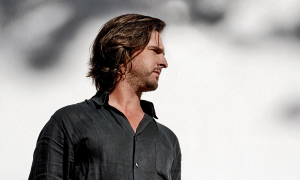
Home » Jazz Articles » Interview » Chris Jentsch: Cycles and Reflecting on the Journey
Chris Jentsch: Cycles and Reflecting on the Journey


"I was intrigued by a recent John Abercrombie interview in which he described his Jazz as European influenced," Jentsch says. "When pressed for elaboration of that buzz-term, he indicated European Classical and Folk music influences in balance with or even at the expense of more hardcore Bebop or Blues sonorities."
All About Jazz: What kinds of music were you hearing growing up in Brooklyn?
Christopher Jentsch: I grew up in the '60s in Cherry Hill, NJ, which is a nice suburb across the river from Philadelphia. The music I heard was basically the Beatles (from my interest), Frank Sinatra (from my father), the musical family next door and all the hits on pop/rock radio at that time, since I listened to the radio a lot. I've been in Brooklyn since 1999.
AAJ: Did you do the usual sideman apprenticeship while studying the guitar and composing?
CJ: Not as much as many other NY musicians. I was self- or informally taught for quite a while on guitar before I began doing gigs or attending music schools. Consequently, my sight-reading was poor, even for a guitarist. The sideman apprenticeship thing you refer to still happens, but it is much less common a phenomenon for learning the music. Colleges and conservatories of music have sort of replaced the sideman thing you refer to, and I'm afraid I'm an example of this trend for better or worse. As the rise of jazz in music schools has developed, touring and keeping a regular band has become more challenging. My friend Gary Versace is a great contemporary example of someone who has combined the best of both of these two educational models.
My reading has gotten better over the years, but only to the point where it helps me with what I'm trying to create as a composer and guitarist. I don't really get calls to be a sideman because there are so many others who are faster at being able to contribute to the situation. Plus, I'm not as strong rhythmically as many others. As [Frank] Frank Zappa once referred to himself, "I'm an unreliable parts player," so perhaps I'm perceived as best cut out for playing my own music.
Having said all that, I'm comfortable with the situation as it is and also with my continuing evolution as a player. I'm so busy with teaching and organizing my own projects, that I probably don't have time for adding on a bunch of sideman stuff. Plus, a guitarist friend of mine does too much sideman work in his own view; he remarked that he felt I was lucky I didn't have to make my living that way.
AAJ: Your candor about your sight-reading is interesting in light of the formal education which you received at the New England Conservatory and the Eastman School of Music.
CJ: I began attending all the music schools six years after I had already graduated from college. (I have a degree in history from Gettysburg College.) Like I said before, I had been largely self-taught on an instrument that was not known for players who were great readers in the first place, especially back in the big hair metal '80s. I didn't even start guitar in the first place until age 17, so I also missed out on the whole high school band experience where a lot of players get their early intensive reading experience. I never played a band instrument. So I gained admittance to those schools on the strength of my ears and guitar audition—a modest ability to play standard tunes and improvise that I had developed in the '80s playing in small jazz groups and also doing casuals and weddings (good situations in which to be expected to know tunes). I was already somewhat of a working professional, playing commercial gigs, touring with top-40 bands, etc., but I sensed a real dead end for my musical development in that direction and decided to get some more education.
I even went to Berklee [College of Music] for a semester, waiting for a spot to open up at the conservatory. At Berklee, all the musicians earned a four-digit "ensemble number" that changed with the twice-a-year instrument juries; it was used primarily to place people in the different bands. The first digit was for sight-reading, the second for scales or modes or something, and then playing a standard melody with improvising, and the fourth was all-around musicianship. At one point during the one semester I was there, I was assigned something like a 2445 or a 1334 as a 26-year-old "freshman." If you asked someone to play a session, they would ask you for your ensemble number, and if it was too much lower than theirs, they might say no and vibe you. Tiger Okoshi [the trumpeter, now on Berklee staff] was rumored to have had the only 9999.
 I went into the toilet once at Berklee, and in one of the stalls was a kid sitting on the commode practicing guitar with his pants around his ankles. That's the kind of school it was, and ultimately not for me, but I certainly learned a lot of important fundamentals in the four months I was there (beginning harmony, ear training, arranging basics, calligraphy/notation, etc). I think the people who could read and play at a higher level even upon entering Berklee made out better than I did. Plenty of friends that I know now thrived there back in the day.
It was assumed then that my deficiency in sight-reading would be rectified along the way as I progressed through music schools. Once I actually got into the schools, I concentrated more on improvisation, ear training, composition and orchestration. I got better at reading since I was dealing with printed music all the time and playing a lot, but I never achieved the sort of reading fluency that many of the good NYC guitarists have. In the end, I think this unusual path has helped me develop an individual musical personality.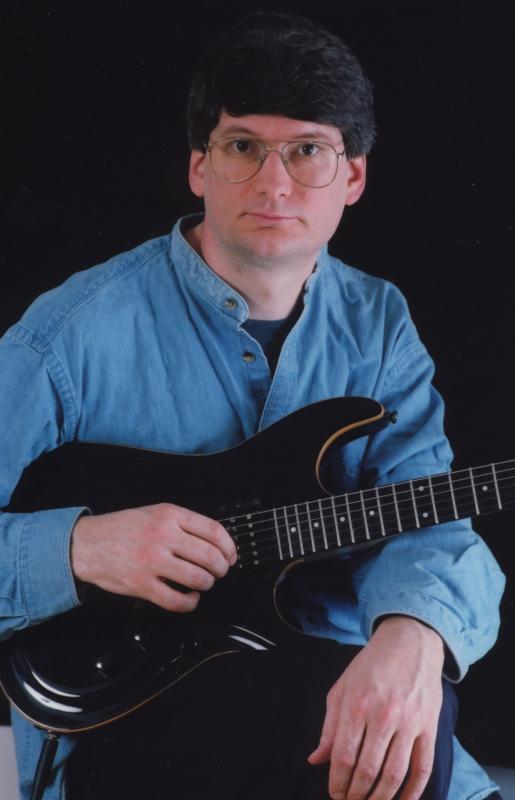 AAJ: Does releasing discs mean quite what it meant decades ago in jazz? Do you even see a monetary return on any of your recordings?
CJ: Not really. Many musicians don't do it for the money, so society and culture benefit from their altruistic impulses. For some time now, the cliché has been that, at minimum, you needed a CD as a calling card for the purposes of publicity (it used to be a cassette tape. The basic applicability of this maxim is still in effect. I think there may be two groups who are making some money from their CD sales: the jazz superstars, and also independents that have some kind of a following who produce their own product and sell them at gigs.
Obviously the entire industry is undergoing an enormous upheaval in terms of music formats and distribution; I don't pretend to know how it'll all shake out. Having one's own LP or a CD available in eras past conveyed a real aura of professionalism, if not artistry—seems like a given expectation today. I've noticed that many smaller clubs don't necessarily need to see a CD anymore for booking, which is an interesting indication of the direction we're headed in. The procedure for getting a gig sometimes simply involves forwarding the URL of a Web site that features the music you want to present. Some bookers even refuse to accept traditional promotional packages. So to answer your first question, I think the industrial meaning of releasing your own music is changing, but the impulse of wanting to create an inspired artifact and/or to document your artistic development remains the same.
My reflex response to the question is to bemoan our current situation—poor paying gigs (sometimes in bad venues), falling hard-copy CD sales, saturated markets for live and recorded music, and tendencies toward hyper-categorization and sensationalism in the media (print and particularly radio—TV isn't really even on the radar or within the grasp of most jazz musicians). But when I think about it, I'm not sure the situation was so much better for musicians in the 1950s or the '70s or whenever. All that may sound depressing, but remember, we're just talking about the industry. I feel that my actual music and the state of jazz music generally is very healthy—so many different styles and scenes. It's just the music business that is kind of sick. The music continues to grow in spite of the business.
AAJ: It is fascinating that in this tough economic climate most of your recordings have been large ensembles. Please give us a glimpse into how each of these projects got off the ground—from getting funding to just the sheer logistics of getting all of these working artists to practice and record your projects?
CJ: I'd always thought of myself as more of a small group kind of bandleader until I started getting some of the grants I'd been applying for, and to look at my formal discography to date, I guess you're right that three out of the four are large ensemble releases. I think of myself as a performing composer/guitarist, mostly in a small group context, but perhaps you could say that my career itself has been improvised—a trajectory determined by my ideas and interests and the opportunities that have been made available to me.
Brooklyn Suite (2007, Fleur De Son) was an idea I submitted to American Composers Forum (ACF)—a connected group of compositions that would feature my various electric guitar textures along with the instruments of a jazz big band. The American Music Center (AMC) was another resource for this project; I was awarded some funds to put toward the preparation of the score and parts.
Brooklyn was the piece that got Jentsch Group Large off the ground—the ACF commission was a great initial excuse to try and call a bunch of great people together. The band members are all extremely busy, first call-type people here in the city, about half of which are bandleaders themselves. There has been surprisingly little turnover in band personnel through the various projects. That so many choose to continue to participate for very modest remuneration has been very gratifying. I get the sense that the members see the band as a good hang, and that apparently the music enhances that. The actual scheduling of rehearsals and concerts may be the hardest part of the process—trying to determine who's available on various day parts and scheduling events accordingly. You might be surprised how easy it is to get sidetracked with all of these administrative details while trying to keep one's eye on the creative ball.
My large ensemble streak was bolstered when my idea for Cycles Suite (2009, Fleur De Son) was approved for funding, principally by the New York State Council on the Arts. I wanted to feature my friend, trumpeter Mike Kaupa, with the ensemble. For the application I was represented by The Field (a composer's service organization). I was also selected to travel to Ucross in Wyoming, a beautiful retreat opportunity for artists, to take time and focus on creative work and little else. I used the two-week residency at Ucross to jump-start the actual composing of the work as a transition out of a heavy administrative phase.
 Since I received a substantial large ensemble commission around 2002 and then the other fairly soon after, I allowed that work flow to radically affect my professional activities for these six or seven years. All through that time, I continued writing for and gigging moderately with my small group, but that I've been so diverted up until recently by these large ensemble activities is an indication of the work involved and/or a statement about being uncomfortable doing too many things at once. The wearing of too many hats can make me a little inert (producer, composer, music copyist, contractor, grant writer/researcher, guitarist, etc.), and this has impeded my medium- and long-term planning. I might have been able to realize more projects if I knew then what I know now about production delays.
It hasn't been a terribly efficient span in my career, but it has been a rich and rewarding one. I have plenty of ideas for future large ensemble projects—mostly on the order of taking a break from this extended suite form with the long, connected movements (having produced a trilogy of those) and instead working with some shorter subjects, and a further interest in acquiring funding for a studio recording as a main component of a project, rather than a one-shot recording of a live premiere being the main emphasis as with these three suites. Even though commissions paid to me have been involved, none of the large ensemble projects have made any money because anything that comes in goes out to pay for musicians, concert hall rental, insurance, recording, publicity, etc. I think I made a few hundred on Brooklyn Suite (for two years' work), and the Cycles Suite project lost a little money. So I haven't been able to really afford to do much else during those years.
AAJ: Please elaborate on your acknowledged influences of Jim Hall and Wes Montgomery in contrast to how you actually play, which suggests more in the way of Jimi Hendrix.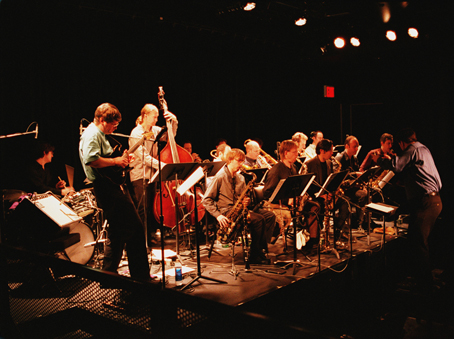
CJ: On the large ensemble records, the soaring-type melodies and improvisations that I assigned to myself to be executed with rock distortion and feedback are perhaps the most ear-visible aspects of the guitar parts. It's true that I feel these moments are the closest to whatever voice I feel I project as an instrumentalist—moments specifically designed, in fact, to be able to be heard in balance with a sizable jazz orchestra. But I also issue a lot of integrated lines with a warm/clean, jazz type of sound, and there are several spots in the suites where I am supporting someone else's improvisation, comping through chord changes with a jazz sound and more of a standard, interactive, jazz rhythmic approach. Further, I might point out that my guitar work in smaller groups strives to project the kind of intimacy in which a cleaner, jazz sound can be more at the forefront.
AAJ: Please talk about your influences both in terms of your own guitar playing and composing for large ensembles.
CJ: That's a huge question, of course. As a guitarist I really heard a lot of The Beatles through the '60s and later found guitarists like Jeff Beck, Hendrix, [Carlos] Carlos Santana, Neil Young and Zappa as very important players to me vaguely associated with rock. In terms of the jazz guitar world, the most formative ones for me make an eclectic and perhaps revealing list: the two you mentioned above, Freddie Green, Django Reinhardt, John Abercrombie, Ralph Towner, Allan Holdsworth, Bill Frisell and Terje Rypdal. I would say also that the music of India and the German label ECM Records have been very important to me specifically as a guitarist.
As a composer, all of the above—in particular the Beatles, Zappa, Towner and Rypdal. As for checking out how other composers write for larger numbers of musicians or create longer forms, I would list Duke Ellington, Gil Evans, Maria Schneider and Kenny Wheeler from jazz. Louis Armstrong, Miles Davis, John Coltrane, Thelonious Monk, Ornette Coleman, Keith Jarrett, Bill Evans and Steve Lacy from musicians associated more with small group performance. Bach, Beethoven, Brahms, Richard Strauss, Wagner, Charles Ives, Toru Takemitsu, John Cage and Edgard Varese are highly mentionable, loosely from the European tradition. Traditional African music, I would say, has been important along with British/Irish folk music (Martin Carthy, Steeleye Span, June Tabor, Fairport Convention) and, of course, the long, lush history of the blues.
I've had so many friends, family and certainly teachers that have made an impact. The older I get, the lines between my life and music don't really exist, so I should name the Marx Brothers, Ingmar Bergman, Tom Waits, Bugs Bunny, traffic sounds, Sergio Leone, Bill Cosby, bird calls, George Carlin, car radios on scan, Monty Python, Bob Dylan and my wife as pretty important influences on my composing. I'm leaving a lot of things out.
Lastly, I've found entertainment of late by listening to two records together at the same time, sort of at random. Picking any two things can be a really interesting listen, but sometimes I try and focus my combinations to two relatively sparse recordings in order to generate an aggregate that presents a little more transparency—say, [Brian] Eno's Music for Airports (1978, Polydor) (ambient piano and electric keyboards) combined with Zappa's Sleep Dirt (1979, DiscReet Records). The juxtapositions can yield some truly stunning results, often conveying a kind of organic bitonality with clear polyrhythms—if your mind can swing that way.
AAJ: Since most of your discography is comprised of large ensemble recordings, how successful is your small group in terms of touring, etc.?
 CJ: As I've suggested, since 2002, I have been very occupied with these two substantial Group Large projects, whether in pre-, post- or actual production, at times juggling aspects of both projects at once. Indeed, whatever quartet energy I had going since moving to Brooklyn in 1999 has suffered. We've done a couple of gigs a year, I guess, in the NYC area in the last 10 years as a trio or quartet and a bunch of sessions. I've also done a couple of projects that could loosely be described as chamber music. I can think of other bandleaders among my peers who seem to be able to keep small group momentum while producing projects with larger ensembles, but I don't seem to have been inclined to toss that many balls in the air.
Consequently, a small group recording project has been long-delayed (my last one was 1998) and as of September 2009, I have moved ahead with Jentsch Group Quartet recording sessions for a CD to be titled Fractured Pop featuring John Mettam and Jim Whitney (the rhythm section from Group Large) along with reed player Matt Renzi. I don't regret my recent focus on large ensemble works. I am finding that I'm turning back to the small group with a renewed vitality and, bolstered by the large group experiences, with a richer perspective of what I want to achieve.
I would also like to point out that whatever exists on my official discography (four CDs as of now) is a "tip of the iceberg" situation. I am readying the Jentsch Underground Series of CD releases, material going back to the late '80s. The advances we've seen in the technology of home recording have facilitated the editing and mastering of this archival material. Some volumes have an enhanced bootleg sound quality to them, but others are full-blown studio documents of various bands I've led over the years—at least four separate trios or quartets playing various tunes, a trio and a duo committing free improvisation, live alternate versions of the large ensemble playing the suites, a live quartet version of a large ensemble suite, anthology-type compilations of rare tracks, and guitar-oriented collections. The initial issue will be perhaps 10 CD volumes released separately all at the same time. Six are already finished, and a few more are very nearly so.
AAJ: Does the lack of African Americans in your large ensembles reflect a dearth of black instrumentalists to choose from?
CJ: No dearth.

AAJ: Is then the lack of African American musicians in your ensembles just circumstantial?
CJ: Yes. Why do you ask?
AAJ: As both an African American listener and a fan of your music, I found it curious that no African Americans were in your various groups. This is not to infer any prejudice on your part at all.
CJ: I appreciate that. Neither all white, all black or mixed groups would be unusual to see in NYC, in my experience. The musicians I hire are drawn from my personal relationships or from specific recommendations from those who are already in the band. There's no formal audition process or anything. Having said that, I think people of all races, including myself, could make more of an effort to expand the circle of those personal relationships to have a more representative pool to draw from. I remember Wynton Marsalis said as much once when an interviewer queried him generally about perceived motivation behind the membership of notable all-white jazz groups. Wynton said (I'm paraphrasing) that someone like Gerry Mulligan didn't hire the guys in his band because they were white but because those were the musicians he knew. I thought Wynton's comment showed a lot of sensitivity and wisdom.
I noticed, Ludwig, that you've done some work for WRTI in Philadelphia. There was a time—must have been in the early or mid-70s—when they were back-announcing a lot of Muslim-named jazz musicians I'd never heard of. I remember how unusual and outside my experience that all seemed as a young teen listening from across the river in Cherry Hill. That is my background, and I'm proud that my music accurately reflects those formative suburban experiences, culturally, at its base, before I later added all the other influences to the mix.
I've been privileged, lastly, to have one particularly remarkable individual in the band since the beginning, certainly not hired due to her gender. It seems lame to me that once in awhile, I have the fleeting thought that her presence is good for the group demographically because that to me is actually an indication of how much further we have to go as a society to overcome sexism and, by analogy, racism. Hope that all makes some kind of sense, and thanks for drawing me out.
Selected Discography:
Jentsch Group Large, Cycles Suite featuring Mike Kaupa ( Fleur De Son, 2009)
Jentsch Group Large, Brooklyn Suite (Fleur De Son, 2007)
The Christopher Jentsch Trio, Media Event (Blue Schist, 1998)
Christopher Jentsch, Miami Suite (Blue Schist, 1999)
Photo Credits
Pages 1 and 3: David Frost
Page 2: Helena Fierlinger
Page 4: Gina Renzi
< Previous
Kenny Davis
Next >
February 2010
Comments

About Chris Jentsch
Instrument: Guitar, electric
Related Articles | Concerts | Albums | Photos | Similar ToTags
For the Love of Jazz
 All About Jazz has been a pillar of jazz since 1995, championing it as an art form and, more importantly, supporting the musicians who create it. Our enduring commitment has made "AAJ" one of the most culturally important websites of its kind, read by hundreds of thousands of fans, musicians and industry figures every month.
You Can Help
To expand our coverage even further and develop new means to foster jazz discovery and connectivity we need your help. You can become a sustaining member for a modest $20 and in return, we'll immediately hide those pesky ads plus provide access to future articles for a full year. This winning combination will vastly improve your AAJ experience and allow us to vigorously build on the pioneering work we first started in 1995. So enjoy an ad-free AAJ experience and help us remain a positive beacon for jazz by making a donation today.

Giveaway

Days remaining: 6