Home » Jazz Articles » Interview » Sizhukong: It Don't Mean a Thing if it Ain't Got That Oon
Sizhukong: It Don't Mean a Thing if it Ain't Got That Oon


With something like 10 million people migrating every year to China's cities, it seems inevitable, though, that old musical traditions will find new voices once merged with influences such as electronic music, hip-hop, rock and jazz. Most likely, much experimentation is actually taking place among a population numbering 1.3 billion.
As yet, however, little if any interesting fusion of traditional Chinese music with jazz has announced itself to the outside world. Taiwanese sextet Sizhukong is pioneering a trail in the fusion of traditional Chinese music and jazz. The results are spectacular; imagine Weather Report jamming with Tito Puente, sculpting beautiful and unmistakably Chinese melodies.
The name Sizhukong comes from the joining of three Chinese characters, and the meaning is multi-layered. Si means silk, from which strings were originally made, and may represent the flow of the music. Zhu means bamboo and may represent the roots nature of the traditional instruments. Sizhu means musical instrument. Kong means emptiness or the state of enlightenment that comes through meditation. Sizhukong means the pressure point at the end of the eyebrow which may signify the flow of energy that brings the body into physical and emotional harmony.
The multiplicity of meaning behind the name is entirely appropriate, as the music of Sizhukong is not easy to pin down; African and Latin rhythms blend with thousand-year-old Chinese traditional instruments and a jazz rhythm section. Sizhukong, it could be said, embodies the universality of music.
The roots of Sizhukong date back to 2003. The band followed a natural evolution, explains Yuwen Peng, the band's founder, main composer, musical director and pianist. "Actually, I started this band by accident," she says, laughing. "At the beginning, my friend Yichien Chen [lute/mandolin player] wanted a song composed for her instrument in a jazz style, so she asked me to write a composition for her concert. So I wrote the first one, which is called 'Fengyang.' At the beginning it was just a duo version with piano and liuquin [Chinese mandolin], and every year, she asked me to write one more song, so we got more and more repertoire, and I added more instruments."
"Fengyang," a highlight of a Sizhukong concert, appeared on the band's debut recording, Sizhukong(Sizhukong Records, 2007). That album contained all the elements of Sizhukong's style—the adaptation of old Chinese folk songs, a jazz sensibility and the incorporation of rhythms and sounds from Africa and Latin America.
In the time since then there have been some personnel changes in the band and the sound of the band has evolved, growing more confident and assured. It is not, however, a simple matter playing Chinese music in a jazz style, and for each of the members of Sizhukong, this fusion presents its particular challenges.
Chihping Huang, xiao [Chinese recorder] and dizi [flute] player notes, "Before I joined Sizhukong, I only played the flute the traditional way. The chromatic tones and modulation of keys, which are very common in jazz, were very difficult for me. So when you see me play, you see me change flutes very often, but it's still possible to modulate to another key and beat. You have to cover the holes [using paper] to make the chromatic tones. So there are still many problems I have to face when I play in this western style."
Listening to Huang's mastery of a vast array of recorders and flutes from various parts of China, it is hard to imagine that such difficulties ever existed in the first place. The fluidity of his playing, the lyricism and virtuosity in his improvisation, recalls at times great Latin flautist Dave Valentin or jazz great Herbie Mann.

If the flute brings a Latin feel to the flow of Sizhukong's music, then the erhu [two-stringed fiddle] lends another dimension to the musical palette of the band. Alex Wu, who also plays percussion in the band, says, "Erhu originally came from other countries—not China, but from middle east Asia. Later the Chinese developed it, so it looks like what you see today. The ancestor of erhu had a fingerboard, and you pressed the strings onto the fingerboard, but now on the modern erhu, you don't need the board; you just press the strings. It sounds very emotional and can express feelings dramatically, and because there is no fingerboard, the vibrations and the emotions you want to express can be stronger."
Wu is another virtuoso on his chosen instrument. His playing can be as soft as a sigh and exude a sobbing melancholy, or it can sound like an imitation of singing or be wild and abrasive. The exact origins of the instrument may be unclear, but it does bear a very strong resemblance to the African ritti, the one-stringed fiddle played by Gambian griot master Juldeh Camara. In Wu's more sweet-toned passages, there is a bluesy swing, which can recall the joyous playing of jazz violinist Stephane Grappelli.

Playing in Sizhukong presents a particular difficulty for Wu. "Usually if the erhu is played solo in front of a large traditional Chinese orchestra, the orchestra members will be asked to play softer, so that you can hear the erhu clearly. In Sizhukong there are many loud instruments, which make it difficult sometimes for me to hear myself, so I have to stay close to the monitor to hear," he says. "In jazz, you have to modulate very often, but it's not difficult for erhu to modulate to other keys. I also play many percussion instruments in Sizhukong, so I understand different concepts of rhythm, which I can also apply to erhu."
If Sizhukong's melodies and sound colors are predominantly Chinese, then the harmonies and rhythms are largely western. Drummer Toshi Fujii, who hails from Japan, does much more than keep rhythm in Sizhukong. "Chinese instruments often play sounds from nature," Fujii explains. "With one cymbal, I can play a wind sound, with another I can make a sound like rain or a very Chinese-sounding cymbal. These are a little bit different from traditional jazz cymbals. I use traditional sounds from bamboo block, which has two different pitches."
Fujii's percussive coloring can be as subtle as a breeze, evoking croaking frogs one moment and becoming an utterly exhilarating sound the next, creating a din which would waken a Chinese dancing dragon from the dead. "I didn't used to pay attention to Japanese traditional music, but after I joined Sizhukong, I paid more attention," Fujii says. "I won't use Japanese rhythms, but sometimes I'll use a Japanese percussion instrument."
For Fujii, the challenges of playing the music written and arranged by Peng are not insignificant. "There are other differences between jazz and Chinese music; in jazz you will hear a two and four backbeat, but in Chinese traditional music they always have the accent on one and three. Sometimes I will get confused to keep that foreign beat," Fujii says, laughing.
Sizhukong's manager, Peter Lee, illustrates a fundamental difference between Chinese and western music. "A lot of Chinese music and dance does not rely on rhythm or meter. The three step is difficult for a lot of western drummers because it has no meter; they only count how long the breath is held and where it ends. They know the timing by how they breathe—it's complicated," he says.
If there was ever any confusion in Fujii's time keeping, then it certainly doesn't transmit itself to the audience. Before switching to the drums, Fujii played bass in Sizhukong, a role now undertaken by Belgian Martjin Vanbuel.
 "The first time I heard Chinese music was in Shanghai," Vanbuel recalls, "and then moving to Taiwan, the first time I heard Sizhukong was on the radio—an interview with Yuwen [Peng]—and I was like, 'Wow! This is really cool!' There was clearly something very creative happening in Taiwan. At that time I didn't know that just a few months later I would be joining that band."
Vanbuel plays both electric and double bass in Sizhukong and also is a composer. Yet as difficult as it for the Taiwanese members of the band to adapt to western musical concepts, approaching Chinese traditional music posed its own problems for Vanbuel. "There are quite a few challenges to playing in Sizhukong. Before I joined Sizhukong, I played double bass in traditional jazz and swing jazz, so I needed to adjust, to study more arrangements and play more regularly," he says. "I tried to learn Chinese traditional instruments' techniques and sounds to put on my instrument."
"I think the Chinese use a lot more decorative sounds, which can be very expressive, so I found that I should also use more dynamics," he continues. "There are certain solo moments where I try to imitate ... Chinese instruments like gouzen. Sizhukong is a very fresh and very inspiring experience."
For musical director/pianist Peng, Vanbuel brings an extra dimension to Sizhukong's music. "I'm really happy Martin joined our band," she explains, "because his ideas and his writing mean we have more variety. I think it's always good to have people from different cultures and backgrounds."
"Working together, we, the rhythm section, have to avoid eating up the other instruments," Vanbuel says. "We have to play more quietly or choose a certain sound color that doesn't eat their frequencies up."
The third of Sizhukong's traditional instrumentalists is the exceptionally talented Chihling Chen. Whether on ruan [Chinese lute], an instrument that dates back 2,000 years, or liuquin, Chen's technical prowess on these beautiful instruments is something to behold. Her facility in conjuring moods or creating a scene like a painter is an essential part of Sizhukong's sound. Two hundred years ago, the liuquin was, like the other traditional instruments in Sizhukong, an instrument of accompaniment in Chinese opera. Then it had only two strings and seven frets and was not designed for chromatic tones. Over the years, like a tree growing and gaining branches and reach, it has evolved to its present status as a four-stringed instrument with 24 frets.

Perhaps more than the other instrumentalists in Sizhukong, Chen faced the greatest challenges in adapting her instruments and playing to a western musical framework. "The difference between playing in Sizhukong and in a traditional ensemble is that in the traditional way I only have to play melody and some simple harmony—like two notes or three notes—but in Sizhukong I have to play chords, so it was very difficult when I first joined the band," she says.
Undeterred, Chen started to learn guitar to better understand the concepts of the western way of thinking and playing and voicing chords. "Liuquin is played very similar to guitar," Chen continues. "You use a pick and press the frets. The difference is that the guitar fret is lower, and with liuquin, you don't really press down to the board. In the Chinese orchestra, it has the melodic part because it is the highest instrument. In Sizhukong, I have to accompany other instruments, so I had to learn how to play the chords. When you learn liuquin, you learn to play by notes and not by chords, and with higher strings it is more difficult then guitar to play chords. "
"Adapting traditional Chinese instruments to jazz is not easy," she continues. "Technically, the way of thinking, the way to express yourself, is different. I used to think note for note, but now I have a more jazz way of thinking."
This jazz way of thinking, which is as good a way as any to describe the music of Sizhukong, is an ongoing process. Even for Peng, who was trained at Berklee, the fusion of Chinese traditional music with jazz has been and continues to be a constant challenge.
"Up to 100 years ago, there was no concept of harmony at all in China," Peng explains. "They only had melodies. So when we use harmony, it's already a little bit westernized. At the beginning it was very difficult for us to play together. This syncopation, for me, is already very difficult, even though I studied jazz. It's not easy to play in time. So much syncopation is just not natural for me, and for Chinese music it's like an alien thing," she says, laughing, "so we practice a lot to make it happen."
 "Although I studied jazz at the beginning," Peng continues, "I didn't understand the expression or detailed parts like tone or rhythm. But after I met classical Chinese music instrumentalists, I found the way they deal with every note is very delicate. The way to start a note or to end it has many different ways. Just one note you can make sound very different—the tone, the color. I learned a lot from Chinese classical music. I think western classical music has those details too, but I just didn't learn that before. I learned the details from Chinese traditional music. I think that helped my ear to develop a lot, and I can hear more things, which is reflected in my playing."
As the other members of Sizhukong are embracing jazz, Peng, like Vanbuel, is also embracing Chinese traditional music in an effort to better fuse the two idioms. "I'm learning; I'm taking traditional lessons of nanguan singing, which has a different philosophy of singing to western cultures," she explains. "I'm also learning some instruments like sanxian, a three-stringed instrument, and try to see if I can get more into traditional music. "
Peng's jazz idol is Herbie Hancock, though on the beautiful "Bathing in the Stream" from Sizhukong's first CD, there is a distinct flavor of Duke Ellington in the arrangement and in her playing. In fact, the inspiration that Peng draws from the environment around her, the courting of African and Latin rhythms and colors and the graphic nature of the music is very Ellingtonian.
When Peng solos, there is an ever-present grace in her improvisations, but her playing is tempered by the dynamics of the band. "The difficulty we face is that we have to adjust to each other. I feel I cannot play too loud or too sharp, otherwise I will counter the traditional instruments, so I make the tone more tender," she says. "Mine is more of a supportive role. They need a good platform. I need to choose the voicings to fit in with their sound."
Does the music of Sizhukong swing? Peng doesn't think it matters too much. "Traditionally, jazz is played in a swing style, but I don't think swing is the best dynamic for this combination with Chinese instruments. I might try it later, but so far I don't think the groove sounds right with Chinese instruments," she explains. "Instead, Latin rhythms sound more appropriate for our arrangements."
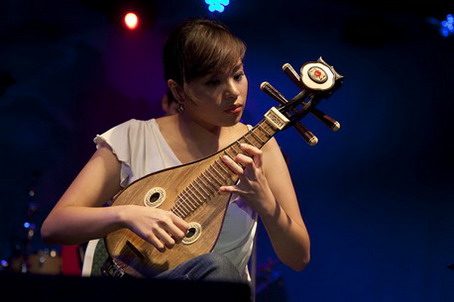
The use of Latin rhythms in Sizhukong's music is something quite natural for erhu player Wu. "When I played Beijing opera or traditional Chinese music, I discovered certain Latin rhythms in the melodies," Wu says. "I think it's because of the Silk Road going all the way from Europe to Asia; there must always have been some kind of connection between musics."
Listening to Sizhukong's second CD, Paper Eagle (Sizhukong Records, 2009), this connection, the universality of music, can be clearly discerned. Beyond the aforementioned Latin and African influences, elements of bluegrass and country color the music. There is not much light, either, between the sound of Chinese traditional stringed instruments or flutes and Irish folk music, a fact that legendary Irish band The Chieftans underlined on The Chieftans in China(Claddagh,1985).
Returning to the question of swing and jazz, Peng has this to say: "Apart from swing rhythm, there are some very important elements in jazz, like syncopation and a certain way of articulation. You don't have to play swing to sound jazz. Articulation, syncopation and some harmony can sound jazzy."
Undoubtedly there are those who would cast doubt on Sizhukong's jazz credentials, but then again Joe Zawinul faced similar accusations and replied by saying he had never played anything but jazz. Peng is less defensive. "Sometimes I'm asked if I think our music is jazz or not, and I'm like, 'I really don't know,'" she says. "When I write music, I'm just trying to make it sound right or beautiful to myself. I try to be honest and to hear what's inside, what touches me first. Sometimes I feel it's not jazzy enough, so I'm still thinking what I can do besides what I've already done, and I'm still searching for directions."
If the musical scores were clear in Peng's mind in the beginning, she admits that the other members of Sizhukong found switching to the jazz idiom difficult at first. She describes the band's playing in the early days as "maybe a little stiff."
"Jazz has a very kind of flexible rhythm, a relaxed feel, and we discussed how we should put the jazz feeling inside and also bring out the traditional way of the dizi [flute]—we call it oon [imagine a pouting French pronunciation]. It's hard to translate, but that kind of grace note and decoration of the note," she says. "I want to bring the oon of Chinese music to our own music because I think it is a very important and beautiful part of Chinese music."
The concept of oon is essential to Chinese music, and thus, it follows Sizhukong's music. Much discussion and laughter takes place among the band members as they try to succinctly define what it means in terms that a westerner could understand. It is variously compared to singing or conversing; words like rhyme, tone, Chinese Kunqu Opera, Tai Chi and meditation are all thrown into the ring in an attempt to describe its essential characteristic, but none of these seem to completely satisfy. In the end, Lee offers this explanation: "In Chinese calligraphy, you concentrate on a stroke. A stroke has many rhythms, but you have the starting point, you have the upper point and you have an end, but everything has to be in one action. This kind of flow, we call oon. Oon is not something you can grab, like the air; it's something you can only feel." This eloquent definition earns Lee a round of applause from all.
 Emboldened by this breakthrough in understanding, Peng adds, "Even in one note, you can have that oon. It's not abstract; it is the Chinese traditional expression of the music, and it's down to the technique. But that could be one kind of oon."
The announcement that there is more than one type of oon and therefore the need for more brain wracking causes laughter amongst the band. Suffice it say, when Sizhukong play, it is poetry in motion. The band, individually and collectively, sound as if they are, to repeat a well-know jazz phrase, "in the zone."
Sizhukong's performance was warmly received by the Penang Island Jazz Festival crowd, and the band has won over audiences in Indonesia, Korea and China, as well. The band's music however, had a few detractors in the beginning.
"When we released the first album," Lee explains, "some traditional players criticized the band for not playing traditionally. But after some years and the release of the second album, the market is starting to accept our music. Astor Piazzolla, before he died, he was a traitor for tango." Lee adds pointedly. And one could add Paco de Lucia and Miles Davis to the list of innovators who were met at some point with incomprehension, suspicion or even derision.

Detractors aside, Peng is full of optimism. "When people hear the word jazz, they think it is something difficult or distant, but when they hear our music they think, 'Oh, jazz can be like this,' and that's fun. On the other hand, some people hate Chinese traditional music, but after they hear Sizhukong they think, 'Oh, traditional music and instruments can sound like that. That's interesting and fresh.'"
"Colleges are accepting jazz more," Peng continues, "maybe not departments, but some courses, and so classical musicians are more in touch with it, and they think jazz is a decent music from which there is a lot to learn. So both traditional and western music students are more interested and more open to jazz music."
Sizhukong too is actively playing its part in breaking down musical barriers. "Sizhukong has also started educating a lot of musicians in Taiwan—Yuwen, myself and Toshi all teach, and a lot of our students have Chinese instruments," Vanbuel says. "So because of this band, a lot of those younger Chinese instrumentalists say, 'Wow! I want to be able to play like that!' The younger generation is really interested in improvised music—jazz. They want to learn harmony, and this might lead to more Sizhukongs."
For the time being, Sizhukong is plying something of a lone course, but its example will hopefully inspire musicians in Taiwan and China to experiment. For Peng, jazz is the perfect vehicle for musical self expression. "I think jazz is very flexible, very tolerant and can accept different kinds of elements," she says.
The beauty and power of Sizhukong's music lies in the fact that it embraces both the old and the new. Centuries-old Chinese folk songs given a jazz treatment are illuminated, and traditional instruments are given wings in a new language—a language of flexibility, tolerance and acceptance.
Selected Discography
Sizhukong, Paper Eagle (Sizhukong Records, 2009)
Sizhukong, Sizhukong (Sizhukong Records, 2007)
Photo Credits
Page 1, top: Jerome Quah
Page 1, bottom: William Ellis
Page 2: Jerome Quah
Page 3, top: Jerome Quah
Page 3, bottom: William Ellis
Page 4: Jerome Quah
Page 5: William Ellis
About Sizhukong

Tags
PREVIOUS / NEXT
Become a Sustaining Member

Since 1995, All About Jazz has championed jazz as an art form and supported the musicians who create it. Over three decades, it has grown into one of the world's leading jazz resources, serving hundreds of thousands of readers, musicians, presenters and industry professionals each month.
Help Build the Future of All About Jazz
Your support helps us continue building All About Jazz for the next generation—expanding our editorial coverage, preserving jazz history, developing new community features and creating better ways to discover the music and the people behind it.
Become a sustaining member for as little as $20 per year and you'll immediately enjoy an ad-free experience along with access to subscriber features and future articles for a full year.
Together, we're not simply sustaining All About Jazz—we're building its future. Thank you for being part of the journey.