Home » Jazz Articles » Built to Sound » Dan Koentopp: Chicago Manual of Style
Dan Koentopp: Chicago Manual of Style

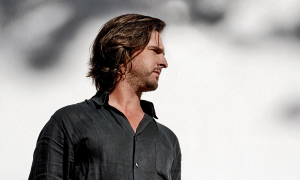
 Within minutes of talking to Chicago guitar builder and DK Custom Guitars founder Dan Koentopp, it becomes readily apparent what lights him up: this guy is all about getting it right. His knowledge of stringed instrument-making is vast and his conversation flows effortlessly from the Amati violins of Renaissance Italy, to modern tool-making, to the need to understand customer playing styles, to the built-in acoustic limitations of factory made guitars. As with the masters he so admires, Koentopp's instruments artfully incorporate a respect for traditional building techniques, a bent toward purposeful innovation, striking visual beauty and a warm, organic tonality.
 Although just 27, Koentopp has acquired a broad range of experiences that directly affect his building style and instincts. He built his first guitar as a teenager in the basement with his father. "I was attracted to the guitar as THE instrument at an early age," Koentopp recalls. But he quickly moved on to the playing and performance side of music, eventually studying Classical Guitar Performance under Fredric Hand at The State University of New York at Purchase. "Studying classical guitar gave me an ear for hearing different things that are lacking in the modern age of guitars," Koentopp says. The idea of instrument building never vanished. "Even as I was learning and studying that experience of building a guitar always stayed with me," Koentopp reflects. After relocating to Chicago, Koentopp enrolled in Columbia College's Design School which he credits with giving him the time and incentive to imagine a guitar line of his own.
There are any number of things that set DK Custom Guitars apart from the herd, but certainly Koentopp's understanding of classically built stringed instruments is foremost among them. You can see it in the overall portions and look of his instruments, as well as in his eye for the details. For example, he chooses to use a French polished shellac finish on a number of his guitars as opposed to the heavier lacquer finish favored by most modern guitar builders. This plays a big part in creating the warm, immediate tones his guitars radiate. "I really like watching the 'wow-ness' in a player's face when they pick up and play one of my guitars," Koentopp says. "My guitars are very responsive across all the strings. They're alive." Chicago Jazz guitarist veteran, Andy Brown, agrees. "Dan's attention to detail is really amazing, and his guitars have such a consistently warm sound all over the neck. They are really light but very stable," Brown explains. "Each note really rings clear." Brown is currently awaiting delivery of the DK acoustic archtop he commissioned this fall.
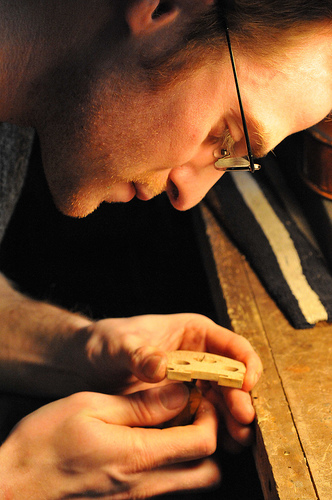
Koentopp's ability to incorporate so many ideas and techniques associated with traditional violin building comes right from the many hours he spent working under Chicago master violin-builder, Michael Darnton, whom he met after graduating from design school. "Michael is a master of the craft and a wealth of knowledge. In his workshop there are no power tools, everything is done by hand," Koentopp recalls. "I said to him: 'I want to do what you do.'" Working with a Master Builder gave Koentopp an unique insight into how and, more importantly, why instruments are built the way they are. "Really 15th and 16th century violins are just perfectly made. There is a purpose to everything that goes into them," Koentopp says. "I spent a year learning tool-making. And then learning how to get my hands to copy what my eyes were seeing. That's a huge part of the learning curve—really using your eyes to see and then using the tool to get you going in the right direction," Koentopp remembers.
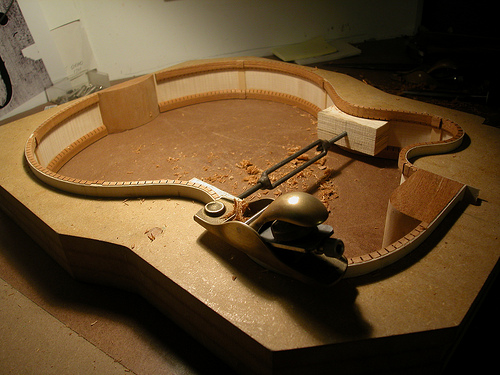
After three years with Darnton, Koentopp was ready to commit to building his own guitars full-time. He'd already been building in the basement of his mother's house in the off hours. So Koentopp found space for his own workshop and DK Custom Guitars was founded. He set to creating his own line of guitars using the classic building techniques he had honed with violins, cellos and violas. "I wanted to take what I had learned and immediately transpose it to guitars," Koentopp says. " Like I'm using a single-piece bridge on an archtop which I modeled on a Baroque violin tailpiece. The f-holes I create [for one model] come right from an Amati cello. If I hadn't worked with a violin maker, I'd be building old Gibsons or D'Angelicos today. I'd be copying those designs.
 "The classical stringed instrument represents to me the most pure acoustic form that we can experience," Koentopp continues. "When builders copy designs of early 20th century guitars like Gibson or Stromberg, their guitars end up over-built." While Koentopp says some factory-built guitars are decent instruments, he thinks the odds of getting one that really sparkles are not great. "It's really from guitar to guitar. They are made to withstand being shipped all over the world. Some are great and some aren't. The odds are like 1 out of 20 that you'll find one that really plays," he estimates.
To get his instruments to breath and sound like his Platonic ideal of what a guitar is meant to sound like, Koentopp pays close attention to the lessons each guitar teaches him. Meaning, although Koentopp has distinct guitar models, in reality each guitar is a customized job that blends the buyer's input/needs, what the materials allow for, and the knowledge Koentopp acquired from the last guitar he built. "What's cool about Dan is that he has this amazing hold on the tradition but is not afraid to put his own stamp on the guitars, to put in his own ideas," Andy Brown commented. "I think acoustic instruments are magical," Koentopp says. "They should really be breathing. When it's right, it's like the walls are vibrating when it's played." Critiquing his Amati model, Koentopp says: "This guitar represents the finest incarnation of my traditional methods. It's as light as possible while still maintaining the body's stability. A violin rib is 1 mm thick, a cello's is 1.5 mm—very thin and light. I'm looking for ways to have the least amount of possible mass like that."
And the eye toward detail continues in the instrument set up. "In a violin, the strings' after-length is very important to the instrument's tone. It adds a frequency to the sound, a fuller harmonic," he says, adding, "It's traditionally one-sixth the total string length, which is how I did mine." Thomas Cray, a DK Custom Guitar enthusiast and owner of guitar '#7,' sees the pay off in that kind of attention. "I go to meet with him and we spend hours playing, listening and talking," Cray remembers. "I picked up the guitar that I had not come in to look at and two strums later, I couldn't get the guitar out of my head," he recalls. "It's the first oval hole archtop Dan built. It's half the weight of a [Gibson] ES-175. There's a real clarity to the mids and highs, but the oval sound hole gives it a warmer lower-end too. The bracing is thin. It's a beautifully resonating instrument. You can really hear the sustain," Cray says.
Currently, the DK Custom Guitars model lineup consists of both acoustic and electric instruments. The Amati model was Koentopp's first and has a 17" archtop body design and a 25" scale. It has a 3" body depth with a spruce top and maple back and sides. The bracing is either an X-style or parallel depending on the customer's sound needs. Also built as an archtop with a spruce top and maple back and sides, The Chicagoan comes in two styles: the standard f-hole type archtop or the oval holed archtop. The standard version comes with more modern looking f-holes than the classic look of the Amati ones, while the oval hole version has a hint of the Selmer look to it. Both versions share the 17" graduated body in a 25" scale, with the Venetian cutaway as an option.

The Blue Line is Koentopp's latest model in production and is designed and priced to be more of what he describes as "a working man's guitar." It has a smaller body (16") and reduced depth (2.75") with thicker plates that help reduce any potential feedback. It is a 22 fret, 24.75" scale and outfitted with a Kent Armstrong floating pickup, which is also an option on both The Amati and The Blue Line models. Koentopp is also building a true Classical style guitar based the design of famed builder, Antonio de Torres. "I'm building it with laminated sides because I want it to be more of a drum. So the sides have to be real stable," Koentopp says. Never afraid to incorporate innovations, he is using a set neck joint instead of the traditional Spanish heel. "Normally, the neck on a Classical guitar is tilted a little forward," he explains. "But there are issues with that over the life time of the guitar, so I'm doing it this way and including a slight taper in the body to make up the difference." Also in development is a new electric line that he is still perfecting. "I am in the process of designing a new guitar line called the Evolution Series, which is a new, forward approach in guitar design," Koentopp explains.
"I love what I'm doing right now. I love not being rushed in the process," Koentopp says describing his current shop. On the future of DK Custom Guitars, he stresses his desire to maintain quality and the relationship he builds with customers. "My biggest concern is losing the relationships I have with the people I'm building for," he says. "I like spending this much attention and time on a single instrument.

The saddest thing is to have to sell one," Koentopp says half-jestingly. But you can sense that he truly grows attached to each instrument as he marshals them through the stages of development. And it's understandable given the amount of thought, technique and creativity he invests in each instrument. "He may be a guy at the start of his career, but he's an old soul," Thomas Cray muses. "He's an artist as well as a builder." And while it's true that DK Custom Guitars share a tone and feel bred of unsurpassed craftsmanship, they are also all stunningly beautiful.
Photo Credits
Courtesy of Dan Koentopp
< Previous
adrift
Next >
Boca Negra
Comments
Tags
For the Love of Jazz
 All About Jazz has been a pillar of jazz since 1995, championing it as an art form and, more importantly, supporting the musicians who create it. Our enduring commitment has made "AAJ" one of the most culturally important websites of its kind, read by hundreds of thousands of fans, musicians and industry figures every month.
You Can Help
To expand our coverage even further and develop new means to foster jazz discovery and connectivity we need your help. You can become a sustaining member for a modest $20 and in return, we'll immediately hide those pesky ads plus provide access to future articles for a full year. This winning combination will vastly improve your AAJ experience and allow us to vigorously build on the pioneering work we first started in 1995. So enjoy an ad-free AAJ experience and help us remain a positive beacon for jazz by making a donation today.

Giveaway

Days remaining: 11