Home » Jazz Articles » Big Band Caravan » Glenn Cashman / UAB SuperJazz / Elliot Deutsch Big Band ...
Glenn Cashman / UAB SuperJazz / Elliot Deutsch Big Band / Russ Spiegel Jazz Orchestra

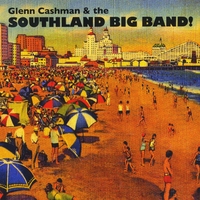 Glenn Cashman
And the Southland Big Band!
Primrose Lane Music
2009
Even though Glenn Cashman's superlative Southland Big Band makes its home (technically) south of the Mason-Dixon Line, it is more than a few miles removed from cotton fields, mint juleps and the Mississippi River—to be more precise, in the greater Los Angeles area. There's no discernible southern partiality to the music either; it's pure-blooded straight-ahead big-band jazz, written (for the most part) and arranged by Cashman and performed by an all-star troupe of southern California's most accomplished sidemen.
As noted, eight of the nine selections on this persuasive all-original studio date are Cashman's. The lone exception is Antonio Carlos Jobim's "Aguas de Marco" (Waters of March), scored by Cashman for his fourteen-member ensemble. The sunny opener, "Cookin' with Shorty and Coop" (for Shorty Rogers and Bob Cooper), is outstanding, thanks to Cashman's well-grooved arrangement and bright solos by trumpeter Carl Saunders and tenor saxophonist Rob Hardt. There are other earnest tributes, to Howard Rumsey ("Lighthouse Keeping Man"), fellow bassist Luther Hughes ("Concerto por Basso Pavimento," on which Hughes and guitarist Ron Eschete are the soloists), composer / arranger / Cashman mentor Hank Levy ("A Samba for You") and Cashman's wife, "Cheryl," featuring the composer's expressive alto sax.
Besides those already mentioned, the band's squadron of snappy improvisers includes trumpeters Ron Stout and Bob Summers, trombonists Andy Martin and Alex Iles, tenor Tom Luer, baritone Bob Efford and pianist Ed Czach (Hammond B-3 organ on "The Circuit"). Saunders is showcased again on "Chesapeake Bay," Summers, Martin and Cashman on "Blues in the Tunnel," Stout and Hardt on "Satellite Twelve." The rhythm section (Czach, Eschete, Hodges, drummer Paul Kreibich) is on top of its game throughout, as are split lead trumpeters Lee Thornburg and Pete DeSiena.
The recording, Cashman writes, is "the realization of a longtime dream." It's a safe bet that even he never dreamed it would turn out this well. Thanks to Cashman's persistence and expertise, the "Southland" has risen again. Long may it endure and prosper.
 UAB SuperJazz
Featuring Ellis Marsalis
UAB Entertainment
2009
Any album that blasts into orbit with Bill Holman's marvelous arrangement of Johnny Mercer's "I Remember You" has all but won this reviewer's heart while still on the launch pad. But there's far more than that to UAB SuperJazz, such as following that enchanting opener with two more personal favorites, "The Very Thought of You" and "The Night Has a Thousand Eyes," the first showcasing the eloquent tenor saxophonist Dave Amaral. Or devoting four of the last five numbers on this engaging concert date to the tasteful piano stylings of guest pianist Ellis Marsalis, patriarch of the celebrated Marsalis family of New Orleans.
UAB, of course, denotes the University of Alabama-Birmingham, from whose ranks UAB SuperJazz arose more than thirty years ago. The ensemble is comprised of some of the Birmingham area's finest instrumentalists and arrangers under the baton of music director Everett Lawler. While SuperJazz serves nothing here that hasn't been cooked before, that doesn't mean the bill of fare is any less than appetizing. Everything flows buoyantly along, thanks to resourceful charts and assiduous blowing by all hands. Lawler arranged "The Very Thought of You," "The Song Is You" and "Tin Roof Blues," trombonist Charlie Ard "A Thousand Eyes," "Making Whoopee," "I'm Beginning to See the Light" and "It Don't Mean a Thing," Steve Sample "The Thrill Is Gone," "Sometimes I'm Happy" and "Hello, Young Lovers."
There are amiable vocals by Ray Reach on "Making Whoopee" and his own arrangement of Michel Legrand's "How Do You Keep the Music Playing?" while Reach's piano is featured on "Young Lovers" and "The Song Is You." Other soloists include Ard, Mike Lyle (alto on "I Remember You," tenor on "Thousand Eyes"), trumpeters Bo Berry and Mal Pierce, tenor Niel McLean and drummer Sonny Harris. Marsalis solos on "After Hours," "Tin Roof Blues," Jobim's "How Insensitive" and Ard's groovy take on "It Don't Mean a Thing." While the recording has a slight yet noticeable "concert" sound, it is never disagreeable, and the balance between the various sections is admirable. In sum, a consistently entertaining live performance by SuperJazz and its legendary guest.
 Elliot Deutsch Big Band
Weeknight Music
Self Published
2009
Weeknight Music, as it turns out, is suitable for any time of day or night, for weekends, holidays or any type of special occasion where the music must be sultry and swinging. Trumpeter Elliot Deutsch's young southern California-based ensemble comes out roaring on its debut album and keeps the pedal to the metal through a marvelous sequence of engaging charts by Deutsch, trumpeter Brian Owen and tenor saxophonist Jimmy Emerzian.
That's not to imply that every number is played at or near warp speed. Au contraire. Easygoing anthems can't evince much more charm than Deutsch's "Coffee Time," Emerzian's "Home," or the leader's shimmering arrangements of "The Nearness of You" (on which his gossamer flugelhorn is front and center) and "When I Fall in Love." Deutsch also wrote the buoyant ensemble showpiece "Rhythm Challenge," the deeply-grooved "Yeah...We're Sleeping Together" (a.k.a "Just Friends") and leisurely "Stroll at the Beach," Emerzian "The Jury's Out," Owen the wild-riding "Space Cowboys." There is (alas) one vocal, by uninspiring Kalil Wilson on "Beautiful Friendship."
Besides Deutsch, the band's soloists, each of whom is first-rate, include Emerzian, Owen, trombonists Nick Depinna, Ermeluito Navarro and Paul Young, alto Will Vargas (showcased on "Coffee Time"), tenor Ken Moran, baritone Stephan Cardenas, pianist Nick Paul and drummer Adam Alesi. The band as a whole is as tight as Alesi's snare, the rhythm section sharp and industrious. According to Deutsch's bio, he has performed with Solomon Burke, Bobby Rodriguez' Latin Jazz Band, B.B. King, Lalo Schifrin and Kenny Burrell, among others, none of which would lead one to anticipate a big-band date as captivating and resourceful as Weeknight Music. But here it is, and Deutsch deserves a round of applause for marshaling (and recording) an ensemble of this caliber. Let's hope we haven't heard the last of them.
 Russ Spiegel Jazz Orchestra
Transplants
Ruzztone Music
2009
Not many guitarists lead big bands. Russ Spiegel does, and it's a winner, thanks in large measure to his tasteful compositions and arrangements. Spiegel wrote six of the nine selections on Transplants and arranged all of them, in most cases quite agreeably. Spiegel's "Count Up," "Kangaroo," "Number One" and "Undertow" are highlights, as is the standard "I Let a Song Go Out of My Heart."
On the other side of the ledger are vocals by Michael Camacho, on the standards "I Should Care" and "The Very Thought of You" and Spiegel's funky "Chain Reaction." Camacho's a no-better-than-average singer who isn't well-served by "Chain Reaction" (not his fault, really) and whose limited range is sorely tested on "I Should Care." He fares best on "The Very Thought of You."
The ensemble, however, more than makes up for that modest blemish on its half-dozen numbers, only one of which—"The Rub," at over nine minutes—overstays its welcome. Elsewhere, all is in apple pie order, with everyone toeing the mark to bring out the best in Spiegel's admirable charts. Spiegel solos only on four of them—"Count Up," "Kangaroo," "Number One," "The Rub"—but has splendid support in that area from soprano saxophonist Aron Luthra, tenors Tim Armacost and Dan Pratt, trumpeters Sharif Kales and David Smith, trombonist Michael Boscarino, pianist Rachel Eckroth, bassist Yoshi Waki and drummer Owen Howard who spearheads the orchestra's nimble rhythm section.
The album's title, Transplants, is taken from a passage by Walt Whitman in the poem Leaves of Grass. While it's unclear what it has to do with Spiegel's musical purpose, he and his orchestra must have gleaned some incentive from it, as they carry out their task with awareness and intensity. Even making allowances for the vocals, this is first-class big-band jazz all the way.
 Toronto Jazz Orchestra
The Path
TJO
2009
Two brief observations: First, the Toronto Jazz Orchestra is good, really good; there are no greenhorns on these premises. Second, the TJO can swing, really swing, something it does often on The Path. But this isn't Basie-style swing; it's more akin to Maria Schneider or the Vanguard Jazz Orchestra. The compositions are prismatic, the arrangements demanding. The TJO takes to them like ducks to water, as one would suspect from an ensemble that has been together for a decade.
The Path consists of nine original compositions—three by music director Josh Grossman—and the spiritual "Amazing Grace," the last a soulful vehicle for alto saxophonist Chris Hunsburger. Grossman's funky title selection features another member of the reed section, tenor saxophonist Terry Quinley. There are vocals by seductive Sophia Perlman on Vince Mendoza's "Esperanto" (on which she also scats) and Charles Mingus' winsome "Old Portrait."
Grossman's groovy "Chazz" (nimble solos by the composer on flugel and guitarist Todd Elsliger) is a highlight, as is David Braid's "The Call," a punchy flag-waver with apposite statements by alto Mark Laver, pianist Ali Berkok and drummer David MacDougall. Capping the flavorful menu are Moiya Callahan's all-instrumental tone poem, "i love you on the microphone," Grossman's cliche—laden "theme song" for the ensemble, "TJO," Finnish composer Johan Pykko's rhythmic "Cereal Blocks" and Erik Patterson's upbeat "Happy at Sad Things" (spotlighting Eslinger and trumpeter Ewan Divitt).
The Path, Grossman writes, is "a celebration of the Toronto Jazz Orchestra's achievements since [its] first performance..." The orchestra's purpose, he adds, "has remained: to perform interesting and challenging music, all the time, and put on a great show, every time." Mission accomplished.
 Northeastern State University Jazz Ensemble
Portrait
NSU Jazz Lab
2009
Would that every Portrait were as handsome as this. Even though there's no plausible reason why an undergraduate jazz ensemble from a mid-sized university in out-of-the-way Tahlequah, Oklahoma, should sound so accomplished, the ears can't lie. The NSU band is exemplary on its fifth album in as many years, thanks in large measure, no doubt, to the astute leadership of director Arthur White who has since moved on to become head of Jazz Studies at the University of Missouri. What is perhaps most remarkable—and unusual—is that all seventeen members of the ensemble are from Oklahoma.
As on each of its earlier albums, White and the NSU ensemble have invited a special guest artist, in this case guitarist Russell Malone, to sit in. Malone not only enhances the rhythmic texture but solos on every number, three of which—"Mugshot," "To Benny Golson," "You Should Know Better"—he also wrote. Malone is a perceptive improviser who favors mellow single-note lines that are equal parts sagacity and charm. The band follows suit, skating easily through the engaging charts by Malone, White and Daniel Thompson ("We've Found the Main Nerve"). White arranged Malone's trio of compositions, his own "Portrait of Art Blakey," Bob Mintzer's "The Red Sea," Eric Person's "The Multitudes," Peter Erskine's "Cats & Kittens" and Mulgrew Miller's "Go East Young Man."
While Malone solos often, he's by no means the only one stepping forward. Trumpeter Timothy Moore and baritone Jonathan Rice are impressive on "Mugshot," as are alto Tracy Patterson ("Benny Golson"), soprano Zach Eldridge ("Red Sea," "Go East"), trombonist Aaron Hollon ("Benny Golson," "Red Sea," "Go East "), tenor Ross Loney ("Multitudes," "Art Blakey"), pianist Daniel Thompson ("Main Nerve," "Go East") and drummer Tony Hankins ("Cats & Kittens"). Alto Zirl Hopkins adds a trim violin solo on "Art Blakey," and trombonist Blake Peters switches to guitar to accompany Malone on "Cats & Kittens." Malone, ever the gentleman, usually lets the students take the first shot before splintering the bull's-eye with his weapon of choice.
With White no longer at the helm, Portrait represents the end of an era at NSU. He'll no doubt be missed but has left in place a solid foundation on which to build, one that bodes well for the future of big-band jazz at the little Oklahoma university that could.
 University of North Texas Two O'Clock Lab Band
Denton, Texas Jazz Giant
North Texas Jazz
2009
Denton, Texas Jazz Giant, the third of four albums by the University of North Texas Two O'Clock Lab Band to be reviewed here in chronological order, covers the years 2007-08 and is the last to be presided over by the band's recently retired director, James Riggs. Not to belabor the point, which has been made before, but there's not enough space between UNT's various Lab Bands, especially the One O'Clock and Two O'Clock ensembles, to squeeze in a page from one of their charts.
The Class of 2007 is featured on two numbers, Louie Bellson's turbulent "Quiet Riot" and Dave Richards' glittering "Starscream," sandwiched around half a dozen others by the Class of 2008. As the personnel is largely unchanged, the ensembles are basically one and the same, in their approach to the music and the superior manner in which it is performed. One doesn't advance through the ranks to become a member of the Two O'Clock Lab Band by sitting on his or her hands. This first-rate group of undergraduate overachievers could turn pro today and earn immediate credibility.
The 2008 ensemble embraces four standards (five, if you count Phil Kelly's "Play Tonic Budz," his clever variation on "Just Friends") and one original, Chuck Owen's "A Quiet Longing." The standards are Rodgers and Hart's "My Funny Valentine," Johnny Green's "Body and Soul," Johnny Mercer / Jimmy Van Heusen's "I Thought About You" (marvelously played) and Cole Porter's "Night and Day," the last taken at slightly less than warp speed to punctuate a searing "tenor battle" between Sylvester Onyejiaka and Carlos Espinosa. Espinosa is featured with trumpeter Clink Yerkes on "Tonic Budz," Onyejiaka with pianist Ben Haugland on "Longing," and pianist Roberto Verastegui, alto Brian Girley, trumpeter Thomas Eby and drummer Ryan Jacobi on "Riot." Baritone saxophonist Aaron Lovato is the lone soloist on "Body and Soul." (Albuquerque residents, by the way, are happy to have Lovato back "home," where he sits in occasionally with the Albuquerque Jazz Orchestra on baritone and / or alto.)
Riggs, who has left the Two O'Clock Band in the capable hands of Jay Saunders, deserves high praise for his dedicated work in making the ensemble one that UNT and others can point to with pride and admiration. As for Denton, Texas Jazz Giant, what better phrase can one envision with which to epitomize the awesome Two O'Clock Lab Band.
Tracks and Personnel
And the Southland Big Band!
Tracks: Cookin' with Shorty & Coop; Aguas de Marco; Blues in the Tunnel; Chesapeake Bay; Lighthouse Keeping Man; The Circuit; Satellite Twelve; Cheryl; Concerto per Basso; Pavimento; A Samba for You.
Personnel: Glenn Cashman: composer, arranger, leader, alto sax; Lee Thornburg: trumpet (1-4, 10); Pete DeSiena: trumpet (5-9); Bob Summers: trumpet; Ron Stout: trumpet, flugelhorn; Carl Saunders: trumpet solos (1, 4); Tom Luer, Rob Hardt: tenor sax; Bob Efford: baritone sax; Andy Martin: trombone; Alex Iles: trombone, bass trombone; Ron Eschete: guitar; Ed Czach: piano, Hammond B-3 organ; Luther Hughes: bass; Paul Kreibich: drums.
Featuring Ellis Marsalis
Tracks: I Remember You; The Very Thought of You; The Night Has a Thousand Eyes; Makin' Whoopee; The Thrill Is Gone; Sometimes I'm Happy; Hello, Young Lovers; I'm Beginning to See the Light; How Do You Keep the Music Playing?; The Song Is You; After Hours; Tin Roof Blues; How Insensitive; It Don't Mean a Thing; One O'Clock Jump.
Personnel: Everett Lawler: music director; Craig Konicek, John Taylor, Bo Berry, Darryl Jones, Harry McAfee, Mallory Pierce: trumpet; Mike Lyle, Claude Hughes, Ken Carroll, Dave Amaral, Grady Chandler, Niel McLean, Sallie White: reeds; Charlie Ard, Bob Black, Mark Foster, Jim Henderson, Mike Lingo, Edson Worden: trombone; Ray Reach: piano, vocals; Lester Alexander, Carlos piano: guitar; Chris Wendle: bass; Sonny Harris: drums. Guest artist: Ellis Marsalis: piano.
Weeknight Music
Tracks: Cheek to Cheek; The Jury's Out; A Beautiful Friendship; Rhythm Challenge; Space Cowboys; Coffee Time; Yeah...We're Sleeping Together; Home; The Nearness of You; When I Fall in Love; Stroll at the Beach.
Personnel: Elliot Deutsch: leader, composer, arranger; Jonathan Bradley: trumpet; Walter Simonsen: trumpet (1, 2, 4, 5); Bijon Watson: trumpet (3, 6-11); Erick Jovel: trumpet (1, 2, 4, 5); Chris Gray: trumpet (3, 6-11); Brian Owen: trumpet; Will Vargas, Dan Kaneyuki: alto sax; Jimmy Emerzian, Ken Moran: tenor sax; Stephan Cardenas: baritone sax; Paul Young: trombone (3, 6-11); Nick Daley: trombone (1, 2, 4, 5); Ermuelito Navarro: trombone; Nick Depinna: trombone; Steve Hughes: bass trombone; Nick Paul: piano; Greg Swiller : bass (3, 6-11); Justin Carney: bass (1, 2, 4, 5); Adam Alesi: drums; Kalil Wilson: vocal (3).
Transplants
Tracks: Count Up; The Very Thought of You; Kangaroo; Number One; Chain Reaction; Undertow; I Let a Song Go Out of My Heart; The Rub; I Should Care.
Personnel: Russ Spiegel: leader, guitar; Colin Brigstocke, Sharif Kales, David Smith, Charles Porter, James Smith: trumpet; Arun Luthra, Craig Yaremko, Tim Armacost, Dan Pratt, Frank Basile: reeds; Michael Boscarino, John Yao, Jack Davis, Darrell Hendricks: trombone; Rachel Eckroth: piano; Yoshi Waki: bass; Owen Howard: drums; Todd Isler, Jack Davis: percussion. Guest vocalist: Michael Camacho.
The Path
Tracks: The Path; Cereal Blocks; Esperanto; Happy at Sad Things; Amazing Grace; Chazz; The Call; i love you on the microphone; Old Portrait; TJO.
Personnel: Josh Grossman: artistic director, conductor, trumpet, flugelhorn; Dave Dulong, Brian Walters, Marcius Extavour, Ewan Divitt: trumpet, flugelhorn; Mark Laver, Chris Hunsburger: alto, soprano sax, flute; Terry Quinney, Michael Carter: tenor sax, clarinet, flute; Erica Jensen: baritone sax, bass clarinet; Christian Overton, Pat Blanchard, Karl Silveira, Sylvain Bedard: trombone; Chris Hunt: bass trombone; Ali Berkok: piano; Todd Esliger: guitar; Carlie Howell: acoustic, electric bass; David MacDougall: drums; Sophia Perlman: voice.
Portrait
Tracks: Mugshot; To Benny Golson; The Red Sea; The Love We Had Yesterday; The Multitudes; Portrait of Art Blakey; We've Found the Main Nerve; Cats & Kittens; Go East Young Man; You Should Know Better.
Personnel: Arthur White: composer, arranger, director (5); Kristen Layne, Kyle Williams, Michael Black, Timothy Moore: trumpet; Zach Eldridge: alto, soprano sax; Tracy Patterson: alto sax; Zirl Hopkins: alto sax, violin; Ross Loney, Chris Beard: tenor sax; Jonathan Rice: baritone sax; Aaron Hollon, Danielle Embry: trombone; Blake Peters: trombone, guitar (8); Trevor Moore: bass trombone; Daniel Thompson: piano; Greg Breeding: vibes, drums (6, 9); Gerard Breeding: bass; Tony Hankins: drums (1-5, 7, 8, 10). Guest artist: Russell Malone: guitar.
Denton, Texas Jazz Giant
Tracks: Quiet Riot; My Funny Valentine; Body and Soul; Play Tonic Budz; I Thought About You; Night and Day; Quiet Longing; Starscream.
Personnel: James Riggs: director. 2007 Two O'Clock Lab Band—Dave Richards, Justin Woodward, Brandon Potts, Clynt Yerkes, Thomas Eby: trumpet; Adam Hutcheson, Brian Girley, Sylvester Onyejiaka, Brandon McGhee, Aaron Lovato: reeds; Hiroshi Wada, Nick Wlodarczyk, Sean Nelson, Nic Butts, Matt Jefferson: trombone; Roberta Verastegui: piano; Ryan Davidson: guitar; Cooper Appelt: bass; Ryan Jacobi: drums. 2008 Two O'Clock Lab Band—Dave Richards, Justin Woodward, Tim Schleinat, Clynt Yerkes, Thomas Eby: trumpet; Adam Hutcheson, Collin Hauser, Sylvester Onyejiaka, Carlos Espinosa, Aaron Lovato: reeds; Austin Scharf, Nick Wlodarczyk, Sean Nelson, Nic Butts, Matt Jefferson: trombone; Ben Haugland: piano; Ryan Davidson: guitar; Mikel Combs: bass; Sean Jones: drums.
< Previous
set: For Lynn Margulis
Next >
Thirty Six Ghosts
Comments
Tags
For the Love of Jazz
 All About Jazz has been a pillar of jazz since 1995, championing it as an art form and, more importantly, supporting the musicians who create it. Our enduring commitment has made "AAJ" one of the most culturally important websites of its kind, read by hundreds of thousands of fans, musicians and industry figures every month.
You Can Help
To expand our coverage even further and develop new means to foster jazz discovery and connectivity we need your help. You can become a sustaining member for a modest $20 and in return, we'll immediately hide those pesky ads plus provide access to future articles for a full year. This winning combination will vastly improve your AAJ experience and allow us to vigorously build on the pioneering work we first started in 1995. So enjoy an ad-free AAJ experience and help us remain a positive beacon for jazz by making a donation today.

Giveaway

Days remaining: 10