Home » Jazz Articles » Interview » Gwilym Simcock: It's All Just Music
Gwilym Simcock: It's All Just Music


Prior to that Simcock had captured attention for lighting up Bill Bruford's Earthworks, Tim Garland's Lighthouse Trio and Malcolm Creese's Acoustic Triangle.
Awards and commissions began to roll in accompanied by a certain amount of hype; Chick Corea labeled him a "creative genius" and comparisons between the talent of Simcock and Brad Mehldau andKeith Jarrett soon became commonplace.
However, as the old saying goes there is no smoke without fire, and Simcock's ambitious double CD Blues Vignette (Basho, 2009) is an impressive distillation of his classical upbringing and his jazz soul, marking him out as an original voice.
Featuring Simcock solo, in a duo setting with cellist Cara Berridge and in a trio format with double- bassist Yuri Goloubev and drummer James Maddren, Simcock's eclecticism is never less than absorbing. The line between classical music and jazz is not so much blurred as wiped out. It is, as Simcock emphasizes, all just music.
All About Jazz: How did you find your way to jazz so late in life?
Gwilym Simcock: I had a classical music background but wanted to find a different angle. I was introduced to jazz whilst I was still at classical music school and found an area which is the one I seem to operate in now. This was really the only way to go . The first thing I heard of jazz was Keith Jarrett and of course the way he plays the piano has the classical sensibilities and that area felt completely like home.
At the time I got into jazz I was getting a bit fed up of going along to my piano lessons, where you're told how to play every single note. Then you do a lunchtime performance at music school and all the other people in the audience are playing the same piece of music and I didn't like that competitive right or wrong element of classical music.
So finding jazz where you find your way and create your own voice was a really major thing for me; for it to come along at that time was very fortunate. I left music school to and went to the Royal Academy of Music to do a jazz course.
I went away from classical music for a few years, but I've definitely come back to it in the last few years because you realize when you've spent so much of your life studying something then it seems like a shame not to utilize that in what you do. And you're trying to find a way to be yourself and sound different to everyone else. You've got to use what you've learnt and your background to create that voice, otherwise there's no substance to it.
There are lots of people crossing over between classical and jazz and it's maybe not such a unique thing as it was say ten or twenty years ago. There are the jazz purists and the classical purists who wouldn't like that kind of thing but I think it's a really valid area of music.
AAJ: Do you think these purists are becoming more marginalized?
GS: Maybe; it can be hard in England sometimes because once you get outside London and go to different places around the country people want to hear more what they know. I remember doing one gig up in the north of England a couple of years ago and I was playing my own music and the promoter came up to me at the interval and said: "I'm really enjoying it, it's fantastic, but can you throw them a lollipop?" meaning can you play something that people know and like.
Then if you go to Germany or Italy, or anywhere in mainland Europe you feel as if you can play exactly what you want to and people will accept that and sit back and appreciate that. I'm not saying there's anything wrong with the English mentality, but it would be nice if people thought that way sometimes.
The general demographics of the audience are funny, depending on what country you're in. I was in Korea not long ago with Tim Garland, and about seventy percent of the audience was females between the ages of twenty and thirty, which is amazing really. Of course it's different in England; it's very much older people, and older men. Trying to get women interested and young people outside of London is a great challenge.
AAJ: Any theory as to why the Korean demographic is like that? It seems very curious.
 GS: No idea. It is very curious. It's a shame it's not like that elsewhere. In general it's hard to get young people interested in classical or jazz music, because it's so far away from the popular music of the day now that it's difficult to encourage young people to come along. Hopefully when they come to the concert they'll enjoy it but getting them through the door is a mighty struggle. I mean, here we are in Bangkok, a city of over ten million people and we can't even get four hundred people to come and see four very different bands.
 it's a shame because when you have musicians creating music off each other which will never ever be that way again, a one-off performance, I think that should be something really exciting and really appealing, but unfortunately it doesn't seem to work like that. I think too often people are scared by it.
I guess you're trying to find a way of playing music without selling out which has its artistic integrity but which can appeal to as many people as possible, so you've got to have a strong thread of melody which is something people can really hang onto.
But out of the three elements of music, melody, rhythm and harmony the one that really appeals to me is harmony, but that's the thing people are least familiar with. You can have a good melody you can sing along to, a good rhythm, a good groove you can tap your foot to or clap to but you can't show any affinity or physical appreciation of harmony. But I think harmony is actually the element of music that can move you the most subconsciously.
If you take film music, say the theme tune for Jaws (1975), what makes that scary is the semi-tone, [hums theme for Jaws] but if you turn that into a tone [hums again] then it's happy. I'm fascinated by the little technicalities of changing something by a semi-tone can completely change the mood of the music, and that's something I'm always looking at with music ---the emotional side.
 AAJ: On Blues Vignette you play interpretations of several jazz standards like "On Broadway" and "Cry Me a River"; would you ever consider covering, and I'm thinking of lollipops here, more modern pop tunes the way Brad Mehldau has?
 GS: For me it's about doing what's true to yourself and I'm not so into some of the singer/songwriters that have influenced Brad Mehldau in his music.
AAJ: I just wondered if there were any particular pop tunes from the modern era which you thought were so beautiful that you might like to interpret them.
GS: Not really, though if I do find something I'll do it for sure. I need to listen to more things, but there is so much music out there that there are massive gaps in my knowledge as I'm sure there are with most people. But it has to be something you do because you really want to.
AAJ: You've talked about finding your own voice, do you think this is a quest which has an actual destination or is it just a chimera?
GS: I think it's an on-going process and what your voice is can change completely from week to week, and as I mention in the liner notes for Blues Vignette that when you record an album that's just what you were doing at that particular time.
This is my second record so I'm still a complete newcomer to the process. We recorded it in May and it came out in November and I find it really hard to listen back to it because you already feel like you're doing different things.
And there's a conundrum, almost like a chicken and egg thing: do you record the music and then play it or do you tour the music and then record it? Of course financially, and marketing, means that you have to do the album first and then tour it because then you're selling the album.
But actually the music develops so much more when you tour it and once you've done twenty or thirty concerts it takes on a completely different life from when you started. I think this Blues Vignette album was a combination of things which were learnt for the album and some things which we'd played a little before so hopefully there's a nice balance.
I think with this album there's more of a thread whereas the first album I did, Perception was more of a calling card with different types of things going on.
Finding Yuri [Goloubev] and James [Maddren] has been really fantastic because I absolutely love working with them. Yuri has given the music a strong direction by taking it back to the classical side because he's a fantastically trained classical musician and his arco is quite a special sound.
AAJ: He is amazing. His double-bass playing has the fluidity of a fretless electric bassist. How did you hook up with him?
GS: I met him when I had to dep at the last minute on a recording by Klaus Gesing, who's a wonderful saxophonist from Austria. I got the gig through Asaf Sirkis, who was the drummer in the band and who very kindly recommended me. So I came in at the last minute and learnt all the music and did this recording which was Klaus, Asaf, Yuri and myself.
So that's how I met Yuri but it's one of those things where I feel like I've played with him all my life because his musical direction has the same kind of story. And James plays with such clarity that he really brings the music to life. He's only twenty-two, but he's so mature in the way he plays, and he can throw bombs in there and let rip when it's the right time, but he plays so supportively and just makes everything sound really good, which is such an amazing gift.
I think that's how you should approach playing music in any group— you are there to make the other people sound better. If you only go down your own path and play only for yourself then that's only half the idea, really.
You know, the whole is greater than the sum of the parts and finding people to create that like James and Yuri who throw so many amazing ideas in there that I really want to play off their ideas as opposed to my own. It's so much more exciting playing off other peoples' ideas.
I like the bass to be very melodic and of course Yuri has the ability, at the top of his instrument, to play melodic lines, and as a composer that's a great thing to work with.
AAJ: You mentioned the word "clarity," and that strikes me about this trio's music, both watching you perform and listening to the record, a tremendous clarity; is that something you strive for or is it something organic in your playing?
 GS: I think it's a bit of both. I'm very pleased you feel that because trying to appeal to as wide an audience as possible you've got to have that clarity. If it becomes too dense and obtuse, then it's very difficult for people to get into if they're not used to jazz. Hopefully with clarity that makes it easier for people to access what we're doing.
 It's a combination of different things but having the right combination of people helps create that clarity. If you feel uncomfortable and ill at ease on stage then you play too much and things get jumbled up, and there's no shape to it. But when you're listening to what's coming back at you from the other musicians, and in the case of Yuri and James it's very beautiful, then you don't want to clutter that up, so you feel that every note you play has to really mean something.
If you get to the end of a gig and you realize that you haven't really listened to the other musicians then you feel really annoyed with yourself, but if you get into that zone where everything is going really well and you're so wrapped up in it that every note is the most priceless, precious thing. I feel a great debt of gratitude for creating that sound world and that situation.
AAJ: The sound on Blues Vignette is wonderful; it's not overly produced and it sounds so clear. I also like the way there are between five to ten seconds of silence between the tracks which kind of frames them. Was that something that was thought through?
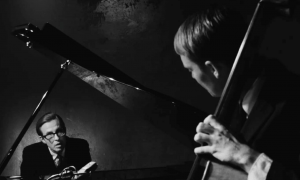
 From left: James Maddren, Gwilym Simcock, Yuri Goloubev
 GS: It's funny you should say that because the whole thing for me, my big mantra about making music is that everything should come from silence; silence is the starting point. You have to start from absolutely nothing.
Curtis Schwartz, the engineer who's a very close friend of mine and whom I absolutely love working with, sat down with me at the beginning and we worked out what we wanted in terms of the sound. Surrounding yourself with the right people is so important. I feel very lucky to have found Curtis because I feel really comfortable working with him.
Feeling comfortable both recording and performing is so important for me. Recording can be a very restrictive process, psychologically, because when you're on stage you're just going for it and you've got that energy and you're in the moment, but it's a very sterile atmosphere in the studio because you think, "Crikey, every single note I play is going to be documented until the end of time," and that's quite a stressful thing to think about.
I'm quite a nervous performer in many ways, which is a bit of a hangover from classical music school and worrying about making a mistake. I'm very conscious of that fear of doing things wrong, especially in the studio.
AAJ: Do you think losing that fear is part of finding your voice?
GS: Maybe, but whether or not you're happy with the direction you're going in worrying about doing something wrong is always a very restrictive feeling.
I guess being a fan of Jarrett and this very lush sound world is something I feel a lot more at home with because I guess it's more similar to the classical side than say some of the young New York guys who have a very dry, in your face sound which is nice as well but it's not really what I hear. But each track has to start from complete silence.
AAJ: Your music sounds very impressionistic and lyrical and I wonder what music has influenced that side of your playing.
GS: For sure on the jazz side I'm a big fan of Keith Jarrett. I'm also a big fan of Chick Corea and John Taylor, a wonderful English pianist who is very original and unique.
On the classical side I'm into more contemporary music which has rather more interesting harmonic palette. I never really got into Beethoven or Mozart because, whilst obviously you can appreciate the beauty of the music, there's never going to be any surprises because they worked in a harmonic world which was quite prescriptive at their time.
Once you get into the latter half of the twentieth century, where you have Bartok, and a wonderful French composer called Henri Deutilleux, here you're getting into multi-layered harmony, which is the thing that really appeals to me because it pricks my ears up and I think: "What's going on there?"
I don't think I listen to enough music. I think when that's what you do sometimes when you're resting the very last thing you want to do is listen to more music. When I'm in my car I listen to football or spoken word, or comedy or something just to have a break.
AAJ: The Spanish have a saying which is: "In the ironmonger's house, wooden spoons." The last thing he wants when he comes home is to see or touch...
GS: More fucking iron [laughs]. When I do listen to music it'll be Earth, Wind and Fire or Michael Jackson, something completely different. If it's too close to what you do then you end up going into an analytical mode. I have a terrible problem in that I find it terribly hard to listen to music without analyzing it.
And I've got perfect pitch which is obviously brilliant for jazz but it means that there's a score in your head when you hear any music; even the birds singing, I can hear what notes they are. In a way it would be nice to have a more plaintive appreciation of music sometimes and just be able to enjoy it. But I would never complain as it's so important to know what everybody else is playing when you're improvising.
 AAJ: Going back to Blues Vignette and the piece for piano and cello featuring Cara Berridge, did you consider using Yuri Goloubev to play that part on double-bass? When Yuri plays arco he doesn't really sound like a bass...
 GS: He sounds a lot more like a cello, yeah. That piece came about because of the opening of King's Place, a new arts space in London near King's Cross and they did something like a hundred concerts in ten nights. I did an evening of four different concerts one after the other in about a four-hour period, but one of the things I did was this suite, for cello and piano
It seemed to go down well and people seemed to like it, and I think it fits in with what I'm trying to do on the rest of the album, so I wanted to document it. For me it's just music, it's not classical or jazz and you've just got to think of it as music.
Some lazy journalists have commented on the great cello playing on the second CD but of course that's Yuri playing bass. I guess it never even crossed my mind that it could be done on bass because it was written specifically for cello. I do hope there's a nice development from the solo to the duo to the trio.
 AAJ: Is playing a solo concert and then playing in a trio like being in parallel universes for you because playing solo you are so looking inwards and listening to yourself, and yet in a trio you must have an antenna out the whole time for what the other two guys in the trio are doing?
 GS: There were a couple of reasons why I wanted to do a double album; one of the reasons was a boring financial one in a way because in the next year or two I'll be doing a lot of solo concerts and a lot of trio concerts, so people want to then buy something that they've heard.
So do you bring out a solo CD or a trio CD or both, and what order do you do it in? The actual cost of making a double CD is not very much more than making a single one, and in terms of promotion it's a lot easier to do that.
The other side of it is that playing in this trio I almost play less than I would in any other trio just because Yuri is doing so much.
AAJ: In the Lighthouse Trio you seem to use the whole keyboard to a far greater extent than you do in this trio.
GS: Totally, because there's no bass so I'm being the bassist there, but in this trio, my trio, it's not just that I'm the pianist and he's the bassist...there's a classic thing where a pianist has to be careful not to get in the bassist's way but it's completely the other way round in our band, because Yuri gets so high and there are so many melodic and linear things going on in what he does that I end up leaving more space for him than I would with maybe another bassist. I play quite little in this trio compared to some trios, but hopefully there is a balance. Hopefully people hear the sound of the trio and not individual sounds.
You're trying to find something that makes your trio sound different to all the millions of others and Yuri's voice is so distinctive; what he does with his instrument is quite a unique thing.
AAJ: You've been commissioned to write different music for cello, for piano and choir; when you're asked to write a piece of music does that put a special kind of pressure on you and does it give you a different type of satisfaction when you premier it?
GS: Absolutely, you've almost answered the question. For example when I get back to England I've got to write a fifteen-minute orchestral piece by the end of January [2010] for something I'm doing in Holland. That means when I get back to England I'll just be sitting in my house getting up at eight o'clock every day in the morning and working through 'til midnight just writing music, because it's such a long process writing orchestral music. It's quite an insular existence.
Of course when you hear something back sang by a choir or played by an orchestra it's a nice feeling to know that you did that. It's something relatively new for me so I feel like I'm learning all the time. I've never had any lessons so I'm teaching myself, and studying a lot of different scores. In an ideal world you'd have a nice balance between writing and playing but it never really works out that way; you do a couple of months of touring and then you do a couple of months of sitting at home writing.
AAJ: Tell us a little bit about "I Prefer the Gorgeous Freedom;" how did that come about?
GS: I got asked to write this piece for the Norwich and Norfolk Festival which was a great opportunity. The piece was for a choir in Norwich Cathedral which is one of the most gorgeous buildings in the whole of the country. These are community choirs, they are not professional musicians so most of them don't read music and everything had to be taught by ear, which was a hell of an undertaking, really.
There was a completely open book what to do, so I sat down with the two people who run the choir, Jon Baker and Sian Croose, and they are amazingly enthusiastic people who dedicate their time to this choir. We asked ourselves what we could do and the topic of freedom as a starting point came up, something which everyone can relate to. It's always appropriate and relevant to what's going on in current affairs.
I love setting words to music, poetry and other written work and we thought we might set four or five different pieces of poetry to music and have it a s a suite. So I scoured around and found this one particular book, which was a collection of poems written by some of the detainees of Guantanamo prison, which was amazingly humbling to read.
AAJ: You just don't imagine the inmates at Guantanamo writing poetry somehow.
 GS: It's incredible. I thought well, we're doing something about freedom and this is the antithesis of it, so it's really important to have that in there. On a musical level it was a great challenge because I like very chromatic and harmonically sophisticated music, but when you've got a choir of people who don't read music, that's very hard.
 I had to approach the writing of the music on a completely different level and from a different starting point. It was a lot more diatonic and less harmonically dense to make it physically possible for Sian and John to teach it to the choir. It was an interesting process and there was a lot of to'ed and fro'ed maybe four or five times between London and Norwich until we eventually came up with the final version of it.
I also wanted to have four vocal soloists, almost as a safety net, because anything which was too hard for them to learn or they couldn't quite get together, then the soloists could take that on, though that was also for texture. So you've got the choir, Klaus Gesing on saxophone, four vocal soloists and the trio. Through that we could create fifty minutes of , which the choir could feel comfortable about performing and enjoy it.
At the end of the day we wanted the choir not to feel roasted and actually enjoy making the music. It has to be fun for them to come to the rehearsals after a day at work.
It was so inspiring to work with them because they just wanted to make music, and that spirit of joyful music making was so infectious and that really translated to us as the band. It was one of the most enjoyable experiences of my life, especially when we premiered it in Norwich Cathedral. Those buildings are so emotionally charged when you just step foot in them, whether you're a religious believer or not; they are just incredible spaces to be in.
AAJ: Those are typical kind of venues for the Acoustic Triangle Trio you play in, right?
 GS: Yeah, totally, I've played in churches and cathedrals all round the country and I'd played in Norwich Cathedral before.
 AAJ: Is that the kind of venue you'd like to take your trio to play in?
GS: Yeah, they are wonderful places to play in. It's a challenge with drums because it's so reverberant but I've never met a more subtle drummer and I really love that about his [James Maddren] playing. He's such an intelligent musician and he does the right thing for each situation. So I was never worried about him playing in a cathedral but if it was anyone else it would be a little difficult to work in those conditions.
James never, ever complains; whatever the drum kit he'll make something of it. He's played in some really difficult situations but he'll just get on with it and I think that's the mark of a really great musician.
AAJ: Finally; you've been voted one of the thousand most influential people in London, which I'm sure you take with a pinch of salt, but if you had the influence to change one thing about London for the better, what would that be?
GS: That's a very good question. The licensing laws in England are very prohibitive, and there used to be this law that you could only have two musicians and that was fine, you didn't need a license, and the Musicians Union tried to intervene and said it should be a lot more open, but the government changed the law and made it even worse so that you had to have a license for any music whatsoever.
So there used to be hundreds of little duo gigs in bars and restaurants, which may sound like it's not a very important thing but to students, and people coming out of college this is the way you learn tunes and build up musical relationships through these gigs. So all of a sudden these gigs stopped because the places can't afford thousands of pounds for licensing. These gigs just evaporated overnight, which is a real shame.
There are jazz course at nearly all the colleges now and hundreds of people coming out of college each year and there just aren't enough gigs for them. I could name dozens of musicians who are my age or younger and who are great musicians but people don't get to hear them. That's something I would like to change.
Selected Discography
Gwilym Simcock, Blues Vignette (Basho Records, 2009)
Yuri Goloubev, Metafor Semplice (Universal, 2009)
Tim Garland's Lighthouse Trio, Libra (Global Mix, 2008)
Neon, Here to There (Basho Records, 2008)
Acoustic Triangle 3 Dimensions , (Audio-B, 2008)
Gwilym Simcock, Perception (Basho Records, 2007)
Tim Garland, Due North (Jazzaction, 2007)
Klaus Gesing, Heart Luggage (ATS Records, 2006)
Acoustic Triangle, Resonance (Audio-B, 2006)
Tim Garland, If the Sea Replied (Sirocco Music, 2005)
Kathleen Wilson, Close to You (Basho Records, 2004)
Acoustic Triangle, Catalyst (Audio-B, 2003)
About Gwilym Simcock

Tags
PREVIOUS / NEXT
Gwilym Simcock Concerts

Become a Sustaining Member

Since 1995, All About Jazz has championed jazz as an art form and supported the musicians who create it. Over three decades, it has grown into one of the world's leading jazz resources, serving hundreds of thousands of readers, musicians, presenters and industry professionals each month.
Help Build the Future of All About Jazz
Your support helps us continue building All About Jazz for the next generation—expanding our editorial coverage, preserving jazz history, developing new community features and creating better ways to discover the music and the people behind it.
Become a sustaining member for as little as $20 per year and you'll immediately enjoy an ad-free experience along with access to subscriber features and future articles for a full year.
Together, we're not simply sustaining All About Jazz—we're building its future. Thank you for being part of the journey.