Home » Jazz Articles » Extended Analysis » Jaco Pastorius: Jaco Pastorius: Portrait of Jaco - The E...
Jaco Pastorius: Jaco Pastorius: Portrait of Jaco - The Early Years 1968-1978

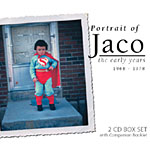
 Jaco Pastorius
 Portrait of Jaco: The Early Years 1968-1978
Holiday Park Records
2009
If only every jazz artist had an advocate like label owner/project producer Bob Bobbing. Bass wunderkind Jaco Pastorius seemingly leapt into the jazz scene in 1976 with the quadruple punch of his remarkably mature debut, Jaco Pastorius (Epic), a trio date with guitar-god-in-the-making Pat Metheny on Bright Size Life (ECM), a stunning reinvention of the singer/songwriter space with Joni Mitchell's Hejira (Elektra/Asylum) and, most importantly, two tracks on Black Market (Columbia)—his first appearance with fusion super group Weather Report and the beginning of a relationship that would continue until 1982. And while that was the year that Pastorius—known to many as just "Jaco"—became a larger than life musical figure, musicians in the know, like Metheny, reedman/trumpeter Ira Sullivan, and keyboard players Joe Zawinul and Herbie Hancock, had begun hearing about this young phenom a few years earlier.
The truth, however, is that Pastorius was one of those rare musical figures whose trajectory was clear from the time he was just a child, and it's the true depth of his genius that Bobbing has revealed on Portrait of Jaco: The Early Years 1968-1978, a two-CD audio documentary that combines music and spoken word into a compelling aural biography that firmly establishes Jaco's legacy and, once again, raises its profile to where it belongs.
Pastorius left only two true studio albums of his own, a couple of strong live sets and a plethora of subpar late-period albums that did nothing but demonstrate the increasingly aberrant behavior that so defined that last few years of his life until he died tragically in 1987—the circumstances surrounding which remain unsettled to this day. Other than a half dozen records with Weather Report, a couple with Mitchell and a handful of guest appearances with artists including Hancock, singer Flora Purim, and guitarists Al Di Meola and Mike Stern, his recorded legacy may be diminutive, but its stature undeniably important. More than just the bassist who put the fretless electric on the map and turned the virtuosic tendencies of immediate predecessors like Stanley Clarke on their side with a combination of stunning technique and passionate lyricism—not that this wouldn't have been enough—Pastorius was one of the last half century's great writers.
Like his bass playing, Pastorius' writing was broad. Some tunes, like the deeply grooving "Teen Town" and staggeringly harmonic-driven solo tour de force "Portrait of Tracy," remain rites of passage for aspiring bassists. Others, like the eminently singable and swinging "Three Views of a Secret" and vivacious "Liberty City," continue to be grist for jazz musicians in 2009—"Three Views" has been recorded nearly 90 times and new versions crop up each and every year. Nor was Pastorius a stranger to free improvisation, with "Crisis," from Word of Mouth (Warner Bros., 1981), joining a knotty bass line and unfettered group free play. The lure of the Caribbean was also a part of this Florida native's being, with the sound of steel pans a definitive texture on his funky "Opus Pocus." And the R&B that grabbed his attention from an early age not only shouted out on Jaco Pastorius' "Come On, Come Over" (but only after he demonstrated unequivocal bebop chops on a duet version of Charlie Parker's "Donna Lee," with percussionist Don Alias, but in the song that became so associated with Pastorius that many think he actually wrote it: Pee Wee Ellis' "The Chicken."
 Some consider it hyperbole to place Pastorius' instrumental innovation and compositional distinction in the same stratum as other jazz giants like bassist Charles Mingus, pianist Duke Ellington and trumpeter Miles Davis, but for those who knew Pastorius—Metheny, Hancock, Zawinul and Mitchell, for example—there's never been any doubt. What's most remarkable is that this feeling—that Pastorius was more than just an unusually talented artist, he was an important one—was an instant first impression common to virtually everyone who met him. Certainly Bobbing—a childhood friend who was an unexpected bystander to Pastorius' seemingly meteoric trajectory from an early age—was sure of the absolute inevitability of his friend's path, beginning as a child prodigy seemingly capable of learning any instrument he set his mind to, and gradually evolving a distinctive instrumental and compositional voice long before those who would later become his musical collaborators and friends had even heard his name.
 Portrait of Jaco is broken into two CDs, each nearly 80 minutes in length. The first, subtitled The Early Years, traces Pastorius right back to when, according to his father Jack, "Jocko" sang the entire Frank Sinatra Come Fly With Me (Capitol, 1957) album when he was brought onto the bandstand at one of his father's gigs...at the age of five. Pastorius started on drums, and there's an early recording of him playing the kit, but it's the home recording made at the age of 17, playing every instrument on a multi-tracked version of "The Chicken"—bass, electric guitar, drums and horns—that's perhaps the earliest recorded document of his tremendous promise.
The rest of the first disc traces Pastorius' growth as a bassist, as he became immersed in the R&B scene of late-1960s/early-1970s. The 1971 recording of his extended solo on a Tommy Strand & The Upper Hand version of Sly Stone's "I Want to Take You Higher" may not possess all the remarkable chops that would evolve so quickly over the next couple years, but his unshakable groove and ability to build gripping solos were already well in evidence. Pastorius' stint with Wayne Cochran & the C.C. Riders—his first major gig—is well-documented here, with five tracks that demonstrate his increasing sophistication, including a 1972 original composition, "Amelia," that easily presages where he was going...and quickly.
Two tracks where Pastorius experiments with a five-string acoustic bass guitar, honing his bebop chops living next door to his close friend, pianist Alex Darqui, are revealing. But easily the most significant track on the first disc is from an Ira Sullivan performance, where Sullivan hosts an early version of Pastorius' "Continuum," after discussing how the bassist, by this time on his fretless Fender bass, had told him "I'm going to make this non-instrument an instrument." Sullivan also talks about Pastorius' dedication, and his clean living; the bassist's substance abuse later in life would become extreme, but at this point he truly was, as the track title puts it, "Mr. Clean." A soul-drenched tune called "I Can Dig It Baby," from his first album appearance on Little Beaver's 1974 disc, Party Down, demonstrates the same distinctive funk lines that would emerge on the bassist's 1976 debut and Black Market. By the time the first disc ends, Pastorius may not have been fully formed, but he was certainly lining up the arsenal that would result, as Sullivan and so many others would call it, "the shot heard around the world."
The second disc, The World's Greatest Bass Player, opens with another revelation—a home recording by Bobbing, with Pastorius demonstrating and explaining his remarkable use of harmonics. It's no surprise, of course, but to hear him articulate his deep harmonic knowledge is a set-up for what's to come. Tracks with the Peter Graves Big Band, especially the burning "Between Races," demonstrate just how far Pastorius had come in a matter of months. "Domingo," the first professional recording of a Pastorius tune, is another signal that the stars were beginning to align, as are versions of Herbie Hancock's "Wiggle Waggle" and, even more importantly, a demo version of "Opus Pocus," with steel pan player Othello Molineaux (who would continue to work with the bassist for years after). Comparing this early version with what would ultimately appear on Jaco Pastorius reveals the benefit of a good producer, but also how much Pastorius would learn from that producer (Blood, Sweat and Tears' Bobby Colomby).
 There's gem after gem on the second disc. In addition to relaxed testimonials by Metheny, Mitchell, Hancock and Zawinul, there are two live tracks by Metheny, Pastorius, along with drummer Bob Moses, that may be a little low-fi, but demonstrate just how well-matched these two rising stars were. Voracious listeners and players both, in some ways it's a shame that their personal directions left them unable to work together after those early years in the mid-1970s. Interview footage with Epic A&R head Steve Popovitch reveals, with the harmonic-driven "Portrait of Tracy" in the background, just how striking, how immediately groundbreaking Pastorius' approach was. There truly was no other bassist who sounded like Pastorius at that time, and the excitement of the label's discovery is palpable, even 35 years later. That countless bassists now sound like him may have sadly diminished his importance in the public eye, but that's where Portrait of Jaco comes in: to remind just how innovative and unprecedented he truly was.
 Listening to Zawinul talk about Pastorius, it's clear that, while his later life would be plagued with problems resulting from a mood disorder that went untreated, the bassist was not just someone who was attractive to others for his musicianship; he truly became friends with those people. Portrait of Jaco goes beyond Pastorius the musician to paint a picture of him as a person, before illness and drugs took him away from those who cared about him, leading to an ending that was tragic in its ultimate inevitability.
What's perhaps most remarkable about Portrait of Jaco, however, is that, while most documentaries are the kind of thing best heard once and filed away for future reference, the music here is so striking and so remarkable for its time, that this is a set that's primed for repeat listens. The careful attention to creating story arcs across the two discs is a testament to Bobbing. In the passenger seat for most of Pastorius early years, Bobbing has parlayed his friendship into a compilation of interview footage and sound clips that paint the kind of picture of an emerging artist that so many important, but gone and somewhat forgotten, artists deserve.
Every artist needs an advocate like Bob Bobbing, but only Pastorius had him. The result is an audio document that dovetails with noted jazz writer Bill Milkowski's exhaustive Jaco: The Extraordinary and Tragic Life of Jaco Pastorius: Deluxe Edition (Backbeat Books, 2006)—which includes a CD with excerpts from Portrait of Jaco—to create a new window into the emergence of one of the most important jazz artists to emerge since 1970. Coupled with Pastorius' small but significant recorded legacy, Portrait of Jaco completes the picture of an artist who may be gone but will, thanks to Bobbing and all this important release's participants, never be forgotten.
Tracks: CD1: Sermon at the Crossroads; Please Don't Love Me; Jocko's First Gig; The Chicken; Suzanne; If You Were Mine; Street Life; Mr. Pitiful; Higher Solo; Ming of Mings; Rice Pudding; Amelia; Do You Like the Sound of Music?; Long, Long Day; Exploring the Acoustic; Dexterity; The Birth of Continuum; Mr. Clean; I Can Dig it Baby; Touch the Sky. CD2: Behind the Scenes; Between Races; Domingo; Wiggle Waggle; Opus Pocus; Balloon Song; Continuum; Behind the Scenes...Part 2; All the Things You Are; Bright Size Life; Epic "Hitman" Contracts Jaco; The Real Deal; Refuge of the Roads; Hejjira; Jaco, John & Mary; Cannonball; Kuru/Speak Like a Child; Las Olas Farewell.
Personnel: Voices heard: Jaco Pastorius; Jack Pastorius; Gregory Pastorius; Scott Kirkpatrick; Tracy Lee; Bob Herzog; Downbeat Freddy; Freddy Beasley; Bob Bobbing; Wayne Cochran; Charles Brent; Ira Sullivan; Little Beaver; Mr. Simmons; Bob Economou; Joe Zawinul; Pat Metheny; Steve Popovitch; Joni Mitchell; Herbie Hancock. Music by: Weather Report; Jaco Pastorius; Frank Sinatra; Woodchuck; Tommy Strand & The Upper Hand; Wayne Cochran & the C. C. Riders; Alex Darqui; Ira Sullivan; Little Beaver; Mr. Simmons; Peter Graves Orchestra; Othello Molineaux and Sir Cedric Luces; Pat Metheny and Bob Moses; Joni Mitchell; John and Mary Pastorius; Herbie Hancock.
Personnel

Jaco Pastorius
bass, electricAlbum information
Title: Jaco Pastorius: Portrait of Jaco - The Early Years 1968-1978 | Year Released: 2009
Comments
Tags
For the Love of Jazz
 All About Jazz has been a pillar of jazz since 1995, championing it as an art form and, more importantly, supporting the musicians who create it. Our enduring commitment has made "AAJ" one of the most culturally important websites of its kind, read by hundreds of thousands of fans, musicians and industry figures every month.
You Can Help
To expand our coverage even further and develop new means to foster jazz discovery and connectivity we need your help. You can become a sustaining member for a modest $20 and in return, we'll immediately hide those pesky ads plus provide access to future articles for a full year. This winning combination will vastly improve your AAJ experience and allow us to vigorously build on the pioneering work we first started in 1995. So enjoy an ad-free AAJ experience and help us remain a positive beacon for jazz by making a donation today.

Giveaway

Days remaining: 4



