Home » Jazz Articles » Profile » Eli Newberger: Music Maker, Medicine Man
Eli Newberger: Music Maker, Medicine Man


To jazz fans, Newberger is perhaps best-known as co-founder and the original pianist, then tuba player, of the Massachusetts-based Black Eagle Jazz Band. Though no longer with that band, he is proud to have been involved in establishing it as one of the most significant exponents of traditional jazz extant.
His feet still firmly planted in the trad jazz firmament, Newberger is equally renowned in the medical community as a pediatrician who practices on the border of psychology and trauma.
When you see the term "Medical Arts" on a building, chances are you don't think about any one individual or one discipline. Certainly not about Eli Newberger. A top-tier jazz tuba player, lecturer, writer, expert witness, a pianist, and, well, the picture might be getting clearer: Eli Newberger gives new meaning to the term "medical arts."
New Englanders who know Dr. Eli Newberger through his clinical services respect him as an expert in family conflict. His face is as familiar as almost any other jazz musicians, but for a different reason: his (all-too-frequent) television appearances as an expert commentator on matters of family violence and child abuse. But if forced to make a choice between current careers, one wonders whether he could do so, as the two paths of medicine and music are so intertwined as to be one.
For icing on this musical montage, there's The Cupcake Philharmonic Orchestra, a chamber group that brings musical programming to school children. Performances of the group, which includes Eli's wife Carolyn on flute, are underwritten by the Boston Symphony Orchestra, as part of the BSO's community commitment to education. In the group, Eli switches to piano, the BSO's Mike Roylance plays the tuba and Roylance's musician wife plays trumpet. The Cupcakes also supplement their ensemble with other musicians, including Boston Symphony players.
Although it comprises a relatively small portion of their professional lives, The Cupcake Philharmonic's occasional rendition of Tubby the Tuba represents the intersection of the Newbergers' work with children and music. These concerts deliver happy moments outside the context of their clinical work, where there is so much stress, controversy, and sadness.
Is music an escape from the controversy of family violence? Not exactly, but it represents a good jumping-off point for an interview. But first, some context.
Throughout their careers, Eli and Carolyn Newberger have collaborated on both music and medicine. The two disciplines have been such an integral part of their individual lives, and are so intertwined that it is difficult to choose one starting point.
Their joint work includes research, writing various articles both for professionals and consumers, on subjects having to do with many issues concerning families: the effects of poverty on family life; malnutrition and its impact on children and their development; the causes of malnutrition from both a social/political sense, as well as a medical/physiological sense. What they may be best-known for, over their years of clinical work, may be the issues that affect children and their families: child abuse, domestic violence, and sexual abuse, where Eli is often an expert witness.
 For 28 years, Eli Newberger directed the Family Development clinic at Children's Hospital in Boston, which evaluated children in the setting of divorce or conflict, particularly when there were issues of abuse of children or women. In fact, judges would often refer children to the clinic when such allegations were involved. Eventually, his expertise became nationally recognized, which brought Dr. Eli Newberger's face and persona to many a television screen when news reports were seeking independent opinions on matters of family violence.
Still active on the consulting and lecture circuit, and spending less time as a clinician, Eli writes in their Berkshires hideaway near Tanglewood, where Carolyn does her painting and practices her flute and piccolo playing.
Although it would be tempting to conjecture otherwise, music isn't an escape from all this; to describe it so would be to diminish its importance in his life, his psyche, and his work. Escapism is not the reason why both Eli and Carolyn are so deeply ensconced in both fields. Art has been part of both of their lives since their youths, even before they met in college.
That being said, does playing music put the trials and tribulations of the day aside, so he can depart that troubled work and just be creative? For Eli, there does come a point where "if you are deeply in the music, you have at least one foot in another world, and the instrument ceases to exist. There is something deep inside you. The feelings, the emotions that get expressed in sound that you share, and engage with the audience, makes a communication that transcends the boundaries between people."
 Butch Thompson Trio, from left: Thompson, Eli Newberger, Jimmy Mazzy
Eli says that when he is in this part of his work, "it is so richly rewarding that it has the affect of elevating your own experience, and the kind of human transaction that goes on with performance, and attentive musical response."
He can feel this both in a classical setting as well as jazz, he says. "But in jazz, there is a kind of immediacy and spontaneity, where the ideas and feelings as they unfold, especially if you are playing for a sympathetic crowd, are really quite amazing ...both transcendent and transformational. It changes you."
As co-founder of the New Black Eagle Jazz Band in 1970, he began on piano, switching to tuba in 1971, and has made over 40 recordings and hundreds of concert and festival appearances across the U.S. and Europe.
Prior to setting roots in jazz, he had an eight-year stint (1958-66) as tubaist with the New Haven Symphony, his last serious flirtation with a classical tuba career. His most recent classical foray was in March, 2007, when, with the Boston Classical Orchestra, and Mike Roylance, principal tuba of the Boston Symphony, he gave the premiere of Howard Frazin's concerto for 2 tubas and chamber orchestra. The next summer, he would be lecturing on jazz improvisation to Fellows of the Tanglewood Music Institute in Lenox, where the Boston Symphony Orchestra is in residence for 10 weeks a year.
It was with Roylance, as mentioned at the outset of this article, that he organized the Cupcake Philharmonic to perform children's classics like "Tubby the Tuba," and similar works.
But mainly, musical audiences are likely to find Eli Newberger in a jazz environment. Making music together with sympathetic jazz colleagues is very powerful, he avers. "And, it's not as simple as an experience of joy as opposed to sadness, or struggle. There is a great deal of discipline involved in playing jazz, and especially in playing traditional jazz," where there are very tight improvising rules, and where "a high premium is placed on original expression, within those rules."
In trad jazz,Newberger continues, there is a real priority given to one's emotional expression, and less concern about technical display.
Newberger offers an anecdote about how intertwined music and medicine are, for him. "I wish I had had today's clinical understanding and language back then in 1970, the same year that I organized the child protection team at Children's Hospital, and when Tommy Sancton, Tony Pringle and I formed the Black Eagle Jazz Band," he relates. "I was plunged into the trauma area; no one then appreciated what we now call the secondary trauma, on the caregivers, of their exposure to severely injured people, of the psychological impact they suffer. For me, in today's language, in retrospect I think that the music was not only therapeutic, but also enabled me to do the work in a particular and specific way."
 One of the tasks resulting from trauma exposure is to be able to contend with the surges of emotion that the traumatic experience signifies, for both clinicians and victims. "The term of art today, in the trauma field, that for me was a personal task is what is called affect regulation, contending with the strong surges of emotion in response to trauma. Professionals must maintain a positive professional demeanor. For example, you have to avoid —at all costs—expressing rage against someone who has committed horrible acts against a child, because that person typically is isolated, typically needs help. This is an extremely difficult task to accomplish for most professionals, who can unwittingly mete out punishment in the guise of help.
"As I look at it in retrospect, I think it was the music, more than any other artifact of my professional training, or colleagues, or the splendid professional environment that Children's Hospital made possible, I really do think that the music enabled me to give care in a way that I would otherwise not have been able to do."
So intertwined are his interests, in fact, that a discussion of the interconnections of his two careers appears in the book Doctors Afield (Yale University Press, 1999). "My life has been a constant balancing act, music sometimes serving as the counterweight to medicine, and sometimes the reverse," he says in "The Medicine of the Tuba," his essay in that book.
Medicine of the Tuba
Music transports Carolyn to a different place, in a different way, she says. From the perspective of a painter, "art is the hardest thing I've ever done. It's harder than graduate school and writing a dissertation. Harder than double-tonguing on piccolo. In art, you're always trying to bring order out of chaos. And you are creating the order."
 A Girl and Her Horn by Carolyn Newberger
On the other hand, in music "there is a standard. Jazz is a little different, because it has its structure, but there is freedom on top of that structure, and you have to be able to exercise that freedom while still making sense within that structure. I work hard at my music, and hard at my art, so it's not all about transcendental or transformational experience. You have to really work hard to get to a point where sometimes that happens. And, sometimes that happens reliably."
That's when the transport occurs. She relates that she can pick up her flute or piccolo and play a Telemann Suite for Flute, "and totally be in another world. The music is so sublime. The music and I are seamless, and as Eli has said, the instrument disappears.
"Those are extraordinary experiences," she adds.
Pediatrician, Author, Musician
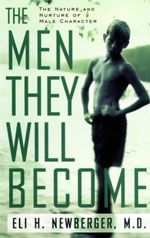
Anyone who says there's no handbook for raising boys has not met Dr. Eli Newberger. As a pediatrician who practices at the boundary between medicine and psychiatry; Eli has probably published more work in psychiatry than pediatric medicine, not the least important of which is his 1999 book The Men They Will Become. He describes this seminal work as "a guide to guiding character development, and prevention of mental disturbance in males from birth to young adulthood."
Intended for parents and professionals alike, it is still in print some 10 years after publication. This literary longevity attests to the book's significance, and is a credit to the publisher Da Capo Press, which has sensibly placed it in its Lifelong Books series. The book comprises anecdotes and expert analysis and commentary about the process of raising boys through adolescence. Important work, and as occurs with all his projects, it is done with depth and caring.
Although he is encamped in two professions today, there was, in fact, a point when Eli Newberger had to choose between music and medicine, and the decision was a practical as well as personal matter.
The revelation came during his sophomore year at Yale, where he was a music theory major. Although he also plays piano, the only instrument where he believes he plays at a high professional level is the tuba. By the time he was in his second year at Yale, he had played most of the classical repertory for tuba, and could compete for a classical job. But, he figured he would be bored, as the job of a tubaist in a classical orchestra comprises "mainly counting rests."
In other words, not a lot of notes to play.
On the other side, while he is a good jazz pianist, he still considers himself a better tuba player; and, the job prospects were not good, for either a middling pianist or a tuba player regardless of skill level.
The career choices, then, were between classical (lots of rests) and jazz (lots of rest) —neither of which was very appealing— and something else.
"I knew that if I went into medicine, I somehow would always be able to play music." The converse prospects, a career in music and a sideline in medicine, weren't realistic.
 The following year, the leader of an undergraduate jazz band in which Newberger had played fixed him up on a blind date to go to a gig in New York. The date was a Carolyn Moore, a sophomore at Sarah Lawrence. She was "a wonderful date" who has turned into a wonderful date for the 46 years that they have been married, plus the two years of courtship.
Carolyn studied art briefly as a Freshman, but by the end of the semester she concluded, and her teacher concurred, that "I had a facile hand but lacked an artist's mind." She left that course, a move that she now considers "a youthful mistake, I was insecure and didn't know what I wanted to do in life. I didn't have a goal."
Through serendipity, after doing fine in college and graduating and doing a lot of work and study in literary analysis, "we realized that we needed to support ourselves." Eli was going on to medical school; Carolyn, a year behind him, finished her senior year and became a teacher for four years. That led her to child development, and to the discovery that she loved working with children.
They joined the Peace Corps for two years. Upon returning, Eli joined the pediatrics faculty of Harvard Medical School. His research, clinical philosophy, and many publications reflect a deep devotion to improving the protection and nurturing of children and to strengthening parent-child relationships. They have been acknowledged with numerous local and national awards.
After returning to Boston from their stint in the Peace Corps (with their infant daughter), "it was natural to apply to grad school at Harvard," Carolyn recalls. She earned a doctorate in Human Development, and trained in clinical psychology at the Judge Baker Children's Center and Children's Hospital, which are affiliated with Harvard Medical School. After completing her graduate training, she continued at Harvard Medical School and Children's Hospital in clinical and academic roles doing research, teaching, and clinical practice, "Finding things as I went along that were fascinating and exciting, tapping into things that I really cared about. But as an undergrad, I hadn't a clue."
 From left: Eli Newberger, Carolyn Newberger
At 18 years of age, Carolyn lay down her pencil and brush for two human generations. She returned to art in 2003, after reluctantly accepting a friend's invitation to attend a week-long painting seminar.
"When I first squeezed pigments from their tubes onto my plastic palette, tears came to my eyes," she recalled. "Then, when I dipped my wet brush into paint and swirled forms on the white paper, I felt relief, as if I were finally coming home."
It was like a revelation, a eureka moment: "This is what I am supposed to do." The conversion was quick and sure. Now, she may awaken mid-sleep, thinking about art, about things that might be amiss in a painting. "Being an artist was in me, but I had to re-discover it. It's like I started a new life," she says.
Carolyn's studio in their suburban Boston home is a monument to the variety of her views. Still lifes, nude portraits, beautiful flowers, profiles of native peoples from their trips to Africa. And, one favorite, inspired by Eli's musicality: their granddaughter trying to play his sousaphone, looking quite serious but dwarfed by the instrument, which surrounds the young, would-be musician.
Although she abandoned art for most of her adult life, she never put down the flute for very long, even though spending many of the interim years going to grad school and then raising a daughter. After that came her demanding career as a child psychologist, juggling this with doing grant proposals, research, and teaching around the world. She's even been on Oprah.
Twice.
A Book-music Link
Writing a full-length book was challenging, sometimes competing with his regular night gig at the famed Sticky Wicket Pub in Hopkinton, Massachusetts, where the Black Eagles held sway every Thursday. And, while it is only Eli's name on the book cover, he is quick to acknowledge Carolyn's contributions. Although Eli has never shrunk from difficult conceptual tasks, this was an order of magnitude more ambitious than a thesis or scholarly paper. Some of the research papers on which they jointly worked became foundation for some of the thinking in The Men They Will Become, such as "The Social Ecology of Malnutrition in Childhood," knitting broad cultural themes to malnutrition.
What was the motivation for the book? "I wanted to re-think the notion of boys' character," said Eli. He had to do lots of research and interviews, and he wanted the book to be written for a lay audience of parents and teachers. "Carolyn played a vital role in the book. She takes a resourceful, daring approach to child psychology and cognitive development," he said. A chapter in the book, The Roots of Character, makes use of her theory.
The book doesn't have much jargon, it is written for people who are trying to understand boys and their development, and the main tasks of forming fine character in boys, through the first two decades of life. He summarized the principal messages from his book in a paper he presented at the White House Conference on Helping America's Children, in 2005, entitled "Strengthening the Characters of Boys: What We Know and Can Do." A video of the presentation, with an illustrative story and music from his jazz idol, Louis Armstrong, is on Eli's website, www.elinewberger.com
 The book took about two-and-a-half years, from signing the contract to submitting the manuscript in early 1999. Coincidentally, at that same time he got a call from the pianist Butch Thompson about a return gig to a place in Rockport, Maine. Eli got the idea of doing an album of pieces on the same theme as the book: male development.
The tracks they recorded betray (or at least chronicle) a variety of human frailties, such as: "It's a Sin to Tell a Lie"; "If I Let You Get Away With It Once (You'll Do It All the Time)"; "Ain't Much Good in the Best of Men These Days"; "There'll Be Some Changes Made"; "Miss Otis Regrets (She's Unable to Lunch Today)," and the like.
A fascinating concept, the CD can also be appreciated at its most basic level of entertaining music, with Newberger, Thompson, and vocals by banjoist Jimmy Mazzy, with whom Newberger still performs on occasion. He updates his performance schedule, CDs, and other news at www.elinewberger.com.
Performances these days will feature Thompson when the pianist comes east. Other times, he is more likely to be playing with his Jazz Tuber Trio, with Mazzy and the remarkable reedman Ted Casher. The group is a popular attraction for benefits and private parties, as well as the more typical jazz gigs.
 Jazz Tuber Trio, from left: Ted Casher, Jimmy Mazzy, Eli Newberger
As to the book, it is still extant after all these years, and has provided Eli with a welcome transition from almost a full-time focus on trauma and its events to a whole new set of teaching opportunities. He is now "less burdened by the stigma and unpleasantness of working in the abuse field," and spends more time lecturing, researching, and consulting.
Meanwhile, he has become a trustee at the Berklee College of Music, not least because of his interest in their new music therapy program, which is now the largest in the U.S. He has started to conceptualize an edited book on music and trauma, directed towards music therapists and trauma specialists.
So, a definite link emerges between book and music, and medicine and music. One would expect no less from someone who had the aptitude and drive to make a career in either discipline.
Why do they do all this? The mountain climber does so "because it's there." The Newbergers have quite different motivations for their callings. If the writer can be permitted an amateur psychoanalysis, perhaps they are engaged in medicine because they know they can make a difference, and in art because they must...they have no choice.
Reader, patient, parent, music fan, or family person, the individual who has encountered Dr. Eli Newberger and Dr. Carolyn Newberger has much of note (and notes) to contemplate, as we behold the adults they have become.
Selected Discography
Eli Newberger/Butch Thompson/Jimmy Mazzy, The Men They Will Become - Jazz Takes on Male Character (Stomp Off Records, 1999)
The M 'N' M Trio, Halfway to Heaven (Stomp Off Records, 1997)
Jimmy Mazzy/Eli Newberger,Shake It Down (Stomp Off Records, 1985)
The New Black Eagle Jazz Band, The New Black Eagle Jazz Band at Symphony Hall (Philo Records, 1982)
The New Black Eagle Jazz Band, Classic Jazz (Phillips Records, 1979)
Musical Bibliography
Newberger, E.H. The transition from ragtime to improvised piano style (Journal of Jazz Studies 3:3-18, 1976)
Newberger, E.H. Archetypes and antecedents of piano blues and boogie-woogie style (Journal of Jazz Studies 4:84-109, 1976)
Photo Credits
All Photos Courtesy of Eli Newberger
Newberger, E.H. The development of New Orleans and stride piano style (Journal of Jazz Studies 4:43-71, 1977)
Newberger, E.H. Refinement of melody and accompaniment in the evolution of swing piano style, in Annual Review of Jazz Studies I. New Brunswick (Transaction Books, 85-109, 1982), Morgenstern, D., Nanry, C., Cayer, D.A., editors
About Eli Newberger
Tags
PREVIOUS / NEXT


Become a Sustaining Member

Since 1995, All About Jazz has championed jazz as an art form and supported the musicians who create it. Over three decades, it has grown into one of the world's leading jazz resources, serving hundreds of thousands of readers, musicians, presenters and industry professionals each month.
Help Build the Future of All About Jazz
Your support helps us continue building All About Jazz for the next generation—expanding our editorial coverage, preserving jazz history, developing new community features and creating better ways to discover the music and the people behind it.
Become a sustaining member for as little as $20 per year and you'll immediately enjoy an ad-free experience along with access to subscriber features and future articles for a full year.
Together, we're not simply sustaining All About Jazz—we're building its future. Thank you for being part of the journey.