Home » Jazz Articles » Big Band Caravan » Mike Barone Big Band / North Texas Two O'Clock Lab Band ...
Mike Barone Big Band / North Texas Two O'Clock Lab Band / John Daversa Big Band

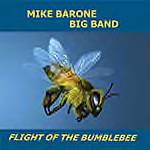 Mike Barone Big Band
Flight of the Bumblebee
Rhubarb Recordings
2009
Flight of the Bumblebee is composer/arranger/trombonist Mike Barone's fifth big band album in as many years, and one can always deduce beyond the shadow of a doubt that he has some fresh and engaging insights to share. Barone's purpose isn't to overwhelm but enlighten, and what better way to edify than to open with a splendidly remodeled version of "Bumblebee." Yes, that "Bumblebee," the one deified in song more than a century ago by the Russian composer Nikolai Rimsky-Korsakov (1844-1908) who may have been pleased to behold it in a brand new twenty-first century wardrobe.
Charming as it is, "Bumblebee" is but the first of several pleasurable surprises in store for the listener. Barone has delved deep into his treasure house of vintage songs to unearth two other neglected gems, "Put Your Arms Around Me, Honey" and the Al Jolson favorite, "Avalon," each of which shines anew thanks to Barone's radiant charts. "Honey" is actually making an encore appearance, having been recorded by Barone's band on the album Live at Donte's, 1968 (VSOP 103). The other nine selections are Barone originals, and with due respect to those songs already mentioned, they embody an unbroken succession of highlights. After more than half a century of writing, Barone's earnestness and know-how are as strong as ever, perhaps even more so. How he continues to produce so many entrancing melodies may be a mystery, but one that's a pleasure to contemplate.
While Barone's themes are presumably based for the most part on standards, unearthing their genesis is no easy task. "Lobbers No More" is almost certainly a covert "Just Friends," "Limes Away" a more readily identifiable variant of "Limehouse Blues." While the other tunes aren't as handily linked to their forebears, they are entirely capable of standing on their own. There are, in fact, a couple ("Trottin,'" "Easy Does It") that could conceivably (and deservedly) enter the pantheon of jazz standards.
Among the soloists, trumpeter Bob Summers is out front most often, and that's a good thing, as there aren't many more persuasive ad-libbers on the West Coast or anywhere else. Others heard to good advantage are altos Keith Bishop and Tom Luer, tenors Kevin Garren and Vince Trombetta, trumpeter Mark Lewis - Trumpet, pianist Andy Langham and drummer Bob Leatherbarrow. Trombetta is showcased on "Exceptionally Moist," Garren on "Trottin,'" Bishop on "The Other Half," Luer on "Slow Walkin,'" Langham on "Minus Five."
Barone prefers to record in a studio with an invited audience, which not only assures superior sound quality but the chance for do-overs if needed (with these musicians, it's a safe bet that not many were). The sound here is excellent, as is the ensemble. Everyone is sharp and well-rehearsed, as one would anticipate, while the rhythm section (Langham, Leatherbarrow, bassist David Tranchina) makes all the right moves and drives the band with power and finesse. Meanwhile, Barone's resplendent arrangements eclipse even their laudable efforts, making Flight of the Bumblebee a strong contender for anyone's big band Album of the Year.
 North Texas Two O'Clock Lab Band
Bruce Hall Jazz Music
North Texas Jazz
2009
Bruce Hall Jazz Music, the second of four albums by the University of North Texas Two O'Clock Lab Band to be reviewed consecutively in this column, brings to the fore the Classes of Spring 2006-07 under recently retired director James Riggs. Bruce Hall, as it turns out, is not a person but a place, a dormitory and rehearsal space situated next to the UNT Music Building. Many music majors have been and are among those housed in its 492 rooms, presumably including some or even all of those who perform on this admirable CD.
The 2007 band leads off with trombonist Dave Richards' suitably named "Funkle Jelly Bags," spotlighting tenor saxophonist Alastair Otteson and trumpeter Thomas Eby. The 2006 ensemble embraces the next three numbers—the standard "There Will Never Be Another You" (arranged by UNT's Matt Gowlick), Bob Brookmeyer's explosive "Boom-Boom" and Thad Jones' luminous "Thank You"—but appears only once more, on Phil Kelly's swinging version of "You and the Night and the Music." The Class of 2007 takes charge on Kelly's galloping arrangement of Duke Pearson's "Jeannine," trumpeter Sean Foley's multi-layered "Raga," Alf Clausen's playful "Looking for the Back Door," Bill Holman's Stan Kentonesque arrangement of "Polka Dots and Moonbeams" (featuring trombonist Dave Winslow) and Steve Owen's perceptive look at Wayne Shorter's vigorous "Yes or No" (a splendid showpiece for altos John Leadbetter and Tim Barclay).
As noted before, the Two O'Clock Lab Band is one of a sizable number of blue-chip jazz ensembles at UNT, and its resemblance to the renowned One O'Clock Band is about as close as that of the Doublemint Twins. In fact, the Two O'Clock Band was named Best College Jazz Ensemble in DownBeat magazine's 31st annual Student Music Awards in 2008. Listening to Bruce Hall Jazz Music, it's easy to understand why. The soloists are consistently strong, the ensembles tight and focused, the rhythm sections sharp and responsive. As a bonus, the playing time is generous, sound clear and well-balanced. The listener can't ask for more than that from a university-level performance.
 John Daversa Big Band
Live at Catalina's
Daversafications
2009
As everything on this album, recorded live in April 2000 at Catalina Bar & Grill in Hollywood, CA, was written and arranged by leader/trumpeter John Daversa, appraisal of its substance must ultimately rest on the listener's impression of Daversa's progressive themes. One opinion is that even though some of Daversa's compositions overstay their welcome, the advantages generally outweigh any such shortcomings, thus giving rise to one lukewarm but positive vote.
Besides writing and arranging, Daversa solos on five of seven numbers including EVI (electronic valve instrument) on the funky "Slick." One of his most engaging compositions, the tender "Bare Your Soul," is also the briefest at 6:04. Among the others, only "Pententium Motion" (7:22) and "Most of All" (9:58) clock in under ten minutes. Alto saxophonist Bill Perkins steps forward on the curtain-raising "Don't Jive the Hitman," "Slick" and "You Think You're Funny," but this was during Perk's more probative interval, and his solos aren't nearly as pleasing to these ears as in times past. Soprano Tom Peterson is featured on the earnest "Oma," Daversa and drummer John Payne Guerin on "Pententium Motion," bass clarinetist Jennifer Hall and trumpeter Matt Nabours on "Most of All," which some may also consider best of all. The band cuts loose on the fast-paced closer, "Funny," whose other soloists are Daversa, Guerin and alto Kim Richmond.
Guerin leads a piano-less rhythm section (Todd Sickafoose, bass; Justin Morell, guitar) that gives the ensemble and soloists all the support they need, while everyone else plays with expertise and elan. Daversa has kept his band intact and working for more than a decade, which speaks volumes about his leadership. If your musical taste leans toward the contemporary, a wealth of pleasurable moments is yours to uncover and appreciate in Live at Catalina's.
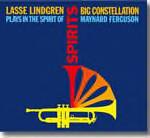 Lasse Lindgren Big Constellation
Spirits
Imogena
2009
On Spirits, Lasse Lindgren, a trumpet standout of some note (jazz and lead) in his native Sweden, pays tribute to one of his seminal influences, the peerless Maynard Ferguson, in a rollicking studio date whose purpose is not to copy Ferguson but to recapture his indomitable spirit. Like his mentor, Stan Kenton, Ferguson was known for his rampageous approach to big band jazz, but there are times here when Lindgren's 14-piece Big Constellation overshadows even Maynard's boundless take-no-prisoners style. For the most part, however, these are songs associated with Ferguson, framed as a whole the way he would have played them, from Joe Zawinul's shuffling "Birdland" to the closing medley, Slide Hampton's frenzied, gospel-style "Got the Spirit" and Ferguson's customary finale, Jimmy Giuffre's emphatic "Blue Birdland" (with commentary by Lindgren).
Sandwiched between is a smorgasbord of Ferguson favorites including his durable ballad show-stoppers, Leonard Bernstein's "Maria" and the Gershwin brothers' "I Can't Get Started" (on which Lindgren plays and sings, as Maynard often did). Mike Abene composed "The Fox Hunt" and "New Bag Blues" and arranged Sonny Rollins' flag-waving "Airegin." The impulsive "Si! Si! MF" was written by trumpeter Don Rader, the fiery "Left Bank Express" by pianist Pete Jackson, the slithering "Serpent" by Keith Mansfield (if pressed to single out the least engaging tune among them, this would be the one).
Lindgren is a standout on trumpet or valve trombone ("Birdland," "The Serpent"), amplifying incisive statements by trumpeter Johan Holmberg ("Fox Hunt"), trombonists Lars-Goran Dimle and Niklas Rydh, alto Johan Borgstrom, tenors Bjorn "Skane" Cedergren and Jens Nilsson, baritone Erik Kristofferson and pianist Johan Johansson. The rhythm section, so pivotal in any Ferguson band, is marvelous, from bass guitarist Owe Almgren's resonant substratum on "Birdland" to the excellent work by both drummers (yes, there are two), David Sunby and Goran Kroon, on every number but especially the burners: "Birdland," "Airegin," "Fox Hunt," "Si! Si! MF" and "Left Bank Express."
The album was co-produced by Lindgren and Ernie Garside, who was Ferguson's manager during the trumpeter's stay in England during the late 1960s and early 1970s. While Lindgren is careful to point out that he doesn't try to "copy" Ferguson, there's no doubt that he and his Big Constellation have "got the spirit," and that spirit is palpable throughout this lively and warm-hearted tribute to the most illustrious high-note master who ever lived.
 North Texas State College
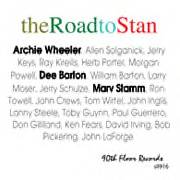
The Road to Stan
90th Floor Records
2009
Even though it's not entirely clear from the concise liner notes who is playing with whom and where, what is evident is that, from an historical perspective, The Road to Stan is significant. What's even more important is that, from a musical standpoint, it is consistently rewarding. Apparently, most (perhaps even all) of the tracks were recorded by the then-North Texas State College Jazz Ensemble (now the UNT One O'Clock Lab Band) under its celebrated director, Leon Breeden. According to the notes, "two exciting concert performances have been added from 1961 [when the original LP was issued by 90th Floor Records] and sometime later, not definable at this [time]." The album was conceived as a companion piece to Artistry in Rhythm, the Los Angeles Jazz Institute's salute to Stan Kenton, held in October 2009.
A list of personnel is provided on the front cover, but one can't ascertain by reading it whether the musicians are present on some, most or all numbers, as only the soloists on each track are named (the last tune, Johnny Richards' "La Suerte de Los Tontos," includes the note "personnel unknown"). A few of the names should be familiar; at least two, trumpeter Marvin Stamm and trombonist (later drummer) Dee Barton, were members for a time of the Stan Kenton Orchestra. Trumpeter Tom (Shabda Noor) Wirtel is a long-time standout in Galen Jeter's Dallas' Original Jazz Orchestra, trombonist Morgan Powell is a well-known educator, and pianist Lanny Steele founded the Texas Southern University Jazz Ensemble.
Barton, also known as a first-rate composer/arranger, wrote the breezy opener, "Dee Day" (why isn't that heard more often?), the intoxicating "Vino for Doris" and seductive "Waltz of the Prophets." Powell wrote "Moon Bag" and "Reflections," while Wirtel arranged the standard "Old Devil Moon," on which he solos with Steele, alto Archie Wheeler, tenor Jerry Keys and drummer Paul Guerrero. Stamm solos twice, on "Reflections" and Jim Knight's dynamic "Gold Road," Powell on "Moon Bag" and Larry Cansler's colorful "Procesion de los Esclavos," Barton on "Vino" and "Prophets," Wirtel on "Esclavos" and Cansler's groovy "Spring Sketch." Wheeler has his say on "Dee Day" and "Gold Road," trumpeter Ronnie Towell on "Vino," guitarist Donnie Gilliland (with unnamed trumpet and tenor) on Bill Holman's definitive arrangement of "Stompin' at the Savoy," which is played at the proper tempo. "Savoy" and "La Suerte de los Tontos" are the numbers recorded in concert.
Fans of big bands in general and Stan Kenton in particular should find much to appreciate here. The playing time (52 minutes-plus) is acceptable, sound and balance remarkably strong and clear. Best of all, the musicianship is splendid throughout. Recommended without pause.
Repass Brass
Bonehenge
Self Published
2009
As its clever play on words denotes, Bonehenge, by the Repass Brass, is about brass in general, trombones in particular. Its leader, trombonist par excellence Morris Repass, a mainstay for many years in Southern California studios and ensembles of various shapes and sizes, plays all the trombone parts (plus euphonium and tuba) in what isn't strictly a big band album but more a showcase for Repass's impressive talents.
There is, however, a big band of sorts on tracks 4-5 with the "trombone section" augmented by two trumpets, three clarinets, two flutes, bass clarinet and rhythm on Fritz Kreisler's "Liebesleid" and Harry Lincoln's "Repasz Band Samba," whose old-fashioned piano roll intro is a salute to the Repasz Band in Williamsport, PA, the oldest town band in America, formed in 1831 and named after Repass's great-uncle, Daniel Repasz. While no guitar is listed on either track, there is a genial guitar solo on "Liebesleid" (and a corker by flugel Steve Huffsteter on "Samba").
Elsewhere, Repass is in the forefront, playing in unison and soloing nicely on "Angel Eyes," "Sweet Georgia Brown," Clare Fischer's "Blues Bossa," Gordon Jenkins' "This Is All I Ask" and Luis Bonfa's "Morning of the Carnival" from Black Orpheus. Guitarist Larry Koonse sits in on "This Is All I Ask," trumpeter Allen Vizutti on "Blues Bossa," while Fischer mans the keyboard on "Angel Eyes," "Georgia Brown," "Blues Bossa" and "Carnival."
Repass, as one would surmise, is a topnotch player with a velvety tone and grade-A agility who blends seamlessly on every number. None, however, really tests his chops, as only "Blues Bossa" and "Repasz Band Samba" raise the tempo or temperature above medium, and Repass solos on neither one. For trombone fans, a burnished, even-tempered session by one of the West Coast's best. A caveat: the playing time is a modest 38:55.
Century Jazz Ensemble
Live
Self Published
2009
The Century Jazz Ensemble isn't a working professional band but an undergraduate group from Century College in White Bear Lake, MN, near Minneapolis-St. Paul. This concert date, recorded during the 2008 season at the Century College Theatre, is as lively and colorful as it is entertaining, with incandescent charts by Bill Holman, Tom Kubis and Gordon Goodwin lighting the way along with three intriguing compositions and seven tasteful arrangements by members of the ensemble.
Two of those themes, "Song and Smile" (arranged by pianist Tim Lackas) and "1234567" (arranged by trombonist Steve Devich), are thoroughly engaging (and swinging) Chinese folk songs specially designed for the band's two-week tour of China in 2006. Tenor saxophonist Paul Peterson wrote the rhythmic "Sallydance" and even-tempered "That's How I Know," bassist Greg Stinson the roof-raising "Penny Gospel," on which Peterson and Lackas are the soloists. Larry Neumann, a hands-on director, is showcased (on flute) on Devich's arrangement of John Castro-Neves' "All in One," tenor Terry Peffer on "Sallydance," baritone Warren Weise on another handsome Devich chart, Hoagy Carmichael's evocative "Georgia on My Mind."
Rounding out the splendid performance are Kubis' enchanting "Exactly Like This," Goodwin's soulful "What Sammy Said," Charles Mingus' rollicking "Better Get Hit in Your Soul" and Holman's sunny arrangement of Rodgers and Hammerstein's "June Is Bustin' Out All Over." Other soloists of note include trumpeters Scott Snyder and John Whitlock, alto Mark Jordheim and trombonists Ralph Brindle and Steve Sopoci. Director Neumann solos on alto (with Snyder and Peterson) on "Soul."
A word should be said about the rhythm section—Lackas, Stinson, guitarist Paul Berger, drummer Brett Smith—as it is sharp as a paring knife from preamble to coda. In fact, the same could be said of the ensemble as a whole, which may hail from a relatively small and unheralded university but plays much larger than that. One could reasonably argue, in fact, that the Century College Class of 2008 is in a class by itself.
Tracks and Personnel
Flight of the Bumblebee
Tracks: Flight of the Bumblebee; Easy Does It; Exceptionally Moist; Trottin'; The Other Half; Lobbers No More; Put Your Arms Around Me, Honey; Limes Away; Slow Walkin'; Minus Five; Sprung Time; Avalon.
Personnel: Mike Barone: leader, composer, arranger; Tony Bonsera, Pete DeSiena, Adolfo Acosta, Mark Lewis, Bob Summers: trumpet; Tom Luer, Keith Bishop, Kevin Garren, Vince Trombetta, Brian Williams: reeds; Charlie Loper, Dick Hamilton, Dave Ryan, George Thatcher: trombone; Andy Langham: piano; David Tranchina: bass; Bob Leatherbarrow: drums.
Bruce Hall Jazz Music
Tracks: Funkle Jelly Bags; There Will Never Be Another You; Boom-Boom; Thank You; Jeannine; Raga; Looking for the Back Door; Polka Dots and Moonbeams; You and the Night and the Music; Yes or No.
Personnel: James Riggs: director. Spring 2006 Two O'Clock Lab Band: Sean Foley, Lee Koelz, Matt Timm, Thomas Eby, Justin Stanton: trumpet; John Leadbetter, Brian Girley, Isaac Lamar, Carlos Espinosa, Kazuki Nagashima: reeds; Dave Richards, Nick Wlodarczyk, Aric Schneller, Jason Oliver, Jason Hausback: trombone; Ryota Ishikawa: piano; Lindsey Miller: guitar; Joe Johnson: bass; Michael D'Angelo: drums. Spring 2007 Two O'Clock Lab Band: Sean Foley, Matt Timm, Brandon Potts, Clynt Yerkes, Thomas Eby: trumpet; Tim Barclay, John Leadbetter, Alastair Otteson, Chris Bullock, Chris Mike: reeds; Dave Richards, Nick Wlodarczyk, David Winslow, Nic Butts, Jason Oliver: trombone; Brad Williams: piano; Justin Cash: guitar; Ryan Hagler: bass; Michael D'Angelo: drums.
Live at Catalina's
Tracks: Don't Jive the Hitman; Bare Your Soul; Slick; Oma; Pententium Motion; Most of All; You Think You're Funny.
Personnel: John Daversa: leader, composer, arranger, trumpet, EVI; George Graham, Glenda Smith, Ron King, Matt Nabours: trumpet; Kim Richmond, Bill Perkins, Tom Peterson, Jeff Driskill, Vince Trombetta Jr., Jennifer Hall: reeds; Alex Iles, Bill Booth, Charlie Morillas, George Thatcher: trombone; Justin Morell: guitar; Todd Sickafoose: bass; John Guerin: drums.
Spirits
Tracks: Birdland; Airegin; Gonna Fly Now; Maria; The Fox Hunt; Si Si MF; New Bag Blues; Left Bank Express; I Can't Get Started; The Serpent; Got the Spirit / Blue Birdland.
Personnel: Lasse Lindgren: leader, trumpet, valve trombone, didgeridoo, percussion, vocal; Robin Rydquist, Johan Holmberg, Fredrik Hakansson: trumpet; Johan Borgstrom: alto, soprano sax; Bjorn "Skane" Cedergren, Jens Nilsson: tenor sax; Erik Kristofferson: baritone sax; Lars-Goran Dimle, Niklas Rydh: trombone; Johan Johansson: piano, keyboard; Owe Almgren: electric bass; David Sunby, Goran Kroon: drums.
The Road to Stan
Tracks: Dee Day; Gold Road; La Procesion de los Esclavos; Moon Bag; Old Devil Moon; Reflections; Spring Sketch; Vino for Doris; Waltz of the Prophets; Stompin' at the Savoy; La Suerte de los Tontos.
Personnel: John Crews, Marvin Stamm, Tom Wirtel, Ronnie Towell: trumpet; Archie Wheeler: alto sax; Jerry Keys: tenor sax; Ken Fears: flute; Morgan Powell, Dee Barton: trombone; Lanny Steele: piano; Donnie Gilliland: guitar; Paul Guerrero: drums. Other personnel unlisted.
Bonehenge
Tracks: Angel Eyes; Sweet Georgia Brown; Blues Bossa; Liebesleid; Repasz Band Samba; This Is All I Ask; Morning of the Carnival.
Personnel: Morris Repass: leader, trombone, bass trombone, euphonium, tuba; Allen Vizzutti: trumpet (3), flugelhorn; Clare Fischer: keyboards (1-3, 7); Jay Leach: guitar (1, 2, 7); Larry Koonse: guitar (6); Jerry Scheff: bass (1, 2, 7); Brent Fischer bass (3); Chris Conner: bass (6); Ron Tutt: drums (1, 2, 7); Kendall Kay: drums (3, 6); drums; Brian Kilgore: percussion (3). Tracks 4, 5: Don Clarke, Steve Huffsteter: trumpet, flugelhorn; Gary Foster, Phil Feather, Tom Peterson, Bob Carr: flute, alto flute; Gene Cipriano, Kim Richmond, Glenn Morrissette: clarinet; Lee Callet: bass clarinet; Rich Eames: piano; Chris Conner: bass; Paul Humphrey: drums; Brian Kilgore: percussion.
Live
Tracks: June Is Bustin' Out All Over; Exactly Like This; All One; The Penny Gospel; That's How I Know; Georgia on My Mind; Sallydance; What Sammy Said; Song and Smile; 1234567; Better Get Hit in Your Soul.
Personnel: Larry Neumann: director, alto, soprano sax, flute; Kurt Christensen, Scott Snyder, Craig Jacquart, John Whitlock: trumpet; Mark Jordheim: alto sax, flute; Paul Peterson, Terry Peffer: tenor sax, clarinet; Warren Weise: baritone sax; Ralph Brindle, Steve Sopoci, Phil Florine, Steve Devich, Nick Syman (2): trombone; Tim Lackas: piano; Paul Berger: guitar; Greg Stinson: bass; Brett Smith: drums.
Tags
PREVIOUS / NEXT
Become a Sustaining Member

Since 1995, All About Jazz has championed jazz as an art form and supported the musicians who create it. Over three decades, it has grown into one of the world's leading jazz resources, serving hundreds of thousands of readers, musicians, presenters and industry professionals each month.
Help Build the Future of All About Jazz
Your support helps us continue building All About Jazz for the next generation—expanding our editorial coverage, preserving jazz history, developing new community features and creating better ways to discover the music and the people behind it.
Become a sustaining member for as little as $20 per year and you'll immediately enjoy an ad-free experience along with access to subscriber features and future articles for a full year.
Together, we're not simply sustaining All About Jazz—we're building its future. Thank you for being part of the journey.