Home » Jazz Articles » Interview » Myron Walden: Eclectic Reedman
Myron Walden: Eclectic Reedman


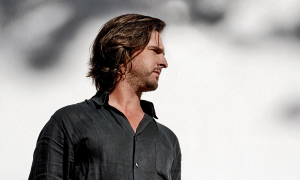
The same can be said of the music he plays. Three current releases (1) conjure Miles Davis, (2) reflect his innermost feelings of love, and (3) jump with countrified vigor. Look up the word "eclectic" in the dictionary, and you'll find a photo of Myron Walden.
While it is not uncommon for saxophonists to stray from their main instrument, or to explore musical variety, Walden is a committed non-denominational. The driving factors are usually the voice, range and weight that he is seeking on a particular performance or composition. Although not unusual on the surface, the fact that he expresses no favorite does suggest a big melodic and tonal palette.
Walden's work ethic is something to behold, having appeared with six different lineups in September and October (some of them as part of a fundraising effort for The Jazz Gallery, the Greenwich Village non-profit venue). And, he is releasing three different recordings between mid-November, 2009 and January, 2010. After a recording hiatus of four years, during which Walden wrote feverishly and wood-shedded the tenor saxophone, the first new release to hit stores was the November 17, 2009 issue of Momentum, to be followed by In This World and Countrified.
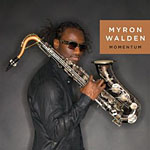
Momentum was inspired by the range of expression from Miles Davis' 1960s bands, recordings and compositions. This fall's Jazz Gallery performances included Walden on tenor saxophone, with Darren Barrett on trumpet, Eden Ladin on piano, Yasushi Nakamura on bass, and John Davis on drums.
In This World is a labor of love and gift to his wife, a project that captures feelings of reflection. This aggregation features Walden on tenor, soprano saxophones and bass clarinet, Jon Cowherd on piano, Mike Moreno on acoustic and electric guitar, Yasushi Nakamura on bass, and Obed Calviare on drums.
Completing the eclectic trilogy, Countrified is a funky, down-home project which he describes as "southern fried soul meets a little blues and rock and roll." For that performance, Jared Gold plays organ and Kenneth Salters is on the drums.
He took three other projects to the Jazz Gallery and other NY stages this fall, including a tribute to Stanley Turrentine, duo-sax reflections from earlier work, and a trio set.
Walden started studying alto in early childhood, and then added bass clarinet. The inspiration to play other reed instruments came about "because I felt I wasn't able to sonically convey in a way that could and would equate emotionally to the alto and its register. I had played some of the current music on alto, and listening back, it didn't feel right. It was not as impactful as I thought it could or should be." Realizing that, and doing something about it, was basically the process of growing up—or simply, growing.
 His first jazz model was Charlie Parker, and one other band that always moved him was Miles Davis' quintet. "What moved me? The comping? The drums? The repertoire? All of the above."
So, Walden asked himself how he could achieve that presence without copying; what could he change that was actually changeable? "It came down to the blend of the tenor and trumpet that gave it that edge, that depth, that blend."
While as an altoist he liked the sound that Parker and Dizzy Gillespie could get, with their higher frequency and agility, "the sound that Miles and Wayne Shorter got had more weight, less agility." Walden understood the musical vocabulary and could play the melody. "But the weight and sound and texture of the trumpet and tenor was closer to what I wanted to do."
If he wasn't going to mimic or cover the songs that Miles played, yet still wanted that sound, "I needed to move to the instruments. Even when I was only playing alto, I think my sound and style were more characteristic of a tenor. So, here I am."
Walden was born in 1972, when Parker was already dead for 15 years, so he never even came close to hearing Bird in person. It may seem unusual for a performer of Walden's originality to be using Parker as a gauge for the sound he wanted to create, then comparing and contrasting with Miles, who died when Walden was barely out of high school. While he had no chance to hear either of them when they were still making the sort of straight-ahead acoustic jazz that influenced so many others —and that primarily characterizes his playing— they were both critical influences on his developmental years.
 Not surprisingly, his initial "lessons" were based on recordings, and that's where Bird enters the picture. He taught himself to play alto while listening to Charlie Parker. "I did not come from a household that played jazz. When I was younger, 7 or 8, my mother would hear The Carpenters on the radio, and I was at home with them as I am with jazz today. This was what I was connected to."
An uncle was so moved by the music of Charlie Parker that young Walden became curious. "I gravitated towards that; from that moment on, I have almost removed myself from the music that I grew up with. Charlie Parker was my inspiration." Not just for a musical style, but for a career choice (to the extent that any artist really has a "choice"). "I knew that that was what I wanted to do."
It didn't exactly come easy. As a boy in Miami, the local public school had no music department; but a sympathetic teacher, touched by the child's desire to play the saxophone, encouraged him to take home an old alto saxophone from the school storage closet. By studying Charlie Parker's album art and listening to his uncle's record, Walden actually taught himself to play.
At the age of 12, his family moved to the New York area, where his first formal instruction came at the Harlem School of The Arts' after-school program. He attended LaGuardia High School of Music and the Arts in New York City and, after graduation, attended the Manhattan School of Music, graduating in 1994. The previous year, he won the prestigious Lincoln Center Charlie Parker Competition. A listener thanks his lucky stars for that uncle's passion for Bird.
One might wonder where Myron Walden would be today, if he'd been stuck with The Carpenters. "All I had was the Parker recordings, and maybe a Paquito D'Rivera recording. And, I don't know how I came up with it, but I also had a Kenny G recording. Eventually, my uncle brought a Sonny Stitt recording around. And that was all I knew, those four or five recordings. I wasn't hearing jazz at home. I didn't know jazz fans, except for my uncle. He wasn't there every day, so those records were really all I had."
In making choices about playing records, he never put on the Kenny G album. And he rarely, if ever, put on Paquito D'Rivera. What really moved him was Bird. "It's difficult to express the influence of others. But in a way, instead of my uncle taking the lead in a conversation with me, it was Charlie Parker taking the lead. So, Charlie Parker had that influence on my uncle, and it certainly transferred to me."
School of Hard Knocks
Lessons came from every corner. Besides his self-instruction and after-school training, he learned by visiting clubs, and by attending yet another school, one that is called "hard knocks." Here's one class that he particularly remembers: In high school, he would hear Jesse Davis play every Friday and Saturday at a New York club called Augie's (now known as Smoke). Whether there was snow, rain, no matter the weather, he found a way to be there. One night, "Jesse came over to me, figured I played something, and he invited me to play. 'That's the only way you're going to get to it, is to play it.' I did my best, but wasn't very good."
Usually, an audience will encourage a new player, but this time, a woman nearly destroyed his spirit. "I realized that people had paid their money to get in and have a professional encounter, and I didn't play very well. But, I felt good that I had at least tried. Then, this woman came over and said I sounded terrible, that I shouldn't be playing, and she ranted on and on; at the end, I was in tears."
 Davis came over to Walden and could see that what she said was troubling him. "You did the right thing," Davis told Walden, "this is how you develop your chops. Don't listen to her, just keep coming back. I'll let you sit in, whenever you come here." Although he has never forgotten that woman's crude critique, it's Davis' handling of the situation that helped him through it, and provided a life lesson as to how to treat up-and-coming musicians.
In these younger years, he credits Vincent Herring as being a strong influence on his developing sound. "In a way, Vincent adopted me. I spent days at a time with him. He watched my behavior, my outward being. As I got older, it became clearer that personality finds its way into the art. A boisterous person plays that way; a quiet person plays softer, slower, and so forth. This isn't a hard-and-fast rule, but an honest person will reflect their personality in their art."
Walden didn't have much money, and Herring gave him lessons, and reeds, "and took me to clubs; when he ate, I ate. When I was with him, it was like his little brother. I could go on and on about how he encouraged me; he would show me by example. I cannot express how grateful and appreciative I am, to this very day. He didn't have to do that."
 Herring would take Walden around to clubs like Bradley's, where he introduced Walden to Gary Bartz. "In fact, he thought I played like Gary Bartz, and that's why he took me to hear him. I found the similarities, too. I said Wow. That sounds like me."
Herring knew Walden's playing so well, "but also knew I needed to get better at it. So, he took me to hear someone who can do it so much better. He pointed me in a direction, and connected me with people like Nat Adderley. And through him I was able to play with Jimmy Cobb, Walter Booker, and other great musicians."
Some lessons one can take from books, others from recordings, others from sitting-in in clubs. To help him develop his range, Walden even tried social osmosis, or so it seems. Mark Turner had eye-opening range and played with such authority that Walden was captivated.
"I first met Mark Turner a session of a mutual friend Victor Atkins (the pianist from New Orleans, on the faculty of the University of New Orleans music department). I was floored. I wanted to do that, on alto. Not his lines, but with his authority and extended range."
So, Walden asked him how to do it. "I'd get advice like 'Practice overtones, do the scales, practice long tones.' I kept asking him how he actually did it, and he couldn't give me a concise answer, so I started hanging out with him and started a band with him."
In fact, Turner was sharing a house in Brooklyn with Joshua Redman and drummer Jorge Rossy. "With Turner and Redman in the same house, I wondered: Is this contagious? Turner had some range, and I kept asking 'how do you do that?' I figured I should live there, and catch it."
But in the end, it came down to "a lot of trial and error, and I'm still in that mode today." In one way or another, they would keep telling him that "you've got to hear it." He didn't really get the point, "until after all that practicing, I finally got it. You practice mundane things like the scales, in the middle range and the high end and the low end. You eventually hear it, you do it. They were telling me the truth."
"Challenges Give Me Strength"
That brash woman at Augie's also "told me the truth," but in reality her demeanor momentarily destroyed his spirit. Perhaps others would have let such criticism affect their commitment to the music, but not Walden, it steeled him to do greater things. Not that he'd recommend that sort of regimen to other artists.
"A lot of musicians just want to hear how good they sound, when they do something right. I wasn't brought up that way. People were always telling me what I was doing wrong. I didn't run from it; maybe I didn't belong up there at Augie's. But I listened to Jesse tell me how to do it. He and Vincent Herring taught me, showed me. I trusted Vincent to direct my musical growth. Vincent could say, 'You've got to get this, man, because if you keep playing this way, you'll starve,' and for some musicians, that would be a breaking point. For me, it strengthened me. I use instances of challenge to give me strength, as opposed to letting it break me down."
Now, at the ripe old age of 37, Walden is becoming the teacher, and is realizing that young children need encouragement more than frank negative criticism. As they mature, it becomes more important that they realize where their shortcomings are, and they need to be able to face them.
"Challenges give me strength," he said. "As I become an elder, I realize that young children need encouragement more than pointing out all the negatives. Eventually, as the student matures, they must realize their shortcomings. Then, if they are not able to face them, they're living a lie, living in a make-believe world. They need to face the reality of things. It made me stronger."
 Now, there's more than one type of learning, and more than one thing needing to be learned. He could play his horn, but it took awhile before he knew the standard repertoire and could sit in with others. Walden recalled a gig when he subbed for Hamiet Bluiett at Visiones, in Greenwich Village. He was out of high school and college. Drummer Greg Bandy was the leader, and the band included Gary Bartz. "I didn't know any of the tunes that he'd be calling out; one after the other. It was pretty rough, and I was constantly involved in situations where I was forced to learn things. Knowing how to play the saxophone wasn't enough, there was 50-60 years of music that I had to get a handle on, immediately."
Another seminal time in his development occurred in 1997, when Walden joined the Brian Blade Fellowship Band at its inception, and he continues to record and perform with the group today. His soulful, passionate solos on the alto saxophone and bass clarinet are frequently cited as moving and exciting parts of this ensemble's performances and Blade has credited Myron's voice as one of his inspirations for his compositions.
 Among the many other people who have taught Myron Walden a thing or two, he also credits his wife as playing a key role. "My wife and I are as close as two can be. When I gave the recording [In This World] to her, I told her how much I love her and wanted to write something that was representative, and I asked if she thought it captures it."
His wife, whom he describes as "the most appreciative and loving person I know," responded. "In not-so-many words, she said, 'Slower, and lower.' Some people may have been insulted by that, but I'm not that way. I wanted to get it closer to my intent. Her, not being a musician, saying that, was probably the most profound thing that anyone has ever said, in the terms of getting my music do to what I intended it to do, to convey more depth, and the sentiment of love. I'm not sure she totally understood what she was saying. She is not a musician; I could take the most truth from that. "
How so?
Because sometimes as musicians we can over-study something, we might like it because the chords are hip, or moving in an interesting way, we sometimes don't hear...can't step outside of it and say: How does it make me feel? A layman, non-musician, is more able to do that."
Pausing from the fascinating anecdotes of his development, Walden reflected on the state of the jazz business. "Music in general is facing a challenge. The economy at large has presented the world with a situation that is difficult to surmount. People are losing their homes, their jobs; their kids can't go to college. These situations weigh on the arts, which are in decline in the schools. It seems they are the first to be cut, especially in the inner city."
There is no appropriate one-line answer, he averred, there are many things that will ultimately affect the fate of the arts and performers. "But I sense that because of the economy, artists have had to depend more on themselves, and in a way I think that's a good thing. They need to look towards themselves, to find the reasons they are doing this. And if the reasons don't add up...what next?"
He asked a rhetorical question: "Can you imagine a famous artist being dropped by a label? If the big jazz names aren't secure in this, what kind of chance does an up-and-coming artist, without a following yet, without supportive backing, have?"
Even the most accredited and accomplished artists have looked at this situation and taken charge. "Individual artists need to take charge. In the rock, field, a big name like Prince has done it; in jazz, Branford Marsalis, Dave Douglas. The younger generation, Marcus Strickland. Kendrick Scott and others are taking advantage of a new opportunity. Because of the Internet, they can make a move for themselves, and be in charge of their own destiny."
In some ways, Myron Walden's current batch of 2009-2010 albums best reflects the way music made him feel at that early age. Beyond those recordings, the Brian Blade Fellowship left a long-lasting impression on him, which he frequently cites as a meaningful, influential experience. "Here was a jazz master who knew country, blues and early rock. Brian helped me realize the vast possibilities in music. My passion is too expansive to be limited to one style. I like to express myself and my emotions beyond the conventions of any one genre."
Rather beyond category, one thinks.
Selected Discography
Myron Walden, Countrified (Demi Sound Records, 2010 )
Myron Walden, In This World (Demi Sound Records, 2010)
Myron Walden, Momentum (Demi Sound Records, 2009)
Brian Blade and the Fellowship Band, Season of Changes (Verve, 2008)
Freddie Hubbard, On the Real Side (Times Square, 2008)
Kendrick Scott Oracle, The Source (World Culture, 2006)
Myron Walden, This Way (Fresh Sound New Talent, 2005)
Jeremy Pelt, Identity (MAXJAZZ, 2005)
Lizz Wright, Salt (Verve, 2003)
Myron Walden, Higher Ground (Fresh Sound New Talent, 2002)
Brian Blade Fellowship, Perceptual (Blue Note, 2000)
Myron Walden, Like a Flower Seeking the Sun (NYC Records, 1999)
Brian Blade, Fellowship (Blue Note, 1998)
Myron Walden, Hypnosis (NYC Records, 1996)
Photo Credits
Page 1, 2: Miyako Hannan, courtesy of Myron Walden
Page 3: Barrett Walden, courtesy of Myron Walden
Page 4: Paul Elledge
< Previous
Christian McBride: Getting the Inside...
Next >
Matuto
Comments

Tags
For the Love of Jazz
 All About Jazz has been a pillar of jazz since 1995, championing it as an art form and, more importantly, supporting the musicians who create it. Our enduring commitment has made "AAJ" one of the most culturally important websites of its kind, read by hundreds of thousands of fans, musicians and industry figures every month.
You Can Help
To expand our coverage even further and develop new means to foster jazz discovery and connectivity we need your help. You can become a sustaining member for a modest $20 and in return, we'll immediately hide those pesky ads plus provide access to future articles for a full year. This winning combination will vastly improve your AAJ experience and allow us to vigorously build on the pioneering work we first started in 1995. So enjoy an ad-free AAJ experience and help us remain a positive beacon for jazz by making a donation today.

Giveaway

Days remaining: 13