Home » Jazz Articles » Interview » Portico Quartet: Not Particularly a Jazz Band
Portico Quartet: Not Particularly a Jazz Band

 Portico Quartet (l:r): Jack Wyllie, Nick Mulvey, Duncan Bellamy, Milo Fitzpatrick
Saxophonist Jack Wyllie and percussionist Nick Mulvey were more than happy to discuss Portico Quartet's past, present and future over the telephone from East London, taking it in turns to share Nick's mobile phone after some technical problems arose. They are friendly and articulate interviewees and their insights into the band and its activities are illuminating.
Unlike many in the new wave of young British bands, Portico Quartet isn't the result of meetings at music college. Wyllie and bassist Milo Fitzpatrick were friends in Southampton on the south coast of England, where they both played in the Southampton Youth Jazz Orchestra. Mulvey and drummer Duncan Bellamy were friends in Cambridge. All four moved to London to study—Wyllie and Mulvey at the School of Oriental and African Studies, Bellamy at art college and Fitzpatrick at Goldsmith's College. None of them studied music, although three of the band did music-related degrees, as Mulvey explains: "Milo studied popular music, different styles of Western music... Me and Jack both studied ethnomusicology. So there has been related study, but not of performance techniques or styles. I'm quite happy about that...it gives a certain liberation."
Mulvey agrees that the band's formation was not typically that of a jazz band: "We met and formed along the lines of many other bands—not jazz bands, just mates with shared musical interests and an appetite to make music. We started in our first year at university, which is a great time to make music. We were aware of some British jazz but not so aware of the 'normal' way for jazz bands to form—from one institution or centered on one writer or soloist. That chimes with our feeling that in the general operation of things, we're not particularly a jazz band." This sensibility pervades many other aspects of Portico Quartet's activity. For example, they jointly compose all of their numbers: "It's completely equal," Mulvey continues. "There may be one or two songs of all the ones we've written where one person has led [the writing] more than the others. Usually one person has a riff or motif, a nugget, and everyone will sit around and work on it and take it from there." The band members may not have experienced a formal musical education, but the education they did get was perhaps better preparation for the life of a working musician. For much of their time at university, Portico Quartet's members supplemented their incomes by busking, particularly on London's South Bank. Mulvey expands on this experience: "Parallel to our degrees, we were playing all the time—one or two gigs a week, then five or six hours on the South Bank busking, which in gig terms is like four or five gigs more. So, for quite a few years we were doing the equivalent of six or seven gigs a week in terms of playing together, honing our rapport, and that really helped us in terms of playing and getting our sound together."
 After playing for a couple of years, the band signed to Babel Records for their first album, Knee Deep In The North Sea. But here again the process was not typical. Mulvey happily expands on what happened, despite a nearby car alarm vying for attention: "We developed a following and we were selling demo CDs [while busking]...then we met our booking agent, started to get better gigs, then were approached by a few record labels. We talked to one label for a while and that made us think, 'Well...if they think we can make an album then we reckon we can too.' So we thought, 'Rather than make another demo, let's pool our student loans'—this is about 18 months after we started—'go to a proper professional studio and make something properly.' Then in summer 2007, at the end of our degrees, we met Will Gresford who managed the Vortex jazz club and wanted to help us and get some co-ordination behind us. We already had the record made. He got it mastered and then put us in touch with Oliver Weindling at Babel. We'd liked their releases of people like Acoustic Ladyland and Polar Bear, so just after my last exam at university we signed with Babel...and to formalize Will's role we added the Vortex imprint to the Babel label, pooling together the club, the label and the band...their collective energies."
Knee Deep In The North Sea had an immediate impact on the British jazz scene and was nominated for the 2008 Mercury Music Award, one of Britain's most prestigious music prizes. While the album didn't win the overall prize, the award was a great stimulus for the band, as Wyllie is quick to acknowledge: "Essentially, it put three years' worth of press into three months, and suddenly there is this circus around you. I think that brought us to the attention of [record label] Real World and our publishers. For a small band I think the nomination means a lot; bands like Radiohead, who get lots of awards, don't need it so much. It brought us to the attention of lots more listeners and a greater variety of listeners, and it definitely boosted our sales. This meant that our publishers and record label are willing to take bigger risks with us than they would have done without the Mercury."
Real World is a substantial record label, able to put more resources behind a release than a smaller label such as Babel. The move has given Portico Quartet a greater potential for international markets, but Wyllie is grateful to Babel for its backing of the first album. "Babel were great," he says "we had made the album and we licensed it to them, basically. They are quite big in jazz circles and it was a nice way into that scene. For Isla, we wanted someone who could push it internationally, give us substantial distribution in Europe."
Comparing the two albums, it is clear that all four musicians have developed: the playing on Isla is stronger, more varied and more confident. Wyllie in particular has developed a harder edge to his playing, with more drive. Is this deliberate, or simply the result of greater experience? "It's a bit of each," says Wyllie. "Definitely playing more, having time to experiment with different techniques, mouthpieces and horns. Also, broadening what I listen to, getting more into some freer stuff. I've been to see [British free jazz pioneer] Evan Parker quite a few times and really enjoyed that. Also, I think, the difference with this album is that we wrote it over a period of four months in our back garden [where the band members have built a rehearsal studio]. So rather than making tunes up as we went along, as we were busking, this was four guys in a room in the middle of winter, getting much deeper into it. Some of the discussions got quite tense, and we got quite critical about the thing and I think that comes across. It's maybe a bit darker, deeper." 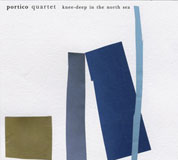 This darkness certainly does come across. In contrast to the first album, which is almost universally light and positive, there are definite dark tones on Isla. "The Visitor" is the best example—dark and even a bit scary at times, due mainly to Wyllie's soprano sax. "Clipper" sounds almost like an Acoustic Ladyland tune at times. Wyllie laughs, "Yeah, the four months of writing was quite intense. I think another reason is that a lot of the first album was written when we were busking, so the songs are written to draw people in...the structures are fairly simple, less hard-edged. But that scenario wasn't there when we were playing in our shed in our garden."
Wyllie has declared his love for new jazz bands such as Acoustic Ladyland and Big Air, but at the same time he is less interested in musicians who remain rooted in older jazz styles, making no attempt to move the music on. So how comfortable is he with applying the jazz label to Portico Quartet? "There are definitely elements of jazz in our music, especially if you view jazz as a dynamic art form, like the later Miles Davis stuff—taking jazz and contemporary music and bringing them together, pushing things forward, rather than just a static form of music; that side of jazz we try to encompass. And our instruments smell like jazz as well. But there is so much more to what we do." Portico Quartet (l:r): Duncan Bellamy, Milo Fitzpatrick
One non-jazz aspect of Isla is its producer. John Leckie is one of the best-known and most influential music producers of the last 30 years. His past credits include work with jazz-related acts such as Dr. John and Baaba Maal, but he is better known for rock bands such as Radiohead, Simple Minds, and the Stone Roses. Once again, Portico Quartet's progress is slightly unusual—coincidence comes into play, as Wyllie explains. "[John Leckie] had worked with Real World before, and he was looking for new projects to do. Coincidentally, he had bought our first album a few weeks before meeting the label manager, while we had been thinking about who we would like to produce us and John Leckie's name had come up. So we mooted the idea to Real World at the same time as he met them to talk about new projects. It was a happy coincidence."
The band recorded with Leckie in Abbey Road Studio 2—home of the Beatles' most famous work. The actual recording process was quick and efficient: "We got all the live takes down in three or four days. Then we had a week at a smaller studio [Fish Factory] in northeast London doing overdubs, adding electronics and trying out one or two ideas. A lot of that stuff didn't actually get used in the end. Then we mixed it for a week at Real World Studios. So it took about two-and-a-half weeks in total working with John Leckie."
Most of Portico Quartet's instruments might "smell like jazz," but one of them most certainly does not. The band's sound is characterized by their use of the Hang—a percussion instrument broadly akin to a steel drum or a large metallic cooking pot, made by PANart in Berne, Switzerland. Both Mulvey and drummer Bellamy play them, with Mulvey taking on the main responsibility for adding the hypnotic and ethereal sound to the mix. The band's use of the instrument has brought it to the attention of a wide audience, as well as to the attention of percussion players in jazz and beyond, but their relationship with the Hang's makers is unusual and ambivalent.
The Hang, according to its Swiss creators, is a spiritual instrument that must be played according to strict rules: Portico Quartet doesn't conform to these rules, and this has led to some tense discussion. Mulvey takes up the story: "We went to Switzerland in July to have our Hangs re-tuned [one had been dropped and damaged accidentally by a taxi driver]. I knew that they had heard our music but that they weren't into how we play [the Hang], with mallets. However, I didn't realize how strongly they felt about it. They are serious people, serious instrument makers, but not particularly interested in our success or in our music, in fact."
The relationship is not at all what you would expect of a manufacturer whose instrument is on the brink of widespread fame as the result of a group's success. "They are certainly not impressed by our success," Mulvey continues. "Part of me hoped that we could get some sort of endorsement from them or build a relationship, as we use the Hang in such a key way. But they don't particularly like the fact that the Hang is getting really popular. They put so much time and effort into each individual instrument, and each one is beautiful, but they have a quite admirable refusal to expand production. All that I quite respect, but as noble as that is, it's also anti-innovation. They feel strongly that the Hang should only be played with the fingers and the palms of the hands whilst placed in the lap of the player and it should never be amplified. They struck me as quite esoteric people and, while I don't want to put words in their mouths, they seem very aware of the spiritual side to music and musicians. You know, that's a pretty far-out thing and I don't discard that side of things, but when we played them the record, all they could hear was clanging Hangs and they couldn't hear Milo's bass, or all the other elements coming together. But I think it's kinda cool that they won't sell out, you know."
But the Hang is such a key part of the Portico Quartet sound that the tensions between the maker and the musician are rather worrying. Mulvey clearly has strong feelings about it and the effects the makers' approach can have. "They've created this incredible instrument, it's remarkable, a new acoustic instrument for the twentieth century, and they are trying to be very controlling of it. They spoke very strongly to us about their disapproval of how we use them [Mulvey and Bellamy use mallets and also wear gloves when playing with their hands]. I really believe that they have no commercial desire. They have a waiting list that everyone has to join. One very high profile percussionist that I know of, and probably several others, approached [the makers] with a view to getting a Hang and they were told the same as everyone else—get to the back of the queue." Portico Quartet: Nick Mulvey
On a happier note, Portico Quartet's success has brought with it an ever-increasing touring schedule. Late 2009 and early 2010 tours include trips to Finland, Germany, Ireland and Australia, as well as two tours of Britain. The tours are a key element of the Portico Quartet master plan which is, as Mulvey reveals, "to put together a cohesive and co-ordinated international release for [Isla] in the early part of 2010 which may well include the USA at the same time as Europe—to see that through with all the touring necessary. That side of stuff always works to a slightly different timescale to our more creative side. We were talking today about looking forward to writing again. We have never had too much of a plan about how the music sounds, just to keep playing and see how things develop, really."
Another aspect of Portico Quartet that separates its members from most of the jazz community is their lack of involvement with other projects. In contrast, most professional jazz musicians seem to work in numerous collaborations across genres, either for variety and experience or, more pragmatically, to earn a living. Mulvey also works as a singer/songwriter and guitarist, and Wyllie has indicated that he and Bellamy could develop a side project, but Portico Quartet is very much the primary musical activity for all four members. "The band meets so many of our musical needs at the moment," Mulvey says, "that other projects aren't a priority, but all of us do have other interests. Milo could probably turn himself to any number of styles, for example. For the moment, this band is a great place to be for the four of us."
Portico Quartet: young, ambitious, innovative. Their instruments "smell like jazz" even if they're "not particularly a jazz band." They share a house, rehearse in the garden shed and learned their craft outside, rather than inside, some of London's finest concert halls. Their music defies easy categorization and presents a strong case for the unimportance of categorization. It's music for pleasure—the musicians' and the listeners'—no more pigeonholing is necessary.
Selected Discography
Portico Quartet, Isla (Real World Records, 2009)
Portico Quartet, Knee Deep In The North Sea (Babel / Vortex, 2007)
Photo Credits
Page 1: Stephanie Rose Wood
Page 2: Greg N. Baker
Page 3: Tom Watkins
Page 4: Nigel Pickering
About Portico Quartet

Tags
PREVIOUS / NEXT


Become a Sustaining Member

Since 1995, All About Jazz has championed jazz as an art form and supported the musicians who create it. Over three decades, it has grown into one of the world's leading jazz resources, serving hundreds of thousands of readers, musicians, presenters and industry professionals each month.
Help Build the Future of All About Jazz
Your support helps us continue building All About Jazz for the next generation—expanding our editorial coverage, preserving jazz history, developing new community features and creating better ways to discover the music and the people behind it.
Become a sustaining member for as little as $20 per year and you'll immediately enjoy an ad-free experience along with access to subscriber features and future articles for a full year.
Together, we're not simply sustaining All About Jazz—we're building its future. Thank you for being part of the journey.