Home » Jazz Articles » Interview » John Law: Deeper into the Music
John Law: Deeper into the Music

 Classical music and jazz are often perceived as two radically different art forms that cannot be merged. Historically, the idea of a so-called "third stream" that is able to combine the language of jazz and classical music into a coherent whole has proved rather difficult to translate into praxis, and yet it is undeniable that a bond, however fragile, exists between the two musics. This was evident from the very beginning, with pianist Scott Joplin's ambition to create a musical language equal to that of the classical masters. The widespread notion of jazz music as the classical music of America has, in many ways, become common stock, especially since jazz made the transition from popular culture to high art.
 The truth, however, is that the worlds of jazz and classical music still remain fairly separated, but there is a handful of artists, especially pianists, who have been able to navigate between the two worlds while still working distinctively within the idiom of jazz. These artists include pianists Brad Mehldau, Tord Gustavsen, Enrico Pieranunzi and Keith Jarrett. Add to this list the name John Law.
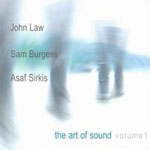
Law started out as classical musician, doing his first public performances at the age of six and soon he received encouragement from legendary pianist Alfred Brandel, but a career as a classical concert pianist was interrupted in 1986 when he turned to jazz. Since then, Law has worked with a vast range of musicians from saxophonists Evan Parker and Jon Lloyd to drummers Louis Moholo-Moholo and Asaf Sirkis. Musically, he has covered genres from free jazz and bop to modern composition, working in several formations: solo, duo, trio, quartet and large ensemble. Besides the large-scale work, Out of the Darkness (Slam, 2006), where he conducted an orchestra of eleven musicians, including a string section, one of his latest projects has been the completion of the series, The Art of Sound that finds him performing solo and with the astounding trio of bassist Sam Burgess and drummer Asaf Sirkis.
All About Jazz: You started out very early as a classical musician. Could you tell something about your experience with the classical tradition and how you made the move into jazz?
John Law: Classical music (whatever that means) was my first love. My mother, who was a Viennese pianist and piano teacher, very much in the Germanic tradition (you know: Bach/Mozart/Beethoven/Schubert/Schumann...) used to relate that one of my first signs of musicality was when I got up and danced, as a two year old, to the last movement of Beethoven's violin concerto. It's worth pointing this out, as many people seem to think that, in relation to jazz, classical music is somehow a more intellectual pursuit. Not at all. It was absolutely my first love. And it still remains very deep within me.
I'm convinced that it's a bit like a field that's been sown with certain crops; my first crop is classical music. That means that if I don't tend my field, in terms of working almost daily on my jazz feel and groove, that first crop, rather like weeds, starts to grow up through the cracks and my time and feel suffer because classical music and playing, compared to any groove-based music, is a totally different feel. Almost every bar is different, time-wise. And that was my mother tongue. My first musical language.
 Why I turned to jazz and how are two different questions. Why? Well I always wanted to write music and do music of now. Not 18th and 19th century music. I got turned on to jazz when I was about 23. I realized, immediately, that it did something that classical music didn't do. And I knew, also immediately, that I would still be able to play the instrument I loved, and compose, which I loved doing. Whether on manuscript paper or in real time, through improvising. It sort of just ticked all the boxes.
How did I change to jazz? Well in a way that's the whole story of my life since then. Because, to be honest, it's been a struggle. I'd love, some day, to communicate to someone else who's starting out on this path of changing from classical to jazz, all the difficulties I've encountered and my particular solutions to them. Because they are very different disciplines, classical and non-classical. If I had to sum up the main difference I would say that classical music is, being about interpretation (as the great English pianist Keith Tippett said: "you have to decide, are you going to be a curator or a creator.")
it's mainly about quantitative improvement. Jazz is about qualitative improvement. By that I mean that classical pianists or instrumentalists practice very hard on their technique, how to play faster, longer, louder etc and on their pieces, how to play them nearly 100% accurate. OK, I know they talk a lot about interpretation, but essentially they work on elements that can sort of be measured. In jazz we work really hard on less tangible things such as feel and groove. On the quality of our feel. On our sound (touch or embouchure, what reeds we use, what cymbals or kit we use, whatever our instrument is), on our harmonic sound (for pianists, those harmonies we really want to be associated with), on our actual melodic/improvisational vocabulary. This is all to do with quality. It's a different approach.
 AAJ: There's a great awareness of form and an extensive knowledge of tradition in your music. Could you comment on your use of musical tradition? How do you see the link between the past and the present, improvised and composed music, mainstream and avant-garde?
JL: Form has always obsessed me. After Music, my main loves are Art and Architecture. I often 'see' music in a semi-synaesthetic way (I'll never forget when I first heard Wagner's opera Die Meistersinger, as a student, when the themes all come together in the orchestra, with the first theme in the bass and the secondary theme in the strings, I could almost literally "see" the music unfolding in front of me; a life-changing experience). I remember, when I used to play with the free jazzers, I was never sure if it was the wrong thing to do or not, but playing with people like Evan Parker, I would start what was supposed to be a totally freely improvised gig with whatever motive popped into my mind but... I'd consciously make a mental note of it and remember it, so I could bring it back at key moments.
In terms of tradition I'm not one of those jazz pianists who embraces the whole jazz tradition. After all it's not essentially my tradition. I'm not a Jaki Byard or such like pianist. In terms of jazz traditions I sometimes try and use the impetus or essence behind certain piano stylings (like older genres such as boogie or stride) without attempting to master and reproduce them.
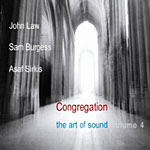
My main link is with the classical traditions, which is my first heritage. How I use this heritage is really up to others to comment on, I think. There are details such as on my latest trio CD Congregation (33 Jazz, 2009), there's a piece inspired partly by Bach (I say partly because the first direct inspiration was actually a tune by e.s.t.). Or another example: in an intro to a piece on a much earlier recording I quote Wagner's "Siegfried Idyll." I also did a four-CD series, in the '90s, based on Gregorian Chant. This was in a period when I was immersing myself in a lot of Renaissance and Medieval music.
 There are quite a few other examples. But I suppose what you're really asking is a more generalized statement on how I feel I relate, in general terms, as someone who would loosely be called a jazz pianist/composer, working in the 21st century, to my musical past and how does it inform what I do now. I do think that's mainly for an outside observer to comment on but here are some thoughts. I think I try and retain some of the best elements of classical music—chief among these has to be classical (functional) harmony; it's unique in the whole of world music—and mix them with those elements I get from jazz which I don't get from the classical tradition—mainly what I sometimes call the voodoo element. The repetitive rhythm and groove, which classical music never has.
You can say, as some people jokingly do, that Boogie Woogie started with Beethoven because he uses a texture and left hand figure remarkably similar to that style in one of the variations in his last piano sonata. But the difference between this and the drive of boogie is actually very revealing. Similarly, you can point to the rhythm and drive of some Systems music, and you can hear, in something like Steve Reich's "Electric Counterpoint" (with Pat Metheny) that there's a great deal of rhythm, but, again, the difference between this music and, say, the African music he derived some of his language from, or jazz rhythms, reveals that they are very different. The classical rhythm lacks an essential, deep groove.
Then there's the element of spontaneity. Funnily enough I try and achieve, with my improvising, a feeling that it's sort of almost been composed beforehand, and with my compositions, the idea that they're made up on the spot. I don't always try for this but it's somewhere at the back of my mind. Because, on the one hand I truly believe that only through real time composition can one achieve some of the most amazing results in music, in terms of perfect form and in terms of matching the atmosphere with something totally appropriate. But on the other hand, I'm very conscious of the fact that when improvising's lost its way and is meandering, then it's suddenly the very poor relative of written music. In times like those I'd sort of rather be playing something I know is really beautiful and works.. <> You asked about how I see a link between mainstream and avant-garde. I don't really do these distinctions. I leave that up to critics! I think most critics would be hard pressed to accurately describe what they mean by these terms. And certainly not in technical terms that a musician would agree with. When people start using the term avant-garde it sort of winds me up. My stock response is how much more avant-garde can you get than a piece by Nam June Paik, which involves the performer crawling inside the vagina of a live whale!
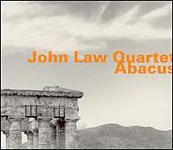
 Abacus Quartet (l:r): John Law, Jon Lloyd, Tim Wells, Gerry Hemingway
I play the piano. That's quite an old instrument, isn't it? I use harmonies.
I'll leave it up to other people to use labels.
AAJ: You have worked in many different constellations, both as a sideman and as a leader. Is there anyone in particular who has influenced your own playing and, if so, in what way?
JL: Not sure if you mean musicians I have played with who have influenced me or just generally pianists or instrumentalists I've listened to...
Regarding the latter I have a policy of never saying which pianists I consider my main influences. Firstly I sort of think it's probably quite obvious, mostly. Secondly, I like to think that's your job... I'm not going to make it easier for you! I enjoy seeing writers name influences just from what they hear, from examples like the very first write up I had (in the Wire Magazine) where the guy said I was obviously influenced by a certain pianist whom I hadn't actually ever heard up to that point (!) right up to where they actually get it spot on.
This policy came about many years ago, with the very first CD I was on, Syzygy (Leo, 1990), by Jon Lloyd. Every review raved about my playing. Except one. That was a French guy whom I sent the CD to, with a letter saying something like I didn't think I played that well on it but hoped he liked it sort of thing. The result was he said, in his review that I sounded, on the CD, ill at ease. I was sure that was because of what I'd said! I decided, from then on, never to do critics' homework for them.
So all I say is I've listened to everybody.
But I will say this about my trio. I'm trying to do something very wide-ranging. The fact is I really like lots of different music and different current piano trios. And I would say that, apart from some very obvious pianists whose influence anyone can hear in my playing (like I said, I won't name them!) there are three trios that are very, very different from each other that have all influenced my composing for the Art of Sound trio. They're what I would call my Holy Trinity of piano trio stylists. In no particular order: Esbjorn Svensson Trio, Tord Gustavsen and The Bad Plus. They all sound so different. And they hardly overlap in territory at all. Yet I like them all. Work that one out; for me, these three seem to cover most, if not all, of the areas I'm interested in.
People I've played with who have influenced me forever: well firstly the two guys in my trio, Sam Burgess and Asaf Sirkis, are a constant source of inspiration. Really, when I play with them I just hope, in my heart, to play to my satisfaction so that I feel worthy enough to be on the same bandstand as them. That's how high I rate them.
 Other than them I would have to say that the following five musicians I've worked with have left an indelible imprint on my sound-world: Evan Parker, Barry Guy, Tim Garland, Jason Rebello and Jon Lloyd.
And, if this isn't backtracking on my saying I wouldn't tell you all my influences, I listen absolutely loads to the new generation in the UK. Younger people give you such a buzz. There are things they do that older, supposed-to-be-wiser people just haven't got. The main guys for me are these pianist/composers: Tom Cawley, Gwilym Simcock and Robert Mitchell.
AAJ: So how do you judge the climate of jazz to be in Great Britain at the moment? And how do you see the relationship between the European and American jazz tradition?
JL: The situation here in the UK is that jazz education has reached, as far as I can tell (and I live now out of London, in the South West of England, where I teach privately, but I have some knowledge of what is going on in the main colleges and universities) an unbelievably high level. With the result that there are, every year, some quite extraordinary young musicians coming out of the colleges. Whether there's work for them all I don't know. I somehow doubt it. But they're unbelievably well equipped. By that I mean they play their instruments wonderfully well (of course), they can all read, they can play in different tempos and meters, they swap time signatures with no problem, they have a thorough knowledge of harmony. Most importantly, they seem to have a great feel and groove.
 And one of the reasons is that, because there isn't enough work for the current jazz musicians, a lot of them are teaching at colleges and universities themselves. So there are some quite amazing instrumentalists all involved in the education system.
I think the new breed of jazz musician is someone who's into trying lots of different things out. Mixing lots of different influences together. It's very exciting.
But I do worry sometimes that the public might be being left behind somewhat. You can go to a small jazz club in London and hear some quite remarkable music and sometimes I wonder whether some members of the public, who clap reasonably enthusiastically, but not wildly, realize quite what level of musicianship they've just heard.
The perennial question is always that American vs. European one...I think it's sort of become a non-question. Maybe not for people like me, as I definitely feel European and still grapple with the American jazz traditions and try to assimilate some elements into my European art music aesthetic. But perhaps for most of the younger breed. They've already assimilated all they want from the American traditions and they're moving on and doing their own thing.
Here's something strange: I got this idea, a while ago, after attending a concert by the Tord Gustavsen trio, that for people like that, for the pianist Tord and for many other Europeans, when we play something bluesy we seem to change the blues ( the scale, the sound, the vocabulary of the genre, because the blues is sort of like an Indian Raga, isn't it? It's not just a scale, it's a set of certain moods and contains also melodic phrases as part of the scale and part of the language), we change it so it sort of mutates into a folk scale, which is sort of what it is anyway.
But that's not quite what I mean. When someone like Tord plays something bluesy it sounds somehow really European, like European folk music. Definitely not black music. And I've heard other people do that. Jan Garbarek used to do it. There's an Italian pianist I really rate... he does it. I somehow try to do it too. I was recently looking at the score of Strauss' opera Salome. I started experimenting with the so-called 'Salome chord.' It's sort of a C# diminished chord over C# minor. That's a bluesy sound, if you like. But the reference points are very different.
So that's the sort of way my mind works and, I'm sure, from the results I hear across Europe, many other musicians' minds work. We're in a time of synthesis, where we take and adapt ideas. It's all a result of a lack of belonging. And it's an attempt to find a new belonging as well, I feel.
AAJ: What is your stance on criticism and the role of value judgment in music. In his 1968 book, Early Jazz: Its Roots and Musical Development, Gunther Schuller famously criticizes what he calls "well-meaning amateur criticism and fascinated opinion." Is the prerequisite for being a good critic a theoretical understanding of things such as melody, harmony, form and rhythm or is it enough to have a more intuitive understanding of these matters in order to make a sound aesthetic judgment?
 JL: Where to start? With a funny story... Quite a few years ago a critic emailed me to say he was writing an article, interviewing pianists about their thoughts on Thelonious Monk and something about their favorite Monk tunes. He asked me what my favorite tune of his was. I emailed back at length, explaining that I don't do favorites. It's against what I believe in and is simply not the way I see things. He emailed back saying fine, but if I had to choose, which one. I emailed back again saying that I didn't do favorites. I explained that I didn't do favorites among my pupils, nor among my children. I just don't compare like that. He emailed again saying yes but which one. So in the end, to please him, I gave him a couple I tend to play a lot. He said Thanks John!
Being a critic he just didn't understand.
I really dislike comparisons. They don't make sense. What's the point in saying artist A is not like artist B? Of course they're not the same; that's why they're different people. What's the point in saying that artist A's album from two years ago is not the same as the one he did this year? Of course they're not; they're different albums.
 A really important point here: I find it totally natural and acceptable to maintain, simultaneously, very different, even opposing, points of view. Some people say that sitting on the fence is a cop-out. It is not. For a start, for a man, sitting on a fence can be quite painful. But seriously, it's actually much harder to see different points of view, especially in relationship problems. But it's the only way, for me.
Another thing: I remember reading, with real anger, something that the British pop music DJ and writer John Peel said: "There are only two kinds of music: good music and bad music." What complete rubbish. It's the sort of statement that makes the uninitiated feel very smug, makes them feel they are party to some special insight and wisdom. And it's complete nonsense.
There's no such absolute thing as good music or bad music. It just can't be measured in those terms. Some music sounds great only after repeated listening. Most music (all music?) eventually grows stale after much repeated listening. Music sounds different at different times of the day; I can only really take, in the morning, Baroque or, even better, Renaissance music [for example]. It depends on your own mood, on your own needs and expectations. It depends, for effect, on what sound system you listen to it and on how you're listening/concentrating.
Many, many factors. Going back to the point about repeated listening, there's a lovely story about the Russian composer Glazunov. When he heard Wagner's Valkyrie for the first time he understood absolutely nothing and didn't like it at all. So he went a second time. Nothing again. And a third time—the same result. He kept on going till finally, the tenth time, he understood it all and loved it.
Going back to the idea that music is only good or bad and thinking of the problem of maintaining opposing opinions at the same time, I often think of something a Viennese cousin of mine once said to me (he's a mathematician and philosopher). He said to me, "You know, John, people say there are only two states for a switch, on or off. [This is supposed to lie at the heart of binary systems and of computer chip technology, isn't it?]. But it's not true," he said. There's the situation of the machine being in standby mode, when it's neither on nor off. This he called in German not Ja or Nein but Jein! So both yes and no and neither really. I found this fascinating and it's informed a lot of my thinking since. It means that you can step back and out of a situation and then see different points of view and different camps of thought.
Basically, when someone says that a piece of music is not good, or doesn't succeed, from this or that point of view, they're pitching their tent somewhere. But there's no absolute need to pitch it there. And often they've pitched it in demonstrably the wrong place. Like someone, let's say, who goes to a concert by the Tord Gustavsen trio and complains that they don't do what the Bad Plus do. Of course they don't. They're not trying to. Or like a very well known young pianist in the UK who complained that the Neil Cowley Trio plays very simple music. Yes, that is actually what they're trying to do. It is simple compared to this other guy's playing and compositions. But does that make it bad? Should one compare the two?
 Out of the Darkness: John Law with the Cornucopia Ensemble
Another memory of mine that's informed my thinking about aesthetics and judgement-making. I remember, when I was a piano student, my mother, who was a classical concert pianist, saying to me that one should never program Brahms straight after Liszt, because then Brahms always sounds boring and stodgy in comparison which, she said, he's not. Wise advice. But does Brahms' music possess an inherent, measurable stodginess? Or is this some quality that just arises out of a direct comparison with the music of someone like Liszt? People who like to think there are qualities we can measure, in an absolute way, believe the former. I believe the latter.
 Going back to my example of the British pianist criticizing the Neil Cowley Trio, isn't there room in the castle of music we build up, for both artists? There is in mine. I have absolutely no problem assigning them different rooms and I can take something from each one when I visit their room. For me it's no problem. And I really do think this is the sacred duty of someone who aspires to be a great artist: they should learn to rise above concepts of like and dislike. After all, anyone, any Tom Dick or Harriet on the street, can say they like or dislike something. For me it isn't the role of the great artist to merely furnish these likes and dislikes with technical justification. It is our duty to rise above this way of creating opposing camps and find good points in all different music (or Art of Architecture or whatever). Once you make the effort to free yourself from some totally artificial, arbitrary, hierarchical value judgement system it actually feels quite liberating. Try it.
Of course you may say all along that likes and dislikes are not made up standpoints, created artificially, as it were, after the event. They're direct, spontaneous results of a positive or negative experience. Well I suppose they can be... But they're not generally. Usually they're considered opinions made well after the experience—unlike the story about the 19th century pianist pupil of Franz Liszt and conductor Hans von Bulow who, after hearing some contemporary piece of music performed, apparently came out of the concert hall and vomited. He may, of course, have simply had a gastric problem.
Is there anything which can be measured in music? Well maybe technical command of an instrument. This too can be a grey area. Does Monk's music suffer when he plays it because he wasn't a pianist like Keith Jarrett? I don't think so. Technical command of an instrument may, however, be an area where we can sometimes make a few (well-informed) judgments. Technical command of a certain style or genre maybe as well. Like Bebop. Maybe if a musician or group sets themselves up to be compared to a well known work of art; let's say they do a remake of the Kind of Blue (Columbia, 1959) album, then one might be able to profitably compare the two. But even here comparison is rather invalid. Maybe another version of the same project has its own merits, quite independent of any comparison.
AAJ: Could you tell something about the project Out of the Darkness? How was it working with a large ensemble as opposed to the more intimate constellations of the trio and quartet?
JL: The project Out of the Darkness was really very enjoyable. I had to work a lot to organise it, first applying for Arts Council funding and then virtually sorting every detail of the tour out myself. And of course I wrote and arranged all the music, played piano in the performances and also conducted most of it, when I wasn't playing. Everyone in the ensemble was really encouraging and helpful and it mostly went without any major hitches. The only negative aspect was that it consumed so much of my time that while it was all in preparation and while I was touring it (a process of about a year) I wasn't busy sorting out my next work and touring. With the result that I worked very little for the next year and a bit!
 The whole project stemmed from the fact that I really missed (and still do) various instruments from the classical orchestra. I still can't understand quite how this particular organism— the classical orchestra— with its such different instruments and instrument sections, ever blends the way it does. But it does and I really miss, working in jazz, many of the instruments I grew up hearing: from the wonderful sound of woodwind such as the bassoon and oboe, to the singing eloquence of the strings, which of course form the backbone of the orchestra. I'm sure there were weaknesses in this, my first attempt to juxtapose non-improvising instrumentalists with jazz musicians, but I really enjoyed the whole learning process. And one thing really sticks out in my memory: right at the beginning the classical players told me Don't expect us to improvise! We don't do that. But I did, in the end, write a couple of sections where they could play more or less what they wanted. And, you know what? I couldn't get them to stop improvising! No they were brilliant at it. They helped shape those particular sections. And, very importantly, when they improvised, it was with no jazz vocabulary but, for my ears, a completely fresh sound, with reference points more likely to be found in contemporary classical music (some of them were members of the London Sinfonietta).
I'd like to write more in the future for classical instrumentalists and also learn more about orchestration.
I think out of the whole project I'm proudest and most pleased with the piece "Nocturne." I can see that the large suite "Out of the Darkness" is a bit cumbersome and a bit of a mishmash (then again that might be what you like). But I'm very happy with the piece "Nocturne," with the ideas in it, the form and the scoring. I think that works.
 AAJ: How did the Art of Sound Trio come about? What were your visions for the project? Could you describe your working relationship with Sam Burgess and Asaf Sirkis and the process of recording the project?
JL: The trio with Sam and Asaf started off as one idea and has been gradually taking on other characteristics since then.
Basically I started the trio, back in 2005, as part of my on-going attempts to try and actually learn to sound and play more like a jazz pianist. But I always wanted a highly interactive trio, with everyone contributing and capable of going different ways. And that's gradually become ever more important. So whatever I was thinking when I first approached the guys to play trio with me, it's now become a group where we really try and do all aspects of contemporary trio playing. Extreme dynamics, mixing influences from classical, jazz and now even some rock influences. I'm gradually adding some more sounds as well. Slight distortion and delay effects on piano and bass. And I've got a number of toys I use: two (yes, two) kids' DJ toys, two Buddha machines (great little toy with nine in-built drones and a pitch altering capability, so I can phase them in and out) a dub siren module oscillator (which does whacky siren effects which I can alter live) and I also use live talk radio on one tune. I'm not exactly sure whether I've gone too far in this area and I'm going to rein it all in, whether I'm going to add something more or whether I'm going to stick with this.
The percussion side is also changing. Already a year ago I emailed Asaf and asked him whether he would like to play glockenspiel. He said he would learn it for me. And so we added that to Asaf's kit. He is also going to incorporate the Hang (which he plays with Tim Garland's Lighthouse project) and the darbuka into the trio. And then maybe just a small xylophone (a sort of kids' one, not a massive orchestral one, which he has however played with me). I think that'll be it.
I first played with Asaf back in 2005. I fell in love with his sound straight away. His accompanying is ultra sensitive and his solos have, for me, redefined the way I've listened to drums. Sam came into the trio shortly after that. His immense strengths are that he is awesome on first tempos, swings like crazy and no-one can touch him on a ballad. He's remarkably eloquent. Sometimes to the point that I want to cry.
It's a very democratic group, musically. We all have input into arrangements, even though we only play my tunes. I just feel I can learn so much from these two musicians that I feel very humble working with them.
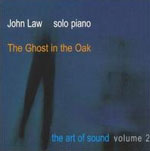
Recording the recent CD Congregation was a mammoth achievement. We recorded so much music! In just two days. We all worked really hard. The studio is called Artesuono, from which I took the group's name and also the name of all four Art of Sound recordings, volumes 1 and 4 being trio and 2 and 3 solo. The two solo recordings I recorded in just two days, in October 2007. Many of the compositions on these two solo recordings are also recorded by the trio, which gives rise to the possibility of comparing solo and trio versions.
AAJ: Some of the compositions come with dedications. Could you expand on the story behind some of them?
JL: Three of my compositions in the Art of Sound series are dedicated to musicians. "Twist" is dedicated to an Austrian vibes player and composer Friedrich Philipp-Pesendorfer (known as Flip Philipp) who plays for the Vienna Symphony Orchestra and writes very Monk-influenced, tricky compositions. I did a bit of touring with him and ripped off the feel of one of his tunes, which he called first "Let's Twist" and then later simply "Let's." (By the way, I often acknowledge a debt to some other composition which influenced me writing one of mine, by hiding a link to the other composition in the title I give my tune. Even without any dedication. I try and leave a thread for later detective work!) The tune "Method in My Madness" was partly stolen (though I would say also improved in the process) from a tune by Jon Lloyd called simply "Method."
 The Art of Sound Trio (l:r): Asaf Sirkis, Sam Burgess, John Law
The composition "Watching, Waiting..." is inspired generally by the music of Tom Cawley. Tom's a wonderful composer and pianist. When I first heard some of his compositions I felt really down and wanted to give up. I felt I would never ever be able to write as beautifully as some of his stuff.
But in the end I did what I always do, I tried instead to incorporate some of his magic and make it my own.
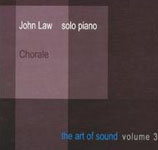
The two compositions on Chorale: The Art of Sound, Volume 3 which are dedicated to Stephen are very personal statements. They're in memory of a younger brother of mine who died in 2006. A really dreadful time. One of the pieces, called simply "?" I just sat down and played pretty much the way I then wrote it out.
AAJ: What are your plans for the future?

< Previous
Requiem
Comments

Tags
For the Love of Jazz
 All About Jazz has been a pillar of jazz since 1995, championing it as an art form and, more importantly, supporting the musicians who create it. Our enduring commitment has made "AAJ" one of the most culturally important websites of its kind, read by hundreds of thousands of fans, musicians and industry figures every month.
You Can Help
To expand our coverage even further and develop new means to foster jazz discovery and connectivity we need your help. You can become a sustaining member for a modest $20 and in return, we'll immediately hide those pesky ads plus provide access to future articles for a full year. This winning combination will vastly improve your AAJ experience and allow us to vigorously build on the pioneering work we first started in 1995. So enjoy an ad-free AAJ experience and help us remain a positive beacon for jazz by making a donation today.

Giveaway

Days remaining: 1



