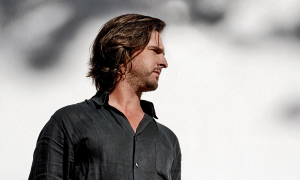
Home » Jazz Articles » Interview » Bruce Hornsby: The Master of Levitation
Bruce Hornsby: The Master of Levitation

He's adapted to the shifts in the business—dealt with the pressures of major recording labels, entertained audiences in small towns or large venues around the globe, and inspired a new generation of fans and artists.
Whether jamming with the Grateful Dead, accompanying soul diva Chaka Khan, or rocking out with guitarist Eric Clapton in a performance during the debut week of Jay Leno's prime-time talk show, or composing the score for his first Broadway musical, SCKBSTD (aka Sick Bastard), the hometown musician from Virginia, who's internationally recognized, is still venturing into new and unexpected territories.
With Levitate (Verve, 2009), he celebrates his tenth studio album, revealing more of his singular approach to contemporary/traditional Americana with his longstanding touring band, The Noisemakers. They are comprised of newer and older members, some of whom, being members of the band for nearly 20 years, Hornsby explained.
"I think we'll stay together for quite a while," he said. "We have a great time playing and we want to capture that feeling of the 'joyful noise' on this record. The last four songs really showcase that and really feature The Noisemaker's playing. And the middle four are more loops. It's the band playing, but along with some other more modern material, it's not just a bunch of guys in a room playing. It's a different approach to record making."
Hornsby's approach to composition is informed of numerous idioms—embracing the sounds of rural small-town, modern classical, rock, gospel, jazz, and urban music. It's a progression that has evolved over time.
"It wasn't always so," Hornsby said. "I think, if you've heard my first two records, they were less stylistically broad or stylistically disparate then the newer music. But I think it's just a question of growing, evolving and assimilating many new elements into my music, so it makes for a broader palate. It's not as tightly concise and consistent, but it's what I'm about now. I'm just broadening my range."
A wise quote from noted author and Jesuit priest, Anthony de Mello, reads that "The shortest distance between truth and a human being is a story." Throughout his career, Hornsby's acumen as a songwriter has articulated the human condition through enlightening lyrics.
"I've always considered myself a storyteller," he said. "I've had my moments of more personal narratives, but I always like stories since I'm a bit of a reader. I always wanted to have my songwriting feel like short stories in most cases, or vignettes. I wanted them to have a strong sense for place throughout the years. My first five records, or so, were really stories emanating from this town, this area, in Williamsburg, Va.—the small town in the South, a college town. Obviously, I loved growing up here so much that I moved back. So I've definitely been interested in telling a tale through the years."
This gift of communication is still resolute within Levitate. Songs such as "The Black Rats of London"—a spirited tale with some early American history thrown in for good measure—are intriguing.
"Yeah, it's sort of a narrative I guess," Hornsby said. "It's really dealing with the white washing in history and giving ourselves so much credit for our glorious past, when in reality—and this reality was made known to me through a National Geographic article on Jamestown—it's about all these bacterial strains and rodents that came back on the ships. It infected the locals and allowed the colonists to prevail, once again, the unsung heroes of American history. Maybe our past is a little stranger; we can't give ourselves all the credit, a lot of it was either good or bad luck, depending on what side you're on."
Provocative lyrics have been integral in conveying life's joys and pains, Hornsby noted.
"No question, and that's why at the end of this song I added a postscript," he said. "I didn't want people to think I thought this was a great thing that we had prevailed over the Indians, so I wrote, 'Where were the black rats when we needed them the most? There were slave owners to infect...' I wanted to make it very clear that I didn't think that this was necessarily such a great thing in every case."
And then there's the infectious "Prairie Dog Town." In what first appears to be an ethological study of cuddly grassland animals, turns into what may be a humorous bite on community boundaries and conflicts.
"It's basically your 'can't judge a book by its cover' song," Hornsby explained. "These prairie dogs look so nice and so cute and sort of huggable, but if you get next to them they'll bite your ass. They're nasty little creatures actually, so I used that as a metaphor for some other situations."
This food for thought is disclosed in this section of the song's verse:
Disregard the great ethical truths
It's the collective life of the herd for you.
Closed society, no open door policy
Collectivist secret ideology
To whom are the lyrics referring to? It's clearly left to interpretation, Hornsby laughs. "That's right—I'll leave it to the listener," he said. "Whoever they think I'm talking about, that's who it is."
Hornsby's thought ballads continue to be memorable, whether dealing with the topic of introspection found in "Invisible" or the deeply personal, "Continental Drift," which contains a guitar solo by his nephew R.S. Hornsby, who tragically died in an automobile accident shortly after the recording. "He was a beautiful player," Hornsby said. "We miss him so much."
The making of the song "Levitate" is a tale within itself. It emerged from a film score that Hornsby was writing for filmmaker Spike Lee's Kobe Doin' Work, a documentary on NBA basketball star Kobe Bryant.
"My producer, Tony Berg, was badgering me for months," Hornsby said. "He knew I was doing the score for the Spike Lee movie, and he was saying, 'You gotta play this song for Spike, he'll love it.' Sure enough, I finally got around to playing it for Spike and he called me and said, 'Levitate, I gotta have it.' And so lyrically, it's a song inspired by the young ballers in the hood. While everyone else is fooling around, these guys are putting in the work, looking for the ecstatic state, the feeling of excelling in something, you know. The state of levitation figuratively speaking, and so that's what the song is about. It seemed to work really well, lyrically and musically, for Spike. But it was a song originally for this record."
While most players began learning music on the piano, Hornsby's first instrument was surprisingly not on the keys.
"Well no, I played guitar, like lots of kids in The Beatles era," Hornsby said. "I had a band in the sixth grade playing junior high dances and The Rolling Stones songs and I was more of a jock. But I got more into the piano at around age 17. I got really intense about it, and so I kind of knew about a year into this immersion that I wanted to do this for a living but I didn't think that I was good enough without being laughed at by my family. Sure enough when I first brought it up, there was definitely some resistance to the idea. But I think I knew that I was gonna do this my first year of college.
"I went to a real college, quote unquote, not a music school," he added. "I went to the University of Richmond for a year and that was when I said, 'You know what, I don't care what people say, this isn't for me, I have to cast my lot with the 'musos.' And I did that the next year. Actually, the very next summer I went to Berklee College of Music for two semesters and then transferred to the University of Miami, where I really got it together. I was playing five or six hours a day; playing at night, putting myself through school because my Dad wasn't so sure about the music thing, but that was good for me because I played all sorts of gigs from disco bands to piano bars, country club functions, Bar Mitzvahs and wedding receptions. It was a good experience."
This pianistic baptism into diverse settings most certainly paid off, rewarding Hornsby not only a wealth of experiences but also an encyclopedic base in the creation of his own voice. But who are some of his influences?
"Well, in the past it was a pretty simple progression of influences," he said. "I started playing the piano because of Elton John and Leon Russell. Then I got into Keith Jarrett and Bill Evans from reading about them and then hearing their records and being completely blown away. Then I got into Bud Powell, Chick Corea, McCoy Tyner, Herbie Hancock and Wynton Kelly and on and on. Later I got into people like Dr. John and Otis Spann and Professor Longhair and New Orleans blues.
"But for the past several years I've been interested in the modern classical idiom, 20th and 21st century music: names such as Charles Ives, Samuel Barber, the Second Viennese School, Twelve-tone composers, Schoenberg, Weber and Berg, and Elliott Carter, the great composer who still is with us at age 101, and the great French composer Olivier Messiaen," Hornsby said. "Those are some of the people whose music I regularly force feed my audience. And so you're starting to hear a little bit of that, a little more chromatic musical language in the songs, and there's two songs on Levitate, 'Paperboy' and 'Michael Raphael,' which deal in more chromatic, melodic language and chordal usage, too. So those are the recent influences that people hope I'd stop being influenced by; because it's not the people's music, it's not the language of the people but it's spoken to me for years."
Popular songs like "The Way It Is" and "Mandolin Rain" may have inspired the first "air piano" solos by Top 40 music fans who appreciated Hornsby's exemplary skills on the ivories. Yet throughout his many recordings and concerts, he's shown an acute aptitude in jazz improvisation, whether playing solo piano, swinging heartily with Pat Metheny and Branford Marsalis on the four-CD/one-DVD box set Intersections [1985-2005] (Legacy Recordings, 2006), and delivering the critically-acclaimed trio session Camp Meeting (Legacy Recordings, 2007). When complimented on his impressive chops on that release, Hornsby respectfully answers, "Compared to who? I tried to find a reason to make the record stylistically my own, a way to play the music that didn't sound like other players. It'd be really easy to make my recording sound like Bill Evans or Chick Corea, but I didn't want to do that. So when Jack (DeJohnette) and Christian (McBride), who'd been badgering me through the years to do the recording, came to the studio, they remarked on how fresh the versions were of the standards, and of course my own songs. So that was the reason for it; I'm pretty sure we're gonna do it again."
Going from being relatively unknown to overnight stardom has both its advantages and disadvantages as Hornsby reflects on "The Way It Is," the breakout hit song that dealt with real-life social themes of classicism and racism, but also the possibility for change.
"I wasn't prepared for it at all. It broke in England out of the blue," he said. "A DJ on BBC radio heard it, and put it on the air and off it went. So it broke in England, then in Holland, the rest of the world and then in the United States. So we went from doing fine in America; selling about 100,000 records, before this happened. Our record had been out for about four months in the U.S. when this occurred in the U.K. and then it exploded and we had to become headliners on nine songs. So that was the full adult way of learning how to become a celebrity, or a well known music person. As I've always said, it was the least enjoyable year I've had because we became the new cash cow at RCA and they were milking the crap out of us. Well, mostly me. So I was new to it. I didn't know how to say no, so they just ran me into the ground. By the time we won the Grammy, my skin tone was green. It was kind of a drag, in fact a complete drag, but also an amazing phenomenon to occur on your first record."
More than just a top singles phenomenon, the song's influence (in many ways) still reverberates.
"Well, I didn't realize the impact it would have, positive or negative," Hornsby said. "I got some nasty letters from people saying, 'You rich rock stars don't know what its like to live next to these people who don't clean up their yard and leave crap everywhere, and lower our property value.' I've become really involved through the years with the National Fair Housing Alliance that deals with these problems, so I know firsthand how prejudice can pervade.
"But on a positive note, a lot of people were moved by the song," he added. "I especially loved the rap and hip hop versions, such as E-40's, and Tupac Shakur's rendition entitled 'Changes,' which many people know. Wyclef Jean also did a version a year or two ago, so that's been enjoyable and fulfilling for me also."
It seems the song is now more prophetic with the election of President Barack Obama, Hornsby agrees.
"Well, right, and in Tupac's version (recorded in the 1990s) he talked about being ready for a black president and now that it has come to pass, I find it to be a beautiful situation," he said.
With a tentative debut in the fall of 2010, Hornsby delves into theater with SCKBSTD, his first musical score with original music and story based on the troubles created when a stranger arrives in a small Virginia town.
"Yeah, it's really called Sick Bastard," Hornsby laughs. Eight of the twelve songs on Levitate are based from the musical. One of the songs is "Paperboy," and gives a hint into the production's curious personality.
"The paperboy is recounting to his friends all the rumors about this mysterious crazy person in the town that everyone's really fearful of," Hornsby said. "So that's really it, he's just spouting off all these rumors he's heard. Of course, it ends up that not all, if any, of them are true, but this is a song about the rumor mill running rampant."
Another one of Bruce Hornsby attributes—other than his talent as a songwriter and performer—is his omnivorous appetite for music. To the chagrin of some, there's no pigeonholing his music, because his multi-informed influences and inquisitive nature may find him playing folksy melodies, bluesy riverboat-like tunes, urban tempos, or sneaking classical music into newer material. With credits on recordings too numerous too count, on a who's who list from expansive backgrounds, touring with the Noisemakers, or his involvement in the Creative American Music Program at the Frost School of Music/University of Miami, a curriculum that is developing aspiring songwriters; he doesn't seem to be slowing down.
Selected Discography
Bruce Hornsby, Levitate (Verve Forecast, 2009)Bruce Hornsby, Camp Meeting (Legacy, 2007)
Ricky Skaggs / Bruce Hornsby, Ricky Skaggs & Bruce Hornsby (Legacy, 2007)
Bruce Hornsby, Intersections [1985-2005] (Legacy, 2006)
Bruce Hornsby, Halcyon Days (Sony, 2004)
Bruce Hornsby, Here Come the Noise Makers (RCA, 2000)
Bruce Hornsby, The Way It Is (RCA, 1986)
< Previous
Of The Body Prone
Next >
Hermeto +
Comments

About Bruce Hornsby
Instrument: Piano and vocals
Related Articles | Concerts | Albums | Photos | Similar ToTags
Bruce Hornsby
Interview
Mark F. Turner
United States
Jack DeJohnette
Christian McBride
Eric Clapton
The Beatles
Rolling Stones
Elton John
Leon Russell
Keith Jarrett
Bill Evans
Bud Powell
Chick Corea
McCoy Tyner
Herbie Hancock
Wynton Kelly
Dr. John
Otis Span
Professor Longhair
pat metheny
Branford Marsalis
Concerts
For the Love of Jazz
 All About Jazz has been a pillar of jazz since 1995, championing it as an art form and, more importantly, supporting the musicians who create it. Our enduring commitment has made "AAJ" one of the most culturally important websites of its kind, read by hundreds of thousands of fans, musicians and industry figures every month.
You Can Help
To expand our coverage even further and develop new means to foster jazz discovery and connectivity we need your help. You can become a sustaining member for a modest $20 and in return, we'll immediately hide those pesky ads plus provide access to future articles for a full year. This winning combination will vastly improve your AAJ experience and allow us to vigorously build on the pioneering work we first started in 1995. So enjoy an ad-free AAJ experience and help us remain a positive beacon for jazz by making a donation today.

Giveaway

Eligible winners: 15
Days remaining: 4
Days remaining: 4