Home » Jazz Articles » Live Review » Guelph Jazz Festival & Colloquium 2009
Guelph Jazz Festival & Colloquium 2009

Guelph, Ontario
September 9-13, 2009
The Guelph Jazz Festival and Colloquium devoted itself this year to trying to unpack an idea so common that it is at once crucial and cliché: whether the practice of music-making might have world-changing implications. Through presentations on (for example) gang intervention in South Africa through drum circles to "workshops" (in a Charles Mingus-ian "jazz workshop" jam session sense) combining musicians from different backgrounds to play together, the practice of improvisation was staged as a means for change.

The annual Guelph Jazz Festival (which ran this year from September 9-13) invites musicians from around the world for one of the more adventurous weeks of improvisation and exploration in North America. But unlike many such festivals, there's an academic side to the schedule, with three full days of papers, panels and presentations, this year under the heading "Improvisation, the Arts and Social Policy."
And if it never got to the point of a "One World" sing-a-long, bringing together players from across North America, Europe and Africa made a philosophical perspective more than apparent.
One of the workshops combined musicians from Toronto and Vancouver, Chicago and Vera Cruz, The Netherlands, Ethiopia and Mali, making for a pretty respectable global representation (at least, within a gathering of nine). Built largely around the presence of saxophone legend Getatchew Mekuria, the assemblage represented not just different musical traditions but the ways those traditions have cross- pollinated between folk musics, improv, punk and jazz, with drummer Hamid Drake bridging many of the gaps.
The conversation covered varied grounds, with every one alternately (and not all at once) contributing to West African jazz and European open improv. Terre Ex on guitar and Abdoulaye Koné on n'goni made an especially subtle, bilingual point. The visiting Malians (Koné and singer/kamelan n'goni player Jay Youssouf also joined Toronto's Woodchoppers for some sometimes goofy groove jazz, the improv outfit containing itself into more structured frameworks than usual.
Mekuria's main gig at the fest was an appearance with the longstanding Dutch punk band The Ex, in one of a handful of Canadian (and no U.S.) appearances. The middle ground they've found has much in common with a lot of great hybrid musics, from Kingston reggae to British ska, borrowing from jazz while retaining a punk angularity.
 With aggro guitar, persistent vocals and Joost Buis's plunged trombone, it was more than a little reminiscent of vintage Specials. Vocalist GW Sok was missed to be sure, although it's hard to imagine as fitting a replacement as Arnold de Boer, who comes off as a younger, burlier Sok (and also plays trumpet). French clarinetist Xavier Charles played a couple shockingly hard-edged solos.
While Mekuria was the impetus for this most recent phase in the adventurous band's career, the show wasn't all about him. Several songs did feature him playing a mean alto somewhere between Fela Kuti and Maceo Parker, and he was the only one to sport costume changes.
The workshops also included a musical gathering of members of Montreal's Ambiances Magnetiques, starting off a day devoted to the pivotal Quebecois collective. Under the heady umbrella, "Musique Actuelle: A New Social Policy for a Distinct Society," they put forth a model of collective discovery, challenge and harmony that could be used as a prototype (as Prof. George Lewis has been promoting at Columbia University) for conflict resolution, investigative research, consensus building and other endeavors. In short, they were 11 people working with the understanding that everyone should be heard (a rarity in improvised music as well as everyday life).
Or maybe it was just a gig, but they made their point beautifully by all answering in an overlapping spoken improvisation the questions posed by the session's moderator, with Lori Freedman bringing it home into the microphone: "I mean, contemporary music, government funding—it's all ridiculous."
That afternoon, the younger generation of the collective appeared in guitarist Antoine Berthiaume's Rodéoscope. Lacking pedal steel and Dobro guitars, the sextet sounded a little less entrenched in Americana than on their recent CD, shining a light instead on the sonorous sounds of the violin, cello and hollowbody bass guitar for an Aaron Copland-cum-Bill Frisell-suite of smartly arranged pieces.
Jean Derome, one of the prominent figures within AM, appeared three times—during an outdoor street festival with an expanded version of his Thelonious Monk-heavy Evidence, during a decentralized downtown parade organized by Toronto trombonist Scott Thomson and, most notably, with a 12-tet version of his Les Dangereux Zhoms. Derome can always be counted upon for well-crafted pieces that lie squarely within jazz, yet blur the line between composition and improvisation. His pieces are exquisitely sculpted, relying on a core of musicians who can create something that feels spontaneous when it isn't and retains coherence when it is.
The ensemble presented two long suites, the first feeling something like a street scene played out primarily by Derome and Freedman's reeds, Joane Hétu's wordless vocals and Martin Tetrault's soft turntable scratches. The second piece was lighter and was an excellent spotlight for trombonist Tom Walsh and included a beautiful (if pretty) solo by pianist Guillaume Dostaler built around interruptions of wrong sounds (an unplugged patch cable, an abrupt turntable scratch, for example) giving way to an noisy concerto. Pierre Tanguay was, as always, modestly propulsive ad perfectly supportive.

Representing the northern reaches of Canada was vocalist Tanya Tagaq from Nunavut. She had just played at New York's Lincoln Center Out of Doors festival a few weeks prior, but her dervishes apparently hadn't made that trip. At Guelph, she swam through long vocal improvisations, a technique she developed based on her native Inuit throat singing (a style similar to the better known Tuvan throat singing, but employing less drone and more humor and caricature). She is frighteningly raw in her performances, embodying wrenching sorrow and ecstatic bliss, sometimes within the space of a couple minutes.
While her accompanists—drummer Jean Martin and violinist Jesse Zubot—used a variety of loops and delays, Tagaq (for this appearance) didn't employ any electronics, yet she would sometimes get caught in her own analog vocal loops, carried in nearly flawless time and intonation even as she interrupted and augmented.
The festival organizers smartly make the most of musicians they fly in, so booking the Stone Quartet meant they got one more gig out of bassist Joëlle Léandre and two from pianist Marilyn Crispell. But against the wood-and-string warmth of viola, double bass and piano, it was hard not to hear the quartet as a platform for trumpeter Roy Campbell, and in that regard, is one of the best settings he's had in years. Campbell likes to solo, and the quartet gave him reason to, even while tempering him. Once he gave up on sounding like wood, he started to play the blues and proceeded to display a variety of mute techniques and moaning solos for much of the set.
Playing without a drummer, the group leaves wide spaces, expanses filled with the slightest gesture. Violist Mat Maneri played unamplified, but made deft use of a stage mic, leaning in and out to shade his short, sudden phrases. Léandre, also working without amplification, was hard and quiet. It's rare to hear her recede into the background, but she was much of the time in the more traditional bassist support role. Even her vocals seemed to sit easily beside (not above or in front of) the viola, flute, and the piano's upper register.
It was well into the set before Maneri broke the trio-plus-horn foundation, refusing to let go of a resolute ending, holding on to a slow, three-note motif that built, slowly again, to his first out-front solo of the night, which invited Crispell to do the same, which brought the quartet back as an entirely new group, solid and heavier. It was a graceful and remarkable reinvention. That new band played less than 10 minutes and they, too, were fantastic.
Léandre appeared again in a matinee concert at the Guelph Youth Music Centre, the warmest and acoustically most satisfying of the various venues the festival employs. Playing alone, she can manage a deeply intimate connection with her audiences. Her rich arco, her resonant vocals, her laughter and dramatic flair managed, as always, to achieve what might be said to be the highest goal of improvised music: to express emotion, immediately and spontaneously, easily understood without relying on words. Few can deliver such musical monologues to as high a standard, and the series of emotive eruptions she delivered was, as always, enormously satisfying.
Where Léandre's presence is too enormous to miss, Crispell's unassuming approach to the piano makes her easy to take for granted; she's a wonderful player with a talent for complementing whoever she plays with. In Ottawa-based bassist John Geggie's trio, she held to a firmer, more structured rigidity than with the Stones, fitting the leader's frameworks. It was, oddly enough, in an arrangement of a Gregorian chant that the trio seemed most open and relaxed.
And with her playing getting, occasionally, heavier again, and saxophonist Fred Anderson's playing, sometimes, getting a little softer and sweeter, it was anybody's guess where their trio with Hamid Drake might go. They went from the sacred to the profound with a sometimes knotty beauty, making for one of the week's most memorable sets. Anderson positioned himself next to the piano, confident, it seemed, that his drummer would be there for him. Drake listened for long stretches and set light cymbal rings over what felt like mesas made of water. Crispell was particularly remarkable, on a placidly-even keel yet finding ways to use repetition, dynamic, space and time, stillness and motion which worked beautifully for Anderson. Meanwhile, Anderson was forever looking for phrases, running through notes until he found a run that worked, repeated it once, maybe twice, and started looking for another one. Slowed down, his searching became tactile.
David Murray also worked double duty in two of the headlining shows, an expanded World Saxophone Quartet playing Jimi Hendrix and a duo with Milford Graves.
There are a couple of givens in considering the World Saxophone Quartet: a rhythm section has never improved them and they've been unstable for a long time anyway. So while the WSQ brand is theirs to sell as they choose, they probably set the bar too high on themselves by continuing to employ it. The same music under a new name would likely meet with less resistance. Oliver Lake not being able to make it to Guelph hurt them, and the rhythm section was different from that on the CD Experience (Justin Time Records, 2008).
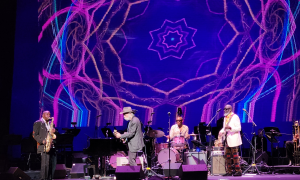
With James Carter and Tony Kofi on horns, Jamaaladeen Tacuma on electric bass and Lee Pearson behind the drums, it was a hugely different group than the original quartet, even—notably—quite different from their 1988 disc Rhythm & Blues (Nonesuch). At the same time, they were a strong band in a new kind of jazz/R&B fold, and they probably pleased the crowd by not trying too hard to.
While the record includes such well-known Hendrix hits as "If 6 Was 9," "Foxey Lady" and "The Wind Cries Mary," they stuck to more obscure arrangements of lesser known (or at least less recognizable) songs, playing long versions of "Hey Joe" and "Machine Gun" and encoring with "Little Wing," a beautiful, complex song given a wonderful lead by Bluiett on B-flat clarinet.
With the exception of a closing party, Murray and Graves played the closing set in what was a small triumph for Artistic Director Ajay Heble. The two have only played together once since their 1992 duo record, in a brief quartet set at a memorial for Don Pullen. And their record was called The Real Deal (DIW, 1991) for a reason. Few sax/drum duos manage the combination of energy and melody that they do. Murray has a way of finding brief melodies in the midst of hard note clusters, but here, especially on bass clarinet (which he didn't break out for the WSQ), he stretched out, creating long cadenzas within the spontaneity.
The two didn't rehearse before the show, but they didn't play pure improv either. They picked up themes from their record of 17 years ago and played a surprising Albert Ayler deconstruction in staggered phrases and tight intervals. It was a remarkable set, ramping up to the end, which only means they have to do it again.
And if music can, perhaps, bring social change, it might represent electoral politics as well: Murray met with enthusiastic applause introducing his "Yes We Can," dedicated to President Barack Obama.
Photo Credit
Hal Schuler
< Previous
Apasionado
Next >
The Secret Song
Comments
Tags
For the Love of Jazz
 All About Jazz has been a pillar of jazz since 1995, championing it as an art form and, more importantly, supporting the musicians who create it. Our enduring commitment has made "AAJ" one of the most culturally important websites of its kind, read by hundreds of thousands of fans, musicians and industry figures every month.
You Can Help
To expand our coverage even further and develop new means to foster jazz discovery and connectivity we need your help. You can become a sustaining member for a modest $20 and in return, we'll immediately hide those pesky ads plus provide access to future articles for a full year. This winning combination will vastly improve your AAJ experience and allow us to vigorously build on the pioneering work we first started in 1995. So enjoy an ad-free AAJ experience and help us remain a positive beacon for jazz by making a donation today.

Giveaway

Days remaining: 12