Home » Jazz Articles » Bailey's Bundles » J.S. Bach's Problem Child: Die Kunst Der Fuge (The Art of Fugue)
J.S. Bach's Problem Child: Die Kunst Der Fuge (The Art of Fugue)

Bach began his counterpoint magnum opus in the early 1740s, making an early copy of 12 fugues and 2 canons dated 1745. A second version of the piece was published in 1750, shortly after the composer's death and is made up of 14 fugues and 4 canons. Bach scholars consider (TAOF) as the composer's effort to fully explore the use of counterpoint within a single musical subject.
At this point, a bit of definition is in order. Counterpoint is the relationship between two or more musical voices, independent in shape, time and rhythm, but harmonically integrated when played concurrently. The net effect of sliding these musical voices over one another at the same time is the creation of chordal harmonies that emerge naturally.
A fugue is a contrapuntal (employing counterpoint) composition for a fixed number of musical voices. Typically, a fugue opens with a main theme, or subject, which is sounded successively in each voice. Once each voice has presented, the thematic exposition is complete. The subject is then modulated through related keys until the "final entry," which logically returns to the opening key, concluding with the coda.
A canon is a contrapuntal composition employing a melody with one or more thematic presentations after a given duration. The initial subject is called the leader, while a progressive theme presentation, played in different voices, is called the follower. The follower must imitate the leader, either as an exact rhythmic and periodic replication or some transformation of the leader. Repeating canons where all voices are musically identical and repeat are called rounds—"Row, Row, Row Your Boat" is an example.
In TAOF, Bach's theme is a simple 13-note figure in D minor:

Bach modulates this theme as its horizontal mirror image (inversion), with augmented (doubling note lengths) and diminished (shortening note lengths) versions also applying altered rhythm and presentation with the ascending addition of new themes going from simple fugues to double, triple, and what most scholars thing would have been a quadruple fugue, the unfinished Contrapunctus XIV.
Bach had previously surveyed the 24 major and minor keys for keyboard with his Das Wohltemperierte Klavier (The Well Tempered Clavier). These represent Bach's horizontal counterpoint investigation where TAOF illustrated Bach's vertical counterpoint investigation, one that was not fully realized because of the composer's death.
Two recordings illustrate the rich loam of creativity, both in composition and performance of Bach's problem child. One is very traditional and one is not.
 Sergio Vartolo and Maddalena Vartolo
J.S. Bach: The Art of Fugue, BWV 1080
Naxos
2009
An historic artifact of TAOF is its open scoring (individual musical voices are given their own staff) in both surviving manuscripts and published forms. This open scoring originally led scholars to speculate that the composition was intended as an intellectual exercise intended for study rather than a vehicle for performance.
While most modern music historians agree that the piece was intended for keyboard, TAOF enjoys many notable inventive treatments, including piano (Zoltan Kocsis, Philips, 1984); organ (and piano; Glenn Gould, Columbia, 1962); string quartet (The Emerson Quartet, Deutsches Grammophon, 2003); viol consort (Fretwork, Archiv, 2002); and orchestra (Rinaldo Alessandrini and Concerto Italiano, Opus 111, 1998).
Sergio Vartolo's TAOF, on Naxos, is performed on harpsichord with pedantically deliberate pacing and sharply demarcated musical diction. Ample time separates the tracks, giving the recording an academic personality well suited for close aural study. Vartolo's informed performance is very three dimensional, allowing the listener access to the composition's many contrapuntal nooks and crannies.
Vartolo adds exhaustive liner notes (adapted from an exhaustive discourse on the origins of composition in print). He takes seriously Bach's notation on Alio modo Fuga a 2 clav., employing frequent partner Maddalena Vartolo as the second harpsichord. Vartolo's TAOF amply fills up two entire compact discs, expertly paced and performed. Vartolo's performance may serve as a standard for understanding Bach's final masterpiece.
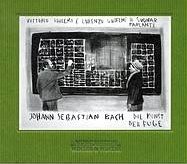 Vittorio Ghielmi e Lorenzo Ghielmi Il Suonar Parlante
Johann Sebastian Bach: Die Kunst Der Fuge
Winter & Winter
2009
Where Sergio Vartolo's TAOF is starched white and fit for the class room (as well as the museum) Vittorio and Lorenzo Ghielmi's is better fit for the parlor, salon or drawing room. It is user-friendly Bach, easy on the ears and nerves. The Ghielmis alternate the various contrapuncti and canons between Vittorio Ghielmi's viol consort, Il Suonar Parlante, and Lorenzo Ghielmi's harpsichord and piano forte.
The Ghielmi vision of TAOF is not unlike Uri Caine's urban realizations of Wagner and Mahler. The performances recall not the concert stage, but the more intimate and modest climes of the neighborhood bar, the coffee shop, the family front room. While precise and well-crafted, Lorenzo Ghielmi's playing is organically homespun and warm with familiarity. This is particularly evident when the elder Ghielmi employs his piano forte, where the contrapunti take on the glow of a child conquering the Master at the family upright.
There is a certain fortune to the fact that Bach did not fully flesh out TAOF. It offers talent as disparate as Sergio Vartolo and Vittorio and Lorenzo Ghielmi a meeting place for their respective scholarship imagination.
Tracks and Personnel
J.S. Bach: The Art of Fugue, BWV 1080
Tracks: Disc 1: Contrapunctus 1 a 4; Contrapunctus 2 a 4; Contrapunctus 3 a 4; Contrapunctus 4 a 4; Contrapunctus 5 a 4; Contrapunctus 6 a 4 in Stylo Francese; Contrapunctus 7 a 4 per Augmentationem et Diminutionem; Contrapunctus 8 a 3; Contrapunctus 9 a 4 alla Duodecima; Contrapunctus 10 a 4 alla Decima. Disc 2:Contrapunctus 11 a 4; Contrapunctus inversus 12 a 4 in forma recta; Contrapunctus inversus 12 a 4 in forma inverse; Contrapunctus inversus 13 a 3 in forma inverse; Contrapunctus inversus 13 a 3 in forma recta; Fuga a 3 Soggetti; Canon alla Ottava; Canon alla Decima; Canon alla Duodecima; Canon per Augmentationem in Contrario Motu.
Personnel: Sergio Vartolo: harpsichord and Maddalena Vartolo: harpsicord.
Johann Sebastian Bach: Die Kunst Der Fuge
Contrapunctus 1; Contrapunctus 2; Contrapunctus 3; Contrapunctus 4; Contrapunctus 5; Contrapunctus 6, a 4 in Stylo Francese; Contrapunctus 7, a 4 per Augmentationem et Diminutionem; Contrapunctus 8, a 3; Contrapunctus 9, a 4 alla Duodecima; Contrapunctus 10, a 4 alla Decima; Contrapunctus 11, a 4; Contrapunctus 12, a 4; Contrapunctus inversus a 4; Contrapunctus 13 a 3; Contrapunctus inversus a 3; Contrapunctus 14 [completed by L. Ghielmi]; Canon alla Ottava; Canon alla Decima Contrapuncto alla Terza; Canon alla Duodecima in Contrapuncto alla Quinta; Canon per Augmentationem in Contrario Motu; Choral. Wenn wir in hoechsten Noethen. Canto fermo in Canto.
Personnel: Vittorio Ghielmi: soprano and bass viol; Rodney Prada: tenor viol; Fahmi Alqhai: bass viol; Cristiano Contadin: great bass viol; Lorenzo Ghielmi: harpsichord, Silbermann fortepiano; Marcello Gatti: flute.
< Previous
Tea Opera
Next >
The Color of Sunshine
Comments
Tags
For the Love of Jazz
 All About Jazz has been a pillar of jazz since 1995, championing it as an art form and, more importantly, supporting the musicians who create it. Our enduring commitment has made "AAJ" one of the most culturally important websites of its kind, read by hundreds of thousands of fans, musicians and industry figures every month.
You Can Help
To expand our coverage even further and develop new means to foster jazz discovery and connectivity we need your help. You can become a sustaining member for a modest $20 and in return, we'll immediately hide those pesky ads plus provide access to future articles for a full year. This winning combination will vastly improve your AAJ experience and allow us to vigorously build on the pioneering work we first started in 1995. So enjoy an ad-free AAJ experience and help us remain a positive beacon for jazz by making a donation today.

Giveaway

Days remaining: 13



