Home » Jazz Articles » Live Review » Tanglewood Jazz Festival 2009, Lenox, MA
Tanglewood Jazz Festival 2009, Lenox, MA

Lenox, Massachusetts
September 4-6, 2009
The annual Tanglewood Jazz Festival in western Massachusetts has become an intriguing mix of music over the years, its programming taking into account jazz masters, as well as young talent, and projects that are as new or at least a bit different; something that isn't experienced everywhere else.
For example, in 2008, Terence Blanchard performed his wonderful music from A Tale of God's Will (A Requiem for Katrina) (Blue Note, 2007). But unlike other festivals and venues where he adapted the music for his quintet, at the hallowed Tanglewood facility in Lenox, Mass., he presented the music backed by a 34-piece orchestra. Stunning. The same year pianist/composer Donal Fox played pieces from his "Scarlatti Jazz Suite," which blended classical and jazz elements and featured monster jazz players like trumpeter Christian Scott aTunde Adjuah and drummer Terri Lyne Carrington.
In 2009, held over Labor Day Weekend, Paquito D'Rivera's presentation of classical music with jazz improv was different and invigorating. Dave Holland, ever out front in the jazz world, with his award-winning quintet and big band to his credit, appeared with yet another new aggregation, a relatively new octet, that was as kick-ass as any of his other terrific bands.
The festival was also able to book the heralded Vanguard Jazz Orchestra, which holds court Monday nights at New York City's Village Vanguard, but doesn't get away from those digs all that much (although it played some European gigs this summer). Meanwhile, master jazz pianists Kenny Barron and Mulgrew Miller put their head—and pianos—together for a rare duet performance. They've done it before, but not in a while, and it was another slightly different lilt that turned out to be memorable. Other exhilarating moments came from a set called "The Majesty of the Trumpet," hosted, as it were, by Jon Faddis and his quartet and featuring fellow trumpeters Wallace Roney and Sean Jones.
It was a memorable weekend for fans and for the festival itself, which remains one of the vital jazz events in the region each year.
No one brought da funk, but if the VJO brought the noise, Barron and Miller brought the class, and Faddis and company brought the majesty, the Holland Octet brought all of that and then some. Closers at the three-night, two-day festival, the best definitely came last. Holland just continues to turn out first-rate bands and first-rate music.
The octet hadn't played that many gigs when it came to Tanglewood, but you wouldn't have known it. The band was on fire—in the pocket, yet edgy and probing; subtle and reflective when need be, and explosive. They generated a bigger sound, and more balls, than the 16 pieces of the VJO, yet it could break down in smaller units and end up revealing forceful stories.
"Dave knows exactly what he wants for music," the band's trumpeter, Alex Sipiagin, told All About Jazz earlier this year. "He has a very distinctive style of writing, and his sound is amazing. But at the same time, he gives you a lot of freedom to express yourself."
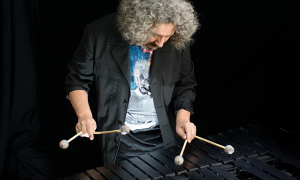
That certainly was the case, and when those expressing themselves are Sipiagin, Chris Potter, Jaleel Shaw and Gary Smulyan on saxophones, Robin Eubanks on trombone, Steve Nelson on vibes and Nate Smith on drums—along with one of the finest bassists in existence in Holland—the recipe for good music is in place. Holland cooks the ingredients and serves up a delicious meal.
The group recorded Pathways in January, which will be released later this year on Holland's Dare2 label.
The group blasted out of the gate with an intensity, the horns playing different lines, but toward the same point. A big sound. Smulyan's baritone horn was raucous over the rhythm. Holland's bass was fleet and imaginative. Sipiagin has been a good addition to Holland's groups of late. He darted and dashed through the changes with imaginative turns of phrase and a glistening tone. The sound was pushed by the propulsive Smith, who needs all his muscular maneuverings to hold up this fine group. And he does it in fine fashion.
"How's Never" showed Holland's bold and gutsy side to his soloing, which led to some smoking horn interplay. The horns accented the funky, exotic rhythm and then helped display the melody. Shaw's alto solo was both funky and sleek.
Potter, one of the great sax men out there, is always a pleasure to hear. When he makes a statement, it can take any direction, but its always inspired and he has a great sound. Eubanks big, round tone always adds great color to the music and Nelson provides the right chordal support and is a dashing soloist as well. This band is extraordinary.
Holland last appeared at Tanglewood in 1969, playing the electric bass as part of the Miles Davis band. That was same year he took part in the Bitches Brew recording sessions. "How come it took you forty years to invite me back?" he said whimsically when he walked on stage. Hopefully, the gap until the next gig will be small.
Faddis is known for his tremendous chops and energy. His set, a tribute to trumpet icons Louis Armstrong, Dizzy Gillespie and Miles had both those attributes. It was exciting throughout.
Faddis is, as always, a disciple of Dizzy's, including his ability to play creatively in the chops-busting highest register of the horn. But he also showed his respect for Satchmo, playing with a fat, clean tone and powerful vibrato on "When It's Sleepy Time Down South" and "West End Blues," the first used by Armstrong as a theme song and the second (1928) often called the first genuine "classic" jazz recording, with its thrilling opening cadenza. Jones' take on "West End" was a hot blowing of the blues, but in his own modern style. He's got outstanding technique and a great feel. Roney strolled out during "Struttin' With Some Barbeque," soloing in a running, fluid manner.
Dizzy's "Con Alma" moved the set into a more modern realm. Jones, again, showed why he's one of the finer young players, twisting through the changes with aplomb. Faddis started out using space, then took off with his power and might, up into the stratosphere like Diz. Roney was more reflective, as is part of his style, yet ideas poured from the bell of his horn. Each was featured on ballad standards, a highlight of which was Roney's take on "Round Midnight," his swirling harmonic improvisations embellishing the well-known Monk nugget.
"Milestones" aptly closed things out, a burner that allowed them all to dip into their bebop bags, Faddis bold and brash, Jones deft and swift, Roney with his great tone and resourcefulness. A moving set.
"Just In Time" started the Barron-Miller duet. Both pianists have so much technique and are so creative that one might wonder about clashes. There were none. They listened intently to each other, complemented one another's lines, backed up with cool chords when the other was taking the lead. Arpeggios here, bluesy runs there. Always inventive, always precise. These are piano players that other pianists watch.
"All God's Children Got Rhythm" was exceptional, as the pianists traded phrases that even changed styles—some stride here, classical influences there. The requisite Thelonious Monk tune for pianists was "Blue Monk." They blues'd it, they bopped it, they re-harmonized and de-harmonized it. A great ending to a great set.
The VJO jumped in with Thad Jones' "Mean what You Say," which coincidentally was what the band did for its hour-plus set. They meant everything they said. The music was mostly arrangements by Jones going back over the 43-year history of the band (started by Jones and drummer Mel Lewis), and also a couple from the celebrated Bob Brookmeyer, who is still active and turns 80 this year.
Brookmeyer contributed "Oats," a free flowing journey that featured the hard, almost-approaching-free jazz, style of altoist Dick Oats, and "The ABC Blues" that started with flute and clarinet voicings in the sax section, then strode more into a blues for the soloists, with Jason Jackson playing a mellow, but swinging, solo.
Other songs from the brilliant Jones were "Kids Are Pretty People," "The Waltz You Swang For Me," "My Centennial," and "For You." This talented group executed this music—intricate and intellectual at times, as well as just plain jazzy—with their trademark expertise, and noted improvisation by each member that soloed—which was nearly all of them, of particular note Billy Drewes on soprano and Smulyan on baritone.
Rivera began with a small group that played highly written and arranged pieces with a classical bent, which he penned for Cuban bassist Israel Lopez, known as "Cachao." Done in three movements, some had a slight Latin tinge, and Rivera negotiated the pieces on both alto sax and clarinet. He gave them passion, even in the spots that weren't improvised. The four musicians—piano, percussion and bass—were in constant conversation; four independent voices at times, at others in unison.
Another part of Rivera's Friday night set was a performance of his "Fiddle Dreams," commissioned by Library of Congress and originally played by Regina Carter. But he gave up the stage, letting two young musicians—flutist José Valentino and pianist Tony Madruga—play the piece. They did so very well.
The rest of his set, played by a different band of nine pieces, played music influenced by Cuba and classical works, as well as jazz, featuring strong soloing throughout. Of note was Benny Reid's band, an alto saxophonist who is recording for Concord (Escaping Shadows is due out soon). He is a capable alto saxophonist who has good melodic sense that comes out in his interesting compositions. He has a knack, thus far in his early career, of creating an accessible—but not simple—melody enhanced by the strong rhythms of drummer Kenny Grohowski. His ballad work on "The Most Beautiful Girl I Ever Knew" showed inventive style and sound. "New Days" was a nice, strolling, melodic line which Reid was able to run through with a good harmonic and melodic feel. OF particular note in the band was fleet-fingered guitarist Richard Padron, who had a nice round tone as well as fluid ideas. On "firelight" he even created a Santana-like sound for a bit. He could be a man to watch down the road. Vocalist Kat Edmonson was also interesting. A vocalist with a limited instrument in terms of strength of flexibility, she uses what she has in an interesting way. She has a thin tone that relies on phrasing and rhythmic changes to get the most out of the music. She uses those tools to good advantage and it will be interesting to see where this style takes her; how big it catches on. The person who comes to mind in comparison is Madeline Peyroux—not that their voices are the same, nor their styles. But they both approach a melody in a mellow fashion and use subtle—sometimes as if speaking to you—elements to get a song across. Standards like Gershwin's "Summertime" and Porter's "Night and Day" and "Just One of Those Things" are known to all, but her band did offbeat arrangements that freshened them and made them more of their generation. Edmonson's attractive phrasing made them atypical enough without losing the general flavor and appeal of the songs. "Night and Day" had a driving pop/rock beat, but her voice adroitly slithered around the rhythms. She couldn't overpower it and didn't try to. Good choices. A fine addition to the group was the presence of John Ellis on sax, who can play in jazz or beyond-jazz veins (see his work with Charlie Hunter) and he brought just the right garnish to each song. Young violinist Ben Powell, born in the united Kingdom and recent graduate of the Berklee College of music, played a swinging set. He comes out of Stephane Grappelli in style and has plenty of technique (his father was a cellist with the London Philharmonic Orchestra and his mother is a violin teacher) and a great sense of swing. His attack is clear and precise. The material included Kern's "I Won't Dance," "Opportunity" and "Tournesol," and it had a toe-tapping ease and enjoyable quality to it. Another fine few days for jazz in the Berkshire Mountains.
< Previous
You Are Special, You are a Special Fr...
Comments
Tags
For the Love of Jazz
 All About Jazz has been a pillar of jazz since 1995, championing it as an art form and, more importantly, supporting the musicians who create it. Our enduring commitment has made "AAJ" one of the most culturally important websites of its kind, read by hundreds of thousands of fans, musicians and industry figures every month.
You Can Help
To expand our coverage even further and develop new means to foster jazz discovery and connectivity we need your help. You can become a sustaining member for a modest $20 and in return, we'll immediately hide those pesky ads plus provide access to future articles for a full year. This winning combination will vastly improve your AAJ experience and allow us to vigorously build on the pioneering work we first started in 1995. So enjoy an ad-free AAJ experience and help us remain a positive beacon for jazz by making a donation today.

Giveaway

Days remaining: 5