Home » Jazz Articles » Film Review » Miles Davis: That's What Happened: Live in Germany 1987
Miles Davis: That's What Happened: Live in Germany 1987

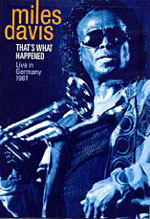 Miles Davis
That's What Happened: Live in Germany 1987
Eagle Eye Media
2009
The exhaustive (and expensive) 20CD box set, The Complete Miles Davis at Montreux 1973-1991 (Columbia/Legacy, 2002), finally set the record straight about the late trumpeter's often misunderstood and overly criticized final decade. Admittedly, many of his studio releases were inconsistent and, at times, flat out weak, with his 1985 swan song for Columbia, You're Under Arrest particularly forgettable. But in performance, Davis was able to take even the most syrupy pop song like Cyndi Lauper's "Time After Time" and, especially, the late Michael Jackson's mega-hit "Human Nature," and turn them respectively into poignant balladry that featured the crying, vocal-like sound of his Harmon muted trumpet and a powerful tour-de-force for his saxophonists—most notably Kenny Garrett, who worked with Davis from 1987 through to his passing. But while the Montreux box features energetic and complete performances from almost every year between 1983 and 1991, it misses out on 1987—a year that saw a number of shifts towards the direction that would increasingly occupy his attention for the last four years of his life, before passing away in September, 1991, two short months after the brief set from Nice, France, that completes the box.
That's What Happened: Live in Germany 1987 nicely fills that gap, with Davis changing rhythm sections, recruiting a 26 year-old Garrett and swapping conventional guitar (the final commercially documented six-stringer being Robben Ford, who made the trumpeter's 1986 Montreux performance one of the hottest shows of the box) for the solo bass guitar of Joseph "Foley" McCreary who, like Garrett, would be a mainstay of his touring group through to his passing. It's a relatively short show, about one hour, but features everything that made Davis a must-see at the time: a potent rhythm section as capable of high velocity workouts like the opening "Medley: One Phone Call/Street Scenes/That's What Happened" as it is the more slinky groove of "Tutu," one of two tracks from Davis' first Warner Bros. release, 1986's Tutu (the darker, Spanish-tinged "Portia" being the other), and the straighter pop-centricity of "Time After Time"; soloists who knew how to follow Davis' lead and move from economic interaction to equally spare but incredibly visceral show-stoppers; two keyboardists who, while texturally reeking of the time, manage to create a rich pad of sound; and a percussionist who, never getting in the way of the groove, proves to be one of Davis' most creative foils of the decade.
 Darryl Jones, Miles Davis
Bassist Darryl Jones—who'd played with another Davis alum, guitarist John Scofield, both inside and out of the trumpeter's groups between 1984 and 1986, and has since gone on to become The Rolling Stones' bassist-on-demand—was brought back into the fold and was a distinct improvement over Felton Crewes, who toured with Davis in 1986; lithe and flexible, yet able to create the deepest groove regardless of context. Working hand-in-glove with drummer Ricky Wellman, he rarely got any upfront time, but is felt throughout the set. Davis recruited Wellman—a Washington, DC-based drummer who was an expert at the go-go beat that was of great interest to the trumpeter at the time—another significant improvement over his nephew, Vincent Wilburn Jr., who was at best an adequate drummer with less than perfect time. Together, Jones and Wellman drive the relentlessly high octane "Medley" and work empathically to help bolster the equally unrelenting build of Garrett's solo at the end of "Human Nature," a solo spot that's an early sign of things to come, as Garrett proves capable of milking even a single note long past it's "best by" date, driving the crowd to a frenzy.
Foley doesn't possess the same broad vernacular as his predecessors, but what he lacks in sophistication he makes up for in attitude, turning his solo on Davis' greasy "New Blues" into a rock-posturing, post-Hendrixian feature of vicious intensity, while his solo on "Medley" demonstrates a capacity for bop-inflection in phrasing if not in harmony. Playing largely in the upper register of his lightly strung electric bass, he also provides the kind of funkified accompaniment that Davis was looking for at the time, given his preoccupation with the music of artists including James Brown and Prince.

Keyboardists Robert Irving III and Adam Holzman—the former a member of Davis' touring groups between 1983 and 1988 and playing an important role on Decoy (Columbia, 1984), while the latter toured with Davis from 1986 through 1989, and appeared on some of Tutu—never really solo but, like Jones, are key to creating the group's complexion. As Davis moved further and further away from more freely improvised music to structured performances—that, despite the solo features and the group's freedom to work in and around the designated form, were increasingly more like rock shows in presentation—the keyboardists worked together surprisingly well, never stepping on each others' toes and creating dense harmonies that belied Davis' statement to the contrary in the 30-minute interview that's included as a bonus feature.

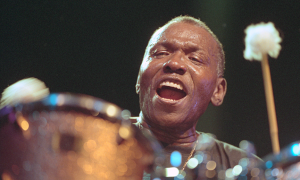
Along with Marilyn Mazur, who toured with Davis in 1988, Mino Cinelu is clearly the trumpeter's best choice in groups that included percussion from 1984 through to 1990. Capable of evoking a wide range of colors from the simplest of instruments—his solo on the clay udu drum during "Tutu" being one of the show's high points—he's a deeply sensitive player who knows when to get busy and when to lay out or play the simplest augmentation to Wellman's strong, backbeat-driven pulse.
As for Davis, That's What Happened captures him in one of his good periods, during a decade where his strength as a player varied greatly with the state of his health. Whether or not his stamina was up to par—he spends more time not playing than he does contributing to the group—when he does put trumpet to lips he's in terrific form, delivering the occasional blistering run that even reaches into the upper registers to lay waste to claims that his range and dexterity were limited. And when he plays with the Harmon mute, his horn becomes a true extension of his body, with a fragile, vulnerable tone that's in sharp contrast to the unmistakable attitude demonstrated in both the interview and another short bonus feature, "Miles and His Art," which captures him at a showing of some of his unique visual artwork. If there's any complaint with That's What Happened it's that "Portia" is incomplete, used as the credits roll at the end of the main program.
In addition to filling a gap in the late, great trumpeter's final decade, one where with few exceptions his performances far overshadowed his studio work—even the Marcus Miller-produced and largely composed classics Tutu and its follow-up, 1989's more satisfying Amandla (Warner Bros.)—That's What Happened: Live in Germany 1987 may be brief, but it's a video document as consistently exciting as the more jazz-centric Live From the Montreal Jazz Festival (Pioneer, 2000), and finds him in far better form than the longer 1988 show of Live in Munich (Pioneer, 2002) and at least equal to the stronger 1989 performance on Miles in Paris (Warner Bros., 2001).

It's also a chance to hear one of his best late-1980s rhythm sections, and the introduction of Foley and Kenny Garrett, two young players who cut their teeth with a master mentor, and one of them (Garrett) going on to an acclaimed solo career that's come full circle with his most recent release, Sketches of MD: Live at the Iridium (Mack Avenue, 2008). All-in-all, a show that continues to demonstrate that while he may have made a directional shift that was undeniably (and, self-admittedly in the interview) aimed at making money, Davis was still putting out for his audience, bringing his more antiseptic studio music to greater life.
Tracks: Medley: One Call/Street Scenes/That's What Happened; New Blues; Human Nature; Tutu; Time After Time; Portia.
Personnel: Miles Davis: trumpet, keyboards; Kenny Garrett: alto saxophone, flute; Joseph "Foley" McCreary: solo bass guitar; Adam Holzman: keyboards; Robert Irving III: keyboards; Darryl Jones: bass; Mino Cinelu: percussion; Ricky Wellman: drums.
DVD Feature: Running Time: 98 minutes (approx; main performance 60 minutes). Bonus Features: Interview (30 minutes); Miles and His Art (6 minutes).
Photo Credit
Stills taken from Miles Davis, That's What Happened: Live in Germany 1987, courtesy of Eagle Eye Media.
About Miles Davis

Tags
PREVIOUS / NEXT
Become a Sustaining Member

Since 1995, All About Jazz has championed jazz as an art form and supported the musicians who create it. Over three decades, it has grown into one of the world's leading jazz resources, serving hundreds of thousands of readers, musicians, presenters and industry professionals each month.
Help Build the Future of All About Jazz
Your support helps us continue building All About Jazz for the next generation—expanding our editorial coverage, preserving jazz history, developing new community features and creating better ways to discover the music and the people behind it.
Become a sustaining member for as little as $20 per year and you'll immediately enjoy an ad-free experience along with access to subscriber features and future articles for a full year.
Together, we're not simply sustaining All About Jazz—we're building its future. Thank you for being part of the journey.