Home » Jazz Articles » Live Review » Umbria Jazz: Days 4-6, July 13-15, 2009
Umbria Jazz: Days 4-6, July 13-15, 2009
The next three days of the Umbria Jazz began with two concert series that promised to be intriguing. American vibraphonist Joe Locke performed three times with Italian pianist Dado Moroni and saxophonist Rosario Giuliani at the very small Oratorio Santa Cecilia church. The trio is recording an album, presumably culling the best performances from all three concerts.
The other series, which the 2009 program calls "One of the feathers in the cap for this year's Festival," is an exclusive program of six concerts by George Lewis' AACM Great Black Music Ensemble, a 20-member big band drawn from the legendary Chicago organization of avant-garde jazz musicians. "No concert will be like any other," Lewis promised.
Meantime, the festival's daily lineup of local and international jazz greats continued unabated.
Chapter Index
- July 13—Chick Corea and Stefano Bollani Duet
- July 13—Richard Galliano Quartet featuring Gonzalo Rubalcaba
- July 14—AACM Great Black Music Ensemble, Program 1
- July 14—Wynton Marsalis and the JALC Orchestra with Francesco Cafiso
- July 15—Joe Locke, Dado Moroni, & Rosario Giuliani
- July 15—Chip Wilson
- July 15—AACM Great Black Music Ensemble, Program 4
July 13—Chick Corea and Stefano Bollani Duet
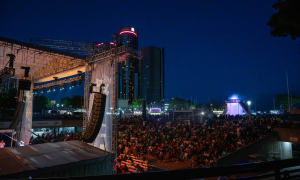
Watching the two great pianists, Chick Corea and Stefano Bollani, at the Arena Santa Giuliana proves that jazz is best experienced live: What you see in a performance can inform the music as much as what you hear.

Certainly their sounds are different. Bollani's is chordal, percussive, and prone to virtuosic flights of fancy; Corea's is sparer, more lyrical, and has bluesier inflections. What can't be heard on a recording, however, is how Bollani throws himself, literally, into his playing—he rocks, sways, stomps his feet, and dances to his own music. Corea, by contrast, is very staid and stiff: a conservatory stance that belies his extraordinary imagination.
After a piece of silly, Victor Borge-inspired stage business, Corea and Bollani began with a long, dissonant improv with shades of Debussy, trading devilish phrasings and re-phrasings in a very dark, very slow development. When Corea hit a double trill, however, the discernible melody of "On Green Dolphin Street" began to take shape. Once the tune had hit its stride, the musicians' stylistic differences revealed themselves; for example, Corea showed a tendency toward the lower half of the keyboard, Bollani to the upper. Bollani also let his percussive instincts loose, slapping the chords out of the keys while Corea's lyrical fingering dominated his work.
Despite the distinctions, the pianists' musical empathy was apparent. They worked from a setlist, but no sheet music—their eyes divided time between the keyboard, and each other. The arena's video monitors focused closely on Corea and Bollani's faces, allowing a glimpse of two master musicians studying each other intently as they traded off the roles of melody and rhythmic accompaniment on "Picture in Black and White" and "Hot House."
If the songs were warhorses, though, at Corea and Bollani's hands they became implacably modern. Nowhere was this more apparent than in a mini-set of Thelonious Monk compositions. "'Round Midnight" emerged from another long, improvised intro, then dissolved into a wash of passing chords and subversions. Occasionally another Monk fragment would surface, but they never lingered long and were frequently dissonant, embellished, and barely recognizable. After a wonderful improvisation that had them trading fours, the duo veered without pause into "Blue Monk," but only as a launchpad for another swirling, abstract improvisation that morphed into disjointed parts (the opening four-note riff, the half-step turnaround) of "Epistrophy" before returning to "Blue Monk." Throughout, Bollani would stop playing the keyboard to begin plucking and tapping the innards of his instrument with a drumstick.
The crowd was thrilled. After an angular, superbly virtuosic encore of "Take the A Train," they swarmed down the central aisle to the stage, screaming for a second encore. The musicians obliged with something sure to please the frenzied spectators: Corea's most popular tune, "Spain." Corea urged the audience to sing along to some of the song's familiar hooks, a tactic that found fan after happy fan whistling those same hooks on the walk back from the arena. That, surely, is how you know you've seen a great concert.
July 13—Richard Galliano Quartet featuring Gonzalo Rubalcaba
Accordion is one of the rarest jazz instruments, perhaps because it's associated with European forms like polka that are mostly regarded as kitsch in the United States. But Richard Galliano is French, burdened with no such biases. Although his instrument's high-pitched, reedy timbre can sound alien in the context of a jazz rhythm section, Galliano's own canny rhythmic sense—coupled with his startling intensity as a performer—makes it work.
He had extraordinary help making it work at Monday's midnight performance at Teatro Morlacchi: a brilliant multinational quartet featuring Cuban pianist Gonzalo Rubalcaba, Cameroon-born bassist Richard Bona, and American drummer Clarence Penn. Though Galliano and Rubalcaba are the quartet's major names, it is a true supergroup with each musician a spectacle of his own.

In the first tune, for example, Galliano made the audience's impatience (the band was more than 10 minutes late) fade instantly when he began playing the sobbing ballad theme "Chat Pitre." Bona entered just behind on bass guitar, then Rubalcaba and Penn joined the fray. The pianist took the first solo, a splendid lyrical tapestry capped by a neat little upper-range descent with sixteenth-note figures in the middle. Galliano's solo was deeply haunting, Bona playing lovely bass droplets behind him. Not to be left out, Penn introduced a unique drumming technique: His right hand played crash cymbal with a brush, while his left tapped on a small pair of bongos.
Over a dozen tunes, Rubalcaba in particular established a pattern (beginning with his work on "Para Jobim"), repeating galloping descents from the top of his keyboard so that they became dominant motifs in his solos, as well as aggressive, even ferocious figures that evoked Cecil Taylor. On "Premier Lessa" and "Liberty Waltz," he showed a predilection for deliberately taking himself and Galliano off-time. Bona, too, set up a recurring methodology on "Liberty Waltz" with a funky bass line that he played with such adroit glisses that the bass guitar sounded fretless; it was a genuine surprise to see the frets gleaming when Bona danced a bit on "Saranita."
Penn had less consistency in his technique and sound, but his rhythmic stability defied reason. The drummer took a slow burn solo in "Para Jobim" and a savage, unbounded one on "Laurita" that were united by their unfaltering hold on the beat—even on the accents.
The leader was the wild card. Galliano could mix a rock groove with a European folk sensibility ("Crepuscule"), play Coltrane-ish harmonies in a carnival-like mood ("Laurita"), and on the encore even joined with Rubalcaba to unfurl a Bach piece. On "Hymns," he even burst forth with a breakneck, bluegrass-style line that dazzled.
It was a performance of sustained exhilaration, although the sustained part was a common problem in Umbria's "Round Midnight" shows; like this one, the performances start late and end much too late, nearly 2 AM—closing time for the city's pedestrian access. Enjoyable as they are, it would be much more so if spectators didn't have to rush to get home afterwards.
July 14—AACM Great Black Music Ensemble, Program 1
Here in Italy, jazz and many other musics—blues, soul, funk—are frequently lumped together into the category of "Black music." That broad label likely delights members of the Association for the Advancement of Creative Musicians (AACM), who decided long ago that their output wouldn't be called "jazz" but "Great Black Music." Indeed, the 20-member big band that trombonist and scholar George Lewis brought to the festival is called the "AACM Great Black Music Ensemble." From Tuesday, July 14 until Thursday, July 16, Theatro Morlacchi belonged to them for six concerts, two per day.

AACM members create a unique and exotic atmosphere everywhere they go, but surely never more than against the frescoes and gilt of the 232-year-old neoclassical theater, with yellow cloths of African-inspired design covering the music stands. The ensemble, too, walked onstage wearing Afro-centric garb... with the exception of Lewis, in a short-sleeved, pinstriped shirt and khaki pants: a self-described "dork."
The dork was the evening's featured composer, and after a moment of silence in which all musicians stood and faced their left, Lewis' music commenced with fiendish swing on bass (Leonard Jones, David Williams) and drums (Dushun Moseley), some members giving whistle-blast accents. Then Lewis stood for the first solo, an atonal, violent performance that left him visibly red in the face, before moving to the front to conduct. (Baritone saxophonist Mwata Bowden was listed as conductor in the program, but is actually the ensemble's director.)
Though this first piece, "The Chicken Skin II," featured unique and riveting solos by alto saxophonists Edwin Daugherty and Khabeer Ernest Dawkins, and flutist (and current AACM president) Nicole Mitchell, it was ultimately a composition for the full orchestra—which in this case includes three vocalists (Dee Alexander, Taalib Din Ziyad, and Saalik Ziyad).
In fact the singer's parts, mostly wordless, were the most compelling in all three of the program's compositions. In "Chicken Skin" they sang in unusual harmony against shimmering horns and strings, and Taalib-Din Ziyad stood for a melodic scat solo that ventured far from the usual vocabulary. The much quieter "Fractals" placed them in a whispery vocal setting, though this time both Ziyads improvised: Mostly counterpoint, they nonetheless responded to and referenced each other's phrasing and diction. "Shuffle" belonged to Alexander, whose vocal used a more conventional vocabulary and rhythmic sense; it ended with her repeating "shuffle-shuffle-shuffle" over bare piano chords that gradually grew and subsumed her.
Though Lewis conducted, during the unbroken combination of "Angry Bird" and "Shuffle" he would take the podium only for a brief ensemble passage or to bring in a soloist—then walk offstage, reappearing again the next time. Whether it was a joke or an indication of how little direction these musicians needed, it's hard to say. But the latter was certainly true: The ensemble knew their stuff, and to call them "daring" wouldn't begin to cover it.
Enthralling as the music was, however, it was exhausting. Between its dense textures and far-flung melodies, this writer left the theater mentally drained. He/she who can endure six such performances is fortified indeed.
July 14—Wynton Marsalis and the JALC Orchestra with Francesco Cafiso
"We're here to swing," trumpeter Wynton Marsalis said in opening the Jazz at Lincoln Center Orchestra's concert at Arena Santa Giuliana. The show was billed as a replication of JALC's performance at the Kennedy Center on January 19, as part of the Obama inaugural festivities. No word on whether Marsalis told the Obamas he was there to swing, too.

But swing he did. The set was biased toward Thelonious Monk, in that three of the nine songs they performed (including the encore) were his compositions: the opening "We See" and following "Light Blue" (on which pianist Dan Nimmer ably captured Monk's harmonic mannerisms), and the main set closer "Epistrophy." No surprise, given that Marsalis' high esteem for Monk is well known. Nor was the remainder a surprise: two originals, trombonist Vincent Gardner's "Up From Down" and the three-part "Offertory" suite from Marsalis' jazz mass, titled "Father, Son, and You Better Watch That Holy Ghost"; the traditional New Orleans rag "Weary Blues"; Lou Donaldson's "Blues Walk"; Horace Silver's "Peace"; and a spectacular arrangement of Kenny Dorham's "Stage West" in the encore.
There are, however, two points on which Marsalis remains full of surprises: his trumpeting, with its clean, burnished sound and evasion of cliche, and his eye for talent. Both gifts were on magnificent display. His bright, tuneful submission on "We See" included a cheeky quote of "O Sole Mio," and "Offertory's" solo "Father" section was a lovely, linear melody for which "lyrical" was an understatement. As for his bandmates, Gardner made ample use of his talents as composer and arranger (he orchestrated "Light Blue" and "Blues Walk"), but on trombone was overshadowed by 25-year-old Chris Crenshaw with a "talking" plunger solo on "You Better Watch That Holy Ghost." Saxophonists Sherman Irby and Ted Nash played hot alto saxophone, and Ali Jackson once again proved himself as a drum wunderkind; he sounded for all the world like an amplified fireworks display.
The featured player, though, was Italian native Francesco Cafiso, who just turned 20 and was also part of the inaugural concert in Washington. The young alto saxophonist has a huge harmonic ear and great facility on the keys, but is still finding his own sound; clearly of the Johnny Hodges school, Cafiso is still too enthralled with Hodges and some of his followers, especially Charlie Mariano. However, he showed particular potential with a stuttering line on "Epistrophy," and Nimmer found his phrasing on "Peace" rich enough to swipe it for his piano solo. So, even if he's not quite there yet, his talent is apparent; Marsalis has found another one.
He's also a splendid showman—and saved the most dazzling for last. On "Stage West," the saxophone section—tenor Vincent Goines, altos Nash and Irby, tenor Walter Blanding, baritone Joe Temperley, and Cafiso, respectively—took solo turns of one chorus each, after which they traded fours, then twos, then swelled into boisterous polyphony. Trumpeter Sean Jones followed with twelve brilliant, raucous choruses, and Jackson topped him with eight. That's how you close a show.
July 15—Joe Locke, Dado Moroni, & Rosario Giuliani
Oratorio Santa Cecilia is a tiny, 800-year-old chapel a few blocks off Perugia's main drag. It's also an elegant, intimate space—an ideal spot for vibraphonist Joe Locke, pianist Dado Moroni, and alto saxophonist Rosario Giuliani to perform and record an upcoming release on the Egea label.
Wednesday's concert was the last of their three (and the first not sold out long in advance). But the trio showed no signs of fatigue, or anything but joy, at playing together. Locke spoke of their great friendship, a bond that shone through from the opening measures of "Stepping on Stars"— indescribable as anything but "pretty." Moroni began with a slow intro, which Locke then joined and dialed up to mid-tempo; once their rapport was crystallized, Giuliani entered with the gorgeous theme.
The saxophonist's remarkable dexterity and originality were put beyond question Saturday, with Enrico Pieranunzi; what astonished here was his ardent passion for the music. It came in strongly in his virtuosic tendrils on "Stepping on Stars," but also in his aching power on Jimmy Rowles' "The Peacocks" and nostalgia on Locke's "Beatrice Rose." His finest moment may have been in his own composition "My Angel," on which he stated a spacious melody (atop a march-like ostinato) of three or four short notes per measure, then gave a solo less spacious than halting—but also tender and wonderfully moving. Giuliani is destined to become one of the greats.
Locke, in the meantime, used the four-mallet approach (a la Bobby Hutcherson) to play hypnotic swirls of color and sound: The whimsical, airy "Love is a Pendulum" had him making the sounds of wind in the same manner as Robert Johnson's guitar, and his figures on "Alone" transformed the piece into a graceful ballet. Yet he was also capable of rhythmic wonders, laying out a scatlike groove and progression on "The Peacocks" and bluesy bluster on Moroni's "Brother Alfred." Moroni was the bluesman of the trio, with a lightning-fast mix of blues and gospel riffs on "Brother Alfred," and masterful triplet phrasing on "My Angel."
Still, the musicians were at best when at their most empathetic—best captured on "Sword of Whispers," a tune Locke dedicated to one of his mentors, singer Jimmy Scott. To a very soft piano and vibe accompaniment, Giuliani began a quiet, haunting melody. Locke's solo was equally haunting: sweet, with a feeling of gratitude. Giuliani's was stronger and more concretely reflective, as though listing the lessons learned from the mentor. Moroni didn't solo, but his delicate accompaniment was steeped in reverence bordering on awe. Quite elegiac, considering the object of the tribute is still alive. Locke apparently agreed; he wiped away tears as the song concluded.
Although beautiful and emotional, the concert's sound was uneven—Moroni's piano, frequently washed out by the vibes, could be heard only with considerable effort. While it's great that the performances will be preserved, the ideal miking for records may conflict with that for live performance—something for Umbria Jazz to consider.
Wednesday was "A Funk and Soul Night" at Arena Santa Giuliana, featuring heavyweights Maceo Parker and Solomon Burke. Knowing that the AACM was on at midnight, however, meant a less-intense prelude would be welcome. Hence, a return to the Non Stop Music at Giardini Carducci for an evening with Chip Wilson.
New Orleanian Wilson is a phenomenal guitarist, a true aficionado of the instrument who writes for Vintage Guitar magazine. He's also a singer-songwriter who describes himself as "classic and original American music: jazz, blues, folk, country, R&B, and funk." But that description reveals much less about his aesthetic than it seems.
If his performance at Giardini Carducci is any indication, Wilson is a folk musician first and foremost—and an Americana folk musician at that. That can sometimes mean a generous mixture of blues, soul, and even pop, but his overall sound is the earthy, dusty, world-weary sound of the working-class American south, delivered on an acoustic guitar with the traditional folk chord changes and the technique of a virtuoso troubadour.
Wilson stood onstage a while, tuning, but at precisely 9:30 he let loose with a deft, but tightly controlled slide lick and began singing "When the Levee Breaks" in a tuneful but slightly raspy voice. His guitar playing, a stunning blend of country blues and gritty folk, was an early indication of the deep vein that he mines.
"That was from our city of Memphis," he explained, referring to the song's 1929 genesis by Memphis Minnie. "Maybe a little bit more Memphis music?" Then came Al Green's "Love and Happiness" with a similar blues-folk fusion, followed by Marc Cohn's iconic "Walking in Memphis" in a pure folk idiom. That did it for songs of the River City—but Wilson hadn't even started yet on the Crescent City, a recurring motif for the rest of the night. He sang "The Ponds of Pontchartrain," an age-old Irish melody with 1850s lyrics; a world-weary original, "Buddy Bolden's Garden"; "Constantinople," about the New Orleans street; and closed with a medley of Big Easy brass band favorites: "Just A Closer Walk With Thee," "Make Me A Pallet on the Floor," and "I Bid You Goodnight." Each song was performed in Wilson's earthen folk style, with varying degrees of guitar pyrotechnics.
But that didn't mean he didn't change it up a little. Wilson also played an acoustic version of Stevie Wonder's "Superstition" that showed off his unbelievable fingerpicking, as well as the early blues "Country Boy" and "Low Down Blues" (which drove the crowd to stitches with the line "I know a gal lives down by the jail/Sign in her window says she's got great booty for sale.")
Wilson has played the last seven Umbria Jazz festivals, and this year plays nightly at both Giardini Carducci and Bottega del Vino. Otherwise he gigs regularly in New Orleans' French quarter. He believes it the best gig in the world ...but it's slightly sad that such an inspired, moving artist doesn't have a national spotlight.
July 15—AACM Great Black Music Ensemble, Program 4
"Signore e signori," the emcee told the midnight crowd of about 40 at Teatro Morlacchi, "AACM Great Black Music Ensemble!" And out stepped...a single woman.
"Obviously I am not the Great Black Music Ensemble," she said, "But I am a dedicated member. My name is Ann Ward and I am going to begin." With that she sat at the piano and created a warm, lovely melodic plain that was punctuated by strange pauses; it was the beginning of a genuinely transcendent musical experience.

Upon the quiet ending of Ward's piano piece, solo became septet when soprano saxophonist Douglas R. Ewarts, altoist Edwin Daugherty, trumpeter Jerome Crosswell, violinist Renee Baker, bassist David Williams, and drummer Dushun Mosley took their seats. Williams began a repeated four-note arco; Mosley brought the swing; Ward and Baker vamped together; and the horns began an oddly melodic and entrancing blast. Each took a solo turn with a zealous spiritual fervor that was both electrifying and contagious—though they rendered Baker's violin all but inaudible until it was her turn to solo in a dirty but impassioned tone. When she finished, the three horns rose from their seats and moved to the lip of the stage, improvising all the while in raw polyphony. So raw, in fact, that Daugherty and Ewarts were literally grunting into their horns; Ewarts' intensity increased until he sounded like he was grappling mightily, while Daugherty's groans evolved into something resembling a barking seal. They finally returned to their stands to restate the head, then all onstage turned toward Mosley for a shattering drum solo; after one final recapitulation of the head, the instruments petered out until all that remained was the sound of the squeak-toy on which Ewarts was tapping his foot.
With the squeak-toy as rhythmic foundation, the players onstage began reciting a spoken incantation of tribute to Chicago avant-garde musician Fred Anderson, "The Prairie Prophet." As they recited, the remainder of the ensemble took their seats, beginning the chant from the beginning so that the final effect was of a "round"; the vocalists filed in singing their part, so that they were behind even those with whom they'd started. Ultimately all explained that Fred Anderson's band was a turning point, preparing Chicago musicians for "transitions east on Planet E"—a phrase that every section of the round repeated several times.
The ensemble started into what might have been one long, multi-sectional piece, or several pieces; there was little breathing room. Ewarts conducted them into a drone, with subtle manipulations on baritone sax (Mwata Bowden) and trombone (George Lewis), out of which Khabeer Ernest Dawkins' alto ultimately arose as if out of a fog. Solos by Daugherty and trumpeter Ben Gay followed, and when all went silent trumpeter Leon Q. Allen held up a noisemaking toy and pushed its buttons at random. Nicole Mitchell then played a graceful, long-note flute solo with the vocalists "oohing" behind, and a primal rhythm—somewhere between a hippie jam and a gospel revival—erupted, with many musicians clapping along. Ewarts even danced. Finally, to conclude the piece and the concert, Ewarts set about a half-dozen tops spinning on the floor at upstage-left. The floor was apparently miked, since the sound of their spinning and toppling soon filled the hall.
While the takeaway from the previous show was exhaustion, this one left the feeling of having seen something profound and euphoric. The last two concerts are eagerly awaited.
Photo Credit
Giancarlo Belfiore for Umbria Jazz
Tags
PREVIOUS / NEXT

Become a Sustaining Member

Since 1995, All About Jazz has championed jazz as an art form and supported the musicians who create it. Over three decades, it has grown into one of the world's leading jazz resources, serving hundreds of thousands of readers, musicians, presenters and industry professionals each month.
Help Build the Future of All About Jazz
Your support helps us continue building All About Jazz for the next generation—expanding our editorial coverage, preserving jazz history, developing new community features and creating better ways to discover the music and the people behind it.
Become a sustaining member for as little as $20 per year and you'll immediately enjoy an ad-free experience along with access to subscriber features and future articles for a full year.
Together, we're not simply sustaining All About Jazz—we're building its future. Thank you for being part of the journey.