Home » Jazz Articles » Live Review » Vision Festival 2009: Day 6
Vision Festival 2009: Day 6

Planet Dream / Fred Anderson Trio / Michelle Rosewoman and Quintessence / Whit Dickey/Eri Yamamoto/Daniel Carter / Peter Brotzmann's Full Blast Trio
14th Annual Vision Festival
Abrons Arts Center
New York City
June 14, 2009
- Planet Dream
- Fred Anderson Trio
- Michelle Rosewoman and Quintessence
- Whit Dickey/Eri Yamamoto/Daniel Carter
- Peter Brotzmann's Full Blast Trio

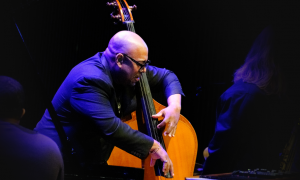
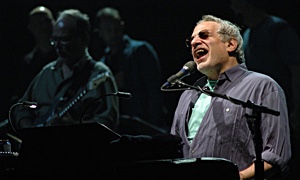
Starting off the penultimate evening of the 14th Vision Festival on a high note was the triumvirate of trombonist Steve Swell (pictured on left), alto saxophonist Rob Brown and cellist Daniel Levin, combining under the moniker of Planet Dream. Though their new release Planet Dream (Clean Feed, 2009) is under Swell's name, live they appeared a complete collective playing spontaneous improvisations. If the instrumentation provoked thoughts of chamber jazz, then it didn't take long for the execution to suggest otherwise in the three pieces of their 40-minute set.
Although there was a relaxed conversational feel to the opening piece, with the twin horns exchanging repartee over Levin's droning strings, once Levin lay out they worked themselves to a peak of garrulousness. Only on his bowed return did they become more contemplative and tentative at, eventually stopping to leave the cellist alone, bow undulating across the strings. Throughout the set Levin demonstrated a breath-taking command of his axe, moving from fluent almost classically inflected arco to ugly scrapes and scratches, even at one point rapidly tapping the end of his bow on the bridge of his cello evoking a pneumatic drill.
Eventually Swell rejoined, first emptying moisture out as he blew and incorporating these breath sounds into his flow. Swell married rumbustuous expression with fine attention to detail such that every note was invested with a particular weight or shading. Indeed the same was no less true of his confreres, evidenced by Levin's delicate arco work matching Swell's muted whisper in a wide-ranging duet. Later a lovely passage ensued where wavering falsetto cries, squeaks and whistles became so intermingled that it was impossible to pin down the source, making a fitting ending to the opening number.
Though the second piece started off slow and spacey it didn't stay that way and featured a Brown tour de force of upper register squeals with overblown whistles and a guttural edge in a knockout solo. One thing was readily apparent in this year's Festival—if Brown was in it then it was good. Not that Swell or Levin were in any way slouches. Supporting and leading roles blurred or switched at the slightest prompt in the three way dialogue of their excellent set.

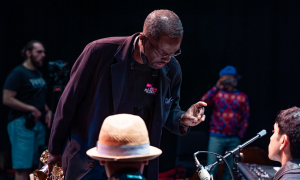
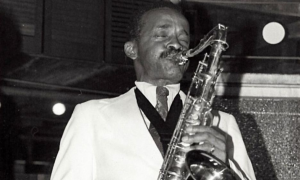
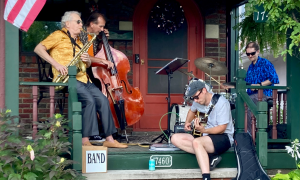
Eighty-year old AACM elder statesman Fred Anderson(on right with William Parker) almost couldn't find his way onto the Vision stage due to the density of microphone stands and leads, but once a path had been cleared he stood stage front listening to long-time associates Hamid Drake on frame drum and William Parker on dousn' gouni embellishing an African-sounding groove . Anderson mentored Drake from his teenage years, taking him on his first trip to Europe back in 1978 when he was still Hank Drake, so there were some deep roots in play manifesting themselves in both the peerless anticipation and responsiveness exposed in two long spontaneously improvised free jazz expositions.
Anderson's first notes were tentative, but then he let a phrase fly, paused and followed it by exploring the middle range of his tenor saxophone, avoiding his more familiar gambits. Drake relaxed into a loping shuffle on frame drum, varying the tempo to push Anderson's wavering cries into sharper relief. At one point Parker took up a double reed horn to inject some strident skirling into the exotic mix, which saw Anderson first mimicking the astringent tone, then weaving his muscular tenor around it. Later Drake added a vocal chant and the three voices commingled in the selfless stream which characterized their set.
Anderson led off the second piece with a strong tenor soliloquy complete with rococo embellishments. At his conclusion Parker and Drake, now at their more familiar stations, launched into some of the spine tingling rhythmic alchemy for which they are so justly feted. Anderson was eventually drawn back in, his simpatico phrasing locking instantly onto Drake's time-keeping in further testament to their shared history.
Occasionally breaking up the flow with periodic excursions around his kit before leaping back in, Drake shaped the organically evolving groove in almost telepathic communion with Parker. Following one astonishing solo where the drummer danced rhythmic motifs around his kit, Parker metamorphosed his speeding motifs into a five note riff, provoking a ticking tempo from the drummer and bottom-end growls from Anderson. Unlike many of the other AACM reedmen, Anderson rarely overblows or makes prolonged forays towards the upper limits. Rather as here he mined the rich middle register seams, hewing out a chiseled phrase, then examining its implications at length. Embarking on a final course of long flowing runs with yelped asides and gruff blurts, Anderson brought things to an end after some fifty minutes with a series of long deliberate notes garnished with a closing trill. Cue standing ovation.
Michelle Rosewoman and Quintessence

Michelle Rosewoman
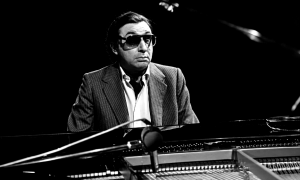
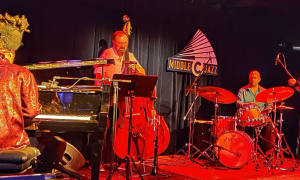
Pianist Michelle Rosewoman brought her six-piece Quintessence band to showcase two charts composed with support from Chamber Music America. Explaining that she liked to blur the boundaries of tradition and wide open spaces, Rosewoman's freeish piano introduced the elaborate head and overlapping horn parts of "Unseen" which had a tight M-Base feel. Drummer Tyshawn Sorey inveigled all sorts of unexpected suspensions and unconventional textures into his time playing, while there was a nicely slurred alto saxophone solo from Loren Stillman. "Power in Numbers" featured a similarly involved arrangement, lurching horn lines and a hot trombone solo from special guest Vincent Gardner. Rosewoman switched to electric piano for the final piece "Warmth" which had a jazz rock feel and featured the leader's wah wahed electric piano in duet with guitrarist Richard Padron, before a cycle of horn solos closed out the set.
Whit Dickey/Eri Yamamoto/Daniel Carter

Daniel Carter
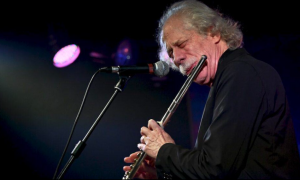
Multi-instrumentalist Daniel Carter remains underexposed, notwithstanding his extended tenure as half the front line in improvising collective Other Dimensions in Music, and more recent work with Matthew Shipp, notably on the wonderful Cosmic Suite (NotTwo, 2008). So it was good to see him prominent in a stripped down format. In fact this trio with drummer Whit Dickey and New York-based Japanese pianist Eri Yamamoto was a subset of last year's Ensemble of Possibilities, and operated in a similar realm of free jazz blowing with ego sublimated to the group whole, through three pieces in a 50-minute set.
Dickey's restrained tattoo opened proceedings, with Carter initially on flute and Yamamoto tolling a single note, for a meditative start. But there was a nervy undercurrent to the drummer's pulse, contrasting with Carter's elongated blues-tinged trumpet lines. Yamamoto selflessly provided a chordal underpinning, and her structural contribution and propulsion demonstrated what a great asset she is in these freely improvised situations. But that wasn't her role exclusively. There was plenty of opportunity for her to show her creative side, whether scraping and plucking inside the piano or hammering at the keys with both hands, and interestingly in a way much more outside than on albums under her own name.
Though understated, Dickey was nothing if not intense, with his face wreathed in concentration for the whole set. At times he was so subtle and self effacing that it seemed he might vanish in the whisper of his cymbal, yet he was also superbly responsive, particularly to Yamamoto's promptings. Like in a lovely passage in the first piece where the drummer and pianist combined in some lightly funky abstract late night musings, framing a splendid showcase for Carter's soulful tenor saxophone.
Pressure built throughout their set, as Carter gave his soprano saxophone a rare outing, in an uncoiling serpentine outpouring over a churning stasis. Dickey's head was still but his hands whirled around his kit in a blur. With Carter wailing and Yamamoto hammering the keys with both hands, the intensity was becoming almost unbearable and crying out for a resolution. But it was not to be and like a storm that passes without breaking, the energy dissipated and we were left to imagine the rain falling elsewhere.
Even in the final piece, Dickey set a ticking pulse behind Carter's spare alto, only to pause as the reedman touched on a boppish phrase. However Dickey sidled back in behind him and Yamamoto pitched in with a few tickles, but as the tension began building again, Carter was reluctant to take the easy route. Yamamoto, seeing emcee Lewis Barnes lurking in the wings, rang churchy rolling chords, as Carter finally began running through the registers. Bending forwards with his alto right between his knees, he excavated the low registers, before rocketing stratospheric with overblown squawks, only to finish on a very delicate vulnerable wavering note for a volcanic release of the tension which had built throughout the set. The roar from the crowd was immense and the standing ovation recognized this as one of the outstanding performances.
Peter Brotzmann's Full Blast Trio
Peter Brotzmann
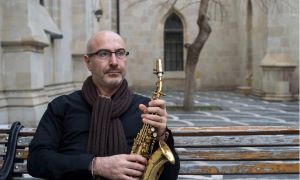
Just the soundcheck for Peter Brötzmann's Full Blast trio had the audience scrabbling for ear plugs. To say they were loud was an understatement. Their high volume set was as much felt as heard, with Mario Pliakas electric bass particularly gut-wrenching. Several noise fanatics in the audience were in ecstasy. Brotzmann has always been an iconoclast, but this was the most brutal setting yet for his wailing reeds. Of course Brotzmann is always worth hearing, and there were still quieter moments where his nuanced and world-weary lyricism shone through, but they tended to be quickly subsumed into a maelstrom of pummeling sound by this piledriver band.
Drummer Michael Wertmueller certainly gave it his all with a ferocious display of the utmost physicality. His recovery time between onslaughts perhaps explained Brotzmann's restraint, like the start of the second piece where the reedman's tender hymn-like variations on his "Master of a Small House" theme from Tales Out Of Time (Hathut, 2004) took on even greater resonance amidst the carnage. Rather than individual notes, Pliakas bass and effects pedals conjoined them into a constant stream, at times a drone but at others more reminiscent of an industrial processing plant.
In the middle of it all, Brotzmann's worried reeds registered the effects of their player's shaking his head from side to side, terrier-like, as his distinctive vibrato-laden tone cut through three tumultuous pieces during their 40-minute set. At the end the audience was left pulverized, but happy to have survived, with some even moved to a standing ovation.
If there was still anyone with unimpaired hearing, then the final night of the Vision Festival had plenty of treats in store with a special string project by Jason Kao Hwang's Spontaneous River, a tenth anniversary set by Trio X featuring Joe McPhee, and William Parker's renowned Quartet, with special guests cornetist Bobby Bradford and saxophonist James Spaulding, to close out the Festival.
Photo credits John Sharpe
Tags
PREVIOUS / NEXT
Become a Sustaining Member

Since 1995, All About Jazz has championed jazz as an art form and supported the musicians who create it. Over three decades, it has grown into one of the world's leading jazz resources, serving hundreds of thousands of readers, musicians, presenters and industry professionals each month.
Help Build the Future of All About Jazz
Your support helps us continue building All About Jazz for the next generation—expanding our editorial coverage, preserving jazz history, developing new community features and creating better ways to discover the music and the people behind it.
Become a sustaining member for as little as $20 per year and you'll immediately enjoy an ad-free experience along with access to subscriber features and future articles for a full year.
Together, we're not simply sustaining All About Jazz—we're building its future. Thank you for being part of the journey.