Home » Jazz Articles » Live Review » The Charles Lloyd Quartet Live at the Highline Ballroom, NYC
The Charles Lloyd Quartet Live at the Highline Ballroom, NYC

...Lloyd's voice spread a warmth all around the ballroom, opening things up even at the wildest times, and pulling the place together around his sound.
Highline Ballroom
New York, New York
July 3, 2009
Charles Lloyd hasn't lost a step. He has an instantly recognizable and deeply personal sound on every instrument in his formidable arsenal. His technique gets an audience feeling it. But perhaps his most underrated gift is the ability to be a catalyst for the players around him.
His 1960s quartet with Jack DeJohnette and Keith Jarrett was one of jazz's most popular groups. Listening to his current rhythm section of Jason Moran on piano, Reuben Rogers on bass, and Eric Harland on drums makes it abundantly clear that these musicians on their own can create wonderful music, and indeed they have. But having Lloyd at the helm makes special things happen. Whether due to his writing, his leadership, his joy at making music, or all of the aforementioned, everyone wins.

Eric Harland, Charles Lloyd, Jason Moran, Reuben Rogers
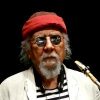
At 71, Lloyd is planning to tour less from his home on the West Coast. His show at New York's Highline Ballroom on July 3 promised to be his last performance of the year in the city, setting the stage for a special night of music. Appearing in a large but still intimate setting, before a packed and excited crowd, Lloyd came out on stage in his trademark black sunglasses and hat.
There was an air of easy grace and self-assurance as he picked up his tarogato and launched into "Ramanujan," off the quartet's 2008 album Rabo de Nube. The piece opened with a series of resonant long tones from the instrument, a Hungarian woodwind which here evoked the nasal, vaguely mystical sound of an Indian reed flute. Lit by entering bass and cymbals, these Eastern tones built up into high speed runs, riding the propulsive groove and Harland's drums. With Lloyd on point, the tune oscillated between Egyptian and funk meditations, building to a free and explosively volatile peak.
Then Moran came in. Giving a sign of good things to come, his hands started flying along the keys with a driving, tireless energy that seemed to loop back into the group, driving Harland's cymbals, bass and snare into an ecstasy of polyrhythmic intensity. At the end of the solo, Rogers kept a steady, simple-sounding groove going. The others hitched back onto the bass line as Lloyd came back and eased the song down with soft, moaning lines.
The tarogato was then set aside for the remainder of the concert, as the tenor sax took the fore. Billy Strayhorn's "Blood Count" emphasized the lush, romantic melody with a beautiful altissimo sigh at the end. Rolling flourishes of piano gave way to beautiful exploratory sax balladry on par with Lloyd's early influence, tenor saxophonist John Coltrane. This was deeply earnest playing, full of vocalizations that rose and fell on the beats of the rhythm section.
Next, the focus was on Moran and his solo piano, mining the established romantic aura, adding angular harmonies, and turning up the heat with a sharp, percussive touch. In answer, Harland rolled the cymbals with an almost pained expression, leading the others into new territory with rich crescendos of emotion from Moran and soulful pulls of arco bass from Rogers.
When Lloyd returned, he sent a shower of notes falling out of his horn like hot sparks, and lending the music a desperate quality. Harland cried and Moran trilled, urging the sax to testify more and more, even as individual notes began to break into cracking multiphonics. Preach he did, but never down to either the musicians or the crowd. Rather, his voice spread a warmth all around the ballroom, opening up new vistas during the wildest passages, yet bringing together all those congregated around the sound.
"Tone Poem" gave Harland the chance to stretch out around Lloyd. He played the drums loud and full, driving a storm of beats that gyred around the leader's sax trills. Lloyd rocked with the energy, as Harland's head snapped backward with each new blast. This was an explosive, cathartic duet that made the stage lights shiver, and evoked Lloyd's great duets with the late Billy Higgins.
When Moran and Rogers entered, there was an audible release of tension. The four engaged in an almost stream of consciousness sound painting. Moments of new, volcanic turmoil played against others of almost painful tenderness.
"Passin' Thru" set up a funky Caribbean groove, as sax and piano swapped and tweaked melody lines. This was some of the best playing from the rhythm section all night, as they stretched out the playful feeling to elastic proportions.
Moran's fingers moved like lightning, dropping new ideas and picking up others from between the keys, until the result was a storm of virtuosity that rose up through the hall, with no end in sight. The energy moved Lloyd to swaying delight. Then he danced a little. As it kept building and building, people in the audience shouted and whooped in appreciation. And when the end finally came, it seemed so simple, so logical, that people looked around to laugh in disbelief.
Rogers then took a deep, extended bass solo that got him joyously bowing with lightning technique, sending multiple strings resonating in harmony with each other. As Lloyd adjusted his reed and readied himself to step back in, the group entered with a high velocity Latin groove that brought a grin to his face. Indeed, there was a touch of hoedown in the music, as lines passed back and forth with an ebullient energy. But the higher speed and the growing intensity brought the four tighter and tighter together, to the point where ideas seemed to pass among the musicians along telepathic power lines.
Moran took a brief solo, dark and stormy but still swinging at breath-like intervals. Rogers danced a little behind his bass, as sax and piano continued their conversation amidst close-knit sections of changing feels. In the end, the bass proved to be the key, pulling everyone together again like the easy tug of tying a knot.
Silvio Rodriguez's "Rabo de Nube" scaled the dynamic back just a little. Harland set a foot pedal to tap a tambourine, while Moran played like a minimalist though, encouraged by Lloyd's shout of "Play it!," his solo almost seemed to sing, or to metamorphose from an indefinite lounge style into folk tinges that blended the beautiful, the exotic, and the familiar into one clear voice.

Rogers, Lloyd, Harland
For the encore, Lloyd and Co. returned to the stage with an arrangement of the traditional "The Water Is Wide." Rogers broke out a funky intro with drums, and Lloyd scattered cool, flitting tones from his tenor. The song took on a soft, mellow yet earthy soul feel that got a clap going in the audience. When Lloyd stepped up to solo, he wailed. His sheets of sound and altissimo vocalizations were like joyous blasts of song, thrust out one after another with all the honk and happiness of an R&B bar walker. Rogers followed with a downright dirty bass solo, quoting Bill Withers' "Lean on Me."
Finally, the concert closed with a beautiful version of "Booker's Garden," the only piece of the night to feature the meditative tones of Lloyd's alto flute. Moran stretched out, exploring the plaintive melody. Rogers set up a heavy bass funk. Harland broke out rock beats and dizzying hi-hat rhythms, then locked into a grooving exchange with Lloyd. Flute spoke, drums answered, and vice versa.
When it was done, the four players took their well-deserved curtain calls. The music left a pleasant hum running through the crowd, like the vibration of a tuning fork. People got up slowly, hesitating to leave. After all the bowing, Master Lloyd came out to greet friends and fans. Even from a distance, through the thick knot of people eager to shake his hand or ask him to sign a CD, his smile was bright and visible. He moved with a bounce, a groove, in his step. Here's hoping he comes back East very soon.
Photo Credit
Group Picture: D. Darr
Highline Ballroom Picture: Alison Johns
About Charles Lloyd
Tags
PREVIOUS / NEXT

Charles Lloyd Concerts
Become a Sustaining Member

Since 1995, All About Jazz has championed jazz as an art form and supported the musicians who create it. Over three decades, it has grown into one of the world's leading jazz resources, serving hundreds of thousands of readers, musicians, presenters and industry professionals each month.
Help Build the Future of All About Jazz
Your support helps us continue building All About Jazz for the next generation—expanding our editorial coverage, preserving jazz history, developing new community features and creating better ways to discover the music and the people behind it.
Become a sustaining member for as little as $20 per year and you'll immediately enjoy an ad-free experience along with access to subscriber features and future articles for a full year.
Together, we're not simply sustaining All About Jazz—we're building its future. Thank you for being part of the journey.