Home » Jazz Articles » Live Review » Umbria Jazz: Days 1-3, July 10-12, 2009
Umbria Jazz: Days 1-3, July 10-12, 2009
"You know," said one American tourist to his friend as he walked past the tents on the first day of Umbria Jazz, "Ever since we got here last week this is all we've heard anyone talk about."
Small wonder. The 10-day, citywide festival is more than just the biggest thing that Perugia, the capital of the small Italian region of Umbria, sees every year. The dozens of artists and hundreds of music fans who swarm in from all over the world make it one of the most important jazz festivals in the Europe, featuring prime practitioners of every conceivable style. Where else can one see Wynton Marsalis and Cecil Taylor on the same bill? How many other places can boast six consecutive performances by the AACM's Great Black Music Ensemble on the same evenings that Freddy Cole, Maceo Parker, and Burt Bacharach can be heard just a few minutes away?

And those acts are just the icing on the cake. Umbria Jazz is also a major showcase for the formidable Italian jazz scene, featuring most of the brightest stars in that universe, as well as daily doses of free roots music in a program that bills itself as "Non Stop Music"—only a slight exaggeration. For the jazz fan, then, this medieval city of 160,000 residents is, in mid-July, a veritable playground. As you may gather, this gigantic festival has few equals.
Chapter Index
- July 10—Non Stop Music at Giardini Carducci
- July 10—Jazz Aperitif with the Freddy Cole Quartet
- July 10—Enrico Rava New Quartet featuring Gianluca Petrella
- July 11—Enrico Pieranunzi Quintet
- July 11—Tuck & Patti at the Caffe HAG Stage
- July 11—Steely Dan
- July 12—Renato Sellani and Massimo Moriconi at Bottega del Vino
- July 12—Ashley Kahn and the Making of Kind of Blue
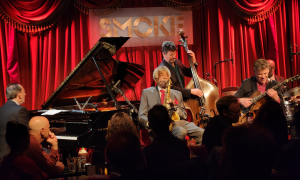
July 10—Non Stop Music at Giardini Carducci
Key to the international popularity of Umbria Jazz is its daily schedule of free concerts. The bands, each of which performs a one-hour set daily at the Giardini Carducci, comprise mostly roots-music that's related to, but isn't, jazz—par for the course at 21st century jazz festivals, but an undeniable crowd pleaser (and, surprisingly, a moneymaker, since snacks and beer are sold alongside the stage). Besides, complaining about the lack of purity seems a little petty: The music is not only free, but also very good, and a lot of fun to boot.
For proof, look no further than the first band of the afternoon, Guido Pistocchi's Dixieland Band. Pistocchi, a trumpeter from the Italian state of Romagna, does a pretty credible impression of Louis Armstrong on his horn, and leads a sextet with a sound like Satchmo's later, New Orleans revivalist groups: trombone, clarinet, piano, bass, and drums. The ensemble is spit-and-polish, even in their boisterous takes on trad polyphony. But they're not quite "authentic"---certainly not in the selection of material, which included a slow but indeed, decidedly Dixieland, rendition of Duke Ellington's "Mood Indigo": right era, wrong style. Yet it was beautifully played and as moving as ever. Pistocchi's heart clearly lies with Armstrong, however; for the band's closer, they played his arrangement of "Mack the Knife," with the leader this time imitating Armstrong on vocal; he had the voice itself right, but couldn't completely disguise his Italian accent, which made the performance enjoyable but weird.
Likewise, the following King Pleasure & the Biscuit Boys band were excellent and fun musicians...but with the emphasis heavily on the "fun" part. A jump blues/R&B quintet from Britain, these guys acted out the part of 1950s bands like Louis Prima's and Bill Haley's) with gusto, down to the slicked-back hair and matching royal blue suits. Pleasure, the band's stout singer and baritone saxophonist, even adopted a foghorn voice with a gleeful Southern (U.S.) drawl. "This is a SHUUH-ffle fer yer dancin' pleasure," he boomed at the start of the band's original "Don't Remember Me Baby"; later, when he asked "Are y'all ready to rock & roll?" and received a lukewarm response, he shouted, "THE KING CAYN'T HEEEEAR YOU!"
For all his outsize personality, however, Pleasure wasn't the star of his own band—at least not musically. The tenor saxophonist, "Big John" Eastman, tore through everything he touched, growling and moaning through hearty blues and rock & roll rhythms with wild melodies that avoided cliché, even when they were little more than beefed-up riffs. When Pleasure left the stage for Eastman's instrumental feature "Parking Lot Blues," the sax's hot-sauce sound nearly burned holes in the audience's ears. Also threatening to steal the show was the clear comedian of the group, bassist Shark von Schtoop (almost a clone of actor/nerd icon John Hodgeman), who might have been a show all his own. He literally shook at the refrain of "Shake, Rattle and Roll"; he pretended Eastman was kicking him on "Kiss Me Once, Kiss Me Twice"; he sat down and played the bass over his knees like a guitar on "Parking Lot Blues." With players like these, every second of the set was a great time.
Then came singer KJ Denhert, who was something else again. Her sound while unique, is closely related to the broadly used term of "roots music": an adult-contemporary sensibility that mixes in pop, folk, soul, and world, accented by light jazz touches. But Denhert's music also packs some surprises: on two songs ("What's My Name" and "Little Problems"), drummer Ray LeVier and percussionist "Bujo" Kevin Johnson brew up the hard-edged rhythms of go-go, the party music indigenous to African-American Washington, D.C.—but their version is less about dancing and shouting, subsumed in Denhert's sweet melodies and thoughtful lyrics. Elsewhere, she mixed in reggae ("Choose Your Weapon"), African inflections ("He's Not Coming Home") courtesy of bassist Mamadou Ba, and classic rock via an acoustic cover of Deep Purple's "Smoke on the Water" (which also featured a ripping alto sax solo from Aaron Heck). When Denhert's set was finished she was cheered as powerfully as the other acts, but there was a different sense to it: this was music where meaning had the most effect.
Call that a temporary change of pace, though; it was followed by Ezra Charles' Texas Blues Band, who brought whooping, hollering, and dancing back to the crowd. The pianist's sextet is a civic treasure in their hometown of Houston, and they brought with them to Italy a hefty stew of musical traditions from the American south. Blues was the base, of course, but there was no shortage of boogie-woogie, country, western swing, jazz, and rock & roll of all kinds, especially Chuck Berry—who speaks through many of Michael Seybold's guitar solos—and rockabilly—Charles is nothing if not a disciple of Jerry Lee Lewis, with his blond hair sticking straight up, the his nasal twang in his vocal shout, and both his hands and feet running wild on the keyboard. But the dominant flavor in the band is southern soul, courtesy of his three-person horn section: trumpeter Rachelle Akpanumoh, trombonist Nancy Dalbey, and tenor saxophonist Damon Sonnier. Every tune, from Willie Nelson's "Night Life" to Charles' urban original "88 Answers," had tasty horn licks of the Stax-Volt variety running through it. If there were exceptions, they were so not because they didn't have great horn charts but because they gave the tunes a different feel; "Drive Time," for example, couldn't be called anything but rock 'n' roll, and "So Many Women, So Little Time" is as pure as the blues gets. Still, Charles, for all his talent and devotion to the blues, couldn't help but sound a little hokey and anachronistic—like a cranky old guy playing sounds from a world long gone—but the way he and his musicians used the horns refreshed the music.
Alas, at this point it was time to explore elsewhere.
July 10—Jazz Aperitif with the Freddy Cole Quartet
And now for the real stuff.
Even if you didn't know that Freddy Cole was Nat King Cole's brother, you'd have drawn a connection between them. The younger Cole shares the elder's knowing, pliant singing voice (if a bit gruffer); the astonishing piano chops; even the instrumentation: Freddy's quartet includes Randy Napoleon on guitar, Elias Bailey on bass, and Curtis Boyd on drums. Their most prominent common trait, though, is the elegance of their music: Cole's pre-dinner performance at a small banquet hall in the Hotel Brufani was an understated set of standard love songs, played and sung with deceptive simplicity.
When Cole opened with "If I Had You," his voice betrayed a sly confidence that comes only with age and experience—and from knowing one's own abilities. Just how good he is, however, didn't become apparent until the next song, "As Far As Love." His vocal chorus was as smartly delivered as before, but this time led into a brightly colored piano solo full of effortless Tin Pan Alley-esque phrases; Cole Porter would have stolen all of them. Equally impressive was a double-quick rendition of "Them There Eyes," seemingly tossed off solely to inject its upbeat energy into the set—but it also happened to show off Boyd's chops by giving him just enough space for stunning fills. Boyd took the spotlight in the set's encore, when he played a mad hand-drumming solo on the Latin-tinged "Let There Be Love."
The other two musicians also got their chances to shine. Cole introduced "Love Walked In" specifically as a feature for Elias Bailey, who fired off a hyper-staccato bass solo to begin the tune—and also demonstrated a sharp ear for very subtle but sophisticated harmony. Guitarist Randy Napoleon, on the other hand, didn't get one feature—he simply got a solo on every tune. But on the band's first instrumental, "Among My Souvenirs," he began to take over the show: Napoleon's light touch got caught up in a whirl of lightning-fast technique. His solos then became the ones to watch for: golden lyricism on "If I Love Again"; sweet, happy variations on "Getting Some Fun Out of Life"; plainspoken, chromatic nostalgia on "Funny How I've Stopped Loving You" (on which his bandmates also took some bows, Boyd with beautiful brushwork and Bailey with imaginative eighth-note accents). He outdid himself during the set's encore with a concise but brilliant submission on "I Was Wrong."
Not that Cole yielded command to Napoleon or anyone else. He sang merrily and sagely on "Something Happens to Me" and "You're Sensational," and the latter contained the longest and most melodically intelligent solo of the evening. But he really let himself go on the final two celebratory tunes, "South Side of Chicago" and "Send for Me," belting out the vocals like a nightclub showoff while playing hard-driving triplet rhythms on the piano.
There is a certain oddity to the scenario: It's considered derogatory to refer to music as "cocktail jazz," but of course that's literally what Cole's "Jazz Aperitif" set was, and its soft character didn't elevate it. The difference is that the audience was listening, and occasionally giving attention to their drinks, not vice versa—and we were well rewarded for it.
July 10—Enrico Rava New Quartet featuring Gianluca Petrella
It's hard enough when the musicians give song titles and explanations to the audience in Italian, which I don't speak; then comes a musician who not only says nothing at all to the audience, but doesn't even pause between the tunes. Either that, or trumpeter Enrico Rava—without question the first name in Italian jazz—his quartet and guest, sensational trombonist Gianluca Petrella, played several very long pieces that shifted direction multiple times. Either way, the music they presented in a midnight performance at Teatro Morlacchi would have been dense and extremely challenging even if they had paused more often.

As it happened, Rava merely introduced the musicians, and off they went into a slow-developing melodrama (appropriate in this centuries-old opera house) led by Rava and Petrella in a very vocal harmony. Bassist Pietro Leveratto carried most of the background with his heavy drones; pianist Giovanni Guidi, by contrast, played a few accent chords, but mostly frequent spurts of fancy fingerwork, and Fabrizio Sferra bashed away at the drums in an advanced, rock-ish groove. Rava and Petrella each took protracted solos, the trumpeter playing with operatic intensity and Petrella actually one-upping him with swooping lines and intense atonalities.
When they trailed off, Leveratto and Sferra did the same, leaving only Guidi to change course all by himself. The pianist slowed down some more and went into extremely dark modes, like the intro to some evil sonata; Sferra crept back in after several measures, keeping the slow pace, then came Leveratto, plucking menacing high notes. Then, with no warning, Sferra suddenly went into a devilish whirl of speed—from 0 to 60, if you will, in a split second—leaving Guidi scrambling to keep up. That's when Rava (with his hand cupping the bell of his horn) and Petrella (with a plunger mute) re-entered and began a tough, ugly dialogue of broken dissonances.
Out of this came a surprise. Smack dab in the middle of their musical violence, Rava and Petrella suddenly led the whole band into a ragtime break, their timbres converging into the bouncy syncopations of the turn of the 20th century. It was a brief moment, perhaps four bars before the aggression resumed, but it changed the context of the music entirely: Though the band's music had been and would continue to be steeped in Italian opera, classical music, and modern art-song, from that point on it was impossible to miss its connection to jazz's ultimately American tradition.
At last some sunshine broke through, with a beautiful (and beautifully jazzy) theme on the horns, from which Rava launched another long solo, with Petrella offering strange squeaking sounds in accompaniment. Speaking of accompaniment, Guidi sat out this section of the performance, and by accident or design amazing lines and figures were suddenly audible from Leveratto. At the end of this tune, the band finally paused to a wild ovation from the house, then launched immediately into another thick, complex piece.
But Rava had more surprises in him. First, he closed the set proper by leading the band through a pure swinger, with a sweet melody and very low range in the rhythm section, which sped up mightily at the end like a Young Lions workout. Then, for the encore, they did their first ballad of the night, set on a cascading trombone descent, ticking drums, and a flugelhorn-like line on the trumpet. Leveratto's sound was the most moving, lumbering and exploiting the deep wood sound, while Guidi managed to sneak in some Bill Evans-like passages. But if this last piece was unique, its emotional payload was exactly in keeping with the full set: sublime, but troubled, as though celebrating a triumph but also realizing its unintended, undesirable consequences.
By its very nature, Umbria is an important showcase for the Italian jazz scene, and appropriately, Rava is the first entry point for any exploration of that scene. Yet the master trumpeter and adventurer set a very high bar for the countrymen who will follow him over the next nine days.
July 11—Enrico Pieranunzi Quintet
It was good fortune to follow Friday night's set by Enrico Rava with Saturday afternoon's, also at Teatro Morlacchi, by Enrico Pieranunzi. The 60-year-old pianist plays a more conventional, hard-boppish style than Rava—an excellent demonstration of just how broad the notion of "Italian jazz" really is.

Pieranunzi's quintet—trumpeter Flavio Boltro, alto saxophonist Rosario Giuliani, bassist Luca Bulgarelli, and drummer Mauro Beggia—is surely one of Italy's best. Boltro is a sterling virtuoso with a burnished sound like Freddie Hubbard, but more staccato and explosive. The opening "Entropy" found him delivering classic bop lines, but with a proficiency and passion that avoided cliché almost by default. Giuliani was even more impressive, sharing Boltro's classic feel without being indebted to any particular influence (save for a brief evocation of Lee Konitz on his ballad feature, "With My Heart in a Song"). That originality made him an immediate standout, particularly on the Latin "Aficionado" when he let loose some incredible, unrestrained blowing.
The front line takes nothing away from the rhythm section's abilities, however. Beggia showed off nearly as much as Boltro and Giuliani, trading pyrotechnic eights with them and Pieranunzi on "Entropy" and doing remarkable brushwork on "As Never Before." Bulgarelli, on the other hand, took only one solo ("No Nonsense")—but is among the most consistent, solid bassists this writer has ever seen.
Nevertheless, it was Pieranunzi's show all the way through. He held a peculiar command of the rhythm section: When Giuliani and Boltro gave their respective solos on "Extra Something," bass and drums followed not them, but the pianist, waiting for him to follow the soloists. Pieranunzi's own solo, based around a four-note vamp that he rode throughout the tune, was complicated with high trills, low-end ventures, and modal chordings that explored all the emotional possibilities at hand. Elsewhere, Pieranunzi remained the dominant character, whether establishing the tenderness of a ballad ("With My Heart in a Song," "As Never Before") or bringing the noise ("Aficionado"); the audience never forgot who was in charge.
For better or for worse, the highlight of the concert came early—in the second song, "No Nonsense." After a tense, waltzing head, Pieranunzi played a variation on his part of the theme, merging with Beggia's nervous ticking and crashing to ratchet up its tensions with every four-bar phrase; Giuliani followed with a lament that would offer a promise of relief from the anxious harmonies, then slowly restore them before resolution could occur. Worrisome Boltro gave no such promises, hitting one, anomalous brief note of contentment, while Bulgarelli on his only solo outing dwelled directly inside the song's tension. By the time the head returned, "No Nonsense" was a cohesive story of anxiety without reprieve; it might have been an excellent suspense-movie theme.
More than displaying the variety of jazz available in this country, Pieranunzi served as a reminder of how exciting and exploratory straight-ahead can be, even weighed against Rava's nontraditional, "ECM sound" approach. The local program is suddenly as beckoning as the international stars.
July 11—Tuck & Patti at the Caffe HAG Stage
The Arena Santa Giuliana has two stages: the mainstage, where the nightly headliners play, and the smaller Caffe HAG Stage, where husband-and-wife duo Tuck & Patti holds court every evening.

Guitarist Tuck Andress and vocalist Patti Cathcart have been together for 30 years, and throughout that time have been among the subtlest, most expressive artists in jazz. Indeed, Andress virtually redefines the role of accompanist—though he plays both bass lines and chords, it isn't a steady background; merely enough to make his point and stay out of Cathcart's way. But she's no showoff, either; she's a talented improviser with tremendous range, but shuns histrionics in favor of directness and charm.
On Saturday night's "Heaven Down Here," Cathcart reached down to a very low, warm register—the Tracy Chapman register—and spent the song there, climbing upward only for an improv on the line "I don't want to wait for the angels." Andress, meanwhile, played short chords and made fascinating use of harmonics as accents. The duo also delivered a deep rendition of Rodgers & Hart's "My Romance" in which Andress relied more on resonance than on the few notes themselves, and Cathcart gave a quiet, confessional vocal that ranks with the song's most romantic, and most intimate, performances.
But Cathcart dropped out of "My Romance" for a guitar break that defied everything described above. Throttling speed, Andress inscribed broken, carefully staggered phrases onto the new rhythm. He began bending not only notes, but entire chords, settling once and for all any question of his chops—he's a fine guitarist—then dropped back to his gentle minimalism as suddenly as he'd risen from it for Cathcart's recapitulation.
Subtlety aside, however, both artists have impeccable rhythm, especially Cathcart. Bob Dorough's "I've Got Just About Everything" had a lively gait that the singer handled with ease, throwing in a little melodic variation at first, then scat, from low-grade grumbles to soaring, precise articulations that sounded much like Italian words (and may have been). And that was only a warm-up for the Cathcart original "Ain't Seen Nothing Yet." The story of an old woman giving advice to a young couple ("This is a true story," Cathcart promised) was in 4/4, Andress walking on the bass strings and sparking an establishing chord just before each "3" beat, when suddenly the vocal whipped into a frenzy of hearty, percussive mouth sounds in 6/8 that astonished the crowd before zooming into "Better Than Anything," also in 6/8 and breathlessly in the pocket.
Unfortunately, "Ain't Seen Nothing Yet" also underscored Tuck & Patti's biggest disappointment: the lack of Cathcart's accomplished songwriting. Granted, with a show every night they need to ration their repertoire, and they also accommodated a request (in this case their transcendent Jimi Hendrix medley, "Castles Made of Sand/Little Wing"), but one original in a set? Perhaps the intent is to lure them in with the classics, and thus bring them back for the originals; with their superb work Saturday, they've earned the repeat business.

Steely Dan has aged well; if anything, the core duo (singer/keyboardist Donald Fagen, guitarist Walter Becker) has only now realized the dirty-old-men personae they adopted nearly 40 years ago. Back then, they were also perhaps the most pedigreed and knowledgeable jazzmen on the rock side of the jazz-rock movement. (The distinctive piano/bass riff from their biggest hit, "Rikki Don't Lose that Number," was once the distinctive riff from Horace Silver's "Song for my Father.") So if Umbria Jazz were forced to bring in an arena-rock band to boost ticket sales, the Dan was an ideal choice.
It's to the band's credit that they understood. Their concert at the mainstage of Arena Santa Giuliana began with only the backup band, all accomplished jazz musicians, performing a sizzling hard bop number. Each of the horns—baritone sax (Roger Rosenberg), tenor sax (Walt Weiskopf), trumpet (Marvin Stamm), and trombone (Jim Pugh)—took a solo turn, Rosenberg and Pugh earning extra credit for tasty performances, followed by a Keith Carlock drum solo. Not too many rock acts begin their gigs that way.
There was never any doubt that once Fagen and Becker hit the stage, the concert would coalesce into a Steely Dan career retrospective. That made it all the more enjoyable when their first tune was a completely new arrangement of their hit "Reelin' in the Years." This time it was a slow funk jam, ultra-loungey and oily; only the familiar opening lyric tipped off the crowd to what song this was.
The remainder of the show was, indeed, a nostalgia trip, with hits and album staples from their 1972 debut to their 2000 Grammy-winner Two Against Nature: "Bodhisattva," "Show Biz Kids," "Bad Sneakers," "Two Against Nature," "Peg." Most of the performances were close recreations of the studio recordings, although some dated synthesizers were replaced with real horns; Fagen presented another surprise, replacing others with a melodica on "Time Out of Mind" and "Aja."
Becker was on a roll, ripping out great and...well, Becker-esque guitar solos on "Show Biz Kids" and "Home at Last." But he also pulled out a lead vocal—he had sung for the first time on the Dan's most recent album, 2003's Everything Must Go, but here he sang the 1975 deep cut "Daddy Don't Live in New York City No More." But his most interesting stage business was a monologue on the band's sleaziest tune, "Hey Nineteen," ramblingly introducing the Cuervo Gold and its sidekick, the fine Colombian. (This writer thanks Fagen for avoiding his old line "Skate a little lower now," which always made this writer uncomfortable.)
These were mostly superficially new touches, but the concert wasn't about breaking new ground anyway. The crowd was expecting, and received, favorite songs by a great old rock band who also kept feet in the jazz world, and dirty-old-man-dom. To drive the latter point home, when Fagen and Becker left the stage, the backup band played another jazz tune—the theme from Last Tango in Paris. If that ain't apropos...
July 12—Renato Sellani and Massimo Moriconi at Bottega del Vino
The Bottega del Vino isn't an arena, theater, patio, or hotel ballroom; it isn't even a jazz club. It's a small wine bar that sits on Perugia's main public square, the Piazza IV Novembre, and during the Umbria Jazz festival just happens to host one of the finest interpretive jazz pianists in the world.
Eighty-three-year-old Renato Sellani, "Il Maestro," performs every afternoon at 1:00 during the festival (including this Sunday, when the bar is otherwise closed) with Massimo Moriconi, a celebrated Roman bassist. Moriconi also acted as an emcee—probably because there wasn't anyone else—who introduced Sellani to the audience and promptly disappeared, leaving the pianist to a solo romantic ballad that sounded faintly like a slow "Witchcraft." Initially he played at a whisper level, suggesting that he was a very meek player. That wasn't the case; when needed, Sellani was more than willing to rise in an impassioned surge. In either case, the music was heartbreakingly pretty.
That's when Moriconi reappeared out of thin air and grabbed an upright from behind the piano. The next two tunes were upbeat and fairly kicky, though both had slow, sensitive intro passages. The first, "Summertime," ran on a four-note vamp from the bassist, while Sellani played at a foot-tapping pace that was lively and even exciting. (In an odd moment, the patrons at a nearby table had a crinkling plastic bag that sounded a bit like a drummer with brushes.) The second had an extraordinary bass solo in which Moriconi quickly ascended into his axe's highest register while Sellani played beautiful pianistic inventions on top. The tune was familiar, but unplaceable; later I realized it was the old folk song "We Shall Not Be Moved."
Henceforth, the duo entered a pattern of slow, romantic ballads followed by livelier numbers. "Somewhere Over the Rainbow" stated its A theme primarily on the bass, with the piano comping even softer than the intro on the first tune; on the B section, Sellani took over, playing tender but complex harmonies on a slightly Latin rhythm. "Besame Mucho, on the other hand, was of course entirely Latin in its groove, played with spectacular syncopation and a sly bass quote from "Smoke on the Water." Here, Sellani soloed via a series of descending trills, then upward-clambering chords against Moriconi's broken-time double stops; the bassist then built a solo on lengthy, elastic pitch bends that culminated in a nifty fast roll. And on it went.
It was astonishing to think that these two extraordinary musicians were working together in such a low-profile setting, not in one of the theaters or a more formal venue. Sellani and Moriconi are two of the most esteemed jazz musicians in Italy. But perhaps the wondrous beauty of their set would not work anywhere but in a small, intimate setting, with good wine and rich food. This mellow lunch hour was ultimately one of the highest points of the festival so far.
July 12—Ashley Kahn and the Making of Kind of Blue
Music historian and NYU professor Ashley Kahn's most critically acclaimed book, 2001's Kind of Blue: The Making of the Miles Davis Masterpiece, is being newly published for the album's 50th anniversary. To publicize the new release, Kahn brought his expertise on the album ("Fifteen years in the making") to Perugia's Hotel Burfani for a multimedia seminar.
To provide some context, Kahn made a request of the audience. "In this age of the iPod, I'm going to ask that we do something that's increasingly rare: Let's listen together to 'So What,' from Kind of Blue." Afterward, Kahn switched into professor mode, presenting a series of study questions:
- Why are we still talking about Kind of Blue after 50 years?
- Why, out of tens of thousands of jazz albums, is this the one that sells 5,000 copies a week?
- Why does it sell so well without any promotion or marketing?
- Why, out of over 40 Miles Davis albums, do we go to this one first?
And like a good professor, Kahn had some possible answers ready. Kind of Blue does all of these things, he suggested, because it's so accessible: rather than challenging the ear, the album seduces it. Because of the once-in-a-lifetime combo of Miles, Coltrane, Cannonball, Bill Evans, Paul Chambers, Jimmy Cobb, and Wynton Kelly. Because of great songs, but more to the point great improvisations that are as studied as the tunes themselves. Finally, said Kahn, because Kind of Blue has for so long been a doorway to jazz for people who don't like jazz. "It's the first taste of a new cuisine," he said, "the first step into a new world."
Questions thus (possibly) dispatched, Kahn turned to Miles' artistic evolution, starting with his famous 45-second solo on Charlie Parker's "Now's the Time" in 1945—proof that from the beginning, the 19-year-old trumpeter was hearing something different than his bebop mentors. From here, history advanced through Claude Thornhill's 1941 recording "Snowfall," arranged by Gil Evans, which Kahn tied easily to the 1949 Birth of the Cool sessions; he did the same with Gene Ammons' blues side "Gravy" and Miles' classic "Walkin,'" and with the respective Ahmad Jamal and Miles Davis versions of "I Don't Want to Be Kissed by Anyone But You."
The fascinating part of the history lesson, however, was an illustration of where Miles got the melodies for Kind of Blue. Khan played versions of the standard "Soft Winds" alongside "Freddie Freeloader," and paired Oscar Peterson's "Bohemia After Dark" with "So What"—followed by Peterson's 1960 response "Why Not? That's What!" The comparisons were instructive even for the seasoned jazz listener.
Even at the presentation's end, when Kahn screened his documentary Kind of Blue: Made in Heaven, there were no definitive explanations for the album's timeless allure. Maybe that's for the best—why take all the mystery from the myth? What he did do was bring yet another new perspective to Kind of Blue. For an album so frequently heard, that's a monumental achievement.
Photo Credit
Giancarlo Belfiore for Umbria Jazz
< Previous
Ornette Coleman's Meltdown is the Bes...
Next >
Sacred Machines
Comments
Tags
For the Love of Jazz
 All About Jazz has been a pillar of jazz since 1995, championing it as an art form and, more importantly, supporting the musicians who create it. Our enduring commitment has made "AAJ" one of the most culturally important websites of its kind, read by hundreds of thousands of fans, musicians and industry figures every month.
You Can Help
To expand our coverage even further and develop new means to foster jazz discovery and connectivity we need your help. You can become a sustaining member for a modest $20 and in return, we'll immediately hide those pesky ads plus provide access to future articles for a full year. This winning combination will vastly improve your AAJ experience and allow us to vigorously build on the pioneering work we first started in 1995. So enjoy an ad-free AAJ experience and help us remain a positive beacon for jazz by making a donation today.

Giveaway

Days remaining: 7