Home » Jazz Articles » Profile » The Allman Brothers Band: 40 Years Out
The Allman Brothers Band: 40 Years Out

As the Allman Brothers Band they collectively began to do what came naturally and this aggregation of the music of the South became their unmistakable sound.
All were part of the Allman Brothers Band's three-week musical extravaganza at New York City's Beacon Theater celebrating the band's 40th anniversary. This year's list of surprise guests also included Johnny Winter, Taj Mahal, Sheryl Crow, John Hammond, Boz Scaggs, Chuck Leavell, Levon Helm, Bruce Hornsby, Southside Johnny, The Juke Horns, Buddy Guy, Susan Tedeschi, Bonnie Bramlett, Jimmy Herring, Robert Randolph, Sonny Landreth, Bob Margolin, John Popper, Trey Anastasio, and members of Los Lobos, Cowboy, Wet Willie and The Grateful Dead.
For those who have followed the band from the beginning, this year's Beacon run definitely recaptured some of the magic that surrounded the band when the late Duane Allman was its leader. As a teenager, I saw them in Daytona Beach, Fla., just after Duane Allman had done the first sessions with Clapton in Miami.
No doubt fired up by the imminent release of their second LP, Idlewild South (Capricorn, 1970), and the possibilities that Duane's work with Clapton signaled, Gregg and Duane returned to their hometown as conquering heroes with their mother sitting proudly in the front row.
That night we were treated to new material from Idlewild South, performed in a set that mirrored The Allman Brothers at Fillmore East (Capricorn, 1971) recordings that would be recorded six months later. It's difficult to convey how spellbinding it was to first experience that music live and observe the faces and hands of Duane Allman, Dickey Betts and Berry Oakley on that September night in 1970.
Eric Clapton
Even back in 1970, rumors concerning Clapton and the Allman Brothers Band began circulating. After Duane recorded and did a couple of shows with Clapton, it wasn't uncommon to hear someone say, "Duane's quitting the Allman Brothers and joining Clapton's Derek and the Dominoes." Soon thereafter the next rumor would surface, "Clapton is going to start touring with the Allman Brothers like he did with Delaney and Bonnie."
Then after Duane's death there were persistent rumors that Clapton would be joining the Allman Brothers. Over the years rumors would routinely surface that Clapton would be a guest during their annual Beacon run. But like a The Beatles reunion, it appeared like this would never happen.
This year, given that Derek Trucks had been out on tour with Clapton for over a year, it seemed like after four decades it might actually happen. But again the rumors flew, "So-n-so knows Clapton's manager, and he says no way, Eric will be in London during March." So it was truly electrifying to see Clapton walk onto the stage after nearly 40 years. Finally we would learn the answer to the question: "What would it have been like if Eric Clapton had joined the band?" With decades of anticipation, the reality shouldn't have lived up to the fantasy, but the truth is, Clapton demonstrated that he would have been a terrific addition to the band.
He was a very special surprise guest, appearing two nights in a row. The first night went well, but the second night was one of those sets that will no doubt become the stuff of rock music lore.
With the exception of Gregg who was focused and serious, the band seemed relaxed and playful between tunes, and Clapton in particular seemed to relish just being a player doing someone else's music on songs like "In Memory of Elizabeth Reed," "Dreams," and "Stormy Monday."
Gregg Allman's illness last year caused the band to miss their annual Beacon run, so he clearly wanted to make up for that. But this year there was more to it than that, this anniversary year was dedicated to his late brother Duane, and their mother and Duane's daughter were seated nearby as images and film from Duane filled the big screen behind the band.
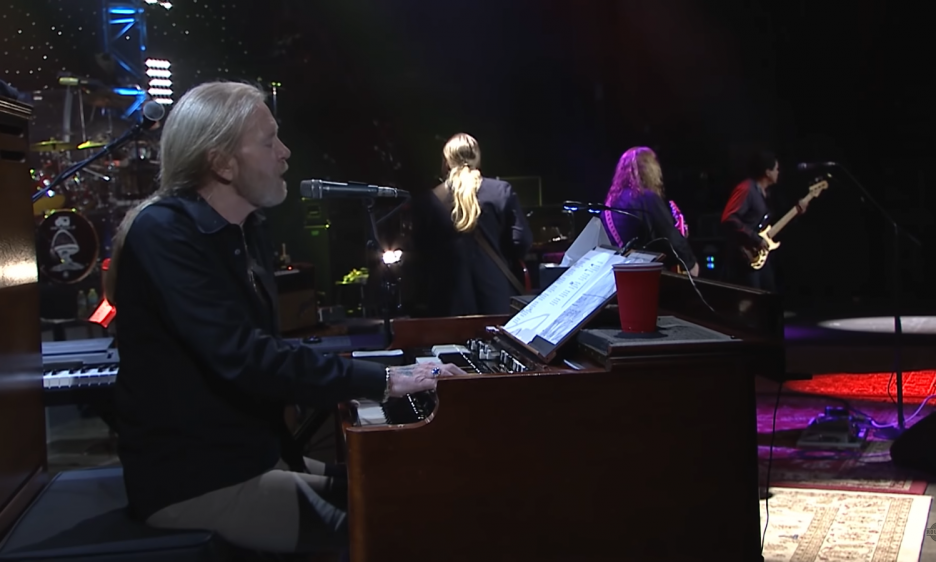
During Clapton's guest appearances, Gregg seemed especially cognizant of the significance of this 40-year milestone. He sang and played with a power and determination that made one recall the days when he and Duane were on stage together. At times he sounded like he was channeling Bobby Blue Bland as he belted out "Stormy Monday," sometimes causing the crowd to roar when he would finish a verse, and he attacked the B3 keyboard with an energy that revealed what this meant to him. Forty years out he occasionally misses a cue or forgets a lyric, but Gregg Allman left no doubt that he is still very much in the game.
To my mind, that set came as close as the Allman Brothers have ever come to recapturing the magic that happened when Duane and Dickey Betts shared the stage. Seeing how Clapton enjoyed himself doing expansive solos on the Allman Brothers material and how well the Allman Brothers backed him up on his songs, one has to wonder if there might be a joint tour someday—so let the next generation of rumors begin.
Another lingering question is what the Allman Brothers might have been like if Duane's interest in jazz had continued to influence the band. In a sense this too was answered when Randy Brecker and Lenny White joined the band on stage for "Dreams," "In Memory of Elizabeth Reed," and Miles Davis's "In a Silent Way." White's drumming gave the material an Elvin Jones-feel as Brecker took the music to new and interesting places. (You can watch their backstage video interviews below.)
This year's Beacon run had a new and exciting twist, fans around the world were able to experience the excitement in the comfort of their living rooms. All 15 shows were streamed live to subscribers in HD video. It was clearly geared to serious music lovers with multiple camera angles highlighting tight shots of musicians' hands, facial expressions, and interactions. In a world where file swapping has challenged the music industry's business model, this promising idea (Moogis), the brainchild of drummer Butch Trucks, may prove to be a win-win for artists and fans.
A Unique Southern Fusion
This is a band whose driving energy attracts rock audiences, but they also have enough blues, jazz, and gospel influences to appeal to more discerning tastes. One can think of the Allman Brothers as a gateway band, once an audience is hooked, it's easier for them to move on to the harder stuff. Indeed, the enthusiastic reception given to jazz musicians who sit in with the Allman Brothers is an indication that smooth jazz isn't the only way to reach a wider audience.
British blues/rock groups such as Clapton's Cream, famous for extended jams, provided an important starting point for the original members of the Allman Brothers, but there were a couple of important differences.
First, they began as relative unknowns and didn't approach music as the creme de la creme, competing with one another for the spotlight. Instead, they saw themselves as a brotherhood who served the music.
Secondly, many of their British counterparts tended to be serious aficionados of the blues. The purists, groups like Chicken Shack, did their best to replicate a sound that reached them via records from an exotic place across the ocean. By contrast, Gregg and Duane only had to cross the railroad tracks to hear the blues, a point that was driven home at the Beacon this year when Gregg introduced Floyd Miles, a friend from his adolescence, who was a local musician in Daytona Beach and mentor to him and Duane.
With the exception of Berry Oakley from Chicago, these were young Southerners who had naturally absorbed the music that surrounded them. They picked up what was going on in local clubs and churches, and they grew up with the 50,000 watt powerhouse WLAC in Nashville. At night between Royal Crown Hair Dressing commercials that promised "radiant obedience," young cats all over the South listened to WLAC to hear the latest R&B and blues records. For the Allman Brothers there was also Jaimoe, a veteran musician who had been on the road for years with acts such as Otis Redding and Sam & Dave, who gradually turned his somewhat younger bandmates on to his love of jazz. They began their careers covering the British invasion, but as they entered their twenties their skills and tastes were maturing. As the Allman Brothers Band they collectively began to do what came naturally and this aggregation of the music of the South became their unmistakable sound.
The Allman Brothers' Southern fusion was indeed something different. Musicians like Miles and Herbie Hancock incorporated the energy, excitement and beat of rock into their sound, using plenty of electronics to achieve something new and modern. The Allman Brothers took a different approach, they looked backward and away from technology. Eschewing synthesizers and guitar effects, they choose instead the electromagnetic Hammond B3 and other vintage gear, and sought inspiration in the golden age of jazz and blues.
This is an admittedly simplistic analogy, but imagine an American football field. One end is represented by edgy driving energy, heat and passion, a raw aggressiveness, and a simple directness. The other end stands for sophistication, complexity and virtuosity. The Allman Brothers often played around their own 40 yard line, 60 yards away from the golden age of jazz. The jazz fusion groups started at the other end of the field and moved 40 yards up field. These two approaches to fusion are separated by 20 yards, similar, but still on different sides of the field.
The Allman Brothers themselves would be the first to admit that their level of skill and understanding is no match for the great jazz fusion artists, but they did have one fundamental advantage. It's extremely difficult to unlearn technique, thus a opera singer, despite vocal gifts, would be hard pressed to match John Lennon's vocal on a simple song like "Twist and Shout," or Etta James' vocal on "At Last." Similarly, not every jazz musician can tap into what's going on in rock, and few rock musicians are comfortable in jazz. That's part of the Allman Brothers Band's contribution to modern music. Because they are capable of playing close to midfield, they've moved their fans with them in the direction of more demanding music. Moreover, something special seems to happen when players like Branford Marsalis and Randy Brecker crossover and join them on the rock side of the field.
The Formative Period
During this year's 40th anniversary at the Beacon, every appearance included a tribute to Duane, a.k.a Skydog. He was a true alpha male, with a take-charge personality, an undeniable personal magnetism, and a record label in Macon, Ga., willing to gamble on his potential. In some ways the current band is an ongoing tribute to the band Duane founded when he was 22 years old. Beginning in March of 1969, his brief two years and seven months as the band's leader have left an indelible mark, even after the passage of nearly four decades.
After years as a teenager playing the Southern circuit covering radio hits, followed by a brief and thoroughly dreadful experience in Los Angeles with a label that used its contract as a straitjacket, he landed in Muscle Shoals, Ala., as a popular session player at FAME Studios. His playing on sessions with people like Aretha Franklin, Clarence Carter, John Hammond, King Curtis and Wilson Pickett would prove to be pivotal in landing a recording contract.
Beyond his guitar skills and innovative use of the slide guitar, Duane had a compelling artistic vision. He was eager to explore, experiment and take risks. Yet his most important asset might have been his leadership skills. Even though he was the band's unchallenged leader, he successfully engendered a common artistic vision and collective ego for the band. Dickey Betts has described Duane's personality as being similar to one of Duane's heroes, the boxer Muhammad Ali: supremely confident, bursting with energy, focused and driven, with an infectious enthusiasm.
"He was all about the music," is a common phrase used to describe him. He was open to new influences and quickly embraced and developed promising impulses from his band mates. During his time with the band there wasn't a hint of competitiveness or ego-driven rock star antics. On stage they wore their street clothes, there was no preening, no prancing, and other than facial expressions, they had what you could describe as a workman-like stage presence.
Musically things progressed better than anyone could have imagined. In the second half of 1970 Tom Dowd, the legendary producer, took Eric Clapton to an Allman Brothers concert in Miami. Blown away, Clapton ended up inviting Duane to guest on his monumental Layla and Other Assorted Love Songs (Polydor, 1970) album as Derek and the Dominoes. This greatly increased Duane's visibility and generated considerable buzz in the rock press. The Allman Brothers first two studio albums had been moderately successful, and then in March of 1971, two years after they formed, they decided to capture what they did best. The result was the landmark, At the Fillmore East, a double LP with only seven songs, produced by Tom Dowd. It was a tremendous critical success coming on the heels of Layla and even as a double live LP it went gold and managed to reach number 13 on the album charts.
By this time Duane was drawn more and more to jazz, he was particularly captivated by Davis' "All Blues," John Coltrane's "My Favorite Things," and the improvisation of Tony Williams, Larry Young and John McLaughlin on the LP Tony Williams Lifetime Emergency! (Polydor, 1969). So after their final Fillmore gig, he remained in New York and spent two days in the Atlantic studios recording Herbie Mann's Push Push(Atlantic, 1971). Interestingly, Jerry Jemmott (bass) and Bernard Purdie (drums) who also played on Push Push, were special guests at the Beacon this year. No doubt if Duane had lived, this would have been the first of many guest appearances with jazz musicians, but tragically it proved to be his first and last.
Perhaps the murder of his close friend King Curtis in the summer of 1971 helped him to realize that drugs and alcohol were threatening his future. In any case, he seemed determined to turn things around and checked himself into a rehab clinic in Buffalo, N.Y. After his release he returned to Macon, Ga., eager to finish the next LP, but this was not to be. He was killed in a motorcycle accident the day after his return.
In the emotional aftermath of Duane Allman's death the band coalesced around his memory and returned to the studio to record three more songs to finish their next LP Eat a Peach (Island/ Mercury, 1972). As a tribute to Duane they released it as a double LP with additional live material from the Fillmore recordings making up the second LP. It was very well received by critics and was even more successful than At the Fillmore, climbing to number 5 on the Billboard charts.
They began to play very large venues and make some serious money. This, together with the loss of their leader, meant that it wasn't just about the music anymore. Nonetheless, Gregg, despite his ongoing problems with substance abuse, used his melancholic state to his artistic advantage. He recorded Laid Back, an impressive solo LP, which, as the name implies, has little to do with the Allman Brothers Band. It's dark mood reveals a heavy heart, his singing is powerfully honest and soulful, and the playing and arrangements are perfectly suited to the overall feeling.
This recording in particular demonstrates the natural connection to the music of the South that characterizes these young Southerners. Likely without conscious planning, there are gospel, blues, jazz, folk and country influences throughout. With "Multicolored Lady" and "Queen of Hearts," Gregg took the blues to a new place in terms of musical structure and lyrics, laying out emotive stories worthy of a country western classic: "I got on the bus in Memphis, destination Rome. Georgia ain't no paradise, but a place I could call home."
The producer, Johnny Sandlin, recruited the best players from the Macon scene, along with notables like David "Fathead" Newman and Cissy Houston. But it was his call to Chuck Leavell, the young pianist, that would have a lasting effect on the music world. (See my 2008 AAJ interview with him for an in depth account of these events.) His playing on the LP and the impromptu jam sessions with members of the Allman Brothers who stopped by the studio, led to him being asked to join the band.
In the fall of 1972 sessions for the band's next LP, Brothers and Sisters(Capricorn, 1973) were underway with Leavell now in the band. He gave the band a boost of youthful vitality, but more importantly, his skillful, intuitive and emotive playing gave the band a whole new range of colors. But in November of 1972 after only two songs were recorded, tragedy struck again. Berry Oakley (bass) was killed in a motorcycle accident only blocks away from where Duane had been killed. Throughout this period Gregg had been devastated by grief and now his problems with substance abuse only intensified. Still, he managed to hold together and contribute three new songs, all, not surprisingly, were blues numbers.
Betts, no longer in Duane's shadow and not sharing the stage with another guitarist, began to blossom. His "Blue Sky" and 9-minute instrumental "Les Brers in A minor" on the previous Eat a Peach LP had been impressive follow-ups to his "In Memory of Elizabeth Reed." On Brothers and Sisters he wrote four new songs as "Richard Betts," which in contrast to Gregg, were joyful and upbeat with a country flavor: "Ramblin' Man," "Jessica," "Southbound," and "Pony Boy." The LP was excellent—arguably the Allman Brothers' best studio recording—and by far their biggest commercial success, charting at #1, with "Ramblin' Man" reaching #2 on the singles chart.
Given the loss of two key members, the fame, recognition, and renumeration that come with a #1 album and hit single, and his immense musical contributions to the band from the beginning, it is perfectly understandable that Betts felt justified in carving out a leadership role for himself. Yet without the force of Duane Allman's leadership, it is also true that the emergence of Betts as the de facto leader of the band marked the beginning of the end of the golden age of the band.
A few years later the departure of Leavell, Jaimoe and bassist Lamar Williams to form their own group, Sea Level, marked the definitive end of the golden age. Over the ensuing decades the band would dissolve and reunite in various combinations, with occasional high points, but it wasn't until the dawn of the new century that some of the old magic returned.
Family Trucks
Throughout the Allman Brothers Band's 40 years there has been one true constant, Butch Trucks, who jokingly refers to himself as the Cal Ripken of the music business. He hasn't missed a single performance in four decades with the band, and along with Gregg Allman he is the only member of the band to have appeared on all of their albums. His connection to Gregg and Duane Allman goes back to the their early years of struggling on the club and lounge circuit in Florida. Over the years no one has done more to champion the memory of Duane Allman than Butch Trucks, and even after four decades he speaks openly of the transformational impact Duane Allman had on his life.
When I interviewed Derek Trucks in February 2009 I asked him if he could go back in time and witness one event in rock music what would it be. His response was the Allman Brothers in their heydays when Duane Allman was alive. He thought that would have been life-changing, and it's little wonder. Chris Trucks, Derek's father and Butch's younger brother, caught the Allman Brothers many times in concert, and while he did not become a professional musician, the experience did have a lasting impact on him—and eventually on the Allman Brothers Band itself.
It's no coincidence that Chris Trucks has a son named Duane and another named Derek, after Clapton's "Derek and the Dominoes." Duane Allman's music was the soundtrack of Derek's early childhood. At the age of nine, Derek Trucks took up guitar and proved to be a natural, quickly mastering the slide, listening primarily to Duane Allman and Elmore James recordings for direction. His musical gifts and family heritage seem like serendipity to the nth degree, almost as if fate had set about to revive the Allman Brothers Band.
Derek's progress was so extraordinarily swift that Chris Trucks realized he needed to nurture his son's unmistakable talent. So he began what must have been a very daunting endeavor, showing up at local bars and clubs in Jacksonville, Fla., and asking ambitious and image-conscious bands if his reticent little 9-year-old in a baseball cap could sit in. Eventually he asked Ace Moreland who, after learning from a band member that Chris Trucks was Butch's brother, agreed. Derek blew everyone away and he became a regular with them, appearing at the end of each show to do three numbers, and eventually touring with the band. Within a few years he would sit in with the Allman Brothers Band.
Derek's precociousness and affinity for the slide guitar, coupled with his impeccable tone, and, thanks to his father, his admiration of Duane Allman, allowed him start out at a very young age where his idol had left off. By his early teens he was already heavily into John Coltrane, Miles Davis, Rahsaan Roland Kirk, Sun Ra, Wayne Shorter, Mahalia Jackson, and scores of others. In the process he developed his own unique musical voice which also draws heavily from his early fascination with oriental sarod players. Exposed at a early age to the ravages of drug abuse in rock music, he avoided the pitfalls that have plagued so many rock musicians. He is not a tortured artist, rather he seems to possess the enviable ability to draw his creative impulses from a stable and positive place. In terms of personality, temperament, and lifestyle he is nearly the polar opposite of Duane, but with respect to talent, tone, proficiency, and the love of music, they are kindred spirits.
Groundhog Day
In the movie "Groundhog Day," every morning Bill Murray woke up to "Midnight Rider" (okay, actually it was a song by Sonny Bono, Cher's first husband, "I Got You Babe.") In any case, this groundhog day sensation is a trade-off for many performers who draw mass audiences. A significant segment of the audience wants to hear what they know (again and again, year after year.) That's the nature of mass appeal, it's why Ray Charles couldn't get away from "Hit the Road Jack" and "Georgia on my Mind," and according to press reports it's why Carlos Santana is now contractually committed to playing his hits during his two year "Journey through the hits" engagement in Las Vegas.
Serious fans might be happy to hear an artist perform new material, but generally speaking, serious fans don't fill large venues. The situation with the Allman Brothers is perhaps more pronounced because their history of breaking up and reforming means that the setlist played during Duane Allman's brief tenure with the band represents a substantial part of their repertoire.
It's actually not such a problem for a concert goer, a bit of nostalgia once a year can be very enjoyable. It's really only a problem for the musician—imagine playing "One Way Out" 5,000 times, perhaps it's the price of packing 5,000 people into a venue. Although, in the case of the Allman Brothers Beacon run, having so many guest artists sit in on Allman Brothers songs, or perform their own material with the band, helps to keep things fresh and exciting.
Nonetheless, for Warren Haynes (lead and slide guitar) and Derek Trucks (slide and lead guitar) it even goes beyond the mere repetition of the songs, they also feel somewhat obliged to remain relatively true to the solos on the original live recordings. Considering that both of them seem to prefer Duane Allman's parts, one must assume that makes the situation even less satisfying. Thus it is understandable that Derek Trucks and Haynes place their primary emphasis on their own bands and projects.
Dicky Betts and Duane Allman had the advantage of simply being themselves, two guitarists with very different styles experimenting with new things. This is surely the reason that Chuck Leavell was able join the band and have such a dramatic impact on their sound and direction during his years with the band. He too had the luxury of just being himself and allowing his creativity to flow. It's a testament to Derek Trucks and Warren Haynes that they've kept this level of energy and commitment alive for so long.
A Personal Reflection on a Four Decade Run
Based on recent comments by band members, it appears that this year's 40th anniversary might be the band's last great push. It seems likely they will continue their annual NYC run, but shorten their summer tour schedule and gradually allow things to wind down.
Unfortunately for Allman Brothers' fans, 2009 marked the end of the band's string of 188 consecutive sold out shows at the Beacon Theater. The Beacon will become the home of the Cirque Du Soleil and the Allman Brothers will need to find another venue. Fortunately, this year's Beacon run was captured for posterity on video and it was a magnificent testimony to what took place in Macon 40 years ago and the impact the band has had on the music world. They could walk away now with pride and satisfaction.
On the other hand, thinking back to Duane Allman and the magic that happened at the Beacon this year, it caused me to wonder if there might be a way to keep this special bit of American music alive for another decade—even if it were just their annual New York run broadcast around the globe.
Looking back, just as Dickey Betts was taking the Allman Brothers down a twangier path, Chuck Leavell, Jaimoe and Lamar Williams were actually taking what Duane Allman did in an interesting and more complex direction. Unfortunately, they were impelled to leave the Allman Brothers and form Sea Level in order to do so. I would encourage Duane Allman fans to dust off their old Sea Level albums or buy a "Best Of" CD and listen closely to songs like "Rain in Spain," "Tidal Wave," "Storm Warning," and "Midnight Pass." It is merely speculation, but my musical sensibilities tell me that Duane Allman would have been completely on board with that much of what Sea Level was about.
For that reason I would love to see the band expand their NYC run to include some permanent special guests who would be there for the entire run—essentially an expansion of a band, but with a very condensed schedule. The obvious first choice would be Chuck Leavell because of his amazing chemistry and longstanding connection with the band. Moreover, considering that Sea Level was made up of three former members of the Allman Brothers, it would be both fitting and refreshing if some of their most memorable music was integrated into the Allman Brothers' setlist.
Two other veterans from the early days in Macon also come to mind. Randall Bramblett (Chuck and Jaimoe's band mate from Sea Level) isn't just a fine keyboard and saxophonist, he is also a first rate and highly prolific song writer. Randall has a wealth of material post Sea Level from which the Allman Brothers could also draw. Another Macon veteran who would be a great addition is Jimmy Hall, a powerful blues singer, and a fine blues harp and saxophonist. Finally, adding someone like Mark Pender, trumpet, vocals, and acoustic guitar would mean a horn section, another soloist, and very deep bench for vocals. With that pool of talent it is not only easy to imagine the band celebrating a 50th anniversary, but perhaps even taking Duane Allman's original musical vision to new and greater heights and enjoying themselves in the process.
That would be my personal fantasy, but the band has been around for 40 years and they've proved they know what they are doing. Congratulations to them for four decades of performing and a well deserved place in the history of American music.
< Previous
Manu Codjia
Next >
Tear This World Up
Comments

About Allman Brothers Band
Instrument: Band / ensemble / orchestra
Related Articles | Concerts | Albums | Photos | Similar ToTags
Allman Brothers Band
Profiles
Alan Bryson
United States
randy brecker
Stanley Clarke
Lenny White
Eric Clapton
Johnny Winter
Taj Mahal
Boz Scaggs
Chuck Leavell
Bruce Hornsby
Buddy Guy
Susan Tedeschi
Jimmy Herring
Robert Randolph
Sonny Landreth
Bob Margolin
Trey Anastasio
Duane Allman
Beatles
Derek Trucks
Miles Davis
Elvin Jones
Cream
Floyd Miles
Otis Redding
Herbie Hancock
John Lennon
Etta James
Branford Marsalis
Aretha Franklin
King Curtis
John Coltrane
Tony Williams
Larry Young
john mclaughlin
Herbie Mann
Bernard Purdie
David "Fathead" Newman
Sea Level
Elmore James
Coltrane
Roland Kirk
Sun Ra
Wayne Shorter
Mahalia Jackson
Ray Charles
Carlos Santana
warren haynes
For the Love of Jazz
 All About Jazz has been a pillar of jazz since 1995, championing it as an art form and, more importantly, supporting the musicians who create it. Our enduring commitment has made "AAJ" one of the most culturally important websites of its kind, read by hundreds of thousands of fans, musicians and industry figures every month.
You Can Help
To expand our coverage even further and develop new means to foster jazz discovery and connectivity we need your help. You can become a sustaining member for a modest $20 and in return, we'll immediately hide those pesky ads plus provide access to future articles for a full year. This winning combination will vastly improve your AAJ experience and allow us to vigorously build on the pioneering work we first started in 1995. So enjoy an ad-free AAJ experience and help us remain a positive beacon for jazz by making a donation today.

Giveaway

Eligible winners: 15
Days remaining: 7
Days remaining: 7