Home » Jazz Articles » Live Review » 30th Annual Tri-C JazzFest Cleveland
30th Annual Tri-C JazzFest Cleveland

Cleveland, Ohio
April 23-May 3, 2009
Now in its 30th year, the Tri-C JazzFest Cleveland has always prided itself as much on its educational offerings as its concerts. The festival's Web site touts it as "the largest educational jazz festival in the country." This emphasis on preserving the music through education may account for the heavy tribute slant of its yearly programming. TCJF often throws in with a handful of big names who tip their caps to past generations rather than featuring the current movers of the music. But that's part and parcel of the festival circuit—there's a collective suffering from fits of nostalgia. And, to be sure, jazz in Cleveland can be a hard enough sell without having to battle over name recognition. So while jazz freaks (or at least one) might rather see headliners like James Carter, Nels Cline, Roy Hargrove, Todd Sickafoose and other notables who are pushing the music forward, this probably isn't a viable recipe in the rust-belt home to the Rock & Roll Hall of Fame. That considered, TCJF strikes a good balance between presenting marquee names like George Benson, Dave Brubeck (whose show was regrettably postponed until June, due to illness) and Dave Koz to draw the masses, while offering the jazz faithful peeks at emerging artists, lesser-known but wonderful avant-garde acts, interesting musical hybrids like the "Jazz Meets Hip Hop" series, local jazz luminaries and legends little-recognized outside jazz circles.
April 24: George Benson
George Benson kicked off this year's festival at the Allen Theatre with his touring Nat King Cole tribute show. The guitarist got things started with a crowd-pleasing take on his 1970s hit "Breezin,'" before switching hats to run through 11 popular tunes from the Cole discography, including "Mona Lisa," "Unforgettable" and "Nature Boy." Benson, backed by a string orchestra, lowered his R&B tone to match the timbre—often eerily—of his hero. There were passages that transported the listener back to a mid-'50s Cole recording session.

George Benson
Singer Janie Kluger, who directs the tour's new group of backing vocalists in each town, joined Benson on "Unforgettable" and "When I Fall in Love." But while flaunting excellent technical skills and range, Kluger overwhelmed the music at times, blasting into operatic orbit and descending with flashy twirls. Benson was best left to his own devices. He strapped on his guitar after Kluger's departure and tore off a jumping take on "Route 66," which featured a barroom piano solo from Randy Waldman.
After the Cole hits Benson turned to his own, pleasing the crowd with straight-ahead renditions of a handful of his popular songs from the '70s and '80s. Scaled down to his core backing group of two keyboards, bass, a second guitar and drums, Benson certainly got the audience's attention, as they clapped and sang along. But the show's tenacious hold on jazz almost slipped away completely. Benson's comping and soloing were strong—particularly on the closer "Into the Night," which found the guitarist firing off his most angular statements—but the music as a whole was pop- and soul-tinged R&B. Great musicianship, great singing, but a somewhat suspect kickoff to a celebration of the music we call jazz.
April 25: Marion Hayden
Detroit bassist Marion Hayden led this year's installment of the festival's Women in Jazz series at the Mt. Zion Congregational Church. Filling out Hayden's trio were Ellen Rowe on piano and GayeLynn McKinney on drums. They continued in the tribute vein, honoring April babies Ella Fitzgerald, Billie Holiday and Carmen McRae. Unfortunately, 2008 Cleveland Jazz Legend honoree Evelyn Wright, who was set seemingly to fill Ella's shoes for the afternoon, was forced to sit out with an illness. Erin Kufel handled Billie's songs and Marsha Newman sang favorites from McRae's repertoire.
Of the two, Newman came across as the more emotive and playful—whether on a swinger like "Bye Bye Blackbird" or more tender fare like "The Man I Love." Her last offering, "How Long Has This Been Going On?" was her best. She bent and stretched the word "all" like a piece of licorice and revved "buzzzzzzz" head on into a door-slamming "click!"
Kufel was hurt by the venue's sound system and acoustics (or, at least, her lack of familiarity with the setup). Her singing loaded the speakers and pierced ears. As a result "Lover Man," her mellowest song of the afternoon, was likewise her best, allowing subtleties of phrase to come through instead of flatten out in the din.
But the vocal highlight of the show came immediately after the intermission, when Rebecca Morris, the star of a local theater production of Lady Day at Emerson's Bar and Grill, stepped to the mic and with solo piano accompaniment loosed a pained, breathy "Deep Song" that truly echoed the harmonic twists and choked agony of Lady Day.
Hayden and her trio were given ample breaks to stretch on each number and they used the space to fine effect, projecting three distinct personalities that blended into harmonious backing behind the singers. Hayden's solos followed the melodic line, while Rowe favored a play with harmonic shading and McKinney crashed out exuberant, personal bop statements that were consistently the highlight of any song on which she found the spotlight.
April 25: John Scofield and Buddy Guy
On tour with the band from his latest release, Piety Street (EmArcy, 2009), John Scofield favored a strong blues feel on his treatment of New Orleans gospel music. But the guitarist was also full of surprises, working his pedals overtime to produce layered loops and sonic effects that ran from wah-wah to something resembling a record being played backwards (Scofield murdered Paul). The highlight was his solitary opening to Hank Williams' "The Angel of Death," the guitar ringing lonesome single-noted runs and mournful bass tones. Organist Jon Cleary handled the vocals on most numbers and was instrumental in producing the heavy swamp voodoo sound that pulsed through the music. Yet with Donald Ramsey's funk groove and drummer Ricky Fataar's rock-steady beat (augmented often by tambourine) the show likewise had a festive, revival quality that had the audience (and Scofield's guitar) clapping along.

John Scofield
That good-times, repentance blues was the perfect lead-in to the devil himself, Buddy Guy. Ever the showman, Guy electrified the crowd from start to finish with his high-pitched hollers, steamy guitar and playful banter.
"I'm gonna play something so funky you can smell it," Guy snorted before launching into "Hoochie Coochie Man." Soon after attempting (and failing) to launch the audience into the first of many sing-along call and response efforts, Guy shut down the music with this admonishment: "I didn't come here to have you fuck that song up." It was the vocalization of the same swaggering humor that haunts his music. Guy tore loose raging chordal barrages and trigger-happy single-noted flurries, but the key—as always—was his use of space. His solos were constructed with the poetic gaps essential to breathing true passion into fire or tripping it up with comedic flare. And, as has been his wont for many years, he used the time on stage to showcase the music of his idols—from Tampa Red to Muddy Waters to Jimi Hendrix—aping their styles to largely humorous effect. A walking (and jamming) lap around the theater was the pinnacle of the entertainer's night.

Buddy Guy
April 26: Jonathan Batiste
With its trip east to the Greg L. Reese Performing Arts Center in the East Cleveland Public Library, the festival truly began to settle into jazz. Jonathan Batiste, a 22-year-old pianist and singer from New Orleans, took the stage with his young quartet (Batiste introduced 20-year-old alto saxophonist Eddie Barbash as a 15-year-old phenom) to blend funk and R&B with Big Easy pomp and post-bop crash and dissonance. Sticking mostly to self-penned numbers, Batiste displayed soulful vocal chops and a mastery of the keyboard that had him pulling quotes and influences from all directions. He worked a death knell passage into "St. James Infirmary," quoted "Bo Diddley" on the original "Kindergarten" and channeled Beethoven on the lead-in to a heart-heavy "What a Wonderful World," the latter sounding an environmentalist lament for what might be passing away from us.

Jonathan Batiste
April 26: Sachal Vasandani
The day continued at the Reese Center with singer/songwriter Sachal Vasandani. Backed by a fabulous local trio of pianist Philly Joe Jones, bassist Glenn Holmes and drummer Bill Ransom, Vasandani addressed standards and originals alike with a comfortable cross between Michael Buble and Johnny Mathis, his voice coursing the songs' curves like molten vinyl. He leveled a verse-worth of energetic, syncopated scat on Guy Lombardo's "By the River Sainte Marie" and scrawled his voice cursively over the lyrics of "Don't Worry 'Bout Me," fashioning a pleading letter to a lover who'd already moved on. But other numbers, such as the original "Storybook Fiction" and "My Sweet Embraceable You," dripped a bit heavily with romantic sap (though the former, admittedly, was written as a look at idealized love).

Sachal Vasandani
April 27: Ernie Krivda and the Detroit Connection
The festival returned to the Reese Center for Monday's show with local sax legend Ernie Krivda and the Detroit Connection, featuring Claude Black on piano, Marion Hayden on bass and Renell Gonsalves on drums. Under the billing "Dexter, Trane and Sonny: A Tribute to the Jazz Tenor Sax Giants of the 1960s," Krivda fired his thin cutting sound through bar after bar of swirling, breathless bop. Hayden favored a more harmonic approach than at Mt. Zion on Saturday. Black flaunted a supple right hand in constructing quick, dancing melodies. And Gonsalves kept matters loose, shifting from aggressive Philly Joe Jones fare to Afro-Cuban beats and many open and wooded landscapes in between.

Ernie Krivda
The group stuck to the biggies, taking on Dexter Gordon's "Cheese Cake," Sonny Rollins "Oleo" and "St. Thomas," Thelonious Monk's "'Round Midnight" and John Coltrane's "Giant Steps" and "Blue Train." Krivda was most subtle on "Midnight," checking his trademark hip twists and knee bends and, with them, the sonic rush of his horn. Single notes were extended into day-ending sighs that trilled off into yawning gaps, pricking and threading the melody. Hayden likewise coursed the melody in her solo attack of "Giant Steps," fashioning perhaps the most expressive statement of the evening. Black's powerful, theatric solos were crowd favorites and Gonsalves, as indicated, was always fresh and inventive, handling a large chuck of "Oleo" by tapping a muted cymbal and its post.
April 28: Nicole Mitchell's Black Earth Ensemble
The Museum of Contemporary Art Cleveland hosted Wednesday's performance by Nicole Mitchell's Black Earth Ensemble. Befitting the venue, it was the most avant-garde performance on the festival's schedule. Mitchell, the Jazz Journalist Association's 2008 "Jazz Flutist of the Year," and her group blend African rhythms with Ornette Coleman-like experimental forays to fashion a wild, natural music. Which isn't to say their music is constantly explosive. On the contrary, it's often gentle, led by Mitchell's flute into a dreamy or spiritual realm. But whatever the dynamic, there's a reviving jungle steam that lifts from their sound and an undergrowth teaming with life.

Nicole Mitchell and Julius Paul
As co-president of the Association for the Advancement of Creative Musicians (AACM), Mitchell said she seeks to "push against the musical limits." And it showed. While her flute was often lilting, sailing in smooth hawk-like glides above the fray, she also immersed herself in the surging greenery. Whether employing a singing technique (to alternately sound her flute and her voice in a dazzling blend of technical virtuosity and artistic soul), launching her flute into dual tones or playfully trilling, Mitchell spiked the music with all manner of exotic avian song. Saxophonist David Boykin, the most experimental trekker of the bunch, blew with a Wayne Shorter-like adventurousness that often squawked with Dolphyesque abandon. His sound was the most urban of the group, plowing streets of asphalt through the jungle, as on "The Creator Has Other Plans for Me," where his solo steamed with vented gas from the manhole. Trumpeter David A Young was as playful as his mates, loosing a Tarzan call on what Mitchell termed the group's theme song, "Africa Rising."
Yet, with all the individual inventiveness, the group dynamic never suffered. An overriding pack and crunch akin to snow carried "February." "Africa Rising" surged with a collective roar of celebration and protest. And time and again an alarm was sounded by the group—underpinning the wild, living cacophony with the plow of encroaching modernity.
April 29: Cecilia Smith
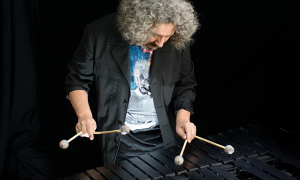
Four-mallet vibraphonist—and Cleveland native—Cecilia Smith was commissioned to compose a work that would foster a collaborative effort between local artists, students and faculty at Tri-C. The result was Crossing Bridges, an inter-media piece of jazz, cinema and spoken word that had its premiere this night at the Ohio Theatre. Backed by three video screens and a set representing the iconic buildings of Cleveland's skyline, Smith anchored a big band that also featured saxophonist Bill Pierce and trumpeters Cecil Bridgewater, Sean Jones and Dominick Farinacci. The music rose and fell with the cinematic sweep of a Terence Blanchard score, as it linked and lifted eight stories told through video and/or live action. With an eye on inner-city blight and social decay, the stories used humor, pathos, stats, anger and triumphant joy to tell of the separations that plague modern life.

Crossing Bridges
One story began with a seven-year-old black girl taking the stage in a pink dress to recite the grim, daily reality of living in the projects. A slightly older girl followed in a slightly more rose-hued dress, representing the same character at age nine, her troubles now a bit more dire, the reality of inner-city womanhood becoming more personal. And so she aged, her dress deepening in red, her troubles mounting, but her will and drive never diminishing. These latter qualities would see her through teenage pregnancies and dead-end, minimum-wage jobs up an academic sweep through college to a stable, rewarding marriage and optimistic future. While a simple tale, it was saved from triteness by the powerful, singular presence of each of the actors on stage. Their harsh reality stood in stark contrast to that seemingly palatial one faced by the young adults projected on the video screens at the show's open and close, their collegiate faces subjected to gentle Warholian "screen tests."
Other tales, such as that of a neighbor known in his community only through rumor and dark, speculative imagination or of the teenage suburbanite slumming in the ghetto to score the city's best barbecue sauce, were more open-ended. But, as the work's title suggests, the whole was a stirring call to action to cross divides (be they economic, social, political, racial, cultural, et. al.) wherever we might find them. To go out and make a difference.
April 30: Roy Haynes and Randy Weston
Randy Weston opened the show at the Tri-C Metro Campus Auditorium with a rousing series of solo piano compositions. Citing the heavy influence African music has had on his art, Weston employed an active left hand to add a deep rhythmic pulse to his playing. Taking the influence further back, he introduced "Blue Moses" (see video excerpt below) with the observation that "Mother Nature was swinging before man ever arrived." He grouped "Berkshire Blues," "High Fly" and "Little Niles" to stirring effect, and closed with a roaring, swinging "improvised tribute" to Fats Waller, Duke Ellington, Dizzy Gillespie and Thelonious Monk.

Roy Haynes' Fountain of Youth Band
His fellow octogenarian Roy Haynes then took the stage with the decidedly younger—though no more vibrant—members of his Fountain of Youth Band. Saxophonist Jaleel Shaw often led the way with quick bop lines that fed the aggressive piano work of David Kikoski and clean, springing bass solos by David Wong. Haynes opened the group's fifth number alone, mastering time and space with a pair of mallets, but mostly he preferred to hang back and give his mates time to stretch. Still, his presence was always felt—rich, banging and varied—showing why he's been the drumming choice for so many musicians over the past 60 years.
May 2: Bill Ransom: Jazz Meets Hip Hop Part VII
The festival moved to the basement-like, red-lit confines of the Grog Shop for a late-night session of its annual "Jazz Meets Hip Hop" show. Drummer Ransom was joined by saxophonist Keith McKelley, bassist Joey Green, guitarist Dan Wilson, keyboardists Theron Brown and Kenny Bell and DJ e.react to create a street-smart wall of sound fronted by MCs/poets ZiON, aLIVE and Q. Nice. Their pieces, often anchored by the choral repetition of emphatic, triumphant or dance-centered pronouncements like "I Shall Proceed," "Burn It Up" and "You Will Never See No Other Like Me," were mostly hard, funky, body-shaking affairs built on group improvisation and solo statements alike. Q. Nice turned in an impressive next-generation rap-scat on his "Mr. Beat Man," backed only by drums and bass. e.react worked his turntable and effects into a sweaty lather on "You Will Never See No Other Like Me," matching the heat blowing from McKelley's sax across stage. And Wilson brokered a tasty fusion bridge—twining old-school jazz, funk and R&B—over a break in "I Wouldn't Have It Any Other Way." The highlight, though, came when the group was joined by guest Sean Jones and his trumpet (see video excerpt below). Taking off from an inspired McKelley sax solo, Jones bent back and blew a crater through the pipe-lined ceiling. His high-register screams sent shock waves around the bandstand, as each musician soaked up a bit of Jones' fire and spit it out at the audience.
May 3: TCJF SoundWorks
Formed especially for the Tri-C JazzFest by two local jazz titans, saxophonist Howie Smith and bassist Glenn Holmes, TCJF SoundWorks took its maiden flight at the Reese Center with a tribute to the music of McCoy Tyner, who played at Tri-C's inaugural festival in 1979. Filled out by trumpeter Sean Jones, pianist Chip Stephens, trombonist Chris Anderson, saxophonist John Klayman and drummer Paul Samuels, the group ran through Tyner music from the 1960s and 1970s, using fresh charts and full-throttle improvisation.

Sean Jones
From his opening, screeching salvo, Jones continually shot back the heads of his bandmates, surprising and impressing them as much as the audience. Stephens flamed mad, spiraling solos from dissonant, block-chord constructions in the Tyner mode. Smith, who was presented with the 2009 Cleveland Jazz Legend award before the concert, worked the sax lineage as is his wont, employing baritone, tenor, alto and soprano voices in his frenetic, leaping statements. Bassist Holmes often used his solos as space- and time-stretching exercises, tempering the sizzle of his mates with musings of deep and economic wisdom. Samuels had his moment on "Elvin (Sir) Jones," filling the titular drummer's shoes with a loud aggressive attack that drilled the rock of this subterraneous rendering—Smith's baritone subbing for Tyner's keys and Anderson's trombone taking over for Ron Carter's bass. And Klayman's second sax stitched the music with a strong bop underpinning. All told it was a highly successful birth for the festival's new "resident ensemble" and, as such, bode well for the event's continued artistic growth over the next 30 years.
Photo Credit
Matt Marshall
< Previous
Already Live (EP)
Next >
Being Dufay
Comments
Tags
For the Love of Jazz
 All About Jazz has been a pillar of jazz since 1995, championing it as an art form and, more importantly, supporting the musicians who create it. Our enduring commitment has made "AAJ" one of the most culturally important websites of its kind, read by hundreds of thousands of fans, musicians and industry figures every month.
You Can Help
To expand our coverage even further and develop new means to foster jazz discovery and connectivity we need your help. You can become a sustaining member for a modest $20 and in return, we'll immediately hide those pesky ads plus provide access to future articles for a full year. This winning combination will vastly improve your AAJ experience and allow us to vigorously build on the pioneering work we first started in 1995. So enjoy an ad-free AAJ experience and help us remain a positive beacon for jazz by making a donation today.Near


Giveaway

Days remaining: 4