Home » Jazz Articles » Live Review » April Jazz Espoo 2009: Day 3 - 5
April Jazz Espoo 2009: Day 3 - 5

As jazz critic Jukka Hauru of the major Finnish daily wrote, 'this music reveals everything that is best under the contemporary jazz rubric--development, improvisational intensity, emotional variety, and more!'
April Jazz Espoo
International Jazz Festival
Tapiola, Espoo, Finland
April 22-26, 2009
Day 3
Friday was the night of major artists, hosting on three separate stages the Portuguese fado singer Ana Moura, local jazz pianist turned funk/soul crooner, Tuomo Prättälä sharing the bill with British hip-hopper Us3, and at the third venue (the Louhi Room) Garland Jeffreys with his Blues Night.
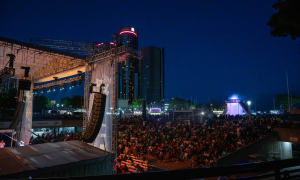
To my regret, and at the expense of my love of the doleful wail of Portuguese guitar, I missed the fado concert of Ana Moura. What is certain is that the audience included a clutch of performers from the same festival, one of whom probably made a discreet exit to start his own show shortly after the start of Moura's—Tuomo Prättälä. Having served his time as a member and major contributor to both Quintessence (the Finnish one) and Ilmiliekki Quartet, Prättälä has now released two well-received solo albums, establishing himself as a singer and song-writer of material reminiscent of Stevie Wonder's work, in addition to his talents as pianist and instrumentalist. Performance in this large, noisy corporate tent would have been a challenge for a solo artist, so in addition to Prättälä's wealth of experience he had the support of a 7-piece band, including his old band-mate Verneri Pohjola.
Likewise the second band on the stage could draw on experience, this time that of one of its founder members, Englishman Geoff Wilkinson. Building on the success of its 1992 single "Cantaloop (Flip Fantasy)," which utilizes Herbie Hancock's piano from "Cantaloupe Island," Wilkinson has continued under the Us3 banner to provide beats on records with various singers and supporting musicians. Earlier, these often featured samples from Blue Note discs, but time has seen the development of a straight-ahead style of rap with Wilkinson—a keyboardist, a scratcher and a bassist at back—fronted by two New York rappers: Brook Young and Sene. These two worked each other and their audience hard, their efforts going down well with the gaggle of young dancers in front of the stage.
In the Louhi Room Garland Jeffreys also worked his audience and his four touring musicians hard with a varied menu of styles and skills. The man has sung with the likes of Lou Reed and Bruce Springsteen, and the experience shone from under his pork-pie hat. His repertoire of sometimes sleazy, sometimes upbeat songs went down well with the late night audience, as the blues always does. He's a man of many sides with songs of just as many colors and moods.
Day 4
This day started in mid-afternoon with a very reasonably priced children's concert featuring four women singing stylish a cappella with an obvious focus on youth. This concert was run concurrently with a second workshop provided free-of-charge to all comers. With its guitarist leader Marzi Nyman, himself no stranger to playing programs for toddlers, the festival organizers spread their attraction wide. However, it's only with the willing participation of the local populous that festivals like this can succeed. The way to ensure success is also to feature truly popular stars, which was the story of the main evening concert.
Salif Keita is known as "the golden voice of Africa," and his reputation is well established in this northern corner of Europe too. His concert in the main hall was sold out with an audience as varied as any metropolis might see. More than any Finnish spectator might expect, this artist provoked the typically passive audience to unusual excess: despite the formal concert environment, the set ended with dancing—in the aisles and even onstage with the artists. His mix of traditional African instrumentation (djembe, kora, udu and more) with superlative vocal arrangements was clearly appreciated across a broad spectrum of listeners.
Equally renowned in its hometown is the Five Corners Quintet, a long established bebop revival band with a twist. The group's trademark sound is the work of its founder saxophonist Timo Lassy and his skill in rebirthing the style of the greats into the electronic age—not by adding electronics, but by finding inspiration in the beats and burps of electronic sound, and reworking it into an acoustic format. The tent audience was probably little interested in these technicalities, their groove-rooted gig being well received by all. Likewise veteran maestro Al Jarreau found a welcoming reception for a long set of his evergreen standards.
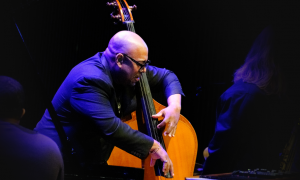
The sizzle this evening definitely originated outside the Anglo-Saxon or African world, though still on the continent of Europe. Megaoctet is as much a troupe as a band comprising nine French males who share few apparent similarities. Here are no matching suits or ties, but acceptance of the leadership of pianist, and composer Andy Emler is one feature which binds them. More important is their shared commitment to both individual instrumental excellence and experimentation. Playing pieces structured to maximize opportunity for improvisation, the ensemble made visual contact among all players the requirement for seamless exchanging of motifs and varied dynamics. Out front is a brass line of five players: three potential saxophones, one tuba and one cornet. Of these, only two of the saxophones were permanent, and normally both alto players. The tuba might be exchanged for a tenor euphonium, or a sax for a bass clarinet, and most dramatically the cornet for lead vocalizations.
Mederic Collignon started the show with simple breath sounds, which quickly transformed into animated rasps and then a whole galaxy of notes, noises, rhythms and voices, all from his own windpipes. The transitions from this level and from later onslaughts into full orchestration were not always easy, but this is definitely music meant to keep the audience guessing. Watching proceedings, from the back, like a hawk, Emler pulled various commands from behind his piano in close collaboration with the rhythm section of Tchamitchian and Echampard and multi-percussionist Verly, and the whole caravan lurched on up the next track. The destination was rarely immediately clear, but the journey was exciting and sometimes even serene. As jazz critic Jukka Hauru of the major Finnish daily wrote, "this music reveals everything that is best under the contemporary jazz rubric—development, improvisational intensity, emotional variety, and more!"
Day 5
By extreme contrast to the previous evening, and being Sunday, the journey from Helsinki was calm, with the sun glittering on the sea, seagulls wheeling, and even a hardened yachtsman out enjoying the chilly Baltic. Inside the tent the local music school hosted a concert starring its own pupils, Espoo City providing the first major stage experience for a large number of Finnish jazz and classical musicians. The country still lives in awe of its musical grandfather, and for many contemporary listeners Jean Sibelius was instrumental in challenging the boundaries between the classical and the modern. The youths involved in the midday concert were no strangers to the appearance of major artists in their midst, and this time they included pianist Lenny-Kalle Taipale, Marzi Nyman and more.
 At least all who follow in the seminal progenitor's footsteps benefit from the lack of borders between styles. This inclusiveness was most vividly shown in the festival's final concert, which saw decorated classical vioinist Pekka Kuusisto join forces with equally internationally-renowned Finnish pianist Iiro Rantala of Trio Tokeat.
Playing under the rubric Tangos from the Underworld, these two masters of their instruments took the title in a very different direction from the mayhem and majesty of the previous evening, weaving delicate paths of improvisational artistry around pieces by a gamut of composers. That their audience included a high percentage of blue rinses, dark slacks and Hilfiger shirts shows how broad an appeal is at the heart of a successful modern jazz festival, which April Jazz surely is. These two bastions of the Finnish music scene have charisma that transcends all genres, styles and ages. They can take a piece like Metheny's "Antonia" and toss it between each other, adding new cadences and inflections as they go, teasing the audience to follow. At one point in his solo offering, Rantala dedicated a new piece to another product of the Tapiola music scene, a musician who has recently passed away—bassist, composer and pioneer of Finnish jazz-rock, Pekka Pohjola. Juusisto followed by playing Bach's G minor Fugue, which he dedicated to Pohjola's father and local choirmaster Eero.
The musical baton has repeatedly passed across the genres and between the generations at April Jazz. That the audiences silently but attentively follows their artists down every rhythmic twist and melodic turn suggests that April Jazz has established a following that is still ready to trek every inch of the way in its pursuit of a very collective muse. April has come to signify not merely a seasonal but a musical rebirth on these shores of the Baltic.
Photo credit
Lauri Salo
Tags
PREVIOUS / NEXT


Become a Sustaining Member

Since 1995, All About Jazz has championed jazz as an art form and supported the musicians who create it. Over three decades, it has grown into one of the world's leading jazz resources, serving hundreds of thousands of readers, musicians, presenters and industry professionals each month.
Help Build the Future of All About Jazz
Your support helps us continue building All About Jazz for the next generation—expanding our editorial coverage, preserving jazz history, developing new community features and creating better ways to discover the music and the people behind it.
Become a sustaining member for as little as $20 per year and you'll immediately enjoy an ad-free experience along with access to subscriber features and future articles for a full year.
Together, we're not simply sustaining All About Jazz—we're building its future. Thank you for being part of the journey.