Home » Jazz Articles » Big Band Caravan » Mike Vax Big Band / Dave Siebels / Phil Woods / London Horn Sound
Mike Vax Big Band / Dave Siebels / Phil Woods / London Horn Sound

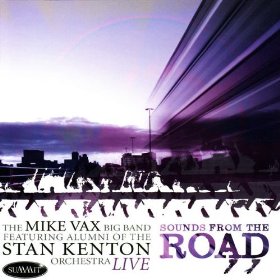 Mike Vax Big Band
Sounds from the Road
Summit Records
2009
As Bob Hope and Bing Crosby entertained millions with their "road" movies in the 1940s, so the Mike Vax Big Band has its own "road show," arguably as entertaining but playing to much smaller audiences than Hope and Crosby were able to command. Sounds from the Road is the third album by Vax and his stalwart bus-riding companions, documenting their annual travels to various parts of the country in what one hopes will continue to be an ongoing series of vignettes from one of the USA's few remaining big-band "travelogues."
A number of things make Sounds special, not least of which is the appearance on four selections by the great (and greatly missed) composer / arranger / pianist Bob Florence who passed away on May 15, 2008, four days after the band completed its tour of seven Midwestern states, a trip that Florence was unable to take part in owing to his illness. Three of the tracks on which Florence performs were recorded during an earlier visit to Houston, TX, and the "bonus" number ("All the Things You Are") at a concert in Los Angeles.
Another hallmark of Vax's band is the presence of alumni from the renowned Stan Kenton Orchestra, no less than a dozen of whom (including Vax himself) help reinforce the ensemble. One of them, trombonist Dale DeVoe, wrote the engaging opener, "Alex's Tune," which features baritone saxophonist Keith Kaminski, trombonist Scott Whitfield and trumpeter Steve Huffsteter who composed and arranged "Mr. Natural" (spotlighting tenor Alex Murzyn) and "Boney" (featuring Florence's ever-graceful piano and his own shapely flugelhorn). Vax and tenor Pete Gallio enhance Rafael Mendez's "La Virgen de la Macarena," while Gallio and drummer Gary Hobbs do likewise on Bennett Friedman's lyrical "Variations on a Brazilian Folk Song." Johnny Mandel's picturesque "Seascape" was arranged by alumnus Kim Richmond whose luminous soprano sets the tone.
Kenton arranged the standard "I'm Glad There Is You," Lennie Niehaus "Pennies from Heaven" and "Baubles, Bangles and Beads," John Boice "Autumn in New York" (showcasing Carl Saunders' breathtaking trumpet work), Bob Curnow "Oblivion" (trumpet solo by Dennis Noday), Bill Holman Ernesto Lecuona's fiery "Malaguena." There is one vocal, by Whitfield and Ginger Berglund, on Frank Loesser's playful "Slow Boat to China."
As is the case with most such endeavors, allowances must be made for some variation in sound and balance. Even though nothing here is less than adequate, occasional acoustic lapses are perceptible, most particularly on "La Virgen," "Oblivion," "All the Things" and Florence's piano on "Boney." The album's many assets, however, easily outweigh its sparse liabilities. If you appreciate the sound of a big band in its natural habitat, blowing with abandon, Sounds from the Road should pave the way to exhilaration and happiness.
 Dave Siebels
With Gordon Goodwin's Big Phat Band
Self Published
2009
Hard on the heels of four fast-selling CDs and three Grammy Award nominations, it seems as though Gordon Goodwin's irrepressible Big Phat Band has finally gotten "organ-ized." The catalyst and marquee name is Dave Siebels, an award-winning keyboardist, composer, arranger and record producer whose spicy Hammond B-3 garnishes each of the ten selections on this sharp and colorful studio session.
Besides playing, TV / film arranger / conductor and jazz fan Siebels wrote seven of the album's songs, the same number on which the Big Phat Band is present and accounted for. The others are tastefully performed by a trio (Neal Hefti's "Girl Talk"), quartet ("I Love You Even More Again") and quintet ("Sort of Like a Samba"). Siebels scored those three as well as Lalo Schifrin's "The Cat," while Goodwin arranged the others. Completing the program is Stevie Wonder's funky "I Wish." Siebels is an effective if not especially visionary writer whose most persuasive anthems are the easy-riding "Coupe," playful "Da Blues" and assertive "Eleventh Hour."
As most people must know by now, the Big Phat Band is a world-class ensemble whose impressive soloists on this date include alto saxophonist Eric Marienthal, tenor Brian Scanlon, trombonist Andy Martin, guitarist Grant Geissman and flautist Sal Lozano. Goodwin's hard-edged tenor is out front twice, on "I Wish" and "Eleventh Hour." Siebels, as noted, solos on every number and is invariably engaging, which equably describes the album as a whole. A clear winner no matter whose name appears first in the batting order.
 Phil Woods
The Children's Suite
Jazzed Media
2009
And now, as John Cleese used to say on the Monty Python television series, for something (veering toward) completely different. Yes, The Children's Suite by renowned alto saxophonist Phil Woods and his Pennsylvania-based big band was inspired by the verses of A.A. Milne (creator of Christopher Robin and his furry friend, Winnie-the-Pooh); yes, there are vocals and / or narration on every number; and yes, the lyrics by Milne are especially geared to elicit a positive response from children. On the other hand, anyone who supposes that Woods' arrangements have been "dumbed down" to accommodate a younger audience will soon be disabused of that notion. This is high-grade contemporary jazz, as sharp and swinging at times as one could envision. Woods, who has spent more than four decades committing Milne's words to music, wouldn't have it any other way.
The vocals are by Vicki Doney, whose limpid little-girl voice is perfectly suited to the spirit of the enterprise, and / or veteran Bob Dorough (who doubles now and then on piano), the enchanting narratives by British actor and jazz fan Peter Dennis, who has presented his one-man show, Bother!, also based on Milne's works, in theatres throughout England and America. Without Dennis the CD might never have happened, as it was he who interceded on Woods' behalf with the Milne estate and the Walt Disney Corporation, which owns the rights to Milne's literary handiwork, and secured permission to record Woods' charts. In 2007, the orchestra was recruited from among professionals teaching at the 30th anniversary observance of the Delaware Water Gap Celebration of the Arts (COTA), an organization co-founded in 1977 by Woods and the late Ed Joubert, and recording dates were set.
It was years earlier, in 1961, on his return from a trip to Europe, that Woods happened upon his children's Milne books and said to himself, "These would make great songs." As he usually is, Woods was squarely on the mark, and the 14 selections on The Children's Suite are bright and charming, as are his tasteful arrangements, several using a four-piece string section, the others a more conventional big band format. Besides Woods (dig his deep but uncredited footprints on the jaunty "Morning Walk") and Dorough (electric piano on "Pinkle Purr"), the admirable soloists include alto Nelson Hill, tenor Tom Hamilton, baritone Roger Rosenberg, trumpeter Ken Brader, trombonist Rick Chamberlain, guitarist Mark Williams, bassist Steve Gilmore and Vicki Doney's husband, pianist Eric Doney (dazzling on "Furry Bear" and "Solitude").
So is The Children's Suite for children? The simplest answer is, yes and no. Or to put it another way, the album should please children of all ages (even those who are fully grown). Woods has seen to that. The suite is one part whimsy, one part wisdom, one part virtuosity, one part lyricism, and last but not least, one part sophisticated big-band jazz. That should be enough to please almost anyone. And with Woods as kingpin and catalyst, one may rest assured that there's no shrinkage in the area of quality control.
 London Horn Sound Big Band
Give It One
Cala Records
2009
Here's an intriguing concept for a big band: French horns and rhythm. Nothing else; that's it. We're not talking about two or three French horns ("Freedom horns," as the Bush administration would have renamed them) here but as many as six to 16 at a time, accompanied by piano, bass and drums, in a program that includes jazz and popular standards as well as a number of original compositions by the horn players themselves.
Where do all those horns come from? Simply put, from symphony orchestras and institutions of higher learning. And why jazz? Well, why not? Even though the French horn is seldom looked upon as an integral part of improvised music, a number of players have managed to earn reputations as credible jazz performers, starting with Julius Watkins and including John Clark, Thomas Varner, Adam Unsworth and a few others. The London Horn Sound Big Band, conducted by Geoffrey Simon, numbers horn virtuosos who have or are presently playing with some of the UK's most celebrated orchestras including the London Symphony, BBC Symphony, the London and Royal Philharmonics, the London Chamber Orchestra, the Academy of Ancient Music, Academy of St. Martin in the Field, the English Concert, Royal Opera House Covent Garden and London Festival, among others. Gwilym Simcock is an award-winning pianist who leads three of his own groups, has backed an array of well-known artists from Dave Holland and Lee Konitz to Bob Mintzer and Norma Winstone, and happens to double on French horn (on which he solos on his own composition, "Blues for Hughie").
What does all this sound like? Basically, like a large number of French horns performing in front of a rhythm section. What else would one expect to hear? That's not to imply that the music is less than resourceful and entertaining, only that there are enough French horns assembled to please even the most zealous Francophile. The jazz soloists—Simcock, Pip Eastop, Richard Bissill and Jim Rattigan—certainly coax the most out of their horns, even while inadvertently exemplifying why the instrument has never quite made the A-list when it comes to spontaneous blowing. Still and all, there are moments of excitement, beauty and surprise, such as sixteen horns and rhythm coming to grips with Maynard Ferguson's volcanic "Give It One" (solo by Eastop). Among other highlights: "The Trolley Song," "God Bless the Child" (much better without the lyric), Ellington / Strayhorn's "Daydream," Bissill's "Los Jaraneros" (guitar and marimba added), Rattigan's rhythmic "Caseoso" (on which he solos), Timothy Jackson's rondo, "Three Point Turn," Marvin Hamlisch's "The Way We Were" (arranged as a chorale by Simcock) and the swift and groovy "Blues for Hughie" (with Simcock and Eastop imparting the album's most indelible solo statements).
Although recorded in a studio, the CD has a reverberant "concert hall" sound that smartly underscores its unorthodox instrumentation. Simcock, bassist Sam Burgess and drummer Martin France are sturdy and unwavering, while the horns are as pliable as horns can be. In sum, a generous banquet for French horn lovers.
 Count Basie
Mustermesse Basil 1956, Part 1
TCB Records
2009
There was at least one thing that all the best-known ensembles of the epic big band era had in common: an explicit personality. Count Basie, Woody Herman, Duke Ellington, Stan Kenton, Jimmie Lunceford, Glenn Miller, Harry James, the Dorsey brothers—each one placed a unique and memorable stamp on the music, leaving no doubt after a few brief measures about whose band was in the spotlight. And each band had—and has—its champions, those who place its singular blueprint at the pinnacle of big band supremacy.
Those who place the Count Basie Orchestra above all others won't find much that is displeasing on Volume 19 of TCB's Swiss Radio Days series, Mustermesse Basil 1956, Part 1. This is the Basie ensemble at its high-powered zenith, dissecting works by Neal Hefti, Ernie Wilkins, Frank Foster, Frank Wess, Bill Doggett and others, galvanized by a stellar troupe of all-stars that includes saxophonists Foster, Wess and lead alto Marshal Royal, trumpeters Thad Jones and Joe Newman, trombonists Henry Coker, Benny Powell and Bill Hughes (present leader of the Basie "ghost band"), guitarist Freddie Green, bassist Eddie Jones, tireless drummer Sonny Payne and the incomparable Kid from Red Bank himself at the keyboard.
After opening with Hefti's hard-swinging "You for Me," the band outflanks Foster's "Shiny Stockings," Hefti's "Cherry Point," Wilkins' "Sixteen Men Swingin'" and Doggett's "Eventide" (featuring baritone Charlie Fowlkes) before moving on to Mario Bauza's impassioned "Mambo Inn" and the potent "Blues Backstage" (misidentified in the tray as "Backstage Blues"). Wess is showcased on his original composition, "Flute Juice" (after a fabulous intro by Basie), Coker on Jerome Kern's "Yesterdays," Jones on the aptly named "Eddie Jones' Blues," the postscript to a thoroughly engaging concert.
Even though the orchestra is swinging from fore to aft, it would be remiss not to observe that the sound, albeit for the most part reasonably balanced, is fairly typical of what was produced at concerts in the 1950s; that is to say, not what one would expect from today's superior recording systems. But after the first few bars of "You for Me," one quickly adapts to it as the music transcends any sonic hindrances. A concert well worth hearing for the first time and for many times thereafter.
 Tom Dossett
Visiting Old Friends
Self Published
2009
Visiting Old Friends is comprised of a series of compositions and arrangements written by Tom Dossett over the course of a long and successful career in radio, television, stage, film and production, embracing a range of musical genres from classical, jazz and rock to country, sacred, blues and Latin. The various numbers were culled from studio recordings, live performances and demos that have been remastered for CD release. As a result, no performance dates or other details are given, nor is there a list of personnel. According to Dossett, many of the musicians were members of the one-time Texas-based Lou Fischer Big Band, while others are friends from the U.S. Air Force Falconaires in Colorado.
As none of the songs was presumably recorded at the same time, the sound is inescapably variable but seldom less than acceptable. As for Dossett's themes, they are for the most part pleasing albeit a few marks short of memorable. On the other hand, one must concede that the album gathers momentum as it moves forward, and that the four numbers following the abbreviated four-part "Suite for Bassett Hound" are its most impressive components. The last two, "Black Crystal" and "The Never-ending Blues," were recorded in concert, presumably by Fischer's band. They, along with "The Lonely Immortal" and "White Fawn" (which may also have been taken from live performances with applause expunged), swing hard and often, with robust statements by the unnamed soloists.
On the earlier numbers, Dossett favors a heavy-duty rock-influenced back beat to underline charts that sometimes veer toward the realm of "smooth jazz" while never actually crossing the divide, coming perhaps closest on track three, "My Search for Love," a feature for trumpet (or flugelhorn) and strings whose unhurried opening and closing testimony encloses a buoyant midsection. "Bassett Hound" is not without its charming moments either, especially on the lyrical third movement, "Easy Life."
In sum, this is a respectable if uneven glance at one writer's approach to big band jazz composition and arranging. There's no doubt that Dossett is talented, or that his essays are admirable, especially the last four. The sound, as noted, isn't state of the art, which some may find off-putting, but once past that liability the music is for the most part earnest and persuasive. Definitely worth a listen.
 Pedro Giraudo Jazz Orchestra
El Viaje
PGM
2009
As is true of many contemporary composers, bassist Pedro Giraudo writes with specific images in mind, in this case el viaje (the voyage), which, he writes, "can be about the landscape, about the destination, or the pure pleasure of movement." There's a little of all of them in the four-movement centerpiece of Giraudo's ambitious odyssey, on which he uses to their utmost the talents of his dozen teammates. The voyage opens leisurely on the wings of Jess Jurkovic's solo piano, unwraps the brass and reeds for an invigorating gallop, segues into a funky Latin tempo that devolves into an entrancing ballad, then ramps up the heat for a brisk canter to journey's end behind Will Vinson's full-bodied alto sax.
Guest Alejandro Aviles' clarinet sets the tone on the rhapsodic "Yarulina," on which Jurkovic also solos nicely. "Nachgeschmack," which follows, is a sturdy vehicle that smoothly enfolds trumpeter Tatum Greenblatt's pensive solo, while the ardent "Punto de Partida" provides solo space for trombonist Ryan Keberle and alto Todd Bashore. The voyage ends solemnly at "Hiroshima," whose tender theme is underscored by Carl Maraghi's bass clarinet. The album opens with trombones, ensemble and Giraudo's arco bass setting the stage for Avila's alto sax on "El Bajonazo," which, the leader says, describes the "deep excitement, fear and anxiety" the accompanied the news that he and his wife, Marianela, were expecting their first child.
Throughout El Viaje, Giraudo shows that he has mastered the fundamentals of writing for a large ensemble, keenly using dynamics, color and shifts in tempo to ensure one's heedfulness. The undersized ensemble is tight and steady, the soloists earnest and enaging. If some of Giraudo's tone poems overstep their spatial boundaries, that lapse is easily pardoned. The music, as noted, is resolutely modern, and should prove eminently pleasing to those whose voyage pursues that course.
 Southside Johnny with LaBamba's Big Band
Grapefruit Moon
Leroy Records
2009
While listening for the first time to Grapefruit Moon, vocalist Southside Johnny's earnest tribute to singer / songwriter Tom Waits, I was wondering with whom to best compare Johnny's husky, gravel-throated style. When Waits himself made a guest appearance on "Walk Away," the answer became obvious. He and Johnny sound like two peas in a pod, almost as if they could have issued forth from the same womb. Little wonder that Waits is not only Johnny's favorite songwriter but an old friend as well.
Johnny is accompanied on the album, recorded in four sessions, by trombonist / arranger Richie "LaBamba" Rosenberg's big band (or, more accurately, bands, as the personnel varies from session to session), comprised of a number of first-rate sidemen and women from the Pennsylvania / New Jersey area. The ensemble plays well in its backup role, providing ample power and elegance to complement Johnny's brusque, bluesy vocals. LaBamba's full-bodied charts are well-suited to their purpose, which is to house Johnny in the best possible surroundings.
As for the songs themselves, all written by Waits and Kathleen Brennan, they're worthy enough in their own way. If the lyrics generally failed to elicit a strong emotional response in these quarters, that's most likely a generational shortcoming and no fault of Waits, Brennan or Southside Johnny, for whom the recording was a labor of love. Those who are admirers of Waits' themes will know more or less what to expect from Grapefruit Moon; those who aren't may or may not be pleasantly surprised. That verdict will rest largely on their fondness for popular folk music spruced up in handsome big-band clothing.
Tracks and Personnel
Sounds from the Road
Tracks: Alex's Tune; Seascape; La Virgen de la Macarena; Mr. Natural; Pennies from Heaven; I'm Glad There Is You; On a Slow Boat to China; Boney; Baubles, Bangles & Beads; Autumn in New York; Variations on a Brazilian Folk Song; Oblivion; Malaguena; All the Things You Are (bonus track).
Personnel: Mike Vax: leader, trumpet, flugelhorn; Dennis Noday, Carl Saunders, Steve Huffsteter, Don Rader, Dan Fava (2, 8, 10): trumpet, flugelhorn; Kim Richmond: alto, soprano sax, flute; Pete Gallio, Alex Murzyn: tenor sax, flute; Keith Kaminski: baritone, alto sax, flute; Scott Peterson (2, 8, 10): baritone sax; Joel Kaye: baritone, bass sax, flute; Roy Wiegand, Dale DeVoe, Scott Whitfield, Curtis Fox (2, 8, 10): trombone; Kenny Shroyer: bass trombone; Mike Suter: bass trombone, tuba; Bob Kafka, Bob Florence (2, 8, 10, 14): piano; Chris Symer: bass; Gary Hobbs: drums; Dee Huffsteter: Latin percussion; Scott Whitfield, Ginger Berglund (7): vocal.
Dave Siebels
Tracks: The Coupe; Not That There's Anything Wrong with That; Da Blues; Girl Talk; I Wish; The Gospel According to Hammond; I Love You Even More Again; The Cat; Sort of Like a Samba; The Eleventh Hour.
Personnel: Dave Siebels: Hammond B3 organ; Gordon Goodwin: leader, piano; Wayne Bergeron, Dan Fornero, Pete De Siena, Dan Savant, Roy Wiegand (7, 9): trumpet; Eric Marienthal, Sal Lozano: alto sax; Brian Scanlon, Jeff Driskill, Ed Smart (9): tenor sax; Jay Mason: baritone sax; Andy Martin, Alex Iles, Charlie Morillas: trombone; Craig Ware: bass trombone; Grant Geissman: guitar; Rick Shaw, Michael George (7, 9): bass; Bernie Dresel, Dave Spurr (4, 7, 9): drums.
The Children's Suite
Tracks: The Good Little Girl; Come Out with Me; Sneezles; Pinkle Purr; Down by the Pond; Waiting at the Window; Buttercup Days; The Friend & Us Two; Furry Bear; Knight-in-Armor; Wind on the Hill & The Engineer; Solitude; The Morning Walk; In the Dark & The End.
Personnel: Phil Woods: conductor, alto sax; Ken Brader III: trumpet, flugelhorn; Bobby Routch: French horn, flugelhorn; Nelson Hill: alto sax, flute; Tom Hamilton: tenor sax, clarinet; Roger Rosenberg: baritone sax, bass clarinet; Rick Chamberlain: trombone; Eric Doney: piano; Mark Williams: guitar; Steve Gilmore: bass; Bill Goodwin: drums; Paul Peabody, Jeanne Farrer: violin; Juliet Haffner: viola; Mary Wooten: cello; Vicki Doney: vocals; Bob Dorough: vocals, keyboards; Peter Dennis: narrator.
Give It One
Tracks: Los Jaraneros; Not Like This; Give It One; Fat Belly Blues; The Trolley Song; Daydream; Caseoso; Three Point Turn; Lana's Lullaby; The Way We Were; God Bless the Child; Blues for Hughie.
Personnel: Geoffrey Simon: conductor; Richard Bissill: composer, arranger, horn; Jim Rattigan, Timothy Jackson: composer, arranger, horn; Angela Barnes, Nigel Black, Jeffrey Bryant, Anthony Chidell, Laurence Davies, Pip Eastop, Anthony Halstead, Nicholas Korth, Dave Lee, Jonathan Lipton, Frank Lloyd, Cormac O hAodain, Martin Owen, Christoper Parkes, Kathryn Saunders, Hugh Seenan: horn; Gwilym Simcock: composer, arranger, piano, solo horn (12); John Parricelli (1): guitar; Sam Burgess: bass; Martin France: drums; Chris Baron (1): marimba.
Mustermesse Basil 1956, Part 1
Tracks: You for Me; Shiny Stockings; Cherry Point; Sixteen Men Swingin'; Eventide; Mambo Inn; Blues Backstage; Flute Juice; Unknown Title; Blee Blop Blues; Yesterdays; Eddie Jones' Blues.
Personnel: Count Basie: leader, piano; Wendell Culley, Reunald Jones Sr., Thad Jones, Joe Newman: trumpet; Marshal Royal, Bill Graham, Frank Foster, Frank Wess, Charlie Fowlkes: reeds; Henry Coker, Bill Hughes, Benny Powell: trombone; Freddie Green: guitar; Eddie Jones: bass; Sonny Payne: drums.
El Viaje
Tracks: El Bajonazo; El Viaje; Yarulina; Nachgeschmack; Punto de Partida; Hiroshima.
Personnel: Pedro Giraudo: composer, arranger, bass; Jonathan Powell, Tatum Greenblatt: trumpet; Will Vinson: alto, soprano sax; Todd Bashore: alto sax; Luke Batson: tenor sax, clarinet; Carl Maraghi: baritone sax, bass clarinet; Ryan Keberle, Mike Fahie: trombone; Jess Jurkovic: piano; Jeff Davis: drums; Tony De Vivo: cajon, guiro. Special guest—Alejandro Aviles (1, 6): alto sax, clarinet.
Visiting Old Friends
Tracks: Starscape; Eye of the Sphinx; My Search for Love; Suite for Bassett Hound (Waggin' It / Chasing Squirrels / Struttin' My Stuff / Easy Life / Ears in the Wind); The Lonely Immortal; White Fawn; Black Crystal; The Never-ending Ending Blues.
Personnel: Unlisted.
Grapefruit Moon
Tracks: Yesterday Is Here; Down, Down, Down; Walk Away; Please Call Me Baby; Grapefruit Moon; All the Time in the World; Tango Till They're Sore; Johnsburg, Illinois; New Coat of Paint; Shiver Me Timbers; Dead and Lovely; Temptation.
Personnel (collective)—Richie "LaBamba" Rosenberg: arranger, conductor, trombone; Southside Johnny: vocals, harmonica; Tom Waits: composer, vocal (3); Mark Pender, Chris Anderson, Mike Spengler, John Barry, Stu Satalof: trumpet, flugelhorn; Frank Elmo: alto, soprano sax, flute; Baron Raymonde, Erik Lawrence: alto sax, flute; Jack Bashkow: alto sax, flute, bass clarinet; Jerry Vivino: tenor sax, flute, alto flute, clarinet; Sam Bortka: tenor sax, flute, clarinet; Timmy Cappello: tenor, soprano sax; Eddie Manion: baritone sax, flute, clarinet; Brian Pastor: trombone, conductor (3, 6); Nathan Mayland, Jeff Bush, Ben Williams, Clarence Banks, Art Baron: trombone; Matt Bilyk, Jonathan Shubert, Aaron Johnson: bass trombone; Marcus Rojas: tuba; Scott Healy: piano, harpsichord; Michael Mancini: piano; Glenn Alexander: guitars, mandolin, dobro; Mike Merritt: bass; Shawn Pelton: drums, percussion; Ray Marchica: drums; Jeff Kazee (12): Hammond B3 organ; Howard Johnson (5, 7): tuba; John Ballesteros (12): percussion; Sue Hadjapoulos (11): bongos; Sean Grissom (7): cajun cello; Charlie Giordano (10): accordion.
< Previous
Inventionen und Sinfonien / Franzosis...
Comments
Tags
For the Love of Jazz
 All About Jazz has been a pillar of jazz since 1995, championing it as an art form and, more importantly, supporting the musicians who create it. Our enduring commitment has made "AAJ" one of the most culturally important websites of its kind, read by hundreds of thousands of fans, musicians and industry figures every month.
You Can Help
To expand our coverage even further and develop new means to foster jazz discovery and connectivity we need your help. You can become a sustaining member for a modest $20 and in return, we'll immediately hide those pesky ads plus provide access to future articles for a full year. This winning combination will vastly improve your AAJ experience and allow us to vigorously build on the pioneering work we first started in 1995. So enjoy an ad-free AAJ experience and help us remain a positive beacon for jazz by making a donation today.

Giveaway

Days remaining: 7