Home » Jazz Articles » Live Review » The Kidd Jordan Trio in Amherst, MA
The Kidd Jordan Trio in Amherst, MA
Magic Triangle Series
Bezanson Recital Hall
UMass Amherst, Amherst, Massachusetts
Febrary 26, 2009

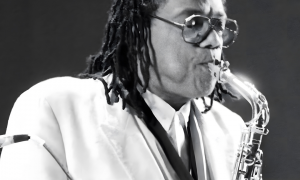
During one of the most tempestuous winters in memory, the twentieth season of the Magic Triangle Series at UMass Amherst began with the highly energetic performance of the Kidd Jordan Trio: Kidd Jordan on tenor, William Parker on upright bass and flute, Hamid Drake on drums, percussion and frame drum.
The producer of the series, Glenn Siegel, announced the players and prepared the audience to expect one set. After rousing applause, the players came to the stage from behind the back wall. A hush blanketed the hall. With his left arm hugging the neck of the bass to steady it, Parker meanwhile applied resin to his bow. Drake settled on his stool in back of his drum set and adjusted his array of drumsticks. Moistening the reed in his mouthpiece by inserting it in his mouth several times, Jordan readied himself to play his glistening silver tenor saxophone.
Soon, Parker was bowing in a slow back and forth motion; Drake used his mallets to expand the timbre of the bass. As Parker deepened the bass tone, Jordan repeated the same mid-range note sharply. The improvisation was beginning. The music was in the hands of three inimitable musicians whose group alliance demonstrated and substantiated the notion of spontaneous improvisation for anyone who might question its occurrence and effect.
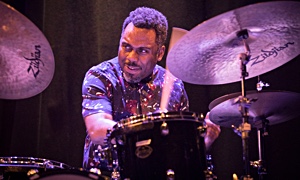
As Jordan pressed through, fingering up and down the register of his horn, Drake fell easily into his fluid address of his drum set. Parker dropped his bow into its carryall on the outside of the bass and plowed into pizzicatos. Drake flipped his mallets to their handles and used them to snap the snare and strike upwards on the hi-hats. The dance-like motion of his arms simulated the image of sound waves that resonated from his actions. He moved from snare to tom to snare to cymbal to hi-hat to form a continuous circle. Parker's endless energetic plucking did nothing but ground the three. All of Jordan's fingers wiggled their way up and down the sax, modifying the notes without imposing any indeterminate fluidity.

Jordan repeatedly reset the pitches in the central register of the horn and jousted with stop-and-go blurts to plug into any spaces in the sound that surrounded him. Then as the bass was plucked more rapidly and the drum sticks flew, Jordan charged through to the highest register of the tenor and, just as quickly, dropped immediately down. That deep tone catapulted him to a register leading to a piercing of the air, extremely high pitches alternating with low tones, before he adopted a slower tempo. Throughout the entire climb, Drake played the drums with a constant insistence, his sticks the extensions of the lithe arabesques outlined by the dancer-like movement of his arms. Parker was no less assiduous as he plucked the bass strings.
The sound each musician produced was tightly interconnected with that of the other two. In no better way could this extemporaneous groove, incapable of being represented by conventional notation, have been measured than at the point at which Jordan stepped out of the mix because he had split his reed. Drake and Parker found themselves in a duet. The tide shifted. The pair suddenly was in a more demanding situation; they had lost the third string in their musical fiber.
After Jordan regained sound capability with his horn, the music turned the corner, finding a bluesy minor key. But the incessant tenor progressions continued. The drums and the bass translated the tenor's musical line, and the tenor seized the nature of the drum or bass sounds. At one point the trio found a synchronized pulse. And way down the line, deep into the set, Jordan broke his own rules of staying away from melody by embracing "Sometimes I Feel Like A Motherless Child," along with a little bit of Ray Charles.
But it was within the multiplicity of different sounds that the character of the trio was forged. It was if a gift from an unknown source had been opened, and out of that package radiated a myriad of sounds that were meant for each other's company, an occasion during which an unanticipated blend was born—a mixture of dissonance, squealing, thematic riffing, tremolos, fluttering vibratos and arpeggios on the horn, all methods to approach the highest of pitches; of snaps, sharpness, sibilance, muted rattling, softness and faultless polyrhythms from the drums; of the depth of finger-plucked tones, drawn-out two-bow scraping, and split- string bent pitches from the bass.
The set sprouted and developed out of the changes: changes in the dynamics, in keys, in the textures, in the phrasings. At one juncture, Jordan was stretching his high pitches and altered the way he played them upon the entrance of discrete bowed strokes from the bass; then with two slurred notes, lower in pitch, Jordan echoed Parker's unique articulations until the two sounds were synchronized. From this mating, Jordan slid through hundreds of successive notes and Parker, still using the bow, fingered one glissando after another, echoing Jordan.
 Finally, as Drake started to tap the frame drum, the tempo decreased and the pitches from the horn descended with Parker responding to the changes by stroking his low-register strings with two bows. Soon, whistling sounds came from the tenor; Parker began to play a wooden flute first, then switched to a double-reeded Oriental horn to match the tenor's coloration; Drake's left-hand fingers tapped one rhythm while his right hand supplied another on the frame drum, the entire texture of the music evolving spontaneously and organically into a creation unlike anything that had preceded it.
The changes were suggestive of the different chapters in a continuous and unified story—a musical one, the preparation of which, more than any rehearsal, was the lives and experience of the three musicians. For artists of this stature, the "rehearsal" is life experience that has occurred in countless concerts in numerous venues and which is documented in as many recordings, both on location and in studio. Rather than a practice room, the preparation for this trio originates in three different habitats: New York for Parker, Chicago for Drake, and New Orleans for Jordan. The commonality of years of practice, performance and teaching is the rehearsal.
Yet, linked to the life experiences of each musician is a form of "internal preparation," a quality of mind capable of shaping spirits and souls, as the musicians so aptly pointed out during an interview broadcast before the performance. The statements of each implied that what turns lives around, changing them the most, is also what has been internalized the most. Jordan met Charlie Parker on the same day that he met his future wife, with whom he has seven children. Birds singing, dogs barking, children playing in the streets of the Bronx and the sound of only one note resonating through the universe become the seeds for Parker's musical imagination. And for Drake, even harmony, rather than being spawned from theory, rises out of how he is actually feeling.
Without diversity and its melding, cultural richness such as that embodied by this trio would not be possible. The sensitivity among Jordan, Parker and Drake allows the three to build and share their art—as a kind of "hybrid" life form in which the historical and the transcendent are never at odds. The common habit is to experience life as though all were determined by rigid and relentless cause-effect logic. But these three seem to be saying that it is possible to create and experience unpremeditated bliss even as we exist as historical beings in time.
Photo credit:
Lyn Horton
About Kidd Jordan

Tags
PREVIOUS / NEXT

Become a Sustaining Member

Since 1995, All About Jazz has championed jazz as an art form and supported the musicians who create it. Over three decades, it has grown into one of the world's leading jazz resources, serving hundreds of thousands of readers, musicians, presenters and industry professionals each month.
Help Build the Future of All About Jazz
Your support helps us continue building All About Jazz for the next generation—expanding our editorial coverage, preserving jazz history, developing new community features and creating better ways to discover the music and the people behind it.
Become a sustaining member for as little as $20 per year and you'll immediately enjoy an ad-free experience along with access to subscriber features and future articles for a full year.
Together, we're not simply sustaining All About Jazz—we're building its future. Thank you for being part of the journey.