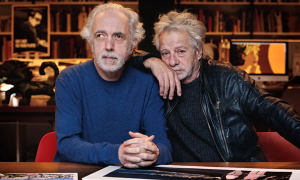
Home » Jazz Articles » Interview » Craig Taborn: Suggesting Textural Dimension
Craig Taborn: Suggesting Textural Dimension

One of the fruits of his labors has been recognition by the forward—hearing ears of one Matthew Shipp, curator of Thirsty Ear's Blue Series, who facilitated the recording and release of Craig's cutting-edge acoustic piano trio project, Light Made Lighter in 2001, to critical acclaim across the spectrum of the jazz community. Craig's knack for multi-level, textural thinking, both in composition and execution, reveals itself to the listener in acoustic, electric and electronic settings and should continue to place him at the very center of modern jazz reinvention for many years to come.
Our recent conversation caught him just prior to taking to the road for a European tour with drummer Susie Ibarra's trio. It also catches him on the initial thrust of his creative effort towards his next offering for your Thirsty Ears; an electric record, which, if his past efforts in the genre are any remote indication, should go a long way towards propelling Craig's intensifying star into a new orbit.
All About Jazz: So you're from Minneapolis originally, and started playing quite young?
Craig Taborn: Not that young, really. When I was about twelve.
AAJ: Pretty serious pretty fast?
CT: Well, in terms of improvising and playing jazz, I knew I was interested in doing that.
AAJ: I read you started off playing electronic keyboards and acoustic piano at the same time.
CT: Yeah. My parents got me a Moog, sort of right away as a Christmas present. So I was exploring that.
AAJ: I was interested to read you grew up with Reid Anderson and Dave King.
CT: Yeah, we were from the same neighborhood
AAJ: I am a fan of yourself, Happy Apple, The Bad Plus and Reid Anderson's recording The Vastness of Space and was surprised to find out you all came up in Minneapolis. You must have had a good jazz program in the schools or something was going on with the water there.
CT: It definitely wasn't a jazz program. I don't think any of us... there was no institutional thing, we just all kinda got into music at the same time. That's sort of how we knew each other. It was more because we were all playing. We would have been at the same high school, but I went to a private school. Dave went to an arts track at this other public high school. It was the same social scene effectively.
AAJ: Well, not to belabor the connection but you have such a unique playing and composing style and Dave's thing is so slamming and so different and Reid is such a great new composer—it's just amazing the sort of common lack of influences you guys display if you ask me. You're all just really new voices.
CT: That's nice to hear. I think coming up where we did and how we did and having the influence of each other was a piece of that, just because we all listened to a lot of different sorts of musics. We didn't have the concept of a specific scene or a specific place we were trying to fit into. We were making it up as we went along in terms of what even playing music was or improvising or anything. We all went different ways during the college years but we all kinda went with that and all came out sort of different. Definitely, individualism was part of the concept—finding your own way to do certain things.
AAJ: After that I read you landed at UMichigan and almost immediately hooked up with Gerald Cleaver, right?
CT: Yeah he is one of the first people I met there.
AAJ: I thought Gerald's record was one of the best of last year, and just a total all-star team there. The way you guys are hearing each other-the listener can hear you hearing each other. It seems like there's so much time between the notes and you're all interacting with each other just so full-on.
CT: Definitely.
AAJ: Let's talk about that transition to U Michigan.
CT: I was looking for somewhere with a music program, even though I ended up not availing myself of the program there. My original idea was to go into a liberal arts thing and eventually get into a composition program but I never did. I went to Ann Arbor because there was some interesting stuff going on there, especially with the composition faculty, and it was close to Detroit, and that was always my goal, to have someplace where I could have some access to a jazz community, in an urban sense, and also study.
AAJ: Is there someone there who is really well known for composition?
CT:At the time they had William Bolcom and William Albright. Big prize-winning contemporary composers were around there then. That was a big draw for me.
AAJ: We're talking contemporary classical then.
CT: Yeah. Pulitzer prize winners. Pretty big names but pretty contemporary. They're still relatively young composers.
AAJ: So you had a classical interest.
CT: Yes. At the time I wanted to do a classical composition kind of thing, or just my own compositional thing, but it definitely had that type of information in it. But I just ended up exploring that kind of stuff aside from academia. I met Gerald really quickly, my first week there, trying out for the jazz ensemble so... he actually got me my first gigs.
AAJ: You guys are the same age?
CT: Actually he's a bit older than I am. I'm 32. Just because of the Detroit thing, the first gig I did-Gerald got me on a gig with James Carter and either Jaribu Shahid or Rodney Whittaker on bass-this was at a time when a lot of these people hadn't left Detroit and moved to New York. It was right when James moved to New York, in fact. So there were a lot of those people, of that age group, who were great players. Many of them are in New York now, but were still in Detroit then.
AAJ:: Everybody still has to move to New York, huh?
CT: Not everybody. Not Happy Apple. I don't think you have to actually. It can help or hurt. I know a lot of players who don't, and it's less of an imperative now. A lot of European players are staying put. I just happen to play with a lot of musicians who don't live in New York. To get on the map on a certain sense you do, but less and less so.
AAJ: Yeah, Columbia just picked up the Bad Plus, a Minneapolis band, with Dave, Reid and Ethan Iverson. Speaking of which, they put their first cd out on Fresh Sounds and you're on a new Fresh Sounds piece.
CT: I'm on the new Elvind Opsvik disc. I didn't even know him. It's called Overseas. Jacob Sacks is another pianist from southeast Michigan, a great player who is on the cd. Both Gerald and Tony (Malaby) were involved, so... Eivind just called me and had this idea for me playing organ on there. When I heard who was involved I said, "Sure, great..let's do it." That one came together that way. On Fresh Sounds, I'm also on Gerald's record. Chris Lightcap has two discs on Fresh Sounds as well. I'm not on his.
AAJ: But he's on yours.
CT: He's on the Light made Lighter disc, with Gerald. My trio has also included Reid in the past.
AAJ: I noticed that Jazztimes called Light Made Lighter a "Jazztronica" release in its latest issue on the jazz/electronica crossover thing. A bit of a mistake there, considering it's a great acoustic piano trio disc!
CT: Yeah, I have no idea-whatever. Maybe there's confusion because the record I'm working on now is electronic.
AAJ: Well, that's exciting. That should be killing.
CT: We'll see, but it's completely in progress. I'm writing and getting it together. I don't want to say too much but definitely Gerald's on it, and I wouldn't want to list anybody else until I've approached everybody and confirmed it all.
AAJ: Thirsty Ear is nicely changing up the musical map a bit. Do they kind of tell you what to do or anything?
CT: No, not at all. It's pretty hands off. I think they probably have some ideas about what they think will happen, but it doesn't really translate into specifics. I've never had them tell me anything to do. It's more curatorial than it is conceptual.
AAJ: Yes. They always make a point of saying Shipp is the "curator" of the series.
CT: He's the one who wanted me to do something for Thirsty Ear.
AAJ: But he doesn't at all suggest what that might be?
CT: Not really. In the loosest of terms they sort of have a broad concept of what they're looking for. When they approached me for my record he had the idea that I would maybe do a piano trio. He maybe had the idea of Gerald, but I don't know if he knew I even knew Gerald, who was in my band anyway. It just so happened that Gerald was playing with Matthew Shipp, also in Roscoe Mitchell's band. All of us were in Roscoe's band-called the Note Factory—Gerald, Matt Shipp and myself. There's a record on ECM called Nine to Get Ready, also with Hugh Ragin, William Parker Jaribu Shahid, George Lewis (note: the MacArthur genius grant-winning George Lewis), and Tanni Tabbal (drums). There's a newer one on PI Records, with Vijay Iyer instead of Matt Shipp. But that's where we originally met-there's two pianos in that group.
AAJ: Was that out of Detroit connections?
CT: Roscoe has long had the Sound Ensemble and other things, with a Detroit affiliation including Gerald, Tanni and Jaribu, as well as Spencer Barefield. Roscoe's from Chicago, but his Ensemble tours have had these Detroit personnel in them. Connie and Jaribu and Gerald are all in New York now. Remember, Tanni, Jaribu and myself are James Carter's rhythm section from the first three records. They also were Roscoe's rhythm section. So it was largely through them that Roscoe became aware of my playing.
AAJ: At any time in Roscoe's band did you do electric keyboards?
CT: No that's all acoustic
AAJ: Well, later in Carter's band you killed it with some of that B-3 stuff.
CT: Oh yeah. I see why you'd ask.
AAJ: I was surprised you've intimated you don't really consider yourself a B-3 player.
CT: Oh no. Not that way. I guess now I can say it because I've played it on records and done tours---by the way I'm playing Hammond on that new Elvind record. But before James I never played it, and I am not one of those organ guys, like Medeski. Like the whole cult or the whole ethos of the organ jazz person-I'm definitely not that and I didn't come up with that. It's sort of an approach to an instrument and I'm not from that and would never claim that. So I don't do bass pedals, but beyond that, I addressed a lot of things in terms of trying to figure out how to do that organ thing. Not only is there a tradition of doing that, but a deeper tradition of coming out of the church and having that organ stuff, and that's a completely other universe-there's a lot to grapple with there that I have no experience with.
AAJ: You did some dates with Jef Lee Johnson with the electric band, right? I interviewed him recently-he's an amazing cat.
CT: He's the greatest guitarist in the world.
AAJ: That covers it. So is your first recorded performance with Roscoe or James?
CT: No, definitely with James.
AAJ: When was that Innerzone Orchestra thing released?
CT: That was later, '99, with Carl Craig, the big Detroit techno dude. Another Detroit thing.
AAJ: So you were physically in Detroit until then?
CT: No. I was in New York by then. I moved there in about 1995. I was in the Ann Arbor/Detroit areas in the early 1990s. The Detroit time period gets murky, in terms of giving you the order of things. I played with Marcus Belgrave, Wendell Harrison. During that period it was pretty well divided, as it's been all along between acoustic and electric work. The electric stuff isn't really documented until later. There's a group I had with Gerald ..we played a lot of electric, improvised music in the early 90s. In and around Ann Arbor we were pretty well-known. We were called the Tracey Science Quartet. That started in '89-'90. I played synthesizer, mostly in that group.
AAJ: Did you play Rhodes then, as well? I'd go so far as to say your Rhodes work is groundbreaking.
CT: Oh, thank you. I cut my teeth on Rhodes because I always had one, from age 12 or 13.
AAJ: Do you customize your instrument, the actual keyboard, at all?
CT: Probably what you're hearing are specific things with pedals. You don't often get your own Rhodes you can do things to. My own Rhodes, which I had in Minneapolis, I did stuff to, but not anything you've probably heard, just because they're always somebody else's instruments.
AAJ: I didn't realize you don't take it with you.
CT: Generally, when you're on the road, just like a piano, you don't take your Rhodes with you too much. I take my effects with me. I have several different things, some more vintage and some newer things. I use little things and try to get certain sounds. I try to exploit aspects of the sound of the Rhodes as much as I can to get as much out of them as I can, using a lot of different techniques. I rarely, when I'm playing the Rhodes, just sit down, plug it in and play it as a keyboard, as a piano. I do a lot of things and work with it a lot to coax more out of it.
AAJ: Are there particular pedals you use that you'd like to divulge?
CT: Well, it's not that I'm loath to tell you, but it can change from gig to gig. Things break... or whatever (laughs) and I sort of make do. I don't have that steady of a rig for financial and other reasons. I'm not a big gear guy. I'm definitely very improvisational with it. Things come into my possession and leave and I utilize them as they come. There's just so much you can do with it. Like, Jamie Saft, for example, has a lot more stuff that he actually knows what he's doing with. I kinda don't and make it up as I go and work with it and improvise with it.
AAJ: Some of the sounds are just so cool, or just so right for the tunes, it seems that you must have it worked out beforehand. On that tact, do you prefer and electronic axe over another... synth, organ or Rhodes, for instance?
CT: No. I like all... and even the nature of them being keyboard instruments is because piano is my first. A lot of the synthesized stuff, I really deal with as sound design and sound manipulation so. ..but just as often I'm playing knobs in a certain sense, manipulating the sound as I'm playing the axe, the keys of the Rhodes for example.
AAJ: Like playing the drawbars on the organ.
CT: Exactly.
AAJ: You are carving out a new vocabulary on the Rhodes.
CT: I have an affinity for the Rhodes just because I've had one for so long, like I said.
AAJ: So when you moved to New York in '95 your first gigs were with'
CT: Still a lot with James Carter, because that's when his stuff really kicked off. There's little pick up things with various people, but I worked so much with James at that point it was just crazy. The hype was incredible at that time too and a ton of roadwork with that group.
AAJ: So did you sort of have to cut that off to start something new?
CT: No it just sort of went that way because he started evolving his concept. Some of his gigging started tapering off and he started doing other things and some other things picked up for me, so it was a fairly smooth transition. As he moved into the guitar/electric group and the Django thing—things changed obviously.
AAJ: Those are the two records he released on the same day, right?
CT: Yeah. And I ended up playing in the funk thing with Jef Lee and that stuff.
AAJ: I saw that unit here in Boston but it had already changed to DD Jackson (keys) and Kelvyn Bell (guitar).
CT: I couldn't do'things opened up. Besides the early years, when James thing was getting going, there was never that much stuff where I couldn't do other things. So it wasn't so much being pulled away. After you do that and you're in New York you get called to other things.
AAJ: The major other things we'd know about, like Berne and Dave Douglas?
CT: Well, Tim actually lives not too far from me and I'd run into him on the road several times and I think we just started by him inviting me over to do some sessions and he just sort of got ideas for writing some music around that thing. At that time at his house he had an electronic keyboard. I started by going over and playing with he, Tony Malaby and Tom Rainey, and I think he just liked it. The way I started playing was probably just by making weird sounds, and I think he just got some ideas to write music around that. A lot of things just started going by word of mouth. The number of different associations I had with different people really engendered different playing possibilities. I even played with sort of the younger guys from Detroit who were coming to New York, like Kareem Wiggins, Carlos McKinney and Ali Jackson. This variety of associations just sort of... people start calling you from different scenes.
AAJ: What about the aesthetic of these bands you play with? This loose, organic, freer, inside-outside kind of thing. Is that what you mean by scene?
CT: I mean as much as these things are exclusive scenes. The scene being defined by process more than anything. A lot of the musicians I play with all play in different types of configurations, whether it be a little more compositional, freer, or straight-ahead, or more electric, acoustic, whatever, inasmuch as they are exclusive.
AAJ: Were Berne and Douglas calling on you simultaneously?
CT: I played with Tim first actually, and then Dave called me. I don't know how he heard me; he probably heard several different things I was doing. I met him when I was doing this gig with Melvin Gibbs Liberation Theology thing. I met Dave on one of those. Dave called me to do a kind of improvised trumpet summit kind of thing, with Roy Campbell and Bakida Carroll, Mark Dresser and Susie Ibarra. Then he called me to do the Witness project, and I did that. I'm on a little bit of the new record as well.
AAJ: Freak In ?
CT: Yeah. That's how Dave's thing happened. I'm in Susie's band too, with Jennifer Choi who is a violinist.
AAJ: So you cover the bass with that band, as well.
CT: Yes. We go to Italy this Saturday (February 22nd) in fact. Right now I'm with Marty Ehrlich's quartet as well. We just cut a record. That's with Billy Drummond and Mike Formanek. It's acoustic, a piano group... really nice.
AAJ: Can I ask for your impression of how or who shapes the sound of Tim Berne's different ensembles? Your contribution on Hard Cell is just so exciting to my ears.
CT: It is an equal contribution between all members in the group. Now, that's not to give the impression that I am equal to Tim in terms of group conception, just that my contribution to the group sound is equal with Tim's or Tom's. I think because of the nature sonically of the instruments I play it has, you know, an obvious color..it definitely colors things in a certain way. But I think in terms of the music-making, everybody shapes it equally. That's something that's the strength of Tim's writing and his groups. It's truly an improviser's group. He writes a lot of specific material, but it's designed to create and foster improvisation. So I think that largely because of the sonic thing 'it's easy to do it, to color the music, because I'm playing electronic things in a context with people who are playing acoustic instruments. With the bands with Marc Ducret , who is playing electric guitar, my stuff still stands out that way, so it changes the whole color and sound of the group... I'd say that..but in terms of musically, I'm not putting any more information in there, in some cases I'm putting less.
AAJ: Can you help me with the differences between Big Satan, Hard Cell and Science Friction ? Can you tell me the differences, both with personnel and musically?
CT: What happens in terms of the group concept, especially in terms of the improvisation, with these personalities, is pretty different. So in terms of writing, Tim writes a certain way, so there's a certain compositional through-line through all those groups, but the way we improvise is very different. Big Satan, with Marc, Tim and Tom for instance, has a very specific sound. A whole different kind of space improvisationally is created than what I do in Hard Cell, which is me, Tom and Tim. In the same format, replacing Ducret with me and a bunch of synths, it becomes a completely different kind of thing. With Science Friction, with both of us in there, we're putting in different kinds of information. That's Hard Cell and Big Satan combined, sort of. It really does go different places and if nothing else, the synth stuff I do does takes it into a different realm. Science Friction, because of what Ducret brings in, changes the way we improvise a lot I think. Definitely, for me, I do completely different things improvisationally in the Science Friction group.
AAJ: And there's a Clownfinger as well, with a bassist.
CT: Yeah. That was ..yeah, I see what you mean. Tim basically, if he changes personnel, that's a different group largely because it's based around the identity improvisationally of the group. Clownfinger has Scott Colley on bass and Herb Robertson on cello too. A larger group that's much different sonically. Clownfinger hasn't recorded yet.
AAJ: That'd be good, if they did I mean.
CT: Yeah (laughs).
AAJ: Has he intimated to you anything that's comin' up?
CT: I don't know exactly. He's always got schemes but I don't know what the final form will be.
AAJ: I noted you guys are doing a week at the Knitting Factory in March?
CT: Then we're going to Europe for three weeks.
AAJ: I wanted to ask, in terms of US touring, why you guys stay put in New York. No US mini-tour or anything?
CT: Well, we've played other places before. It's actually just a little harder in the States. It's getting better and people are trying but it's hard to mount certain kinds of tours.
AAJ: That's kind. Everyone I talk to says it's really bad.
CT: It's challenging. And when you can do it ..it can be really fun. There are great audiences everywhere. It's just the infrastructure isn't set up the same way it is in Europe in terms of how jazz and improvising artists tour. Once the infrastructure gets set up a different way here, it'll be easier to mount different tours like that. You have to create or trail blaze in that sense. In all these towns you have to get the venues and then you have to hook it up..make sure you can get there and... the money is definitely less because it's not as subsidized, but...
AAJ: I've seen such great players come up here from New York and play bad venues and get terrible doors, with just a short hop up to Boston.
CT: It's hard, but I think there has to be some trailblazing done to create the network. It's not just going to materialize. You have to set it up that way and keep going to certain places to even develop an audience of people who are going to come out. I say that knowing people who've done that. Like Happy Apple in their region and the regional thing they've done in the Midwest. They paid a lot of dues developing that scene but now they can mount a tour and go through a number of towns and have a massive turnout. It's not lightweight when they gig live. It just takes time to develop that, and that's something that hasn't always happened. I think Tim did a certain amount of that with Bloodcount, definitely. Tim does a lot of little tours he does. Like Paraphrase, the thing he has with Drew Gress, he's done the southwest before. With this group we just haven't done it yet. It doesn't mean that we won't do it. With me, the electronics up the ante with the travel thing. We've got to figure out what we're going to take and how.
AAJ: So, your own thing. Your debut or your second cd. In fact, a lot of people probably look at your second record as your debut record.
CT: Yeah, in certain circles I think it is. The gap's so wide between them.
AAJ: Tell us about the concept for Light Made Lighter or what brought you to that point.
CT: The biggest thing I was exploring, on that, was dealing with that trio, the piano trio concept, and trying to, while staying true to certain conventions, to discard others. It wasn't that willful in that sense. I'm just always interested in the sonic space certain ensembles create and how you can exploit that..'. how much the identity of a certain ensemble is built around certain instruments, and how they play their role in the space.
AAJ: I know where you found Gerald. Where'd you find Chris Lightcap?
CT: I had known him for a while. At the time, he and Gerald were playing a lot with Joe Morris, and Mat Maneri was in there with that group. They had developed a thing and I had seen them play. I just really liked what had developed with them as a rhythm section. This is between 1998 and 2000. There are a couple records with them... one is live at the Knitting Factory, which is one of the gigs I saw. Again, Matt Shipp just threw that out as a possible rhythm section both Gerald and Chris, and I said, 'You know what? You're closer than you even know.' It was very fortuitous. Little did he know I was already there, in a way.
AAJ: Chris can really change his sound up from one song to the next. He gets that denser deep plucking sound and then he'll have a singing tone, like a different guy is in there.
CT: His technical thing is very evolved that way. He has a lot of control over his sound in that form. It's from the way he's playing and he uses it, which is why I heard him in the context of that project, because that's exactly what I was going for. Y'know, I didn't even talk to anybody... that's the beauty of that... that I didn't say that to anybody... I didn't sit down and say, 'I want to try to do something this way.' I just knew it would happen. But the way I was trying to approach the piano and the way Gerald was approaching his kit, and Chris... I wanted everybody to pull out all the stops with the sonic possibilities with their instrument and then still explore the material we played. It creates different possibilities. Instead of'a lot of piano trios go for a more focused concept, with everybody honing in on specific sounds with their instrument. I wanted to do the opposite in a sense.
AAJ: It's really hard to write about what it is exactly you're doing differently. And it's even hard to explain by the people who are actually doing it. You have to hear it, and then you get it.
CT: Exactly. Like I said, I didn't have to say anything. This is not something I even wanted to talk about. I just knew it'd happen. Once you start talking about it, it kind of just doesn't work, because everybody's trying too hard.
AAJ: In terms of the inside or outside thing.' You're playing doesn't sound, like, way avant or way out, or always avant or always out. There's a lot of melody, a lot of stuff my ears can grab onto. Are you intentionally coming in, then out? Do you think of it in terms of that, or more likely, not?
CT: No. I don't. And I think maybe that's what you hear. I don't really... because of how I developed as a player..I never knew there was such a thing. I think that may be something, going back to the Minneapolis thing. I think that we all came out of something where... I remember not having any idea in a general sense that there was a divide between these kind of concepts in music until I got into Detroit. There, people were delineating what I was doing that was out and what things I was doing that were more appropriate, or in, for certain contexts. I was like, 'Oh, really? Oh!' (laughs). I think for a lot of my listening I just didn't really think of it or worried about it that much.
Of course I'm aware of stylistic conventions in a certain context, but in terms of my improvising and my own creativity I don't think of things being 'out' or 'in' or you have to do this, or if you put something lyrical or melodic in this context it makes it too in and then all of a sudden it's not hardcore anymore, or going the other way, if you play something too out you will kill all of the beauty of what's being played or the purity of the instrument. I just don't hear music that way.
AAJ: Do you ever think about the listener in that equation and what can sort of suck them into the music and then take it back out or whatever.
CT: No, I don't. And it's not that I don't think of the listener, but my role is being true to whatever I'm hearing and bringing that out. And that's the ultimate way to communicate with the listener-through an honest statement, whatever that may be. Otherwise you're not really communicating.
AAJ: Well, that's something about Gerald's record that really stood out for me, that you, Ben Monder and Mat Maneri are so adept at the inside-outside thing that it really makes the whole challenging program, for lack of a better word, 'friendly' to me. It seems intentional, but I guess it's not, on anyone's part.
CT: Speaking for myself, I think I tend to look for..the people I play with and I think of the musicians I want to call to do these projects... that's sort of something everybody has in their playing... and not against other qualities, but it's what sort of recommends them to me. And I think for Gerald it's the same thing. The people that have the 'no borders' playing conception and that have developed that way. So you don't really have that thing where they can't go here... whatever the direction is. Like, we can play free but if there's some kind of harmonic, melodic or rhythmic stuff that comes up, it can go there if it needs to'because ultimately I find that much freer, because there's not someplace I can't go. So if you want to completely jettison that stuff you can do that, if you want to explore it you can do that without thinking, 'This isn't going to work.'
AAJ: So when you're writing for the concept, are there devices in the writing that makes the concept happen, or is it more in the interpretation of what comes off the music paper by the musicians?
CT: I would say finding the right people is half of it. Then, what I try to do, without getting too technical, that I'm interested in almost everything I'm doing now, in anybody's group, I like to have a truly three-dimensional musical space. I like different layers. I like counterpoint and different strata operating at the same time, so I try to look for as deep a texture as is possible in the sense that you really create a musical space that has multidimensional possibilities, musically, so you can have all these things going on at once. You can have noise information, or things that would be purely sound, and you could have melodies and rhythm, and out of time things and arhythmic information, and multi layers of each of those operating. Not that they're all going on at once all the time, but you can work between them-jump to this layer and explore that. So in composition, I try to create these things that suggest that so that when the improvisation starts people can kind of find those things in their improvisation and explore each one. What I find is it generally opens up peoples' approach to sound. When you do that, any sound will fit the texture, to a certain extent, and then it becomes a question of compositional and improvisational ideas being applied there. If somebody feels like they just want to make a sound, say here, it won't be out of place. Or if somebody feels like they want to play a melody that's very consonant and lyrical, that can work, even though somebody is playing sonic information. There's a way I write that tries to get those things going. It's kind of subtle. It's about suggesting that stuff in the writing, really. It's not always that clear, but definitely... you just set up a number of levels of things going on all the time and it gets clearer when people start playing it that they have that going on. And that's really some old Sun Ra stuff-he was doing that in the fifties-composing and setting things up that way. To a large degree I just lifted that from him 'I mean I do it my own way, but there's definitely a big Sun Ra influence there.
< Previous
Zonk
Comments

Tags
For the Love of Jazz
 All About Jazz has been a pillar of jazz since 1995, championing it as an art form and, more importantly, supporting the musicians who create it. Our enduring commitment has made "AAJ" one of the most culturally important websites of its kind, read by hundreds of thousands of fans, musicians and industry figures every month.
You Can Help
To expand our coverage even further and develop new means to foster jazz discovery and connectivity we need your help. You can become a sustaining member for a modest $20 and in return, we'll immediately hide those pesky ads plus provide access to future articles for a full year. This winning combination will vastly improve your AAJ experience and allow us to vigorously build on the pioneering work we first started in 1995. So enjoy an ad-free AAJ experience and help us remain a positive beacon for jazz by making a donation today.

Giveaway

Eligible winners: 15
Days remaining: 11
Days remaining: 11