Home » Jazz Articles » Bailey's Bundles » The Beethoven Symphony Series 3: Two First Symphonies - ...
The Beethoven Symphony Series 3: Two First Symphonies - Vanska and Herreweghe
Beethoven's Symphony No. 1, Opus 21, was composed between 1799 and 1800 when Beethoven was 29 years old. His deafness had already begun manifesting, as tinnitus, as early as 1796. The composer's famous Heiligenstadt Testament, a document detailing his anguish over his progressive hearing loss and his perceived misunderstanding by his family, was not written until October 1802. Beethoven was still in his early creative period, mostly sunny in disposition, but with creative storm clouds on the horizon.
Beethoven's symphonies have the good fortune always to be in fashion. In the modern vernacular, they have never been out of rotation. There are always individual symphonies and full cycles being recorded. We are currently experiencing an embarrassment of riches from the ongoing recording of cycles by two orchestras and conductors, collectively fine Beethoven interpreters. In recent articles on his Fifth and Third symphonies, we discussed acknowledged titans of the Beethoven book. Here, we find where the composer came from and divine where he is going.
Conductor Osmo Vanska and the Minnesota Orchestra (in the first American cycle in decades) on BIS, and conductor Philippe Herreweghe and the Royal Flemish Philharmonic on Pentatone, are approximately two-thirds the way through their respective cycles. These two parties approach Beethoven from qualitatively different, but well-established directions. Hybrid SACD adds further value to these recordings. When starting with music of the quality of the Beethoven symphony cycle, the listener is guaranteed nine sublime pieces of music.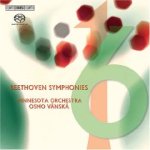 Minnesota Orchestra, Osmo Vanska
Ludwig van Beethoven: Symphonies 1 and 6
BIS Records
2008
Vanska draws broadly from Bernstein and Solti, both of whom characterized their Beethoven with warmth and lushness, creating a breathing, expanding wall of sound. These characteristics are brought to life in the Super Audio nature of this recording, making the digital palette warm with the glow of Beethoven's superb reeds composing. Vanska's First has mercuric fluidity, shiny, dense, and uniform. This is where the conventional is made urgent and exciting and the spirit of the master shines.
Vanska's pacing of this early symphony is perfect. He starts the ball rolling providing an inertia that can only be Beethoven, the composition comes to life, propelling forward with a sunny determination. His closings, particularly of the first, allegro con brio movement are Swiss watch precise, thundering staccato codas. Vanska's is a spiritual Beethoven, deep and thoughtful.
The surround sound sonics may best be described as a digital picture, precise and accurate. These sonics capture that measured, informed approach Vanska applied to his recorded performance of the. Fifth Symphony. Vanska's Beethoven cycle is shaping up to be one for the decade if not the early millennium.
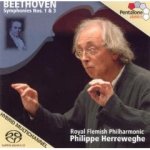 Royal Flemish Philharmonic, Philippe Herreweghe
Ludwig van Beethoven: Symphonies Nos. 1 and 3
Pentatone Records
2007
As with his Fifth Symphony, Herreweghe's performance of the C major symphony is organic and transparent. Herreweghe's interpretation permits the listener entrance into the architecture of the music, beckoning us to come in and stay a while. The festivities are sure to be lively.
It is impossible not to compare Herreweghe's cycle with that of Nikolaus Harnoncourt's and the Chamber Orchestra of Europe in the 1990s: modern instrumentation with period sensibilities. The sonics are comparable between Herreweghe and Harnoncourt, both being superior to the period instrument performances. Where Herreweghe's approach differs from Harnoncourt's is in his use of Baroque kettle drums with modern tuning and natural horns (trumpets).
The promise of lively music is made good. Herreweghe's use of natural horns is well manifested in his First, bright and tart. Insistent is his pace and determined is his approach. Herreweghe's and Vanska's tempi are comparable, but their respective grip on the reins is not. Vanska is a master of control and flow while Herreweghe likes a bit of the high wire, choosing to conduct with the governor removed. Herreweghe's pacing is loosely tethered, feeling as if it will swing out of control. It never does and that tension makes the performance that much more exciting.
Beethoven sings like a mad aria in the hands of Herreweghe and the Royal Flemish Philharmonic. This is highly dramatic stuff. Herreweghe, in his approach, successfully shows Beethoven as the Roman god Janus, looking forward to Wagner and backward to Haydn at the same time. The remainder of his cycle should be quite compelling.
An overview of the Nine Symphonies may be found in The Beethoven Symphony Series 1: The Nine Symphonies.
Tracks and Personnel
Vanska: Beethoven Symphonies 1 and 6
Tracks: Symphony No. 1 in C major, Opus 21: 1. Adagio molto—Allegro con brio, 2. Andante cantabile con moto, 3. Menuetto: Allegro molto e vivace, 4. Adagio—Allegro molto e vivace; Symphony No. 6 in F major, Opus 68: 1. Erwachen heiterer Empfindungen bei der Ankunft auf dem Lande (Awakening of cheerful feelings upon arrival in the country): allegro ma non troppo, 2. Szene am Bach (Scene at the brook): andante molto mosso, 3. Lustiges Zusammensein der Landleute (Happy gathering of country folk): allegro, 4. Gewitter. Sturm (Thunderstorm; Storm): allegro, 5. Hirtengesang. Frohe und dankbare Gefühle nach dem Sturm (Shepherds' song; cheerful and thankful feelings after the storm): allegretto.
Personnel: Minnesota Orchestra, conductor Osmo Vanska.
Herreweghe: Beethoven Symphonies 1 and 3
Tracks: Symphony No. 1 in C major, Opus 21: 1. Adagio molto—Allegro con brio, 2. Andante cantabile con moto, 3. Menuetto: Allegro molto e vivace, 4. Adagio—Allegro molto e vivace; Symphony No. 3 in E flat major, Opus 55: 1. Allegro con brio, 2. Marcia funebre: Adagio assai, 3. Scherzo: Allegro vivace, 4. Finale: Allegro molto.
Personnel: Royal Flemish Philharmonic, conductor Philippe Herreweghe.
Tags
PREVIOUS / NEXT


Become a Sustaining Member

Since 1995, All About Jazz has championed jazz as an art form and supported the musicians who create it. Over three decades, it has grown into one of the world's leading jazz resources, serving hundreds of thousands of readers, musicians, presenters and industry professionals each month.
Help Build the Future of All About Jazz
Your support helps us continue building All About Jazz for the next generation—expanding our editorial coverage, preserving jazz history, developing new community features and creating better ways to discover the music and the people behind it.
Become a sustaining member for as little as $20 per year and you'll immediately enjoy an ad-free experience along with access to subscriber features and future articles for a full year.
Together, we're not simply sustaining All About Jazz—we're building its future. Thank you for being part of the journey.