Home » Jazz Articles » Interview » Reverend Zen: Angels, Blues and the Crying Moon
Reverend Zen: Angels, Blues and the Crying Moon
I always liked a Wayne Shorter quote I read once. He said,'Relax, it's only music.'
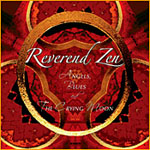
 The New York group Reverend Zen has released its debut album, Angels, Blues & the Crying Moon (Blackjack Music, 2006), that is quickly garnering music industry acclaim around the world. Platitudes aside, Reverend Zen's true genius lies in its music. The album is everything a great album should be: melodies that hang in your head like an old friend, dead-on drum tracks, bad-ass guitar solos, and subtleties that slowly reveal themselves, supporting lyrics of wit, introspection and cultural commentary.
A decade of tempering until just the right balance of every needed ingredient was achieved, Angels, Blues, & the Crying Moon is proving worth the wait. It's now taking Reverend Zen's mix of rock and jazz to the world stage.
All About Jazz: Why is there so little information on you, with your bio more less repeated on your website and in various reviews of Reverend Zen?
Jack Evans: Well, when the Reverend Zen CD was released, a publicist and I compiled basic background info and we then wrote the Reverend Zen bio. The Reverend Zen CD, Angels, Blues & the Crying Moon, is on my own independent label named Blackjack Music. At this point I'm the PR department, along with a whole lot of other things, so the basic Reverend Zen bio, with updates, is what goes out to expedite things. There's only so many hours in the day.
AAJ: Who is Jack Evans?
JE: I grew up in the Midwest, three and a half hours west of Chicago in the Cedar Rapids, Iowa, area which has a population of about 175,000. I played my first bar gig on drums when I was 13. The first song I played publicly was "High Heel Sneakers" with a really great organ trio. I got to play with a lot of older musicians in town because a couple of my drum teachers were always recommending me. Some of the bars were some really tough joints, but the older guys always watched out for me. Usually the music was a mix of everything: soul, R&B, top forty, rock, blues, jazz. We played at bars, concerts, the YMCA, school dances, the Elks Club and American Legion Hall. I played a lot with Billy Lee Janey, who's still on the scene back there and considered one of the best blues guitarists in that area of the country.
Musically, I really gravitated toward James Brown, Wilson Pickett, Paul Butterfield and then Miles Davis at that age. Miles took awhile to fully digest though. I eventually ended up seeing Miles play more than forty times before he passed. Even when he was 60 years old you could still count on ten minutes of an absolutely brilliant solo from him. I think he was also one of the greatest blues players ever. These days the musician I never miss seeing is saxophonist Wayne Shorter. The guy is 75, has a great band, is an incredible composer and still plays his ass off. I'm sure he has some direct lineage that stretches back to the Buddha.
To hear live music during that time I'd ride a Greyhound into Chicago with friends. I got to check out James Cotton, the Butterfeld Blues Band, McCoy Tyner, Weather Report, Muddy Waters, the Mahavishnu Orchestra, Booker T and the MGs and Miles Davis. One of the most incredible nights of music I ever heard was Stan Getz with a band of Chick Corea, Stanley Clarke, Airto Moreira (Moiera) and Tony Williams. Tony Williams was an absolute beast. Then when I was sixteen I made it to one of the old Newport Jazz Festivals. Everyone played there that year. Bill Evans, Thelonious Monk, Art Blakey, Jeff Beck, Miles Davis, B.B. King, Led Zepplin, Johnny Winter, Sly and the Family Stone, Buddy Rich, Frank Zappa and James Brown.
I also found a clear channel radio station from Rochester, New York, that we could pick up in Iowa in those days. They broadcast a really eclectic mix of jazz, blues and early fusion late at night with a DJ named Bill Ardis. He mixed a lot of the best music from different genres, which I loved to hear.
AAJ What is your musical background? Are you formally trained or are you self taught? I see from album credits you play drums, percussion, some keyboards and handle lead vocals.
JE: Besides drum lessons and some piano lessons as a kid, I'd also do the occasional lead vocal. I spent a couple years at the University of Iowa. I took literature courses and studied percussion with a guy named William Parsons, who'd performed with the composer Harry Partch, and I did some 20th Century music performances with the University's Center for New Music.
 From there I headed to Boston, where I graduated from the Berklee College of Music with a B.F.A. in composition. I really started enjoying the composing side of things, so it was a chance to become more involved with writing as well as playing. I studied arranging with Michael Gibbs, who'd worked with Gary Burton and John McLaughlin, and I studied drums with Gary Chaffee and Keith Copeland, who'd played with jazz pianist Billy Taylor and Stevie Wonder.
After seven years in Boston, I moved down to the New York City area, actually about an hour north of the city, where I live today. John Scofield lives in the same town, a few blocks away. I really liked the time I spent in Boston, but I wanted to be nearer to that New York attitude and energy that comes out in the music around the city. Besides writing and recording I began teaching drums privately and part-time at a couple of the public schools in the area, which I enjoyed doing. I seem to have a knack for breaking things down and explaining them, so I picked up a rep as a drum teacher.
AAJ : Apparently it took 10 years of preparation for this release to come to fruition. Why so long?
JE: Well we didn't do much in the middle of the project for seven years. First, my original partner decided to relocate to the West Coast, then I had to deal with some personal issues and a couple times you might say, the Reverend Zen widows and orphan's fund ran low. On top of that I'm kind of a slow worker. It's just your basic independent project pit falls, but I hung in there, and got it finished.
AAJ: James Gerard is credited with being your co-writer. Who is James Gerard?
JE: I first met James up in Boston. We played together in a band up there. He spent some time at Berkley and at the Boston School of Electronic Music. James is originally from the Detroit area and played bass and keyboards with the singer Jim Gold, who had a couple Top 40 hits back in the day. We both relocated to the New York City area about the same time. We put together a jazz/rock group playing clubs and colleges that eventually morphed into Reverend Zen. The two of us handled all the writing and arranging of the RZ songs until he left the project and moved to Seattle. Since then I've pretty much been the chief cook and bottle washer.
AAJ: Can you describe how you composed each track? Was each a group effort, or did you compose each essentially by your self?
JE: Each track was basically composed one of two ways. Sometimes the chord progressions and song form were written first. Sometimes the lyrics, melody, song form and drum groove came first. For example with "Dangerous Times," the music, song form and arrangement came first and then the lyrics and melody were written. With "The Boston Shakedown," the lyrics, melody, song form and drum groove came first and then the chord progression and arrangement were written. From there we'd do midi arrangements of the songs with a sequencer so we could fine tune things. We didn't want the songs to sound like a first draft effort. Then we'd record the basic rhythm tracks with keyboards, bass and drums, I'd lay down a lead vocal track, then guitar tracks and background vocals were added. Ninety per cent of the writing and arrangements on the CD were done between James and myself until he left. By that I mean the keyboards, bass, drums, percussion, guitar parts and background vocals. Since then, it's been in my hands.
AAJ: Your CD credits a large number of musicians on each song. This includes up to two percussionists, two keyboards, multiple guitarists and background vocalists. Did these individuals contribute to different tracks and who are they?
JE: Considering it took 10 years to record the CD, there was a certain amount of attrition, logistics, endurance and an alien abduction or two involved with the musicians. Really, we just tried to find the right musicians for each song and put them in a setting that played to their strengths.
When James was involved with the project, he handled the keyboard parts. After he left, I brought in Rob Aries on keyboards, who'd played in one of John Scofield's bands, and I put down a lot of the pads and background keyboard parts.
Guitarists Chris Carter, Nick Moloch, Gil Paris and Chris Vitarello are all on various tracks of the album. Chris Carter has been called one of the premier R&B guitarists in New York City by Hugh Mc Cracken. He's featured on "Bad Attitude," "My Sigmund Freud," "Dangerous Times" and "Boy Genius". Nick Moroch is a regular in David Sanborn's band. He plays the phenomenal solo on the "The Boston Shakedown". Gil Parris has a really incredible melodic sense with his solos that comes out on "Don't Try to Tell Me" and "Her Love". Chris Vitarello, who does a lot of playing with Jimmy McGriff, covers some of the guitar parts on "Only a Fool". All of them are great players, so after our written guitar parts were recorded we'd usually give one or two of them a crack at the solo and then choose the one we liked best on a particular song.
The background vocalists on the earlier songs are Sheryl Marshall, who's worked with Buster Poindexter and New York City's Uptown Horns Review, and Soozie Tyrell who's now a regular with Bruce Springsteen. The more recent songs feature Margaret Dorn and Vaneese Thomas. Margaret has toured and recorded with everyone from Boz Scaggs and Michael Mc Donald to Celine Dion. Vaneese Thomas is like the consummate musician who's worked with Eric Clapton, B. B. King, Sting and anyone else you can think of. Vaneese is originally from Memphis. She's the daughter of Rufus Thomas and her sister is Carla Thomas. She's like an encyclopedia of Memphis R&B, soul, Stax, and Elvis. As a girl she walked the Civil Rights picket lines with her mother.
AAJ: Once this project was completed and released, how soon after did you realize you had a hit?
JE: It's been pretty much of a gradual process, but things picked up about four months after we started getting the album out to CDBaby, iTunes, Amazon.com, print publications, internet music sites, radio stations, internet radio, various song contests and press releases through Billboard.
AAJ: How many different awards has it been nominated for, and how many has it received?
JE: At last count I think there was 31 or 32 awards from the Billboard, VH1 and Unison song contests, ASCAP, the Songwriters Association of Washington, D.C., the U.K.'s Singer-Songwriter Awards and the Los Angeles Music Awards. Among those are a finalist and five runners-up awards from VH1, an ASCAP Plus Award, two finalist awards from the Unison International Song Contest and four Best Song Nominations in the Adult Contemporary Artist and Blues Category of the Los Angeles Music Awards. Reverend Zen ended up receiving Blues Song of the Year for "Bad Attitude" and was named 2007 Blues Artist of the Year by the LA Music Awards.
AAJ: How did you react when you first learned that you were in the running for these awards? What were they?
JE: It's always terrific to receive recognition and publicity for your work. The first finalist award was from the VH1 Song of the Year Contest for "Dangerous Times" in their AC Category. We've also received five runners-up awards from them in their AC and Lyric Categories for "Magdalena," "Don't Try to Tell Me," "The Boston Shakedown" and a new, unreleased song called "Fingerprints". The Unisong International Contest Finalist awards were for "Magdalena" and "Bad Attitude" in their Lyric and Blues Categories. The ASCAP Plus Award was pretty much a cumulative activity award from ASCAP's Jazz and Popular Music Division. The other three Best Song Nominations from the LA Music Awards were in their Adult Contemporary Artist Category for "Don't Try to Tell Me," "The Boston Shakedown" and "Dangerous Times".
 AAJ: How did you market it to these different groups that has given you these nomination nods?
JE: With an infinite number of old and new recordings available these days, I tried to look for anything that would set Reverend Zen apart and give our CD more visibility. I didn't have a $100,000 PR budget for the album. I just read, spoke to other musicians and spent a lot of time researching on internet sites. The song competitions, ASCAP Award and the LA Music Awards, I all tracked down myself and sent out the Reverend Zen CD or individual songs to them. We're also on four compilation CDs from Research Music in Miami, The Independent Artist Alliance in San Francisco, R.P.W. Records in British Columbia, Canada and MVY Radio on Martha's Vineyard. I was really just trying to get the band noticed.
AAJ: And that you have. There have been many comparisons drawn between Reverend Zen's music, which jumps many different genres, and for example Steely Dan. Do you feel these comparisons are fair?
JE: Yes, as a starting point that's fair. Fagen and Becker do many things very well musically and they're a big influence. So are Joni Mitchell, Miles Davis, Debussy, soul, blues and R&B.
When I was a kid in Iowa, I loved James Brown, Wilson Pickett and Aretha Franklin. Then it was B.B. King, Paul Butterfield, Muddy Waters, Ray Charles and onto Miles Davis and all the musicians that came out of his bands. When I was in Boston, I first heard Steely Dan's Aja (MCA, 1977) album and Joni Mitchell's Court and Spark (Elektra/Asylum, 1974). They really spoke to me. It really hit me how they both incorporated these blues and jazz influences that I loved. They also had really unique visions lyrically. With Reverend Zen it usually breaks down to trying to incorporate a lot of the elements that you might hear on a good R&B song from someone like Bobby Blue Bland, adding in our jazz influences harmonically and offering up an inspired, musical guitar solo. Hopefully the RZ lyrics hit some emotions that move people to think or smirk a bit and stick in their heads.
AAJ: With a group as large as those credited on Angels, Blues & the Crying Moon, have you done any touring to support and promote the release?
JE: No, not yet. In the midst of recording and releasing the CD, my father was ill for a few years and then passed away back in Iowa. I was back and forth a lot between Iowa and New York and it limited my time and resources. As a result I've just done my best to promote the album through the outlets we've already spoken about, along with radio, TV and print interviews and making it out to the LA Music Awards, which was great exposure.
AAJ: Having had this success with your first release, are you working on another or will it be another decade before we hear something new from Jack Evans and Reverend Zen?
JE: I do have five or six new songs that are in the writing stage right now, but none of them are totally finished. There's the one I mentioned earlier "Fingerprints," and there's another one about a neo Nazi, "Billy and the Secret Brotherhood," but it's like I said earlier, I'm a slow worker. I always liked a Wayne Shorter quote I read once. He said, "Relax, it's only music."
Selected Discography
Reverend Zen, Angels, Blues & the Crying Moon (Blackjack Music, 2006)
Photo Credit
Courtesy of Jack Evans and Reverend Zen
< Previous
Some Other Time
Next >
At Last
Comments
About Reverend Zen
Instrument: Band / ensemble / orchestra
Related Articles | Concerts | Albums | Photos | Similar ToTags
For the Love of Jazz
 All About Jazz has been a pillar of jazz since 1995, championing it as an art form and, more importantly, supporting the musicians who create it. Our enduring commitment has made "AAJ" one of the most culturally important websites of its kind, read by hundreds of thousands of fans, musicians and industry figures every month.
You Can Help
To expand our coverage even further and develop new means to foster jazz discovery and connectivity we need your help. You can become a sustaining member for a modest $20 and in return, we'll immediately hide those pesky ads plus provide access to future articles for a full year. This winning combination will vastly improve your AAJ experience and allow us to vigorously build on the pioneering work we first started in 1995. So enjoy an ad-free AAJ experience and help us remain a positive beacon for jazz by making a donation today.

Giveaway

Days remaining: 10