Home » Jazz Articles » Live From New York » July 2008
July 2008

Paul Dunmall took full advantage of the city during a brief stay, playing the Vision Festival with Andrew Cyrille and Henry Grimes and then three nights later, on Jun. 17th, playing the Living Theater with Mark Helias, Tony Malaby and Kevin Norton. And after a rainy week, his second show seemed well saturated. Dunmall had crossed an ocean to get there and Malaby and Norton a river and the skies had been wet for days. The vibes and bowed bass, the players drenched in blue and green lights in the basement space—it could have been jazz from Atlantis. Norton started on vibes, then switched to the kit with brushes, but when he picked up the sticks the band finally breached the water's surface, the two tenors leaping in independent arcs—if only momentarily. Norton's bowed cymbals (he later applied the bow to the vibe keys for an even more haunting call) and Malaby's slippery soprano had the sound swimming again as Dunmall switched from saxophone to bagpipes. He played the Northumbrian smallpipes, a smaller version of the instrument than the common Scottish variety, quieter and without the fan of droning chanters. At Vision it was easily drowned out by Grimes' amplified violin, but Malaby held back on the soprano, letting the thin reedy sound of the pipes come through. But much of the show was given to the twin tenors, with the whole band circling, rising and sinking like a school of fish—appropriately ending with long tones like ship horns and a sudden stop.
Dance for Music at Judson Church
Music and dance have an inextricable history, but in some circles the siblings don't get equal treatment. Music is often treated as incidental in dance, like potpourri in an art gallery. That relationship was turned upside-down at Judson Church Jun. 3rd, as a part of Movement Research's 2008 Festival. The evening, dubbed "Dance for Music," put sound artists in the drivers' seats, letting them choose the dancers and call the shots. Bryan Eubanks played a solo electronics piece, leaving Jessica Ray moving through his nervous tension, circling the room and eventually seeming to be knocked around by the swelling pulses. Jessica Pavone played solo viola with effect pedals, creating repeating and decaying forms that seemed to pin Rachel Bernsen to the wall or leave her chasing little eddies of sound across the floor. Nate Wooley and Newton Armstrong created the most inventive staging (or lack thereof), playing from behind a closed door to the side of the stage. Jennifer Mesch seemed literally to be blown out of the stairwell and into the room by their explosions of trumpet and electronics, then using the door as an enlarged mute, occasionally closing herself in to be blasted out again. The final piece was a prolonged vaudeville routine and perhaps if you hand enough dancers over to enough musicians, it's inevitable someone will call for a striptease. It was uneven and out of context, although David Luther's King Curtis chops were impressive enough to carry the show.
—Kurt Gottschalk
Jane Ira Bloom, Mark Dresser, Min Xiao-Fen at Rubin Museum
It was a multicultural, mixed media affair when Jane Ira Bloom (soprano sax), Mark Dresser (bass) and Min Xiao-Fen (pipa) performed at the Rubin Museum of Art Jun. 6th. A slideshow of Himalayan paintings and ink drawings was visible behind the stage, an electric tambura droned meditatively under the opening and closing pieces and the pentatonic melodies of "White Bird," "Dark Knowledge" and "Two Mays," rendered in tandem by Xiao-Fen's pipa (a Chinese upright lute) and Bloom's soprano, evoked Far Eastern tone poetry. Each performer 'spoke' his or her own body language: Dresser pinwheeled his arm dramatically and hammered the fretboard with both hands; Xiao-Fen swayed with fluid grace and, during "Many Landscapes," sang with unearthly gasps and growled vowels and Bloom was a bundle of motion, perching on one leg, tilting, kicking, lurching forwards and even coiling and releasing her torso in the twisting movement of a discus thrower. Above all, it was the seamless fusion and fission of musical personas that riveted attention. Dresser's room- booming 'wolf-notes,' percussive slaps and sky- scraping overtones intermingled with Bloom's lyrical flights and Xiao-Fen's athletic imagination. Bloom often punctuated her soaring lines with siren-like glissandos, while Xiao-Fen employed a variety of techniques—a metal slide on "Mental Weather," finger-tapped 'raindrops' on "Vanishing Hat"—to complete the conversation.
New Languages Festival at Living Theatre
The New Languages Festival, now in its fourth year, is just that: a meeting of proactive, boundary crashing artists interested in novel ways to speak jazz. The second night (Jun. 13th) of the three-day event at The Living Theatre began with Jackson Moore (alto sax), Eivind Opsvik (bass) and Eric McPherson (drums). The gentle, introspective mood of the trio was buoyed by constant variations in rhythmic pulse and density, generating subtle layering that, paradoxically, seemed to intensify even as it attenuated. Saxophonist Tony Malaby's trio, with Matt Brewer (bass) and Gerald Cleaver (drums), followed in an overtly ecstatic set filled with eclectic textures and mercurial mood swings. The highlight of the evening was Secret Society, an all-star 18-piece big band led by composer/conductor Darcy James Argue. Mixing minimalism, indie rock, contemporary classical and jazz styles, Argue has developed his own thing—a fat, hard-hitting sound with wide dynamic contrasts, unusual chord clusters, asymmetric time signatures and monster riffs. The charts were augmented by the band's precision and charismatic solos, including turns by Ron Horton (flugelhorn) on "Induction Effect," John Ellis (tenor) on "Phobos," Tim Hagans (trumpet) on "Ferromagnetic," Sebastian Noelle (guitar) on "Redeye" and Ingrid Jensen on "Habeas Corpus." The closer, "Transit," was especially potent, melding jazz harmony, rock edge and postmodern angst into a new music creole.
—Tom Greenland
Kurt Rosenwinkel/David Tronzo Group at Smalls
In fusion's heyday, guitar battles were as common as those involving saxophones during the rise of bebop; DiMeola skirmished with McLaughlin, Martino scuffled with Abercrombie and Coryell took on all comers. Today these meetings are far less common as styles diverge and jazz avoids confrontation. But an amiable glimpse into yesteryear came at Smalls Jun. 1st when modern jazz darling Kurt Rosenwinkel matched wits against Downtown slide stalwart David Tronzo, a meeting 15 years in the planning. Rosenwinkel faced forward while Tronzo's back was to the packed house, the result a marvelous image of guitar necks as broadswords in some medieval fracas. But for all the martial imagery the proceedings were intensely jovial, Rosenwinkel peppering the music with lush reverberating chord voicings and Tronzo divebombing with dry spiky slide runs, all anchored by the succulent rhythm section of bassist JA Granelli and the remarkably free drumming of Matt Wilson. Rather than cut each other up, Rosenwinkel and Tronzo celebrated each other's inimitable approaches, rarely overlapping in attack, dynamics or even range. The material extended from stark soundscapes to Bob Marley to anthemic blues, managing, through the polar approaches of the two guitarists, to sound both utopian and dystopic simultaneously. Most were there to see Rosenwinkel but game, set and match had to go to Tronzo, who reveled in the unusual setting.
KMB Jazz Festival at Douglass Street Music Collective
While 'avant-garde' jazz doesn't yet have the history of, say, similar movements in politics or even fine art, it is old enough to be multi-generational and have entire record labels devoted to it. One such imprint is Kordova Milk Bar, a one-man operation run by Eric Devin when he is not working on his Masters. His efforts were fïted for two days in June at the inaugural KMB Jazz Fest, appropriately held at the equally do-it-yourself Douglass Street Music Collective space in downtown Brooklyn. For the first evening (Jun. 8th), the label's breadth was on display, debunking the "it all sounds the same" notion. Matt Lavelle began the evening with a series of solo vignettes for his strong trumpet, abrasive bass clarinet, incidental cuica drum and spoken word by himself, saxophonist Ras Moshe and even the audience. Moshe, in more of a Joe Henderson than Albert Ayler mode, followed with his Transcendence Quartet, his tightest ensemble yet with guitarist Dave Ross adding appreciated chordal variety, bassist Shayna Dulberger duetting nicely with the leader throughout and veteran drummer Rashid Bakr lending sympathetic sticks. The wonderful Steve Lacy Tribute band Ideal Bread led by baritone saxophonist Josh Sinton (once a Lacy student) then demonstrated both Lacy's impact on modern music and his compositional pliability in an expansive setting for baritone, trumpet and rhythm. Future KMB recording artist and avant jazz father figure Roy Campbell's TAZZ closed the evening.
—Andrey Henkin
Saxophone Summit at Birdland
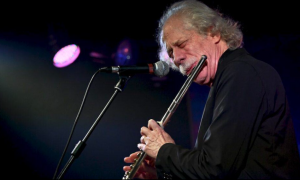
The simultaneous assemblage of three world class saxophonists on a single stage customarily signals a straight-ahead 'blowing session'—a grand jazz tradition marked by extended solos over familiar chord changes that can be either exciting or tedious, depending on the night and participants. Saxophone Summit, the supergroup featuring Dave Liebman, Joe Lovano and Ravi Coltrane (who replaces founding member Michael Brecker) takes a different approach to the union of reeds, one in which composition is as important as improvisation, resulting in a whole that is greater than the sum of its parts. On the band's opening night (Jun. 10th) at Birdland, the stellar sextet, anchored and propelled by its longstanding rhythm section of pianist Phil Markowitz, bassist Cecil McBee and drummer Billy Hart, engaged in four deep explorations of strikingly original music from its two superb albums. Beginning with Hart's intricately arranged "Reneda," Liebman's distinctive soprano in the center of his colleagues' two equally individual tenors, the group searched out harmonies and rhythms that distinguished it from other groups. "Tricycle," an architecturally sophisticated work by Liebman that began subtly with bass and brushes and dynamically rose to heights of intensity, was followed by McBee's beautiful "All About You," offering a fitting contrast. The set closed with a climatic reading of John Coltrane's "India" introduced dramatically by Liebman on wooden flute.
Latin Jazz All-Stars at Iridium
A revolving cast of some of New York's finest AfroCaribbean artists assembled at Iridium under the banner of the Latin Jazz All-Stars to pay tribute to pianist Hilton Ruiz and saxophonist Mario Rivera, two artists whose tragic deaths have deeply saddened all those who had the honor to share in their unparalleled artistry. With Rivera's son Phoenix holding down the drum chair in an ensemble that also featured pianist Arturo O'Farrill, bassist Yunior Terry and conguero Wilson "Chembo" Corniel in the rhythm section, trombonist Steve Turre and trumpeter Claudio Roditi kicked off the Sunday night (Jun. 1st) second set with a high-energy reading of Tito Puente's "Puente of Soul" that found O'Farrill melding Monk-isms with montunos on the fiery mambo. The brass men then revealed their more sensitive sides on Chucho Valdes' beautiful ballad "Claudia," Turre displaying his deeply expressive virtuosity on a moving plunger-muted trombone solo. Flutist Dave Valentin soared on a rhythmic arrangement of "Equinox," with Mario's brother Dioris Rivera joining the group as a surprise guest on soprano saxophone, sharing the spotlight with Roditi and Turre, whose conch shells added a uniquely exciting element to the Coltrane classic. Conga master Candido took to the stage to open the original Latin Jazz warhorse "Caravan" with his inimitable melodic drumming, setting up a no-holds-barred, four-horn blowout with baritonist James Carter that closed the show.
—Russ Musto
Recommended New Listening:
* Kris Davis—Rye Eclipse (Fresh Sound-New Talent)
* Guillermo Klein—Filtros (Sunnyside)
* Bennett Paster & Gregory Ryan—Grupo Yanqui Rides Again (Miles High)
* Mario Pavone—Trio Arc (Playscape)
* Wadada Leo Smith—Tabligh (Cuneiform)
* Miguel Zenon—Awake (Marsalis Music)
—David Adler NY@Night Columnist, AllAboutJazz.com
* Yoon Sun Choi/Jacob Sacks—Imagination: The Music of Joe Raposo (Yeah Yeah)
* Barry Guy/Marilyn Crispell/Paul Lytton— Phases of the Night (Intakt)
* Larry Ochs/ROVA—The Mirror World (Metalanguage)
* Jamie Oehlers/Paul Grabowsky/David Beck—Lost and Found (Jazzhead)
* Sahib Shihab—And the Danish Radio Jazz Group (OKTAV Music)
* Julian F. Thayer/Charlie Mariano/Klaus Suonsaari—The Door is Open (KS Jazz)
—Laurence Donohue-Greene Managing Editor, AllAboutJazz-New York
* Ab Baars Trio & Ken Vandermark—Goofy June Bug (Wig)
* Larry Ochs/ROVA—The Mirror World (Metalanguage)
* Mike Osborne—Force of Nature (Reel Recordings)
* Fred van Hove—Journey (psi)
* Alexander von Schlippenbach Trio—Gold Is Where You Find It (Intakt)
* Yitzhak Yedid—Oud Bass Piano Trio (Between the Lines)
—Andrey Henkin Editorial Director, AllAboutJazz-New York
Tags
PREVIOUS / NEXT

Become a Sustaining Member

Since 1995, All About Jazz has championed jazz as an art form and supported the musicians who create it. Over three decades, it has grown into one of the world's leading jazz resources, serving hundreds of thousands of readers, musicians, presenters and industry professionals each month.
Help Build the Future of All About Jazz
Your support helps us continue building All About Jazz for the next generation—expanding our editorial coverage, preserving jazz history, developing new community features and creating better ways to discover the music and the people behind it.
Become a sustaining member for as little as $20 per year and you'll immediately enjoy an ad-free experience along with access to subscriber features and future articles for a full year.
Together, we're not simply sustaining All About Jazz—we're building its future. Thank you for being part of the journey.