Home » Jazz Articles » Live Review » Joe McPhee and Friends: Directed Improvisation at RUCMA,...
Joe McPhee and Friends: Directed Improvisation at RUCMA, New York City
Even as [McPhee] played an instrument, he both integrated himself with the sound as well as led it.
RUCMA at the Living Theater
New York City
May 11, 2008

Although conducting and improvisation seem to be unlikely partners, nothing is more compelling than witnessing improvisation unfold during the process of conducting. To see a musician direct the music without necessarily playing an instrument can provide a concrete and vivid representation of how the mind of a musician works. This was the case during a May 11, 2008 RUCMA (Rise Up Creative Music and Arts) concert performed at the Living Theater in New York City.
The artist in residence for the day was Joe McPhee; the remaining players were dubbed "friends"—friends of McPhee and fellow improvisers in the music. That a group of musicians who rarely play together can convene and play with such clarity is a tribute to their musicianship as well as to their leader.
Awaiting the arrival of the drummer, McPhee previewed the afternoon's music for the audience, describing it as improvisation by and between horns and strings. In the center of the performance area was an open pit, suitable for accommodating a small musical ensemble to accompany theatrical performances. The horn players stood to the left of the space, joined by a vocalist. To the right, and slightly in back of the pit, stood and sat a group of string players. It was not until the latter part of the session that the drummer appeared, taking a seat at a drum set in the very back of the carpet-covered room.
 L:R Jason Kao Hwang, Kevin Ray, Emmanuel Cremer, Clifton Hyde, Rosi Hertlein, Dominic Duval
McPhee faced the string players, at the outset explaining to them how to interpret his gestures. Immediately following, he signaled to the strings for a soft arco. Three basses, a viola, a violin, and a cello responded with a hum which expanded harmoniously over a wide tonal range while increasing dynamically into a crescendo. The first layer of sound was established. At McPhee's urging, Rosi Hertlein and Jason Kao Hwang emerged from the harmonious arco flutter with single-note, one-line motives. McPhee next turned to the horns and pointed at Roy Campbell, who answered with muted trumpet, his quick-valving technique adding his personal signature; the trumpet of Lewis Barnes countered Campbell with equal directness. The second and third layers of sound came through as the strings provided a continuo underneath the trumpets' persistent spurts. Then the trumpets stopped, yielding to the next sonic wave.
The strings, which had ceased to play, resumed but this time with an onslaught of pizzicato. Guitarist Clifton Hyde played a melody on his acoustic instrument until McPhee shut down the strings and beckoned to tenor saxophonist Ras Moshe, who played phrases, maintaining his lines until McPhee entered on soprano.

L:R McPhee, Roy Campbell, Matt Lavelle, Ras Moshe, Lewis Barnes, Mossa Bildner
Soon all the horns merged with the strings, producing a sound at once large and agitated. The horns stopped, vocalist Mossa Bildner providing a bridge between their silence and the resurgence of Campbell's high pitches played on the flugelhorn over fierce, mid-range bowing by Emmanuel Cremer. The basses joined the aural plane with intense arco gestures while, in the background, Lisle Ellis plucked a reverberant and stunning pizzicato line. Matt Lavelle heightened the intensity with a swelling sound on bass clarinet. Melodies counterpointed then counteracted each other from the horns to the strings. As Lavelle squawked through his bass clarinet, Hyde's strumming contributions on electric guitar increased the volume of sound emanating from his position on the floor.
Out of the darkness, McPhee appeared with flugelhorn, moving to the center of the performance area in front of the audience and using the instrument as a drone, allowing the monotone to highlight both Lavelle's sound on bass clarinet and the strong, confident bowing of Dominic Duval. The viola and violin came close to a flickering effect with their rapid bowing. Hwang changed to scraping his viola strings and Hertlein carved out a tune, the bows of the remaining string players meanwhile moving incessantly. The horns by this time were shrieking: the pace had become furious and the dynamics uproarious over the span of the improv. Sensing that the piece had reached its peak and could go no further, McPhee directed the close. Everyone stopped playing.
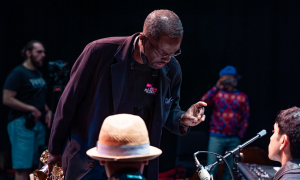
With this opening piece, the way in which the music developed over a period of about two hours was clear as a bell. McPhee acted as the primary listener. What he heard in the music in turn inspired him to encourage crescendos, to stop one instrument from playing while starting another, to brake the sound with his hands or, by wiggling his fingers, to incite quickness of gestural motion from certain instrumentalists. The attention to all categories of music production—tone selection, volume, tempo and choice of technique—never wavered. Even as he played an instrument, he both integrated himself with the sound as well as led it.
The pieces in the remainder of the session demonstrated equal attentiveness to balance, intensity, melody, and trust. These qualities, moreover, hinged as much on the group's interpretation of McPhee's transmission of his ideas as on McPhee's own concept of how the music should flow. The group members watched his every move. Yet, and most importantly, each musician in the ensemble revealed his or her own capacity for attentiveness, awareness and invention, without which the music would have only flirted with success.
McPhee exhibited as much about his acute awareness of sound when not playing his own instrument as he demonstrated commanding skills when he actually played. It was stirring to watch him clap out a tempo when drummer Andrew Barker had taken his center place in the group. And it was a powerful moment when McPhee bared his teeth and pretended to scrape and tear at his left arm with his right-hand fingers in order to pull the severity of that "sound image" out of the strings. It was emotionally gripping to watch him as he played the flugelhorn and leaned into the strings of Duval's bass, bowing a sympathetic response to McPhee's musical line. It was a very human moment when, just before the last piece began, McPhee asked: Who wants to start? And a voice from the other side of the room spoke out: How about a McPhee solo?
McPhee did in fact solo on soprano for a few minutes, gradually squeezing the notes out of an initial breathing through the horn. A two-note ostinato arose, which Campbell captured synchronistically on his muted trumpet. The horn and string sounds accumulated and blended with an implicit rhythm. Duval's bow stroked the final notes of this brief piece on his bass strings. And the music was done.
The music was done. McPhee had imparted a little-known aspect of his vision. It was as if he had physically made a painting of multiple layers, applying the broadest strokes with his brush first and, on top of that foundation, carefully choosing where to project and adjust each detail and new color. And now, after the experience of watching McPhee guide numerous elements to their natural order, only an aural memory remains.
Personnel: Joe McPhee: soprano sax, flugelhorn; Roy Campbell: trumpet, pocket trumpet, flugelhorn, flute; Matt Lavelle: bass clarinet; Lewis Barnes: trumpet; Ras Moshe: tenor sax; Rosi Hertlein: violin; Jason Kao Hwang: viola; Emmanuel Cremer: cello; Mossa Bildner: vocals; Dominic Duval, Lisle Ellis, Kevin Ray: bass; Clifton Hyde: electric and steel guitar; Andrew Barker: drums.
Photo credit Lyn Horton
About Joe McPhee

Tags
PREVIOUS / NEXT

Joe McPhee Concerts
Become a Sustaining Member

Since 1995, All About Jazz has championed jazz as an art form and supported the musicians who create it. Over three decades, it has grown into one of the world's leading jazz resources, serving hundreds of thousands of readers, musicians, presenters and industry professionals each month.
Help Build the Future of All About Jazz
Your support helps us continue building All About Jazz for the next generation—expanding our editorial coverage, preserving jazz history, developing new community features and creating better ways to discover the music and the people behind it.
Become a sustaining member for as little as $20 per year and you'll immediately enjoy an ad-free experience along with access to subscriber features and future articles for a full year.
Together, we're not simply sustaining All About Jazz—we're building its future. Thank you for being part of the journey.