Home » Jazz Articles » Profile » Pete Cosey
Pete Cosey
I've been playing sitar since '66 or so, and I was listening to the music quite extensively before I even touched one...
 The aging process has not compromised Pete Cosey's approach to the guitar. This veteran of the mid-1970s Miles Davis band has resurfaced again on a new two-disc project created by saxophonist, arranger, producer and conceptualist Bob Belden. The Miles From India mission is to re-invent that brooding advocate of synthesis' compositions as a meeting between jazz and Indian classical music. During the period when Cosey was with Miles, the trumpeter was no stranger to exotic global music, and was particularly open to the Indian Subcontinent's sounds, as evidenced by his inclusion in the line-up of tabla player Badal Roy. Both Cosey and Roy will be appearing at the Miles From India concert, on 9th May at The Town Hall, along with Ron Carter, Lenny White, Wallace Roney and many others yet to be announced. Belden will be conducting.
Even though much of the music is introverted and given to meditation, there are other forces at work, principally emanating from the set's guitarists, whether Cosey or Mike Stern. Cosey in particular emits great swathes of fuzzed distortion, beautifully sculpted in contrast to the seductive shimmer of Ravi Chary's sitar strings. Actually, at its core, Cosey's sound is conscious of the many layers created by a sitar's sympathetic strings, and his dense blankets of textured howling are just a noisier expression of similar principles.
Belden's main approach was to have the Indian players initiate the tracks, subsequently lowering the jazz musicians down onto their patterns, via the use of both digital shuffling and flashpoint improvisation. "It's almost like preparing a fine meal," says Cosey, speaking from his Chicago home. "You don't wish to have all the dishes taste the same. That's what we were able to achieve. I think we made a nice blend. We recorded in New York, and it was the first time me and Roy played together for many years. We've been in contact by 'phone, but we haven't had the chance to play."
 As with Miles, Cosey has much more than a passing, superficial familiarity with Indian classical music. "I've been playing sitar since '66 or so, and I was listening to the music quite extensively before I even touched one," he says. "So I mostly understood the mathematics and the approach. The sitar really helped me to open up, in terms of the spectrum of sound. I listened to the Khan family, starting with Vilayat Khan, and then Ali Akbar. I have an appreciation of the music through my father. He field-recorded in India, between 1936 and '38. The first curry I ever tasted was prepared by my father, when I was a child! I haven't played sitar on a regular basis for a while, because I've got an instrument that's really sub-standard. I used to have three sitars, and they were top quality instruments, but I lost all of them over the years. I acquired one a few years ago, but I need to do some work on it."
The distinctive Cosey guitar quality also developed for practical reasons. "The wide open sound of my playing comes from the mountains, when I lived in Arizona. I used to go up to South Mountain, with a very small amplifier." The ensuing natural echo began to shape his fingering responses, arriving naturally at a sound that would now be built up by self-sampling techniques.
With Miles From India, Bob Belden can take credit for the stage-managing of a very effective 'double album,' managing to combine several different approaches and a host of players from very different disciplines into a more than coherent whole. "When I began to conceptualize Miles From India, Pete was the first sound I heard," he reveals. "The genesis was to embrace much of the music Miles recorded from the early '70s, as it seemed more accommodating to the Indian sound. The music is a common language so these musicians can play any of the songs in their own way and make it sound 'right.' It's supposed to sound 'right' as opposed to 'correct.' And they all have voices. The Indian musicians played the music 'right,' as did the Miles alumni. It sounds 'right,' as opposed to some experiment in transcription."

Cosey has an obviously fond regard for those heady 1970s road days. "Miles was pretty much into everything." he enthuses. "He was listening, but he would also have an understanding of other cultures. He was very highly educated, and he came from a family that was very highly educated. A lot of people don't know that, they just saw someone that looked cool, sitting there wearing a pair of shades, and had no idea about the depth of his perception. Miles knew so much that was happening on this planet. When he approached stuff, it was not by happenstance. He knew what he was after. In '75, he had a ball socket operation. He had been quite ill. At the time I came in, he was still on crutches. He had a car accident in '72, and I joined in '73. He was in a lot of pain, and a lot of people don't understand that. We toured for two years, and then he took off to have that operation."
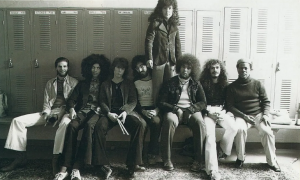
It's not that Cosey has been away, but his profile appears low due to a scarcity of recorded work over the decades. He briefly played with Herbie Hancock, replaced Bill Frisell in Power Tools and started his own band The Children of Agharta, in 2001, dedicated to the electro-funk repertoire of 1970s Miles. Despite remaining a regular gigger in Chicago (and even occasionally here in New York), Cosey hasn't been very fortunate in the documentation of his evolution over the last three decades. Recently, he's recorded an album of Miles material with drummer J.T. Lewis, for the Japanese market, and he's also preparing some original material for a long-awaited solo album. Right now, Cosey leads a trio with bassist Kenny Wiggins (aka Caprice) and drummer Ken Frydrich.
Another facet of Cosey's current work is the leading of workshop sessions in schools, around a wide spread of the Chicago suburbs. Not limiting himself to jazz, he's also harking back to the electric work he did with Muddy Waters and Howlin' Wolf, from the pre-Miles days when Cosey was a session employee of Chess Records. "I utilize more of a concert format, with some explanation, but with more of an emphasis on the music. There's less talk than in the usual lectures, because I find you can lose their attention!"
Cosey's last gig in New York was with his Children Of Agharta, in June of 2007, but he's very keen on bringing his new trio to town, and is even contemplating the possibility of running two bases, oscillating between New York and Chicago. Selfishly speaking, this sounds like a fine idea, for New Yorkers at least.
Recommended Listening:
Various Miles From India: A Celebration of the Music of Miles Davis (Times Square, 2006-7)
Miles Davis Agharta (Columbia—CBS/Sony, 1975)
Miles Davis Pangaea (CBS/Sony, 1975)
Miles Davis Dark Magus: Live at Carnegie Hall (CBS-Sony, 1974)
Miles Davis Get Up With It (Columbia, 1973)
John Klemmer Blowin' Gold (Cadet/Concept—Chess, 1969)
Photo Credit
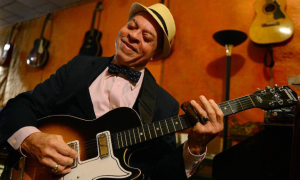
Top: Andre Jackson
Bottom: Audrey Cho
About Pete Cosey

Tags
PREVIOUS / NEXT

Become a Sustaining Member

Since 1995, All About Jazz has championed jazz as an art form and supported the musicians who create it. Over three decades, it has grown into one of the world's leading jazz resources, serving hundreds of thousands of readers, musicians, presenters and industry professionals each month.
Help Build the Future of All About Jazz
Your support helps us continue building All About Jazz for the next generation—expanding our editorial coverage, preserving jazz history, developing new community features and creating better ways to discover the music and the people behind it.
Become a sustaining member for as little as $20 per year and you'll immediately enjoy an ad-free experience along with access to subscriber features and future articles for a full year.
Together, we're not simply sustaining All About Jazz—we're building its future. Thank you for being part of the journey.