Home » Jazz Articles » Profile » Pipi Piazzolla: Argentina's Rhythm Shark
Pipi Piazzolla: Argentina's Rhythm Shark

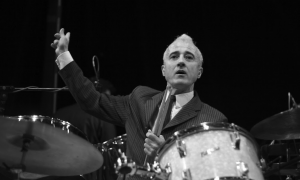
 Ask the Argentine drummer Daniel 'Pipi' Piazzolla about the role of claves in his music and you shouldn't expect an answer so much as an exuberant lesson. Piazzolla, the leader of the celebrated Buenos Aires-based sextet Escalandrum, loves claves—the way they "naturalize" complex time signatures; the infinite rhythmic possibilities they present; the mathematical derring-do of fitting the square-peg of a clave inside the round-hole of a given meter.
"I lived in Los Angeles for a year," Piazzolla tells me in the middle of our interview turned impromptu rhythm class, "and they would make us play [the claves] of our friends' telephone numbers. For example, [my friend's] number is 765-3243. We'd play a clave in seven, then a clave in six. Five, that's the Mission: Impossible theme song. Have you ever thought that it was in five?"
When I reply in the negative, he starts singing and tapping out the famous melody. "It sounds natural," he says, "that's a clave."
"If you have a tune that's in 11/8, you don't have to count out 'one, two, three, until eleven.' What you do is you make the measure into six and five, which gives you eleven. Then, you can divide the six into three and three, and you can divide the five into three and two. When you structure rhythms that way, it's much easier to feel them. It'll end up so that you might think that it feels like it's in 4/4. It sounds natural because of [the clave]...the music of Escalandrum really got going when we started to use these kinds of things."
Escalandrum—whose name is a portmanteau of "escalandrún," the Argentine name for a sand shark (the Piazzollas are avid shark fishermen), and "drum"—formed in 1999 as a group of six friends who hung out with one another nearly every day and thought it high time to collaborate. Their first album, Bar Los Amigos, featured a shark-themed design (Escalandrum's website still has a menacing dorsal fin motif) and a Latin jazz feel, employing Afro-Caribbean percussion, an electric guitar, and an electric bass.

Then, in the space of two months in the spring of 2002, Escalandrum's sound underwent a sea change. It often takes a while for a band to find its most compelling voice—whether it's the Beatles ditching their mop-cuts for shag, or Miles Davis' first classic quintet working its way out of bop and into a new modal vocabulary. For Escalandrum, the change (documented on its second album, Estados Alterados) meant going acoustic, moving past more typical Latin claves into a more complex and global rhythmic conception, and committing itself to an Argentine voice that owes a debt to the tango and folkloric traditions.
Piazzolla was playing in the band of the Argentine pianist and composer Guillermo Klein when the seed was planted for the new Escalandrum sound. Klein, like Piazzolla, is a clave fiend, using fresh takes on typical Argentine rhythms like chacarera and candomble to propel music that owes a heavy debt to the jazz tradition. Klein's style of phrasing jazz with a modern Argentine accent excited Piazzolla enough that he resolved to change what he was doing with his own group.
While Piazzolla cites Klein as one of the crucial influences in his musical maturation, he also—as lovers of tango or Argentina will likely have guessed by this point—comes from a rather distinguished line of musicians. 'Pipi' Piazzolla's father, Daniel, is a noted tango pianist, and his grandfather Astor was one of the most celebrated musicians in Argentine history, occupying a position analogous to Ellington or Stravinsky in the world of tango—the sophisticated modernizer, the gentleman-rebel.
From the time he was very young, Piazzolla was regularly attending his father and grandfather's shows—Daniel and Astor regularly played together—finding it natural to scamper around backstage at the Teatro Colón, Buenos Aires' most famous concert hall. Yet, Piazzolla is quick to dispel the notion that he was groomed to follow in the footsteps of the man Argentines call "the great Astor." "Neither my father nor my grandfather ever gave me a single lesson...In my house there was music playing all day long, and that's the way I got into it, there wasn't any pressure [from either of them.]"

Piazzolla tells a story about the moment when he fell in love with music. He was four-years-old, sitting in front of the TV, when the jingle on a commercial suddenly struck him. He got up, walked over to the grand piano in the living room, and tapped out the melody that he'd just heard. "It was like playing Playstation for a kid today," he says grinningly.
Piazzolla is raising his daughter with the same kind of emphasis on curiosity. During a recent gig at the Buenos Aires club Thelonious, she darted back and forth through the audience as her father played with Argentos, a group lead by the trumpeter Richard Nant that is another important exponent of the new Argentine jazz. At home, Piazzolla has surrounded her with musical instruments but is letting her discover them on her own. When she hears an especially catchy jingle on a commercial, she'll have no shortage of ways to express her enthusiasm.
This sense of curiosity and possibility amidst the palpable influence of the Argentine tradition was not only key to Piazzolla's musical upbringing (and the musical upbringing he's giving his daughter), it informs the kind of music he plays today. Escalandrum is nothing if not a developed version of what Piazzolla found in his home: the band is steeped in Astor Piazzolla's "new tango" and traditional Argentine music, but it let's the influences swirl in the background as it pursues a course of relentless curiosity.

"The other day I was composing a song," Piazzolla says, "and this might seem like a lie, but...later I was rehearsing it with a trio and one of the guys said to me, 'this part has a lot of tango in it.' That hadn't occurred to me at all, but it was there, inside of me, and it came out—and I don't listen to tango. Yes, my grandfather is Astor Piazzolla, and I've listened to that a lot, but that's not what I have playing on the stereo all day. It's in my blood, it's in the air, and what's in the air sticks to you—it's like the accent here."
Now, after two years spent touring Europe, Colombia, and the Dominican Republic, and playing over 100 shows in Argentina, Escalandrum is releasing its fifth album, Visiones—a continuation of the band's recent path that Piazzolla believes documents a marked increase in power and maturity. Following the release of the album, Escalandrum will hold court at Thelonious on Saturday nights in June, and then depart on tours of Europe and Colombia.
There aren't many jazz bands in the world that have the opportunity to play together so often for such an extended period of time. It's the kind of experience that nurtures a band's sound, allowing it to discover its true voice, and letting the musicians develop the kind of interplay that elevates a bunch of excellent players into a great ensemble. With the rhythmic curiosity of its leader driving the music into ever more daring terrain, Escalandrum strides forward at the vanguard of the new Argentine jazz.
Selected Discography
Escalandrum, Visiones, (MDR, 2008)
Escalandrum, Misterioso, (MDR, 2006)
Guillermo Klein, Una Nave, (Sunnyside, 2005)
Argentos, Manifestando, (ArgentosJazz, 2005)
Escalandrum, Sexteto en Movimiento, (Independent, 2004)
Escalandrum, Estados Alterados, (Independent/Milan, 2002)
Piazzolla Jr. Band, Piazzolla by Piazzolla, (Milan, 2000)
Escalandrum, Bar Los Amigos, (Independent, 2000)
Photo Credits
All photos courtesy of Daniel "Pipi" Piazzolla
About Pipi Piazzolla
Tags
PREVIOUS / NEXT

Become a Sustaining Member

Since 1995, All About Jazz has championed jazz as an art form and supported the musicians who create it. Over three decades, it has grown into one of the world's leading jazz resources, serving hundreds of thousands of readers, musicians, presenters and industry professionals each month.
Help Build the Future of All About Jazz
Your support helps us continue building All About Jazz for the next generation—expanding our editorial coverage, preserving jazz history, developing new community features and creating better ways to discover the music and the people behind it.
Become a sustaining member for as little as $20 per year and you'll immediately enjoy an ad-free experience along with access to subscriber features and future articles for a full year.
Together, we're not simply sustaining All About Jazz—we're building its future. Thank you for being part of the journey.