Home » Jazz Articles » Film Review » Inside Out In the Open: A Film by Alan Roth
Inside Out In the Open: A Film by Alan Roth

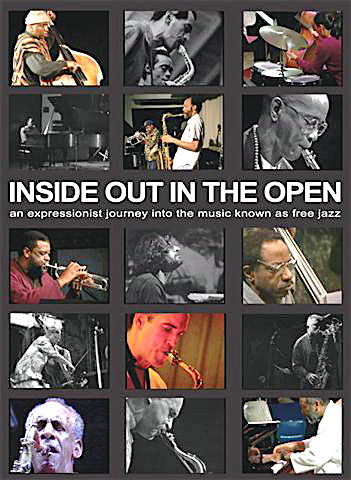 Inside Out In the Open: A Film by Alan Roth
 ESP Disk
2001/2008
Spontaneous improvisation in music has long been relegated to the shadows of public recognition. However much the improvisers themselves have felt estranged from the general culture, they will not be thwarted in their efforts to continue expanding the improvisatory language. It is only they, after all, who can educate society about their music. Not the critics, not the theoreticians, not the academicians—the commentators who circumvent the music. The musicians, on the other hand, are always on the inside of the music: they are the actual story-tellers. They alone hold the key to the appreciation of what they do.
In a 2001 documentary dedicated to the memory of drummer Denis Charles and tenor player Glenn Spearman, director Alan Roth paints a moving portrait of a group of improvisers talking about what they do. The film is entitled Inside Out in the Open. It has been made available on DVD through ESP Disk.
Using his own story-telling sensibility, Roth has woven together numerous interviews and several concerts. The film begins with the voices of each musician-participant defining "sound" over a blurred image of water falling and of sunlight penetrating branches whose green leaves wave in a breeze. In the background, the sound of the rippling water continues. This picture of calm fades effectively into darkness where a backlit Daniel Carter moves his tenor up and down as he blows searing high-pitched passages whose sound devolves into a melody, out of which rises the sound of William Parker's rapid pizzicatos.
Swathed monkishly in a saffron-colored cloak and scarf, bassist Alan Silva is the first musician to speak openly. With the New York scene in the early 1960's as the historical context, he begins defining what an improviser is in terms of identity. The late Joseph Jarman follows, describing his viewpoint in terms of intuition; he represents the Chicago scene. For as many improvisers as are interviewed from either New York or the Chicago area, there are as many definitions of the act of improvising. The definitions are as much autobiographical narratives.
What is common to both of the represented geographical areas is the network of art practices that first inspired then supported musical improvisation. The tendrils of cultural expression in the forms of poetry, dance and visual art are as much part of the fertile ground of spontaneous improvisation as are music theory and formal composition. It is the latter formal disciplines that are studied and known thoroughly before an improviser can develop a musical language that addresses everything and nothing, that is at once all- encompassing and self-referential, a sound expressing the player's world, pulled from within the depths of the human spirit and pushed out into the open air, yet requiring no justification beyond its mere articulation.
The scenes when the musicians speak often dissolve or cut to scenes of the musicians playing, either individually or with a group. Such juxtapositions allow for the meaning of what the musicians say to be applied to the activity of the music. The words give direction to the viewer's experiencing of the music that follows. Even though viewers of this DVD are likely to be familiar with its subject, the sequence of illumination followed by illustration nonetheless contributes to greater appreciation of, and more acute attention to, the creative impulse behind the music.
Roth takes care in identifying the musicians. The viewer always knows who is talking or who is playing and where that person comes from. The cast of characters does not change; each enters the picture in a close-up, at arm's length or a comfortable camera distance away and then disappears and might reappear later, captured either while talking or in the act of playing music. It is regrettable that John Coltrane and Albert Ayler could not speak for themselves. But their effect is described, specifically by saxophonists Marion Brown and John Tchicai. As a result of the film's editing, Alan Silva ends the documentary just as he had started it: as a guru delivering a kind of blessing—that improvisers aspire to nothing more than doing what they like to do...which is playing music.
Close attention to what any of these musicians say will disclose that the music means more than itself. It is an expression not only of commitment and belief but also of gut feeling. Those qualities of character have priority over the pursuit of political or monetary gain. Never letting satisfaction be a goal, the true artist gains momentum from perpetually unresolved tensions—the dynamic between conformity and individuality, uniformity and diversity, convention and difference, the past and the present. This dynamic propels the improvisers to create in the spirit of clarifying these dualities if not unifying them through the power of music. The musicians' words provide entrance to their original worlds. Their music offers access to their conscious beings. All that is needed is an open-minded audience to listen to both.
In the same way that water is free-flowing, travels by force of nature, changes from one physical state to another, is inherently ordered yet powerful enough to cut canyons through rock, so can sound behave, particularly in the hands of those who organize their own music-making to proceed as freely. Inside Out in the Open provides a perfect medium for helping others to understand the process.
Interviewed: Marion Brown, Roswell Rudd, John Tchicai, Alan Silva, Burton Greene, Joseph Jarman, Baikida Carroll, William Parker, Daniel Carter, Matthew Shipp, Susie Ibarra.
Performers: Denis Charles: drums; Glenn Spearman: tenor saxophone; Wilbur Morris: bass; Joseph Jarman: tenor saxophone; Peter Brotzmann: tenor saxophone; John Tchicai: tenor saxophone; Sun Ra Arkestra; In Order to Survive (William Parker: bass; Cooper-Moore: piano; Rob Brown: alto saxophone; Susie Ibarra: drums); Other Dimensions in Music (Roy Campbell: trumpet; Daniel Carter: tenor saxophone; Rashid Bakr: drums; William Parker: bass; Matthew Shipp: piano).
Production Notes: Directed by Alan Roth. Date of DVD release: 2008. Regions: PAL and NTSC (Dual-Sided), with Digipak. Running time: 60 minutes.
< Previous
Afterburn
Next >
Avellaneda
Comments
Tags
For the Love of Jazz
 All About Jazz has been a pillar of jazz since 1995, championing it as an art form and, more importantly, supporting the musicians who create it. Our enduring commitment has made "AAJ" one of the most culturally important websites of its kind, read by hundreds of thousands of fans, musicians and industry figures every month.
You Can Help
To expand our coverage even further and develop new means to foster jazz discovery and connectivity we need your help. You can become a sustaining member for a modest $20 and in return, we'll immediately hide those pesky ads plus provide access to future articles for a full year. This winning combination will vastly improve your AAJ experience and allow us to vigorously build on the pioneering work we first started in 1995. So enjoy an ad-free AAJ experience and help us remain a positive beacon for jazz by making a donation today.

Giveaway

Days remaining: 4