Home » Jazz Articles » Profile » Jon Hendricks: Vocal Ease
Jon Hendricks: Vocal Ease


The language that one speaks attains its height in poetry; a person reads a great poem and his soul is ennobled. The Bible is poetry, great literature is poetry. A good lyricist is a poet.
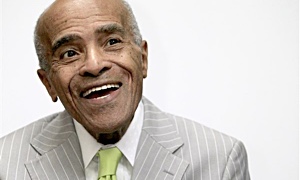
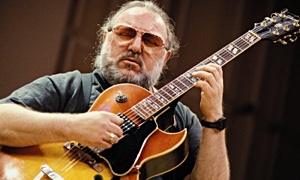
Scat and vocalese master Jon Hendricks and his wife Judith have maintained a residence at Gateway Plaza in Battery Park City for a quarter century. Their high-rise apartment overlooks the Hudson River going north. From the living room window you see the Battery Park City promenade directly below and the New Jersey shoreline across the river. The view is so expansive that the petite size of the place, with walls lined with framed posters of Duke Ellington, Louis Armstrong and Billie Holiday and of Jon Hendricks performing with daughters Aria and Michelle, isn't important.
Hospitality and warmth greet you upon entering, as Judith Hendricks gracefully says, "Come in Greg and make yourself comfortable." Her husband soon makes a grand entrance, clad leisurely in a robe. Small talk follows the firm handshake and hearty hug, after which we sit down at the dining room table, joined also by Kristina, Judith's assistant from Ohio. Nuts, berries, whole grain bread, cups of mayonnaise and Dijon mustard and white meat chicken slices adorn the table and are washed down with tasty Earl Grey tea. These items are components of the protocols designed for Judith by the Gerson Institute after she was diagnosed with melanoma in January 2006. (A recent ultrasound revealed that her tissue has returned to normal.) Then we start swingin':
"My class, 'Jazz in American Society,' is still number one on campus, at the University of Toledo," Jon Hendricks says, beaming with pride. "My course is considered an easy A because, I tell them, I think anyone who registers to take a jazz class has earned an A as far as I'm concerned."
In 2000, he returned to his hometown of Toledo, Ohio to teach bright-eyed freshman the bliss and blues of jazz. The University of Toledo awarded him an honorary Doctorate of the Performing Arts and appointed him Distinguished Professor of Jazz Studies. In the '70s Hendricks taught at several universities in California; hence, he's no stranger to the classroom.
"And this is how I continue, on day one: You will earn an automatic A just for taking this class because this is the only country in the world that systematically degrades its own cultural art form. And while it does that, it pays servile attention to all the world's other art forms. When I say servile, I mean they spend millions of dollars on huge ornate, gaudy opera houses. That's Italian. Each city has a grandiose, sumptuous art museum. That's French. Cities, towns and municipalities subsidize ballet companies. And that's very cultured and very wonderful. Except that's Russian. And they all have symphony orchestras that play symphonic music. That's Russian too. And they have Shakespearean theatres. That's English."
"Remember, this is me talking to freshman kids: And what do they have for American culture? Dark cellars, mostly funky bars where women and drugs are for sale. And then on top of that, with their lying selves, they tell you and anyone else within earshot, that that nigger music was born in the whorehouses of New Orleans. The truth is that jazz is the secular music of our Christian church."
After he explains how Ray Charles transformed the spiritual "When the Saints Go Marchin' In" into "I Got a Woman" he continues: "The music is spiritual. Only the words are changed, to protect the guilty. That's why you have to sit up here, all 200 of you, in the largest lecture hall in this university and listen to stories about your culture while six-year old children across the world can show you the houses of their culture. But our own, they ignore completely. The last thing is, every other country, whose cultural ass they kiss, adores the culture that they spurned, which is jazz."
Hendricks says that his time at the University of Toledo has given birth to a missionary zeal to reveal the cultural value of jazz. This fervor is a natural product of a 70+ year career, which began for him in Toledo, Ohio singing on the radio as a teen, rehearsing and being mentored by the great Art Tatum, also from Toledo. Charlie Parker heard him there and urged him to come to New York. Several years later, when he moved to the Big Apple, he searched for Bird, who upon seeing him said "Hey Jon! What took you so long?"
In 1958, he collaborated with fellow vocalists Dave Lambert and Annie Ross to form Lambert, Hendricks & Ross. Their path-breaking recording Sing a Song of Basie established them as the most successful jazz vocal group in history and was one of the first recordings to utilize overdubbing. They took the art of vocalese—putting lyrics to instrumental jazz solos and arrangements—to another level. According to Hendricks, King Pleasure originated the practice in the early 1950s with "Moody's Mood for Love," based on James Moody's improvisation on "I'm In the Mood for Love." Yet never before had a vocal group taken entire big band arrangements and performed vocalese lyrics to every note.
By his own count, Hendricks has composed 300-400 vocalese lyrics. He has written lyrics to songs and arrangements by Basie, Ellington, Monk, Jobim, Quincy Jones, Horace Silver and many others. He has even written a vocalese version of Rimsky-Korsakov's "Scheherazade" and Rachmaninov's "Piano Concerto No. 2." Premier examples such as "Freddie Freeloader" and "Joy Spring" are perennial classics of the form. In the former, found on Hendricks' album of the same title, he tells a cautionary tale about Fred Tolbert, a bartender at a jazz spot in Philadelphia in the 1950s. Freddie was known and loved by the jazz musicians back then because he liberally gave away drinks and allowed the musicians credit. Hendricks structures the tale by using an all-star cast who start the number (found originally on Miles Davis' classic, Kind of Blue) like a Greek chorus, intoning Freddie's name. Next are the solos, for which Hendricks wrote lyrics that he says are "character analyses" of each of the soloists. Bobby McFerrin sings the vocalese lyrics to Wynton Kelly's solo, giving a glimpse into Kelly's tongue-in-cheek sarcasm and sense of humor, followed by Al Jarreau, displaying Miles Davis's candor. In an incredible exhibition of vocal dexterity, Hendricks reveals John Coltrane's focus on matters serious and spiritual. George Benson's take on Cannonball Adderley demonstrates Adderley's devil-may-care attitude. Freddie gets the last word, explaining why he gave away drinks.
It's a cautionary tale ("Free booze, free dues, free blues") because, as Hendricks tells it, Freddie ended up homeless.
Clifford Brown's "Joy Spring," amended by Hendricks as "Sing Joy Spring" on Manhattan Transfer's multi-Grammy award winning recording Vocalese (with all of the lyrics composed by Hendricks) is perhaps the ultimate vocalese masterpiece. The metaphorical and symbolic density Hendricks displays here is simply stunning. "To me, 'Joy Spring' meant two things. It could mean a spring from which instead of water, we ladled up joy for your spirit," elucidates Hendricks. "Or we drank joy from the spring. Or we waded in the joy spring; we bathed in the joy spring. So I started to philosophize it. First, I had to define the text in the first part of the song. The first chorus had to be a definition of what this thing was. Then the solos had to be commentaries on that first chorus... different horns make different commentaries."
Hendricks takes us on a magic carpet ride, in between reincarnations, then through the current incarnation, in which the key question remains: will you make your life meaningful by tapping into the spiritual joy within or will it signify nothing because you forgot the role of the soul in relation to its temporary dwelling place, the body? By the time Hendricks pens the vocalese commentary on Brown's solo, we are on a metaphysical journey in which Ponce de Leon (who searched for the "fountain of youth"), the Brothers Grimm (Snow White), Buddha, Francis Bacon and Shakespeare all contribute to the realization that joy is the eternal spring of life and the soul.
"As a jazz musician, I would like to be remembered as a poet. That's the highest level, because poetry is the highest use of the word," Hendricks asserts. "The language that one speaks attains its height in poetry; a person reads a great poem and his soul is ennobled. The Bible is poetry, great literature is poetry. A good lyricist is a poet. Johnny Mercer was a poet: 'Footsteps that you hear down the hall, the laugh that floats, on a summer night, that you can never quite recall.' That's poetry. So if I can be remembered as a poet, I'll be happy."
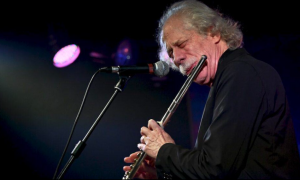
Al Jarreau calls Hendricks "pound-for-pound the best jazz singer on the planet—maybe that's ever been." Most critics and scholars of jazz acknowledge Hendricks' talents, although they may have slept the true depths of his lyrical genius. Saxophone and flute legend James Moody hasn't though, which is why he invited Hendricks to join him as a special guest for his gig at the Blue Note from April 1-6, 2008. "For that week, to have someone of his stature is wonderful," comments Moody. "He's got a great sense of humor. He's a top-notch lyricist and a hell of a scatter." Hendricks thinks very highly of Moody as a musician and scat singer too.
"We were at Wolf Trap celebrating Dizzy's 70th birthday. Everybody was there—Freddie Hubbard, Wynton Marsalis, Jon Faddis, Sonny Rollins, Carmen McRae," recalls Hendricks. "Backstage, I told Moody, man you lucky I don't pick up a brick and split your skull! He come up there and cut everybody! Dizzy, me, Wynton, Freddie Hubbard. He comes up there talkin' about, flop, skibe dibi bop, tu slop, blip! I said to Diz, I oughta cut his throat. Diz says, I been thinking about that. Moody tore all of us up. Boy, that cat was baaad. Every phrase was exact, pronounced. There was no stumblin' or skimpin' or slurrin.' I love Moody, always did. I love his wife Linda. He found a Judith."
Like jazz, Hendricks combines vernacular and fine art elements with felicity. He swings, in conversation and in composition, mightily. But since becoming a tenured professor, his future plans have changed. Why? "Because teaching jazz, I have realized how de-culturalized America really is. This is America, with a culture of its own, that comes from its African people. I am intently concerned with acquainting the American people to the fact that not only do they have a culture, but if they are not up on that culture, how stupid they are, because there's not a country on this planet that does not love our culture."
"I want the whole world to know this, starting with the United States. I would like to become a Visiting Professor at Harvard, Yale or Princeton." He also mentions several institutions in New York at which he's open to teaching, especially since these institutions have thriving jazz programs: Columbia University, NYU, the New School, Manhattan School of Music and Juilliard. "They should be all looking at the light shone by our own culture and not on the rest of the world, like it is now. So that artists in our own culture have to go overseas so they can earn money. That's got to stop. And only knowledge can change that. All of this exists because the people who would change it don't know. I want to shout it out loud!"
Recommended Listening:
Jon Hendricks, Boppin' at the Blue Note (Telarc, 1993)
Jon Hendricks, Freddie Freeloader (Denon, 1989-90)
Jon Hendricks, Tell Me the Truth (Arista, 1975)
Jon Hendricks, Recorded in Person at the Trident (Smash, 1963)
Jon Hendricks, Evolution of the Blues Song (Columbia, 1960)
Lambert, Hendricks & Ross, Sing a Song of Basie (ABC/Paramount-Impulse, 1957)
About Jon Hendricks

Tags
PREVIOUS / NEXT

Become a Sustaining Member

Since 1995, All About Jazz has championed jazz as an art form and supported the musicians who create it. Over three decades, it has grown into one of the world's leading jazz resources, serving hundreds of thousands of readers, musicians, presenters and industry professionals each month.
Help Build the Future of All About Jazz
Your support helps us continue building All About Jazz for the next generation—expanding our editorial coverage, preserving jazz history, developing new community features and creating better ways to discover the music and the people behind it.
Become a sustaining member for as little as $20 per year and you'll immediately enjoy an ad-free experience along with access to subscriber features and future articles for a full year.
Together, we're not simply sustaining All About Jazz—we're building its future. Thank you for being part of the journey.