The Creative Process: Putting It All Together
AAJ: Now, the next question requires a lot of ego, so you need to let go of any false humility [(laughter]. If someone were going to introduce you at a jazz education or jazz journalism conference, and they intended to introduce you as a genuinely original and creative force in jazz, what would you want them to say about you?
 DL: Well, false humility aside, I would never deign to think that I've contributed on a major level in comparison with the jazz "fathers" whom I adore. On the other hand, I have made a contribution to my instrument, in my case to the soprano saxophone, which is really what I intended to do when I stopped playing tenor for a time in the 1980s. I've thought about the instrument and ways to verbalize my observations. Some of my books have made a contribution to theory and aesthetics. I'm proud of that. On the other hand, there are four or five great innovators of this music, and the rest of us are lucky if we get a little piece of it. Richie Beirach and I would say that if you could get a little pinky toe of Coltrane, you could spend your life on it.
JR: For me, I feel as if I'm still in the process of contributing. I've been composing and improvising since I was really young, but now I'm beginning to understand more of what I'm doing. In that sense, I believe that when I'm really contributing, I get into a space where I'm not thinking about anything else, I may not even be conscious of what I'm doing, but I feel that I'm taking the space that a jazz musician should take. Like when I work with Dave, he takes that space every time, meaning that's where the musician should be. So, OK, maybe what I'm doing is not all that innovative, but I'm pushing, I'm pushing something, I'm stretching it in a way that at times it's different enough, that it pushes the envelope. For example, these days, I'm more selective about when and where I play. I'm not gonna play every gig, but I'm going to do work where I can contribute to this art form—that's really important to me. I've always been creative, but it took me a long time to get to where I know that's what I'm about.
AAJ: To quote from Miles Davis, "I'll play it first, and tell you what it is later." That's the creative "space" you're talking about.
DL: A lot of times you don't know what you're doing initially, and then you codify it. In my case, for example, I recently taught my "chromatic approach" at the Manhattan School of Music, and they asked me, "How did you come up with that?" And I said, "Well the truth is, when I was playing with Elvin or Miles, I had no idea what I was doing. I never really thought about it. I was just hanging on for dear life! Then in the mid-eighties, I was teaching, and I had to explain what I'm playing." Actually, Miles and his generation didn't talk about these things at all. They were a little reticent or unwilling. There's a little bit of voodoo there—don't give it away, can't explain it, or we just don't explain it. In the current time, it's completely the opposite. I just came from the IAJE [International Association of Jazz Educators] conference in Toronto, with all the clinics and symposia and books—jazz education has become a business. And I do think an artist should be able to explain how he got to the point where he is now.
AAJ: And that's one reason for this interview. Jim, apropos of this subject, it seems to me that one of your real contributions to jazz is bringing in various forms. Just as one example, your CD Your Cheatin' Heart and Other Works (Dreambox Media, 2005) turns country tunes into jazz, elaborating on the story each song contains, and then in Pianadelphia (Soulsearch, 2006), you did a takeoff on the Pat Martino tune, "The Great Stream," that was so far out that it sounded like it could have been written by Schoenberg or Shostakovich! Would it be fair to say that when you play, you're bringing in the rich legacy of music-as-a-whole in its great variety?
JR: Yes. I think I'm influenced my many things. Some of it is just by osmosis, but some of it is conscious. For example, I grew up on a farm, and that vibe is always coming through me in a certain way. Yet I can play much more complex things. I like both real "out music" and real "in music," and what I do is really a combination of the two. So in other words, I don't think I'm a "mutt," with too many things going on at once. I think I have enough cohesiveness to kind of hang and say what I'm supposed to say, whether it's a country tune or something a lot more 'out,' like twelve tone rows, or whatever. I don't feel funny about putting those things together—I think it's cool.
AAJ: There's something that runs through all of it—its not just a mish mash of styles.
JR: That's part of what's great about this art form. Like Dave draws from Puccini, Brazilan music, so many different sources. But it's always "Dave."
 DL: Well, thankfully, eclecticism is now kosher. I'm a product of the sixties, which was a time of musical explosion on a mass level. You didn't have to be Charlie Parker to listen to Edgar Varese, or Indian music, but for a normal guy like me in Brooklyn, there was Folkways Records, UNESCO, the Bulgarian Girls' Choir, I mean I heard all this stuff, and it was all food for me. There was no distinction between Indian influence, or Beethoven or Puccini or James Brown. Of course, jazz was my avocation, so I put all my money in that ring, to develop myself in that way. But all the musical influences were valid. In the beginning of the sixties, it was the "Common Era" of jazz, so to speak. There was a common understanding of what jazz was all about. It was standard repertoire, blues, standard rhythm changes; people basically played the same language, which was why they became so good at it. Sonny Rollins, Hank Mobley, Jackie McLean, they played the same music night after night.
And then in the sixties, due to the cultural changes in America, suddenly you could have everything on the plate. You could do rock 'n roll, you could do fusion, you could have an Indian guy on the stage. Miles was very influential in that respect. He made it valid. John McLaughlin, what he did with the Mahavishnu Orchestra. Then eclecticism became a style. Before that, eclecticism was a negative judgment—it meant you're dilly-dallying with too many things, without having a focus. I used to get that criticism with my first group, Lookout Farm, because we'd go from a rock tune to an Indian tune. Jim's generation is a little younger than me, and certainly now, it's not only kosher, but it's a prerequisite that you should dance around to different idioms. You can go from an Indian raga to Schoenberg in the same set. The listener expects that. So jazz has really matured in that respect, to become truly a "fusion" music. I mean it was always "fusion" in the respect that it brought in blues, European harmony, African rhythms, and so forth, but we could trace the three to five things. Now we have thirty to fifty things so to say. And the internet has only sped that up.
AAJ: So the vocabulary has vastly increased.
DL: Absolutely, and the requirements have vastly increased. And the challenge now for a young artist is that there's so much food on the plate, what are you going to eat? You're in New York and within three blocks of each other, there are ten different ethnic restaurants, let's say. So now we have to consider, what are you gonna do? Are you gonna be really good at something, or are you gonna be a jack of all trades, master of none sort of thing?
AAJ: OK. So let's try to focus now on the actual process of the act of creation, try to put a microscope on it. For example, a player comes up and says, "Let's do this tune." It's a Jerome Kern tune, or it's an original by one of the group members, and you can do what you want with it. Can you sort of take us in that room and in that space in your head, and give us an idea about how you go about developing that raw material into some format which then becomes a whole arrangement and, in a sense, a new, improvised composition' How do you go from the initial inspiration to what is fleshed out in the performance?
DL: This was a big lesson I learned from Miles, because that was one of his strengths. In the studio, he was the greatest editor of all time—he'd cut away all the fat from the meat. What I learned from him is to ask, first, what does that band do best? Not what you wish it were, but what are your raw materials? What does that pianist do best? Now you need a keen sense of perception or judgment for that. So, play to their strengths in your arrangement. Then the musicians are going to do their best, and they're going to be personally satisfied as well. So it's both psychological and musical. Secondly, with a group, you always want a sense of group construction. So I will always say to them, what do you think? I'd want the input of the guys who are doing it. Jim here is a pianist, so he knows chords. I'm a melody player. If he brings in a tune, and it's awkward, it's my prerogative to suggest a change. So we go to where the strength is.
 JR: I'm in total agreement with that. I'd just add that, for my own group, or even if I'm bringing in my own composition to someone else's group, as a composer, I want to have my tune so together, that the musicians will be able to absorb it really quickly. As much as possible, I want to get all the awkwardness out of my tune. Even the way I write it out—I don't want the guys to get all confused—if they do, it's my fault. You want the musicians to play great, so don't get in their way. So, I sit down at the piano, and it's part of the creative process to trim all the fat and "BS," so it'll sort of lay out. The musician will be able to take it all in and say, "Oh yeah, that's what it is." And then, in a jazz context, I like to present the tune, and then I want the particular players to bring their particular thing into the music. I don't like to specify too much in advance. If the tune is good, it'll have a certain vibe in it, and that's sufficient.
AAJ: You both suggest that an important part of creativity is parsimony—getting rid of the excess, the fat.
DL: Clarity is everything. For one thing, things will go faster, and in this day and age when you make recordings, you have very little time to go over the tunes. And we don't have the six nights a week at the club to get the tune in shape. Coltrane could afford that time to fix things, and believe me, by the third night it was together.
AAJ: You're saying that we are in an era of instant creativity.
DL: Yes we are, by our circumstances.
AAJ: Jim said another important thing—that part of a good composition is keeping it open, so that your musicians can develop it. And that's what really makes for a great jazz arrangement. The guys can take it and use it—it's not just interesting in itself, but it inspires the players in their own creativity.
DL: Elasticity. I'm always ready to yield to one of the guys if necessary. Someone prefers another chord—he's got it. I'm not stuck on what I wrote—it's just a point of departure. Once we have a mutual understanding, we can go forward.
JR: Before you arrived here, Vic, Dave asked me to read through a couple of his arrangements, and I thought to myself, "If this had been eight years ago, I could have hardly read this," because I didn't know Dave's musical language as I do now. Now, I can take in his harmonic, rhythmic, and melodic sense, and I can get it much more quickly, and get to some more creative moments with it instead of puzzling over it.
DL: That what musicianship is, and Jim is a great musician. He can get to it pretty quickly,
AAJ: Jim is also saying that he internalized it, that he's incorporated a piece of you. So he has a template which he can use. And then he can just go with the flow.
DL: It's like being in a foreign country. The first time, you're at sea, confused. After a while, you know what you can do. Now you can start to use the new culture in a way that it expands you. In the end, it's language. It's communication.
AAJ: And music really is a language. Someone recently told me about a book about a tribe somewhere, where they literally sing everything! Their whole society is based on song!
DL: Perfect!
class="f-right">
Getting to the Source
AAJ: Another aspect of the creative process is the nature of its source. Many times, creative people tell you they don't know where the idea came from. It's as if they believe there's a source beyond themselves. Sonny Rollins told me that at a certain point, it's not him that's playing—something takes over. This source, whatever it might be, has different names in different disciplines. In psychology, we call it the unconscious. Literary people call it the Muse. Zen Buddishm calls it transcendence. And Western religion calls it God. But all agree that there's something beyond the conscious self. So I wonder, do you feel the inspiration comes from a source outside yourself, or you feel it's just you doing your thing, constructing something interesting' Like a furniture maker putting together a chest of drawers, and so on.
DL: For me, I actually wrote a tune entitled "Le Roi du Monde," and when you're playing you are indeed the "king of the world." In French, it doesn't mean that you're the feudal lord; it means you're on top of the universe. When you're playing, there's nothing better. Everything is what you want it to be. It's your horn, your group is doing great, it's coming from yourself, but it's also coming from elsewhere. Some of it is mystical, but some of it is nuts and bolts. All of that's happening when your playing. And for me, it never happens other than when I'm playing music. You can, if you want, liken it to the sexual act: there's that moment of ecstasy. Maybe that's closest to what I'm talking about.
AAJ: In an orgasm, however, it's an emotion, rather than a construction. One usually doesn't get the idea for a novel or a tune when having sex or at the moment of orgasm! [Laughter] If you do, you're pretty cool!
DL: Well, this moment of "king of the world" includes the orgasmic feeling, but it's more than that.
AAJ: It's a wonderful terminology, because the paradox is that you feel like a king, but at the same time you're a humble channel for something bigger than yourself.
DL: Yes, and that's when you can say that you're "king of the world." You need to be pretty high up in the first place, in order to look higher up. So that's the moment of playing that is mystical—but also grounded.
AAJ: So, healthy narcissism is a good thing.
DL: Absolutely!
AAJ: Let's hear from Jim on this.
JR: It often times runs the gamut. If I'm arranging music for someone, and I don't have a deep connection, then I'm creative, but more as a craftsman. In that sense, I'm not having a truly transcendent moment, yet I'm being creative. But once in a while, on some arrangements I've done, it has felt much more personal and therefore, even more compositional. It's as if I'm in a space where I can feel it, like I'm goin' for that third cup of coffee, I'm not conscious of time, and it becomes a whole other activity that feels like I'm spontaneously composing.
Now, when playing, there are times when I feel I'm in an amazing space. Not necessarily an out-of-body experience, but like Dave was saying, I'm aware that, say, this is a C-seventh chord, but I'm playing things on it that I've never done before. Now, where that comes from, man, I really don't know. Maybe in some ways we are blessed with a Higher Power—I'm not one hundred percent sure about that. But it can happen in the craziest places. Like I'll be playing a crappy gig where no one's listening, but I'll be so inside what I'm doing that I'm in a very creative space. But even better is when you're connected with your audience.
class="f-right">
On Improvisation
DL: I think that as improvisers—whether jazz or not—playing in the moment, we know more about it than anyone on the planet. Unlike the painter or the composer, the improviser is doing his thing in real time---like a race car driver! Athletes are also in the moment. But we improvisers make an art out of being in the present time.
AAJ: It just occurred to me that a side question might be why real time improvising came to it's height in jazz. Why didn't Beethoven do it, for example?
 DL: He did do it. But we don't have recordings!
AAJ: So in a way recordings have a lot to do with the evolution of improvisation in jazz.
DL: That's the truth. Jim here could've been Beethoven. History says these guys were the baddest cats around. Bach was the greatest improviser.
AAJ: So the jazz idiom itself is not responsible for improvisation as such.
DL: Well, there is something in the rhythm, in the African roots, that facilitates the real time aspect. The groove is what facilitates the real time. I might say there's no groove in a minuet, but Beethoven might say, wait a minute, man, there's a real groove in the minuet—you just don't know about it. But what's important is that in improvisation you're calling on all your faculties at the moment, and it's a magical moment that's unlike anything else in the world. Composing is interesting in itself. I've written hundreds of tunes over the course of forty years, and I don't know how I wrote them.
AAJ: Do you have any take on why some excellent musicians can improvise and some cannot? One of the first things that inspired pianist Bill Evans, was when he discovered that he could make something up as he was playing, change some aspect of the tune. He was immediately an improviser. But you have classical musicians who are superb performers, and they can't improvise at all.
DL: It's fear—they're afraid to improvise. They're so used to reading what's on the page, and getting their security from it—what could be more secure than Mozart? The thought of improvising a cadenza, say, is so fearful to them, and I would love it if you, Vic, who is a psychologist, would explain why they are so fearful to do their thing.
AAJ: It's an anxiety disorder—a phobia.
JR: It's also a learned behavior. Historically, I think there was a lot of improvising done until the nineteenth century. Then, when the Romantic period began, it became this thing of playing totally what the composer wanted, being faithful to the original, and you didn't go outside of that. But when I think about the great pianist, Vladimir Horowitz, I understand that he was an improviser, and he did an awesome takeoff on "Stars and Stripes." If he would've stepped out and taken a cadenza and improvised on it, the audience would have freaked out.
But I do think there are a lot of closet classical musicians who are actually highly creative improvisers, but that trend is just beginning. There's getting to be a crossover between classical and jazz. For example, Keith Jarrett's work has many classical elements in his improvising. It relates so much to a classical European repertoire, which he knows well. But I'm surprised more classical cats haven't come out and done that.
AAJ: The classical musician would have to overcome a certain taboo against breaking with tradition. But you raise an interesting question, namely, what allows someone to compose in real time, to be spontaneous in the moment in a certain medium?
DL: I think it's cultural. And the Romantic image of the writer, the artiste, the composer, being the conveyor or emulator of the Supreme Being, "I am the performer of the master's works." Now the fact that Horowitz became famous as a performer is basically a later development. On the other hand, way back when, Mozart was hired to work in the court of a King or Duke. Bach was hired by the Church. They were fully functioning in their job, so to speak: composing, performing, conducting to meet specific assignments. Later, the composer and performer became two different professions, two different individuals. So, it's the society that gives you permission what you can do. For example, African cultures have no problem with improvising. The Chinese, on the other hand, follow the western traditions. Jazz comes out of the "melting pot" mix of cultures in New Orleans which said, "Do as you want." It has to do with freedom. And the African influence on rhythm happened to slip in, so we have what we call jazz.
AAJ: Well, maybe we could say it's 'both/and': the culture and the individual. But you really brought to my attention that the culture has a huge impact. In some cultures, the children are brought up to improvise, while in western culture, the kids are brought up practicing scales. In Africa, they might just give the kid a drum and say, "Join us! Here are some things you can do."
class="f-right">
Music on the Brain
AAJ: Now let me go somewhat out of this context for a bit. As a psychologist, I'm interested in neuropsychology and the study of the brain. Recently, guitarist Pat Martino participated in a documentary about his miraculous recovery from memory loss due to an aneurysm and surgery. But that aside, neuroscientists tell us that musicians' brains are different from the rest of us. Modern brain scans can show both the structure of the brain and shifting activity levels in various parts as the subject performs certain tasks.
Interestingly, it appears that jazz musicians have more connecting fibers between the left and right hemispheres of the brain. The corpus callosum connects the two hemispheres, and is actually larger in jazz musicians, even larger than those of classical musicians! The left brain does the cognitive, language, and logical stuff, while the right brain deals more with images, perceptions, emotions, and so on. When you play jazz, its real force comes from the bringing together of ideas and concepts (the inspiration, so to speak) with the emotions and the musical images. I just want to check that out with you as musicians—does part of what you do involve crossing that divide between ideas and images, concepts and realization, thought and action?
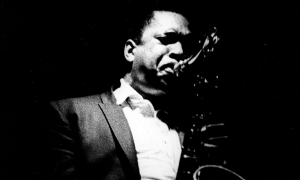
 JR: Yes, that's true, and I think it's poorly understood by the masses that that's what jazz is, that it's a combination of soulfulness, yes, but you can't leave out that it's a real intellectual process. Jazz has grown into a very complex language, yet we can communicate a very complex thing to people who may never have heard it before. But the listener doesn't have to know this. Like when you listen to Coltrane's twenty-seven minute solo on "One Down, One Up." It becomes such a visceral thing to hear, but as a musician, I go "Wow, he's wipin' everybody out here!" It's highly complex, yet it's such a soulful place he got to.
AAJ: Trane was almost chanting when he played, almost trancelike. Yet it's all been thought out in a very complex way—with chord progressions, intervals. He even invented some new ones. And you guys do the same thing.
DL: What you're looking for in any artistic statement is a balance between head, hand, and heart, or mind, body, and soul. You want the thought, the feeling, and the technical means to do it. Some musicians have only one of the three—thirty-three percent of it. Some have the soul; some have incredible ingenuity and thinking—serialism, ideas, computers, etc. but no feeling, no vibe. But I think the ideal is mind, body, and soul, equally shared between the three. That's what I'm striving for. Playing it clean, no misses. Plus you're getting that feeling like you get from Trane, which of course is spiritual. Of course you can't do that all the time, but that's the goal, the vision.
AAJ: Let's stay with the brain/mind thing for a moment. Oliver Sacks recently wrote a book entitled Musicophilia (Knopf, 2007), in which he discusses musical oddities. One anomaly he discusses is a woman student, who was failing her class because she couldn't pass the exams. Her professor thought she was bright and called her into his office to find out why she was having trouble with the exams. As it turned out, she was a vocalist, and said, "I can remember things much better if I sing them." So he said, "'Well, sing it." And she proceeded to sing verbatim the entire course! Not only that, she sang it beautifully and the professor was enthralled.
Another example which occurs fairly often is where people see sounds and hear colors—they cross sensory modalities. In fact some great artists and musicians have this. For example, various tonalities and sonorities form different colors in their minds. It's a disorder, but it can also facilitate creativity. I'd like to ask you if you ever notice such oddities in yourself or your fellow musicians?
JR: It's pretty rare for me. I guess I can have a sense that a sound is blue, for example.
DL: I've only had it when I've been high on LSD. Out of body experiences, and so on. I think the brain is definitely capable of that. Musicians definitely have something going on there. Like a cat who can play things on his left hand that we can't even do with two hands, or the guy who can play tunes upside down and backwards, things like that.
JR: I've had dreams where I'm doing things that in reality are impossible to do. Like in one dream, it's surreal, but I'm playing piano on the floor, but there's no keyboard, and yet the sounds of string instruments are coming out. Then, the keyboard I'm playing on is a person, and it's my wife! Yet even though it's a dream, I can relate to it when I actually perform. Like there are times when I'm playing piano, but I hear string instruments in my mind.
AAJ: That's fascinating, and it's what I'm really getting at—not the freak behaviors, but just what the brain can do with sounds. And I'm wondering whether jazz musicians have a wider range of what they can do with sounds.
DL: Definitely. Brains are differently wired. The brain has even evolved over history—our brains are different from the cave man, right?
 AAJ: Scientists have differing opinions about that. But today they believe the brain is more plastic than we believed; for example, it can generate new nerve cells, so there may be some truth to what you're saying. Julian Jaynes, in his book, The Origins of Consciousness in the Breakdown of the Bicameral Mind (Mariner, 2000), held that consciousness, hence the brain, has changed over the millennia. In particular, self-awareness and the ability to think about thinking was not a given, but emerged culturally and reached its apex in the nineteenth and twentieth centuries. Jazz improvisation would not be possible in the absence of such a development.
DL: So too, what our brains can do musically is evolving, and the next generation will have something we don't, and so on. Charles Lloyd said to me, "You guys are better than I was." Last night, I had a sixteen year-old kid over here for lessons. I couldn't figure out how he was doing what he was doing! It's in the air! His young brain is wired differently from us older guys!


 David Liebman: You bring up a few points, Vic, for example this notion of taking a chance when you play, which is not the norm. That's something I've thought about quite a bit. But regarding inspirations, I think the whole idea of being inspired, for any artist, is really the key for longevity in this field. Because when you're young you're going to be inspired by what's around you, and of course your own work. But after twenty or thirty years, it's a real challenge to keep inspired. It's not that you've seen it all and been around, you've had your love affairs, you've seen war, and so on: the things that make you what you are, and the music. But how do you accomplish what Duke Ellington did, or Picasso? That, for me, is the real deal of ageing, which is relevant to me now because I'm in my sixties and into my fortieth year in the business.