Home » Jazz Articles » Profile » Fred Anderson: Customizing Conviction
Fred Anderson: Customizing Conviction

Chapter Index
- Anderson's Evolution
- The Velvet Lounge
- Younger Musicians
- Harrison Bankhead
- Chad Taylor
- Ken Vandermark
- Hamid Drake
- And thus...
- The Velvet Lounge
 In the mid-1940s, Charlie Parker and Dizzy Gillespie sprang out of the swing era, in Anderson's words, "thinking music should go their way, and revolutionized American jazz. It did not require much to do so. It was actually very simple. They concentrated on producing a melody and then improvising on it. The rhythmic aspect of that change quickened the pace so much that the music required a new label and that label was bebop.
Yet, for Anderson, what the beboppers did, particularly Charlie Parker, was open the gates to crystallizing an art form and establishing their own identity in a way that musicians had never tried before. Anderson stresses how he remains interested in finding out how "the music was traveling along, and discovering the musicians he never knew about. He aims to keep learning so that he can continue to embellish what he perceives as the technical aspects of the jazz music to which he is attracted. He aims to keep researching and learning about the music rather than simply copying licks that originated in that bygone, albeit radical, era. "The more you know, the more you understand.
In his playing, Anderson maintains the simplicity of the stark transition into bebop, and combines it with the fluency of the robust sound of tenor saxophonist Gene Ammons, who also rose out of the big band era. Anderson's invention of melody is unequaled as is his "sense of pulse, according to drummer Chad Taylor, with whom Anderson has often toured.

Much of the know-how that Anderson invests in his music he has learned on his own. It started at about age twenty-five, when living in the Chicago suburb of Evanston, "hanging out in the basement playing the saxophone with a friend. His friend gave him books on music theory from which Anderson absorbed as much as he could; he soaked up everything he needed to know in order to compose and most of all to understand what he heard. It was through those books that Anderson launched himself into figuring out how music works, even before he took formal sax lessons from a teacher later on at a music school in the city.
Acceptance of the straightforward characteristics of how Anderson creates his music and how he advances the "normal range of the saxophone is crucial to appreciating his significant and genuine contributions to the contemporary world of improvised music. To expect something other than what is heard would be ill-advised, because what is heard in Anderson's music is quintessential to the cultivation of listening, in general. His music cannot be compared to what has gone on in the past. He views what he does as it "reflects the past and goes into the future... He is always "playing for the moment in time, and is "interested in the now, not what he used to do.
Anderson is a soft-spoken man. He has internalized his experience and shapes it into the breath that he blows through his horn. He can talk endlessly about the history of the music that was a part of his maturation, but uses fewer words to talk about his art. He calls himself a storyteller. The act of "hooking up licks and blues patterns gives birth to the melody that explains how Anderson honestly feels. The progression of the story requires that he "keep the continuity hooked up within an improvisation, employing all the technical tools that he has mastered through as many as six hours of practice everyday, in the past. These days, though, at age 78, practicing two hours gives him a daily regimen of musical exercise.
The purpose of the musical story he unravels is "....to communicate with the audience...to reach the people...to know that what they hear is not necessarily technical...to give them something to hum... But, he likes his story to unfold with his fellow musicians, for the communication with them builds the intensity of the story, and communication with other players is generally valuable to the development of the music as a whole beyond one performance interaction. In addition, he finds it more economical to play in small groups, duets, trios and quartets. There is more conversation to be had. Playing solo remains in the future.
class="f-right">Return to Index...
In the mid-sixties, when pianist Muhal Richard Abrams and Anderson talked about the formation of the AACM (Association for the Advancement of Creative Music), a subject they also touched on was establishing a place where the musicians could play—a club. The Birdhouse was Anderson's initial attempt to establish a center in which musicians could convene. Although he was successful in attracting musicians to play, the music was not enough to attract audiences, especially since the club was located in a German neighborhood whose denizens could not understand Anderson's intent.
It wasn't until he inherited what would become the Velvet Lounge from Ford "Tip Manyweathers in 1981 that Anderson seized the opportunity to transform a basic tavern into an educational institution, a haven for young musicians to evolve their art in the same way that Minton's Playhouse in Harlem was the bastion for the showcasing of the then radical music of Monk, Parker, and Gillespie (the "velvet of Velvet Lounge is how someone once described Anderson's sound to him; he liked it, so he attached it to the place where it meant the most.). Many musicians who personify contemporary improvised music either started at the Velvet, including flutist Nicole Mitchell; trumpeters Maurice Brown and Corey Wilkes, or have consistently held a spot there as performers (e.g. drummer Hamid Drake and bassist Harrison Bankhead). Reedmen Von Freeman, Joseph Jarman, Kidd Jordan and Roscoe Mitchell have also played there.
class="f-right">Return to Index...
Younger musicians who have worked with Anderson have nothing but admiration and affection for him. He opens his heart and mind to encourage and guide them in honing the music that is so much as part of who they are and how they impact the world. How deeply Anderson reaches his younger followers and collaborators will make certain that the creative tradition of the music that he holds dear, and has upheld with conviction, will be transferred to more practitioners. His legacy will not go unnoticed.
class="f-right">Return to Index...
One of the musicians whom Anderson took under his wing is bassist Harrison Bankhead. He met Anderson through drummer and cover art artist Emilio Cruz in Chicago in 1980. Anderson had already heard Bankhead on a recording and was interested in his playing. After Anderson took over the Velvet, he wanted to secure musicians for the club. He chose Bankhead to become a regular at the Velvet in 1982.
Bankhead has described Anderson's approach to music as viable, absorptive of other forms, yet still remaining itself. In other words, Anderson, himself, "is a living form.

Although Bankhead has a background as an R&B electric bassist and is also classically trained as a cellist, he feels that he has received seminal guidance from Anderson that he would not have received anywhere else. He has been inspired to find his own voice, in how the bass expands the sound that would normally be produced by piano, in a group format. "You have to be able to keep moving and modulate...go into different keys...develop on the bandstand. His mantra is: "Develop...develop...develop.
Anderson has imparted to Bankhead the value of molding his self-esteem, to empower himself in order to vitalize the musical traditions of the African Diaspora that must not be ignored. That is: it is fine to be a dreamer, but always remember to stay grounded.
class="f-right">Return to Index...
Thirty-four year-old drummer Chad Taylor met Anderson in the mid-1990s through bassist Josh Abrams, who was organizing a session at a recording studio where the musicians wound up getting to know each other essentially by jamming together. Taylor has worked with Anderson on and off in Chicago, but mostly at European music festivals, in quartet and trio settings. Anderson calls Taylor "a remarkable drummer...he stays right there like a rock.... Anderson "can weave in and out of his rhythm... [We] never get in each other's way.

Anderson has had a strong influence on Taylor. For Taylor, Anderson "opens the context...for where a tune will go. Taylor is "encouraged to experiment in relation to what Fred does...Fred's sense of time is so strong... [when] he starts the tempo, [he] pulls everyone in. Taylor "has never played with anyone ...who has that sense of time. Anderson sets up tensions in the phrasing by always changing the downbeat. The drummer describes it as a matter of "where one is...your one and his one are not the same... This creates a tension in the phrasing between the two players that changes the "music space...dissolves its linearity...Sounds cool.
Taylor has learned from Anderson "to do [his] own thing and persevere at what [he is] doing and not give up. Within the context of talking about the music as a whole, Taylor says that "Fred's message is unique, has been developed over forty years, and does not require the free label that is automatically slapped onto the music, because no one understands it.
class="f-right">Return to Index...
In 1996, Anderson recorded with reedman Ken Vandermark's group, the DKV trio. According to Vandermark, "the idea was to document a number of Fred's compositions, some which may not have been on record or were on albums long out of print. "They're such fantastic tunes! proclaims Vandermark.
At this session, Anderson reflects that Vandermark "embraced his compositions... [The two of them] found common ground... Ken was doing things he had never done before and had the freedom to play 'himself' because "You never take a guy out of his comfort zone.
As someone who has striven for the establishing the presence of creative improvised music worldwide, forty-two year-old Vandermark has a great deal to say about how Anderson has influenced him. "Through his resolve to be an individual and an artist during a time period when neither carries enough weight in mainstream society, Anderson provides a model for generations to come.
Vandermark measures Anderson's impact not only in terms of his recordings and performances, but also in terms of "his ongoing effort to provide performance spaces and opportunities for the musicians in Chicago, upcoming and established, and to give "the jazz scene in this city a chance to develop its own set of ideas. In both instances, it is the original thinking that Fred has built, both through his own work and by giving other players circumstances to shape their art that will last well into the next decades of this millennium.
class="f-right">Return to Index...
And finally, drummer Hamid Drake, the eldest of all Anderson's younger colleagues, has had a special relationship with Anderson. They both came to the Chicago area from Monroe, Louisiana, and at one point Drake's and Anderson's families all lived together in the same house in Evanston. The two musicians have been talking to each other long before they started conversing in musical terms. Drake quickly became a regular performer at the Velvet.
Anderson speaks fondly of Drake, to whom he feels as close as he would a son. When they play together, Anderson exuberantly explains: "We are on the same page... we listen to each other and communicate. They trust each other so implicitly that their process of making music simply flows without any concerns of yielding one to the other.
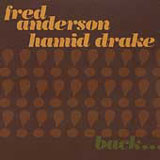
Drake provides so much rhythmic territory to navigate that Anderson can play complementarily to it or weave through it. In turn, Drake can do the same with Anderson. They have no dearth of capacity for interaction. Anderson recounts that Drake has challenged him by bringing new processes to the forefront. One presented itself in the studio recording Back Together Again (Thrill Jockey, 2004), where Drake made three separate tracks playing an African drum on each, combined them to make one and then asked Anderson to play on top of it. On that same recording, the percussionist asked Anderson to play while Drake was singing. This new sound vocabulary kindled Anderson's creative spirit.
At the 2007 Vision Festival, the Anderson-Drake-Bankhead trio performed on the Friday evening line-up. Following its performance, Drake was sitting down, his frame drum in hand. Anderson stood next to him, poised to play a duet with his close friend. But Drake paused for a moment to preface the performance with these words: "I want to pay tribute to Fred while he is still here because he is the reason many of us are here today" [referring to the numerous Chicagoans who played their music at the Festival and began at the Velvet Lounge]. Indeed. That Fred Anderson has remained committed to his purpose is one example of how persistence and stamina has penetrated an art that affects us all and is ingrained in our history as a country.
class="f-right">Return to Index...
Anderson has artfully and skillfully refined his music's tonal flexibility and rhythmic spontaneity. He has made it as rich and pure as honey. The lesson he hands down is simple and instills in others a life's worth of learning: to "put notes on paper is music theory...to blow through the sax... you give life to the music.
A life of musical innovation has flourished through Fred Anderson. He has taught it, he has practiced it, he has played it. And his mark is irrefutable. That the Penguin Guide to Jazz dismisses Anderson as "not a player's player is absurd. That Eremite record producer Michael Ehlers dubs him "a national treasure is more than accurate. For Ehlers, "listening to Fred will always be a heavy and satisfying experience ... His aesthetic is highly personal, yet strongly rooted in the lineage of the great saxophonists....there is nothing glib or inconsequential anywhere in his playing. He's a very disciplined and methodical improviser with his own vocabulary & an incredibly beautiful sound.
align=center> l:r Hamid Drake, Fred Anderson, Harrison Bankhead at The Velvet Lounge
In Lloyd Peterson's Book, Music and the Creative Spirit (Scarecrow Press, 2006), the entry on Fred Anderson takes first place. It is one brief transcribed paragraph. Anderson's most frequently used verbal phrase, both in the interviews supporting this article and the Peterson interview itself, in response to a question about how the music arises is: "I don't know... it's hard to put into words.
The bridge between the mind and the sound that comes out of any instrument can never be described in a language other than itself. Let us be grateful that Fred Anderson has crossed that bridge many times, with his music not only being left behind but also leading the way.
Selected Discography
Territory Band with Fred Anderson, Collide (Okkadisk, 2007)
Fred Anderson and Hamid Drake, From the River to the Ocean (Thrill Jockey, 2006)
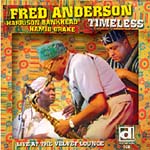
Fred Anderson, Harrison Bankhead, Hamid Drake, Timeless, Live at the Velvet Lounge (Delmark, 2006)
Fred Anderson, William Parker, Hamid Drake, Blue Winter (Eremite, 2005)
Fred Anderson, On the Run: Live at the Velvet Lounge (Delmark, 2001)
Fred Anderson, Dark Day+Live in Verona (Atavistic, 2001)
Fred Anderson and Robert Barry, Duets 2001 (Thrill Jockey, 2001)
Fred Anderson Quartet, Fred Anderson Quartet Vol. 2: Live at the Velvet Lounge (Asian Improv, 2000)
Fred Anderson, The Milwaukee Tapes Vol. 1 (Atavistic, 2000)
Fred Anderson, Kidd Jordan, William Parker, Hamid Drake, 2 Days in April (Eremite, 2000)
Fred Anderson Quartet, Fred Anderson Quartet Vol. 1: Live at the Velvet Lounge (Asian Improv, 1999)
Fred Anderson Trio, Fred Anderson Trio: Live at the Velvet Lounge (Okkadisk, 1999)
Fred Anderson and the DKV Trio, Fred Anderson/DKV Trio (Okkadisk, 1997)
Fred Anderson, The Missing Link (Nessa, 1997)
Fred Anderson Quartet, Birdhouse (Okkadisk, 1996)
Fred Anderson and Marilyn Crispell, Destiny (Okkadisk, 1995)
Fred Anderson, FRED Chicago Chamber Music (Southport Records, 1997)
Fred Anderson and Steve McCall, Vintage Duets (Okkadisk, 1994)
Fred Anderson, Another Place (Moers Music, 1978)
Photo Credit
Peter Bell
< Previous
William Parker: Corn Meal Dance
Next >
Sun Set
Comments

Tags
For the Love of Jazz
 All About Jazz has been a pillar of jazz since 1995, championing it as an art form and, more importantly, supporting the musicians who create it. Our enduring commitment has made "AAJ" one of the most culturally important websites of its kind, read by hundreds of thousands of fans, musicians and industry figures every month.
You Can Help
To expand our coverage even further and develop new means to foster jazz discovery and connectivity we need your help. You can become a sustaining member for a modest $20 and in return, we'll immediately hide those pesky ads plus provide access to future articles for a full year. This winning combination will vastly improve your AAJ experience and allow us to vigorously build on the pioneering work we first started in 1995. So enjoy an ad-free AAJ experience and help us remain a positive beacon for jazz by making a donation today.

Giveaway

Days remaining: 6