Home » Jazz Articles » Extended Analysis » Miles Davis: The Complete On The Corner Sessions
Miles Davis: The Complete On The Corner Sessions

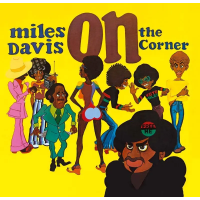
Revisiting the album, and the two June, 1992 sessions from which it was culled, on The Complete On The Corner Sessions, one can only wonder who it was that critics felt Davis was selling out to.
Thirty-five years later, On The Corner has taken its rightful place as one of Davis' most influential electric recordings; a dense, jagged, near-55 minutes that may have grooved, but was hardly the kind of music to which the young demographic of the time was listening.
By this time, many of Davis' illustrious band mates from the mid-to-late-1960s had moved into the fusion camp—guitarist John McLaughlin's raw but beautiful Mahavishnu Orchestra, keyboard players Chick Corea's increasingly progressive rock-informed Return to Forever and Herbie Hancock's more approachably funky Head Hunters, and keyboard player Joe Zawinul/saxophonist Wayne Shorter's collaboration Weather Report, which began closest to Davis' electric work but would ultimately move towards more commercially approachable (and successful) music.
While there's no shortage of hypnotic, booty-shaking grooves on On The Corner, there's an angularity—and a lack of the more formal structures that Davis' fusion cousins were using—that made it largely inaccessible to the audience the trumpeter was targeting at the time. Davis was no stranger to innovations that were ahead of his time, but few (if any) of his other albums have taken so long to be recognized for their significance.
From a trumpeter who'd established his reputation as a lyrical player with an appealing tone, there's little that can be called pretty or lyrical about On The Corner; even McLaughlin's tone is almost guttural. But if On The Corner wasn't melodic or eminently appealing in tone, it was a remarkable mix of stylistic ideas that ran the gamut from 20th Century classical composition to tabla and sitar-driven Indo-centricity, all tied together by Davis' fascination with the unshakable groove music of Sly Stone and James Brown.
The Complete On The Corner Sessions represents, however, more than the music recorded for that controversial album; it includes every studio session from March 9, 1972 through to May 5, 1975, Davis' last studio date before heading into a self-imposed period of retirement for half a decade, finally reemerging as the star and, some might argue (though incorrectly), the sell-out that he was so often accused of being from the moment he plugged in, in the late 1960s.
The set contains much of the material that would ultimately surface on Big Fun and Get Up With It, both on Columbia, from 1974, although some of the material on those releases can be found on The Complete Jack Johnson Sessions (Legacy, 2003) and The Complete Bitches Brew Sessions (Legacy, 1998). In fact, the only track that isn't on any of the box sets in its final form is "Great Expectations," which appears as a thirteen-minute track on the Bitches Brew box, half the length of the Teo Macero-collaged version on Big Fun.
A six-CD set, perhaps the most striking of Legacy's series of Miles Davis box sets, The Complete On The Corner Sessions is housed in a metal box with raised versions of the cartoon-like street images from the original album. A 120-page book brings together the previously unexplored perspective of British composer/cellist Paul Buckmaster (who, for Davis, was a significant link to the contemporary classical music of artists like Karlheinz Stockhausen), along with a lengthy essay by journalist Tom Terrell and brief pieces by series co-producer Bob Belden.
The aesthetic appeal of the box is undeniable, but it's the music—especially the three-plus hours of unreleased material and unedited masters—that matters (and the definitively remastered versions of the material already available). It's a window, not just into the mind of Davis, but of producer Teo Macero, who innovatively utilized primitive looping (does anyone remember two inch tape and an Exacto knife?) to shape the lengthy jam of "On The Corner" into the far more remarkable "On The Corner/New York Girl/Thinkin' Of One Thing And Doin' Another/Vote for Miles," and pare the nearly eighteen minutes of "One And One" into its final six-minute form.
Drummer Greg Masters' in-depth analysis is the definitive detailed look at the material contained in the box, and so what's perhaps a useful dovetail is to examine how Davis evolved from 1972 through to 1975, and how that evolution was aided by the musicians with whom he chose to work.
While Davis was targeting a younger demographic with the music of On The Corner, many of the musicians he worked with for the two sessions were culled from the same large pool of players who contributed to albums from In a Silent Way (Columbia, 1969) through to Jack Johnson, including Chick Corea and Herbie Hancock, John McLaughlin, drummer Jack DeJohnette, bass clarinetist Bennie Maupin and percussionist Don Alias. Still, McLaughlin had a serious blues and session background before relocating from England to the United States, and the rest of the players from those earlier sessions were undoubtedly interested in the popular music that was taking place around them.
There were plenty of new faces, however, including Oregon sitarist Collin Walcott and tablaist Badal Roy, who continued to integrate Davis' interest in Indian music into a cross-cultural, cross-stylistic mélange. But while the music of the On The Corner album was a far cry from what the cognoscenti defined as jazz at the time, the vast majority of Davis' choices were players with broader musical interests to be sure, but who were fully conversant with the language of jazz. The most notable of the new faces that would continue to bring a more sophisticated language to Davis' dense, funky and, at times, jungle-like rhythms were saxophonists Dave Liebman and Carlos Garnett.
Perhaps the most important contributor, however, is the one who, at the time, was the least appreciated—and the farthest removed from jazz. Electric bassist Michael Henderson, first recruited by Davis for the Jack Johnson sessions, would remain with Davis until the trumpeter's retirement in 1975, and is his only constant companion on every session here. Drummer Al Foster appears on all the post-On The Corner album sessions from June, 1972 onwards, and would hook up with the trumpeter again when he returned to the scene in the early '80s. He has no shortage of jazz credentials or chops, but here he's clearly in funk and groove mode.
Between Foster and Henderson, Davis had a flexible groove machine capable of keeping even the most extended tracks—the up- tempo "Calypso Frelimo" and abstract "He Loved Him Madly," both over thirty minutes in length—interesting or, at the very least, trance-inducing.
Henderson's ability to play a repetitive line—seemingly endlessly, with only the slightest of variations—helped contribute to the hypnotic nature of much of Davis' 1970s electric music. Whether it's the gradually building, slightly reggae-tinged "Mr. Foster," the more straightforward soul of "Maiysha" or the frenetic "Mtume," Henderson anchors the music both harmonically and rhythmically, freeing up those around him.
And while the music made was, at the time, considered anything but jazz, retrospectively there was still plenty with which to align it. Davis' playing was as strong as ever (albeit almost always colored with the wah-wah pedal he'd grown to love as a way to sound more Jimi Hendrix-ian, although the late electric guitar innovator never had the breadth of language Davis did), and guitarist Pete Cosey would prove to be a valuable find as well, capable of Hendrix-like abandon but with a more sophisticated vernacular.
Davis' saxophone choices—from Liebman and Garnett to Sonny Fortune—would also retain a link (albeit, at times, tenuous) into the jazz world, but his choice of guitarists—first recruiting Reggie Lucas, then Cosey and, finally, Dominique Gaumont, to create a potent three-guitar line-up—finally supplanted permanent keyboards entirely, although Davis would often play keyboards himself, most notably on "Calypso Frelimo" and "He Loved Him Madly."
Following Davis' live releases from The Cellar Door Sessions 1970 (Legacy, 2005) through to Agharta and Pangaea—both on Columbia, from 1975—provides, perhaps, the best window into the gradual evolution of Davis' 1970s electric music—music that was often so unapproachable in its density and abstruseness that the idea of it being any kind of concession to anyone now seems laughable.
But The Complete On The Corner Sessions creates a no less compelling view. There are the thick layers and edited/looped/processed tracks (both formative and finished) of On The Corner, but equally there's the cleaner groove of the Sly Stone-informed "Hip Skip," the frenetic "What They Do" that suggests what James Brown might have sounded like had he met up with Hendrix, and the near-pop of "Minnie," one of the few tracks to have a form with actual changes and a discernable melody. There's even "Red China Blues," from Get Up With It, that's the closest to the Delta that Davis ever came, complete with Wally Chambers' harmonica and an uncredited brass section.
The only unfortunate aspect of The Complete On The Corner Sessions is that documenting, as it does, all of Davis' studio sessions from 1972 through to his retirement, this appears to be the end Legacy's series of studio session box sets. Still, there are likely plenty of live sets yet to be released—perhaps even full versions of Davis' concerts at the Fillmore East and West that were so brutally edited down, and sonic cleanups of Agharta and Pangaea. One can only hope. In the meantime, The Complete On The Corner Sessions is a treasure trove of 1970s-era electric Miles Davis that has finally come into its own.
Track Listing
CD1: On The Corner (unedited master); On The Corner (take 4); One and One (unedited master);
Helen Butte/Mr. Freedom X (unedited master); Jabali.
CD2: Ife; Chieftain; Rated X; Turnaround (take 14); U - Turnaround (take 15).
CD3: Billy Preston; The Hen (Untitled Original A (take 1); Big Fun/Holly-wuud (take 2);
Big Fun/Holly-wuud (take 3); Peace (Untitled Original (take 5)); Mr. Foster.
CD4: Calypso Frelimo; He Loved Him Madly.
CD5: Maiysha; Mtum; Mtume (take 11); Hip Skip (Untitled Original (take 2)); What They
Do (Untitled Original (take 14)); Minnie (Latin (take 7)).
CD6: Red China Blues; On the Corner/New York
Girl/Thinkin' of One Thing and Doin' Another/Vote for Miles; Black Satin; One And One; Helen
Butte/Mr. Freedom X (master); Big Fun; Holly-wuud.
Personnel

Miles Davis
trumpetMarch 9, 1972: Miles Davis: trumpet; Wally Chambers: harmonica; Cornell Dupree: guitar; Michael
Henderson: electric bass; Al Foster: drums; Bernard Purdie: drums; James Mtume Forman: congas,
percussion; Wade Marcus: brass/saxophone arrangement; Billy Jackson: rhythm arrangement.
June 1, 1972: Miles Davis: trumpet; Dave Liebman: soprano saxophone; Chick Corea:
synthesizer; Herbie Hancock: organ; Harold I. Williams: electric piano; John McLaughlin: guitar;
Collin Walcott: sitar; Paul Buckmaster: cello; Michael Henderson: electric bass; Jack DeJohnette:
drums; Jabali Billy Hart: drums, percussion, bongo; Don Alias: congas, percussion; James Mtume
Forman: congas, percussion; Badal Roy: tabla.
June 6, 1972: Miles Davis: trumpet; Carlos Garnett: alto saxoophone, tenor saxophone;
Bennie Maupin: bass clarinet; Herbie Hancock: electric piano, synthesizer; Harold I. Williams:
electric piano, synthesizer; Lonnie Liston Smith: organ; David Creamer: guitar; Collin Walcott: sitar;
Paul Buckmaster: cello; Michael Henderson: electric bass; Jack DeJohnette: drums, handclaps;
Jabali Billy Hart: drums, handclaps; Charles Don Alias:
percussion, handclaps; James Mtume Forman: percussion, handclaps; Badal Roy: tabla, handclaps.
June 12, 1972: Miles Davis: trumpet; Carlos Garnett: soprano saxophone; Bennie
Maupin: bass clarinet; Lonnie Liston Smith: organ; Harold I. Williams: electric piano, synthesizer;
Michael Henderson: electric bass; Al Foster: drums; Jabali Billy Hart: drums, percussion; James
Mtume Forman: congas, percussion; Badal Roy: tabla.
August 23, 1972: Miles Davis: trumpet; Cedric Lawson: organ; Reggie Lucas: guitar;
Khalil Balakrishna: sitar; Michael Henderson: electric bass; Al Foster: drums; Badal Roy: tabla;
James Mtume Forman: congas.
September 6, 1972: Miles Davis: organ; Reggie Lucas: guitar; Khalil Balakrishna: sitar;
Cedric Lawson: synthesizer; Michael Henderson: electric bass; Al Foster: drums; James Mtume
Forman: congas, percussion; Badal Roy: tabla.
November 29, 1972: Miles Davis: trumpet; Carlos Garnett: soprano saxophone; Cedric
Lawson: keyboards; Reggie Lucas: guitar; Khalil Balakrishna: sitar; Michael Henderson: electric
bass; Al Foster: drums; James Mtume Forman: congas, percussion; Badal Roy: tabla.
December 8, 1972: Miles Davis: organ; Carlos Garnett: soprano saxophone; Cedric
Lawson: keyboards; Reggie Lucas: guitar; Khalil Balakrishna: sitar; Michael Henderson: electric
bass; Al Foster: drums; James Mtume Forman: congas, percussion; Badal Roy: tabla.
January 4, 1973: Miles Davis: trumpet; Dave Liebman: soprano saxophone; Cedric
Lawson: keyboards; Reggie Lucas: guitar; Khalil Balakrishna: sitar; Michael Henderson: electric
bass; Al Foster: drums; James Mtume Forman: congas, percussion; Badal Roy: tabla.
July 26, 1973: Miles Davis: trumpet, organ; Dave Liebman: soprano saxophone, flute;
Pete Cosey: guitar; Reggie Lucas: guitar; Michael Henderson: electric bass; Al Foster: drums; James
Mtume Forman: congas, percussion.
September 17, 1973: Miles Davis: trumpet, organ; Dave Liebman: tenor saxophone,
flute; John Stubblefield: soprano saxophone; Pete Cosey: guitar; Reggie Lucas: guitar; Michael
Henderson: electric bass; Al Foster: drums; James Mtume
Forman: congas, percussion.
September 18, 1973: Miles Davis: trumpet, organ; Dave Liebman: ts; Pete Cosey: guitar;
Reggie Lucas: guitar; Michael Henderson: electric bass; Al Foster: drums; James Mtume Forman:
congas.
June 19, 1974: Miles Davis: trumpet, organ; Dave Liebman: flute; Pete Cosey: guitar;
Reggie Lucas: guitar; Dominique Gaumont: guitar; Michael Henderson: electric bass; Al Foster:
drums; James Mtume Forman: congas, percussion.
October 7, 1974: Miles Davis: trumpet, organ; Sonny Fortune: soprano saxophone, flute;
Pete Cosey: guitar; Reggie Lucas: guitar; Dominique Gaumont: guitar; Michael Henderson: electric
bass; Al Foster: drums; James Mtume Forman: congas, percussion.
November 6, 1974: Miles Davis: trumpet, organ; Sonny Fortune: soprano saxophone,
tenor saxophone, flute; Pete Cosey: guitar, drums, percussion; Reggie Lucas: guitar; Dominique
Gaumont: guitar; Michael Henderson: electric bass; Al Foster: drums; James Mtume Forman:
congas, percussion.
May 5, 1975: Miles Davis: trumpet, organ; Sam Morrison: tenor saxophone; Pete Cosey:
guitar, percussion; Reggie Lucas: guitar; Michael Henderson: electric bass; Al Foster: drums; James
Mtume Forman: congas, percussion.
Album information
Title: The Complete On The Corner Sessions | Year Released: 2007 | Record Label: Legacy Recordings
About Miles Davis
Tags
PREVIOUS / NEXT

Become a Sustaining Member

Since 1995, All About Jazz has championed jazz as an art form and supported the musicians who create it. Over three decades, it has grown into one of the world's leading jazz resources, serving hundreds of thousands of readers, musicians, presenters and industry professionals each month.
Help Build the Future of All About Jazz
Your support helps us continue building All About Jazz for the next generation—expanding our editorial coverage, preserving jazz history, developing new community features and creating better ways to discover the music and the people behind it.
Become a sustaining member for as little as $20 per year and you'll immediately enjoy an ad-free experience along with access to subscriber features and future articles for a full year.
Together, we're not simply sustaining All About Jazz—we're building its future. Thank you for being part of the journey.