Home » Jazz Articles » Extended Analysis » Miles Davis: The Complete On The Corner Sessions
Miles Davis: The Complete On The Corner Sessions

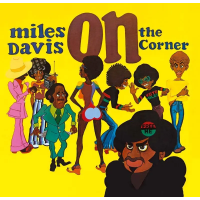
"There is no architecture and no build-up. Just a vivid, uninterrupted succession of colors, rhythms and moods." —Arnold Schoenberg describing his Five Pieces For Orchestra in a letter to Richard Strauss, 1909, quoted in The Rest Is Noise, Alex Ross (Farrar, Straus and Giroux, 2007)
The music that trumpeter Miles Davis forged in the first half of the 1970s, his so-called "electric period," is not jazz. In a determined effort to keep his sound fresh, Davis took the audacious step of leaving behind all the frameworks of the art form which had made him a recognized figure throughout the world.
To open himself up to new ideas and to expand his audience, his new sound appropriates styles of music from outside the jazz canon, namely the propulsive dance groove of funk (particularly James Brown and Sly Stone), the raucous, rough-edged, electro-charged brashness of Jimi Hendrix, the metallic sparkle of India's Ravi Shankar, the European classical avant-garde methods of Karlheinz Stockhausen, as well as from the traditions of jazz going back to Dixieland and ragtime. In the raw, wailing of the soloing, it also is indebted to the free playing of saxophonists Albert Ayler and late John Coltrane with Pharoah Sanders.
And what does this add up to? The music Davis made in these years—with the scorching electric guitars of Pete Cosey and Reggie Lucas, grounded in the steady, incantory pulse of Al Foster's 4/4 rhythm on drums and Michael Henderson's unswerving defining of tempo and key via electric bass—assaults with unfamiliar gestures and strays beyond bar measures to dig deep into emotional recesses never before expressed so vividly. The music was so far ahead of its time, that we're still catching up to it nearly 40 years later.
The Complete On The Corner Sessions is the eighth and final set in a series of Miles Davis re-issue boxes. This six-CD package includes six-plus hours of music, including tracks that would be used for the LPs On the Corner (Columbia, 1972), Get Up With It (Columbia, 1974), and Big Fun (Columbia, 1974). In addition, the package includes 12 previously unissued tracks, plus five tracks previously unissued in full, and contains a 120-page booklet with liner notes and essays by musician/co-producer Bob Belden (Michael Cuscuna is the other co-producer), journalist Tom Terrell and arranger/musician Paul Buckmaster.
First off, The Complete On The Corner Sessions is an inaccurate and misleading title in an academic sense. The tracks presented in this set, recorded at Columbia Studio B in New York City over the course of 16 sessions from March 9, 1972—May 5, 1975, offer up at least two very different artistic intentions.
The first is the material (recorded on June 1 and 6, 1972) that would be released as On The Corner—the extended grooves, as bassist Michael Henderson explains in the liner notes.
Other tracks collected here are another matter. Following the two June 1972 sessions, Davis moved the ensemble sound away from an insistence on a churning, full-speed-ahead jam on one chord. Over the next few years, orchestral colors are explored and there's room for chord changes and melodies.
Perhaps it's quibbling, but I'm more comfortable with distinguishing each of the original LPs as distinct periods, or moments, in Davis' continuous evolution.
The new solo
In the early 1970s, Davis could not play trumpet with the intensity, force and bravado he'd exhibited throughout his career, and which had been at a peak in 1969 and 1970 as he put himself on display to a whole new audience of rock crowds at the Fillmore East (March 6-7, 1970 and again June 17-20, 1970) and Fillmore West (April 10-11, 1970 and again October 15-18, 1970), at huge rock festivals (Isle of Wight, August 29, 1970) and other venues larger than the night clubs and corner bars he'd been playing for decades.His embouchure was compromised. He was in ill health. His use of recreational drugs was reportedly abundant. Playing trumpet is physically demanding and Davis, in the 1970s, was willing, but his body was just not near the same levels as it had been. His soloing and his steering of the ensemble sound via his horn is diminished from the heights of his earlier career.
But what he lacked in physical stamina, he made up for by taking huge risks in exposing his every vulnerability via a shift in musical intention. He refused to rely on playing crowd favorites or tunes from his past repertoire. He was intent on forging something entirely brand new, of presenting something that hadn't been seen or heard before.
The case could be made that he was insulting his devoted audience by merely presenting incomprehensible noise. But I am in the camp which believes this music is enthralling in its complexity and deeply satisfying in its revolutionary achievement.
The Complete On The Corner Sessions box showcases Davis' power as a leader. While the musicians are not playing charts, each player contributes an individual intensity and voice, while fitting into the ensemble sound. Davis' conducting of the group improvisation is firm enough to give a recognizable shape to the tune while trusting enough of the individual voices to bring out their best.
Not many of the musicians who passed through Davis' various groups ever sounded better than when they were with him. Why? Because part of Davis' genius was in encouraging his partners to reach for expressions they hadn't known were within them. As leader, he afforded them the time to expand on their ideas, while at the same time maintaining a unifying order to contain the amalgam of personal contributions.
In his ensembles of the 1970s, however, the soloing is less rewarding to listen to because the musicians aren't as skilled as were the musicians in Davis' previous ensembles. These musicians lacked the virtuosic capabilities of the now-recognized jazz masters who had played with Davis throughout the 40s, 50s and 60s, players who were capable of soloing at the proper time in their prescribed roles as sidemen—beautiful statements that adhered to the chord changes and showed off their technical facility and aesthetic craft in the service of making art music.
Up until Davis extended the boundaries, this was the basic structure: a small team of musicians would play a theme, then each would take a turn soloing, the theme would be stated again by the ensemble, and the piece would end. The audience knew what to expect. The thrill was in how articulate the soloists could express themselves.
Davis, even at 19 years old when he joined saxophonist Charlie Parker's band, added something different to the pyrotechnic virtuosity of players like Parker. Davis' sound brought a softer, feminine element, a brooding, reflective wistfulness that countered the alpha male assertiveness of most other jazz music of the time, and of the preceding 50 years.
The challenge for soloists in Davis' music of the 1970s is there's often less gradations to which the improvisations can respond. Often the solos are enlisted to override the churning, molten funk of the groove laid down by the rest of the pack. So, less skilled and less brave than Davis was when he complemented Charlie Parker's fusillade attack with a whole different approach, the soloing musicians here take less risks and resort to sounding off on their horns in a frenzy of notes in their attempt to meet the demands of the ensemble sound. There's little nuance, little chance to explore and test, as the musical concept is forceful and deliberate.
But this is less a liability because the act of soloing acquires a new purpose and intent on these tracks. Each solo is less ego-based than solos from the 60 years of improvisational music dating back to trumpeter Louis Armstrong's emergence with King Oliver's band. Here, the solo is not the showcase for virtuosity it was before. While each player's skill is on display and each brings his own personal touch to the solo, the act is more directed to serve the musical conception. The solo is a momentary display within the textures of the process. It's a thread in the fabric.
And, while Charlie Parker in the 78 rpm era only had three minutes to make his statement, Davis in the LP era can take his time, and uses the space to elongate the music-listening experience so it can extend the range and incorporate moods and tones beyond bebop and standards boundaries.
There are several reasons why Davis' music of the 1970s may be less attractive to listeners than that of his previous music. For one, it's nasty. It digs deep to express dark recesses of feelings, and sustains those moods for long stretches. It manages to express feelings I've yet to find in any other art form—complex, raw, primal feelings splayed and made almost tangible.
It is not enjoyable in the sense that art has served previously. As Theodor Adorno says, in discussing the music of Schoenberg, affability ceases. The music is less about serving as entertainment, and more an unrestrained attempt to express the rawest emotions. It's beyond entertainment. Davis was through pandering to audience expectations.
Defiling the Cult of Beauty
The music of Miles Davis from the first half of the 1970s deserves more serious examination and certainly more recognition and acclaim. It is remarkable music in that it integrates a universe of sounds.It's not simply bringing in the ethnic influence of a foreign culture, as trumpeter Dizzy Gillespie did decades earlier by bringing Caribbean dance rhythms into his sound. The music adds textures and complexities learned from the European avant-garde collage effects of Karlheinz Stockhausen, whose pieces since the 1950s, besides traditional orchestral instrumentation, were making use of electronic effects (synthesizers, amplified soloists, ring modulators), as well as short wave receivers.
In the liner notes, Paul Buckmaster, who had already experimented with tape loops by the time he met Miles Davis, recounts how he exposed Davis to the music of Stockhausen at this time (the compositions Gruppen, Mixtur and Hymnen, to be exact). The influence this had on Davis' sound is not hard to imagine. Stockhausen's music is a radical break from the classical music tradition in that it does not rely on narrative. Like a movie by Jean-Luc Godard, it interrupts the story-telling structure to offer up a new palette of sensual and intellectual effects. It is full of surprises as the listener can never anticipate what's coming next.
It's a music free of sentiment, untethered to the Romantic strategy of appealing to common urges, where a piece of music follows a pattern, emulating a set of experiences or feelings through time.
Also, with the use of silences, particularly when the band's forward progression comes to a sudden halt, a strategy also likely picked up from Stockhausen, the music emphasizes the collage-like, fragmentary nature of perception. The listener can enter and leave anywhere at anytime.
In its emphasis on colors, rhythms and moods, much of the music contained in this package could be designated "new age," though it's often more raucous than what we typify today as the calming ambient music we use for relaxing or performing yoga. While Davis' intentions with his music might have been to get people up to dance, at the same time he created a panache of listenable grooves filled with surprises and unprecedented ensemble sounds that still retain their freshness and audacious attitude.
The music is so densely layered and there is so much musical activity that repeated listening is rewarded as moments and threads are heard differently each time. And, without the formal dependence on theme and dramatic progression, our listening experience is concentrated on the moment, not the anticipation of a climax and resolution.
Dissonance, Our Friend
Davis' music of the 1970s is not just a rejection of beauty, but a beautiful embrace of the rejected.For Davis, dissonance was an acknowledgement that there was more to be expressed in music than comfort and resolvable sensations. The musical vocabulary of traditional Western harmony—the I, IV, V form, the basic foundation for everything from church hymns to blues, standards and rock n roll—imposed limitations to exploring and expressing a range of emotions and a depiction of possibilities beyond the familiar tonal centers available in major and minor patterns. Abandoning these forms would allow Davis to evolve a new tonal palette incorporating ominous and chilling explorations.
Davis' departure from these confines might be traced back as far as Kind Of Blue (Columbia, 1959), which broke from the blues-based form by using modal scales that gave an effect of suspension as chords didn't resolve back to the root chord as in the familiar traditional manner. Pleasing an audience with tasteful, familiar songs, providing entertainment, became too tired. Davis wanted to grow as an artist.
His group of the mid-60s took it even further. Pushed by Wayne Shorter's spiral compositions and fragmentary style of soloing on sax, and by pianist Herbie Hancock's schooling in Debussy and Ravel, and drummer Tony Williams' aggressive splattering of bar lines, this music also offered a sense of suspension as it uprooted the root and tonic.
The shift from the traditional standards repertory to a push into something new is discerned in The Complete Live At The Plugged Nickel set from December 22-23, 1965 (Columbia, 1995). Davis the leader seems in poor health. His trumpet playing lacks breath and his soloing comes in short bursts which he can't sustain. He, in fact, does not play a lot over the course of the seven live sets over two nights. His weakness gives more of the spotlight to his young, energetic sidemen who are eager to advance into new realms beyond the standards repertoire to which their boss has been anchored.
Later in the decade, Keith Jarrett and Chick Corea would even be nudging Davis' music into totally free territory—leaving behind the grounding in a common key and time signature—before Davis, not quite convinced of the emotional impact of a total abandonment of order, would reign the group back down to a place of agreement.
Fortunate to be working for a record company, Columbia (now Columbia/Legacy, a division of Sony BMG Music Entertainment), that indulged his direction and allowed him to pursue his project, Davis ran with it. Not obliged to the record company to fester as a recognizable brand, Davis could use the studio, and countless live dates, to continue developing, pushing into unexplored territory to create sounds unheard and unimagined before.
The Tunes
The release of unheard music from this phase of Davis' career will thrill devotees of Davis' electric music and there are some gems among the previously unreleased tracks, particularly "On the Corner (take 4) and "Mr. Foster.""On the Corner (take 4)" offers up the entire universe in one chord. It's a five-minute studio fragment that propels the listener via one effect: a determined mining of a vamp pedaled to one chord onto which the musicians, particularly John McLaughlin, augment with furious yet mannered waves of variation. It could have fit onto side one of A Tribute To Jack Johnson (Columbia, 1971).
Davis is in peak form on "Mr. Foster," presumably so named in honor of the fine drummer keeping a steady pulse with him. After the band sets up the groove and intones a sad mood, Davis enters on muted trumpet played through a wah-wah pedal and begins a long declaration, growling in the low register, meandering assuredly through the mid-range and even pushing into the high range, as expressive of a state of sorrow as seems possible.
Davis knew how to shape a solo. For the most part, his solos have something to say. They express an emotional theme. The other soloists—Pete Cosey and saxophonist Dave Liebman especially on this box—decorate the music with their soloing, but their playing doesn't have the lucidity of Davis' statements. At 15 minutes, the track ends too soon.
On the tracks "On the Corner (unedited master)," as well as the unedited master and issued take of "Helen Butte/Mr. Freedom X," some new variants are heard—dark colorful chords on organ—but pedestrian, Theremin-like keyboard noodling is amateurish and grates after awhile. We hear for the first time instrumental solos on electric piano (by either Herbie Hancock, Lonnie Liston Smith or Harold Ivory Williams), John McLaughlin on electric guitar and even Davis on wah-wah trumpet that were excised in the final mix, sacrificed for the ensemble concept. The idea here clearly is that individual efforts contribute to a whole. Ego is gone. What's important is the ensemble.
"Chieftain," another previously unissued track, has a startling, almost Caribbean multi—rhythmic groove provided by Al Foster on drums and Reggie Lucas on electric guitar, with Badal Roy on tablas and Mtume on congas. Michael Henderson provides a bass drone pulse and Davis solos achingly through the wah wah. It's nice to hear a sitar in the mix, but Khalil Balakrishna is no Ravi Shankar.
The previously unreleased studio takes of "Turnaround" and "U-Turnaround," a hook that would become a staple of his live shows for the next few years, doesn't quite get off the ground in this premier rendition. The elementary theme is stated repeatedly over the funk groove with Davis stretching the head statement into varying permutations, but there's little transcendence. Perhaps it's effective as a dance groove, but as concert music, this doesn't provide enough complexity.
(Note: On his Miles Beyond web site, Paul Tingen, in consultation with Miles discography expert Jan Lohmann, disputes the record company's titling of these tracks. They agree that "Turnaround" and "U-Turnaround," in fact, are two early takes of "Agharta Prelude.")
The tunes which would be gathered on Get Up With It, generally employ the churning groove layers of musical activity, but add reprieves in the form of chord changes and choruses, such as on "Maiysha" and "Mtume."
"Calypso Frelimo" rides on a jaunty texture with Al Foster's cymbal work shuffling a simple, child-like statement played on the electric organ, which Davis would subsequently use frequently in concerts. Davis plays with a mournful, pleading sound, as if appealing to the life forces from hell. At around 10 minutes in, a new movement begins quietly with Henderson's bass figure repeated as an ostinato, setting up an eerie, mysterious, almost reverential atmosphere. Guitar chords are spread to open fields and the organ figure repeats, this time with other instruments joining in and answering. The figure has earned a presence.
Davis again enters and begins his statement, calmly engaging the wah-wah to spread his notes with a feeling of suspension. We're enticed to slow down until the ensemble returns to the jaunty vamps of the first movement and we're restored to the surface of the earth. Davis is still expressing darker feelings, but gradually the bounce of the band's groove proves too infectious, and his playing becomes more playful and as full of the celebration as the others. A re-statement of the organ figure closes the piece as if to wrap things up.
"He Loved Him Madly" is the most astounding of compositions, seamlessly assembled from four different takes. A dirge for the recently deceased Duke Ellington, it begins with Miles playing chilling organ chords, or more accurately tone clusters I've heard before only in the music of Olivier Messiaen. Dominique Gaumont's guitar shadings seem to be picking through bones, while Al Foster taps out a graveyard blues as the cortège passes.
The mood shifts when Henderson's bass enters at almost 11 minutes in and Foster, in a rhythmic chant never heard in music before, starts tapping out a slow 4/4, accenting each beat. Liebman enters on flute (through echo) for the first melodic improvisation, a tasty solo that picks up for a second iteration after a trumpet solo from Davis, which begins 16 minutes into the piece (Liebman suggests on a promo clip that his second solo might be a segment from his first solo repeated via Teo Macero's editing. However, a breakdown by Davis discographer Peter Losin of the fragments used in the 32:14-minute issued version of the composition contradicts Liebman's thought, see www.plosin.com/milesAhead/Sessions.aspx?s=740619).
Davis, too, is playing his horn through an echo, which adds to the chill of his haunting cavernous utterances, an eloquent communication of his grief over the loss of his venerated predecessor. The mood is sustained until the tune dissipates.
"Ife" repeats a riff over and over to induce a trance-like fixation on the spiral pattern. Onto that is layered Davis' solo, which wrestles with the rhythm, punctuating oscillations. Paul Buckmaster is noted on electric cello in the box set's discography, but I can't discern his presence in the mix.
"Rated X" begins with Davis playing eerie chord clusters on electric organ. Michael Henderson enters on electric bass with an adrenalin-chilling vamp repeated over and over, with Al Foster laying down his basic, pulse-enhancing 4/4. The tune proceeds as an exploration of the colors with no actual soloing. It's a diagram of a mood, unexplained before, reaching foundation feelings rooted in primitive needs, like a masseuse touching a nerve ending you never knew existed.
The earliest recorded track in this box, "Red China Blues," is a standard, 12-bar blues with a compact horn arrangement. Davis' other-worldly sounding solo through electronic effects is the only aspect that makes it unusual. Used on GUWI, it might have been an attempt to create a reasonably marketable track.
While each tune on The Complete On The Corner Sessions is a continual revelation, not all are completely successful as refined artistic statements. It's the nature of the improv business.
On "Jobali," for example, Michael Henderson lays down a riff, the sort of structure he's used before and will use again, but here it's just not as interesting and feels unrelenting and insistent rather than a skeletal form onto which a composition may develop and unwind.
In a typical funk or R&B song, after 12 or so bars, the vamp shifts into a chorus or refrain, but here it plods along as a root onto which Davis solos like a low-flying bird, texturing on an investigative explication.
Other previously unheard tracks in this set—notably "Big Fun" and "Holly-wuud" (really two different takes of the same material, 7/26/73), as well as "Minnie" from 5/5/75—seem to have similar commercial intent as "Red China Blues." They foreshadow the pop sound Davis would emerge with in 1981 after a six year hiatus, while retaining some of the eccentricities of the more formidable "serious" tracks gathered here. (Note: Tingen claims that "Minnie" is, in fact, a tune Davis titled "Mr. Foster" when it was recorded. As for the tune called "Mr. Foster" (from 9/18/73) discussed earlier, who knows.)
Too Much of a Good Thing?
Is this box too much of a good thing for those just getting initiated into the pleasures and complexities of Miles Davis' electric music? While this box is as good a place to become immersed as anywhere else, for the newcomer it might be too much to digest. I'd suggest those seekers might want to first sample the individual releases, especially On The Corner and Get Up With It. Then you can work your way back to In A Silent Way (Columbia, 1969), A Tribute to Jack Johnson (Columbia, 1970), Bitches Brew (Columbia, 1969) and forward a bit to the live Agharta (Columbia, 1975) and Dark Magus (Columbia, 1974). Also, the music on this box can be seen as an extension of the sound Davis developed in 1970 in an ensemble that included keyboard player Keith Jarrett, drummer Jack DeJohnette, bassist Michael Henderson, saxophonist Gary Bartz, guitarist John McLaughlin and percussionist Airto Moreira (represented on The Cellar Door Sessions, Columbia, 2005). The road opens up from any of these entry points.As Bob Belden says in the liner notes, the box set is also a testament to the genius of producer Teo Macero, who sculpted the hours of studio jams down to artful form, excising weak sections, splicing together complementary movements, layering and performing all manner of tape-editing acrobatics to fashion finished and refined musical compositions. He is more than an able producer, he is a collaborator and co-composer.
I must fault Legacy's design department for the packaging of these Davis sets. While this package is beautiful to look at, for practical purposes it's irritating to use. The 120-page booklet, while colorful, is bound into the spine of the package, which makes it harder than necessary to peruse, and the sans serif typeface is not easy to read, especially when blue type is used over a blue background. Worse, each track's discography data is scattered amidst the CD sleeves and various pages.
The photos, however, add a lot of information, namely a sense of the theatricality of a live Miles Davis show during this era. The tableau we see is equal parts African warrior, Haight—Ashbury, Carnaby Street and Harlem street.
Another quibble, the sequencing is hard to figure out. There seems to be a stab at positioning the tracks chronologically as recorded, but that order breaks down with disc six, thus grouping the OTC material as originally offered on LP with unrelated tracks that diffuse the coherence and impact of the original OTC issue.
For more on the electric music of Miles Davis, Paul Tingen's Miles Beyond (Billboard Books, 2001) is the must-have book for its thorough and dependable documentation of the facts and extensive interviews. Philip Freeman's Running The Voodoo Down (Backbeat Books, 2006) has justifiably come under attack for its sloppy research resulting in a slew of historical inaccuracies (corrected by Tingen on his Miles Beyond web site), but for its impassioned yet reasoned descriptions of the music and its discussions of how the music fits into the trajectory of its time, is an invaluable aid and fun accompaniment to Davis' electric music. Miles, Ornette, Cecil: Jazz Beyond Jazz by Howard Mandel is being released this week by Routledge. It is certain to have deep, thoughtful analysis of this music as well.
While the record company states that this ends its decade-long issuing of Miles Davis box sets, may I suggest there is plenty more that needs to be released: Agharta and Pangea (Columbia, 1975), two concerts in Japan recorded on February 1, 1975 (afternoon and evening performances), together in a box—two CDs with a booklet (or via download), please. And then a series gathering as much as possible of other live material from this period.
Tracks: CD1: On The Corner (M. Davis) [unedited master] Jun 1, 1972 19:25; On The Corner (M. Davis) [take 4] Jun 1, 1972 5:15; One And One (M. Davis) [unedited master] Jun 6, 1972 17:55; Helen Butte/Mr. Freedom X (M. Davis) [unedited master] Jun 6, 1972 23:37; Jabali (M. Davis) Jun 12, 1972 11:04; CD2: Ife (M. Davis)Jun 12, 1972 21:33; Chieftain Aug 23, 1972 14:37; Rated X (M. Davis) Sep 6, 1972 6:50; Turnaround [take 14] Nov 29, 1972 17:16; U-Turnaround [take 15] Nov 29, 1972 8:27; CD3: Billy Preston (M. Davis) Dec 8, 1972 12:33; The Hen [Untitled Original A (take 1)] Jan 4, 1973 12:55; Big Fun/Holly-wuud [take 2] Jul 26, 1973 6:32; Big Fun/Holly-wuud [take 3] Jul 26, 1973 7:07; Peace [Untitled Original (take 5)] Jul 26, 1973 7:01; Mr. Foster Sep 18, 1973 15:14; CD4: Calypso Frelimo (M. Davis) Sep 17, 1973 32:04; He Loved Him Madly (M. Davis) Jun 19, 1974 32:13; CD5: Maiysha (M. Davis) Oct 7, 1974 14:51 Mtume (M. Davis) Oct 7, 1974 15:08; Mtume (M. Davis) [take 11] Oct 7, 1974 6:51; Hip Skip [Untitled Original (take 2)] Nov 6, 1974 18:39; What They Do [Untitled Original (take 14)] Nov 6, 1974 12:00; Minnie [Latin (take 7)] May 5, 1975 4:01; CD6: Red China Blues (M. Davis) Mar 9, 1972 4:06; On The Corner/New York Girl/Thinkin' Of One Thing And Doin' Another/Vote For Miles Jun 6, 1972 19:54; Black Satin (M. Davis) Jun 1, 1972 5:15; One And One (M. Davis) Jun 6, 1972 6:09; Helen Butte/Mr. Freedom X (M. Davis) [master] Jun 6, 1972 23:14; Big Fun (M. Davis) Jul 26, 1973 2:32; Holly-wuud (M. Davis) Jul 26, 1973 2:54.
Personnel: March 9, 1972: Miles Davis: tpt; Wally Chambers: harmonica; Cornell Dupree: g; Michael Henderson: el-b; Al Foster: d; Bernard Purdie: d; James Mtume Forman: cga, perc; Wade Marcus: brass arr; Billy Jackson: rhythm arr. June 1, 1972: Miles Davis: tpt; Dave Liebman: ss; Chick Corea: synth; Herbie Hancock: org; Harold I. Williams: el-p; John McLaughlin: g; Collin Walcott: sitar; Paul Buckmaster: cello; Michael Henderson: el-b; Jack DeJohnette: d; Jabali Billy Hart: d, perc, bgo; Charles Don Alias: cga, perc; James Mtume Forman: cga, perc; Badal Roy: tabla. June 6, 1972: Miles Davis: tpt; Carlos Garnett: as, ts; Bennie Maupin: bcl; Herbie Hancock: el-p, synth; Harold I. Williams: el-p, synth; Lonnie Liston Smith: org; David Creamer: g; Collin Walcott: sitar; Paul Buckmaster: cello; Michael Henderson: el-b; Jack DeJohnette: d, handclaps; Jabali Billy Hart: d, handclaps; Charles Don Alias: perc, handclaps; James Mtume Forman: perc, handclaps; Badal Roy: tabla, handclaps. June 12, 1972: Miles Davis: tpt; Carlos Garnett: ss; Bennie Maupin: bcl; Lonnie Liston Smith: org; Harold I. Williams: el-p, synth; Michael Henderson: el-b; Al Foster: d; Jabali Billy Hart: d, perc; James Mtume Forman: cga, perc; Badal Roy: tabla. August 23, 1972: Miles Davis: tpt; Cedric Lawson: org; Reggie Lucas: g; Khalil Balakrishna: sitar; Michael Henderson: el-b; Al Foster: d; Badal Roy: tabla; James Mtume Forman: cga. September 6, 1972: Miles Davis: org; Reggie Lucas: g; Khalil Balakrishna: sitar; Cedric Lawson: synth; Michael Henderson: el-b; Al Foster: d; James Mtume Forman: cga, perc; Badal Roy: tabla. November 29, 1972: Miles Davis: tpt; Carlos Garnett: ss; Cedric Lawson: keyb; Reggie Lucas: g; Khalil Balakrishna: sitar; Michael Henderson: el-b; Al Foster: d; James Mtume Forman: cga, perc; Badal Roy: tabla. December 8, 1972: Miles Davis: org; Carlos Garnett: ss; Cedric Lawson: keyb; Reggie Lucas: g; Khalil Balakrishna: sitar; Michael Henderson: el-b; Al Foster: d; James Mtume Forman: cga, perc; Badal Roy: tabla. January 4, 1973: Miles Davis: tpt; Dave Liebman: ss; Cedric Lawson: keyb; Reggie Lucas: g; Khalil Balakrishna: sitar; Michael Henderson: el-b; Al Foster: d; James Mtume Forman: cga, perc; Badal Roy: tabla. July 26, 1973: Miles Davis: tpt, org; Dave Liebman: ss, fl; Pete Cosey: g; Reggie Lucas: g; Michael Henderson: el-b; Al Foster: d; James Mtume Forman: cga, perc. September 17, 1973: Miles Davis: tpt, org; Dave Liebman: ts, fl; John Stubblefield: ss; Pete Cosey: g; Reggie Lucas: g; Michael Henderson: el-b; Al Foster: d; James Mtume Forman: cga, perc. September 18, 1973: Miles Davis: tpt, org; Dave Liebman: ts; Pete Cosey: g; Reggie Lucas: g; Michael Henderson: el-b; Al Foster: d; James Mtume Forman: cga. June 19, 1974: Miles Davis: tpt, org; Dave Liebman: fl; Pete Cosey: g; Reggie Lucas: g; Dominique Gaumont: g; Michael Henderson: el-b; Al Foster: d; James Mtume Forman: cga, perc. October 7, 1974: Miles Davis: tpt, org; Sonny Fortune: ss, fl; Pete Cosey: g; Reggie Lucas: g; Dominique Gaumont: g; Michael Henderson: el-b; Al Foster: d; James Mtume Forman: cga, perc. November 6, 1974: Miles Davis: tpt, org; Sonny Fortune: ss, ts, fl; Pete Cosey: g, d, perc; Reggie Lucas: g; Dominique Gaumont: g; Michael Henderson: el-b; Al Foster: d; James Mtume Forman: cga, perc. May 5, 1975: Miles Davis: tpt, org; Sam Morrison: ts; Pete Cosey: g, perc; Reggie Lucas: g; Michael Henderson: el-b; Al Foster: d; James Mtume Forman: cga, perc
Track Listing
CD1: On The Corner (unedited master); On The Corner (take 4); One and One (unedited master);
Helen Butte/Mr. Freedom X (unedited master); Jabali.
CD2: Ife; Chieftain; Rated X; Turnaround (take 14); U - Turnaround (take 15).
CD3: Billy Preston; The Hen (Untitled Original A (take 1); Big Fun/Holly-wuud (take 2);
Big Fun/Holly-wuud (take 3); Peace (Untitled Original (take 5)); Mr. Foster.
CD4: Calypso Frelimo; He Loved Him Madly.
CD5: Maiysha; Mtum; Mtume (take 11); Hip Skip (Untitled Original (take 2)); What They
Do (Untitled Original (take 14)); Minnie (Latin (take 7)).
CD6: Red China Blues; On the Corner/New York
Girl/Thinkin' of One Thing and Doin' Another/Vote for Miles; Black Satin; One And One; Helen
Butte/Mr. Freedom X (master); Big Fun; Holly-wuud.
Personnel

Miles Davis
trumpetMarch 9, 1972: Miles Davis: trumpet; Wally Chambers: harmonica; Cornell Dupree: guitar; Michael
Henderson: electric bass; Al Foster: drums; Bernard Purdie: drums; James Mtume Forman: congas,
percussion; Wade Marcus: brass/saxophone arrangement; Billy Jackson: rhythm arrangement.
June 1, 1972: Miles Davis: trumpet; Dave Liebman: soprano saxophone; Chick Corea:
synthesizer; Herbie Hancock: organ; Harold I. Williams: electric piano; John McLaughlin: guitar;
Collin Walcott: sitar; Paul Buckmaster: cello; Michael Henderson: electric bass; Jack DeJohnette:
drums; Jabali Billy Hart: drums, percussion, bongo; Don Alias: congas, percussion; James Mtume
Forman: congas, percussion; Badal Roy: tabla.
June 6, 1972: Miles Davis: trumpet; Carlos Garnett: alto saxoophone, tenor saxophone;
Bennie Maupin: bass clarinet; Herbie Hancock: electric piano, synthesizer; Harold I. Williams:
electric piano, synthesizer; Lonnie Liston Smith: organ; David Creamer: guitar; Collin Walcott: sitar;
Paul Buckmaster: cello; Michael Henderson: electric bass; Jack DeJohnette: drums, handclaps;
Jabali Billy Hart: drums, handclaps; Charles Don Alias:
percussion, handclaps; James Mtume Forman: percussion, handclaps; Badal Roy: tabla, handclaps.
June 12, 1972: Miles Davis: trumpet; Carlos Garnett: soprano saxophone; Bennie
Maupin: bass clarinet; Lonnie Liston Smith: organ; Harold I. Williams: electric piano, synthesizer;
Michael Henderson: electric bass; Al Foster: drums; Jabali Billy Hart: drums, percussion; James
Mtume Forman: congas, percussion; Badal Roy: tabla.
August 23, 1972: Miles Davis: trumpet; Cedric Lawson: organ; Reggie Lucas: guitar;
Khalil Balakrishna: sitar; Michael Henderson: electric bass; Al Foster: drums; Badal Roy: tabla;
James Mtume Forman: congas.
September 6, 1972: Miles Davis: organ; Reggie Lucas: guitar; Khalil Balakrishna: sitar;
Cedric Lawson: synthesizer; Michael Henderson: electric bass; Al Foster: drums; James Mtume
Forman: congas, percussion; Badal Roy: tabla.
November 29, 1972: Miles Davis: trumpet; Carlos Garnett: soprano saxophone; Cedric
Lawson: keyboards; Reggie Lucas: guitar; Khalil Balakrishna: sitar; Michael Henderson: electric
bass; Al Foster: drums; James Mtume Forman: congas, percussion; Badal Roy: tabla.
December 8, 1972: Miles Davis: organ; Carlos Garnett: soprano saxophone; Cedric
Lawson: keyboards; Reggie Lucas: guitar; Khalil Balakrishna: sitar; Michael Henderson: electric
bass; Al Foster: drums; James Mtume Forman: congas, percussion; Badal Roy: tabla.
January 4, 1973: Miles Davis: trumpet; Dave Liebman: soprano saxophone; Cedric
Lawson: keyboards; Reggie Lucas: guitar; Khalil Balakrishna: sitar; Michael Henderson: electric
bass; Al Foster: drums; James Mtume Forman: congas, percussion; Badal Roy: tabla.
July 26, 1973: Miles Davis: trumpet, organ; Dave Liebman: soprano saxophone, flute;
Pete Cosey: guitar; Reggie Lucas: guitar; Michael Henderson: electric bass; Al Foster: drums; James
Mtume Forman: congas, percussion.
September 17, 1973: Miles Davis: trumpet, organ; Dave Liebman: tenor saxophone,
flute; John Stubblefield: soprano saxophone; Pete Cosey: guitar; Reggie Lucas: guitar; Michael
Henderson: electric bass; Al Foster: drums; James Mtume
Forman: congas, percussion.
September 18, 1973: Miles Davis: trumpet, organ; Dave Liebman: ts; Pete Cosey: guitar;
Reggie Lucas: guitar; Michael Henderson: electric bass; Al Foster: drums; James Mtume Forman:
congas.
June 19, 1974: Miles Davis: trumpet, organ; Dave Liebman: flute; Pete Cosey: guitar;
Reggie Lucas: guitar; Dominique Gaumont: guitar; Michael Henderson: electric bass; Al Foster:
drums; James Mtume Forman: congas, percussion.
October 7, 1974: Miles Davis: trumpet, organ; Sonny Fortune: soprano saxophone, flute;
Pete Cosey: guitar; Reggie Lucas: guitar; Dominique Gaumont: guitar; Michael Henderson: electric
bass; Al Foster: drums; James Mtume Forman: congas, percussion.
November 6, 1974: Miles Davis: trumpet, organ; Sonny Fortune: soprano saxophone,
tenor saxophone, flute; Pete Cosey: guitar, drums, percussion; Reggie Lucas: guitar; Dominique
Gaumont: guitar; Michael Henderson: electric bass; Al Foster: drums; James Mtume Forman:
congas, percussion.
May 5, 1975: Miles Davis: trumpet, organ; Sam Morrison: tenor saxophone; Pete Cosey:
guitar, percussion; Reggie Lucas: guitar; Michael Henderson: electric bass; Al Foster: drums; James
Mtume Forman: congas, percussion.
Album information
Title: The Complete On The Corner Sessions | Year Released: 2007 | Record Label: Legacy Recordings
About Miles Davis
Tags
PREVIOUS / NEXT

Become a Sustaining Member

Since 1995, All About Jazz has championed jazz as an art form and supported the musicians who create it. Over three decades, it has grown into one of the world's leading jazz resources, serving hundreds of thousands of readers, musicians, presenters and industry professionals each month.
Help Build the Future of All About Jazz
Your support helps us continue building All About Jazz for the next generation—expanding our editorial coverage, preserving jazz history, developing new community features and creating better ways to discover the music and the people behind it.
Become a sustaining member for as little as $20 per year and you'll immediately enjoy an ad-free experience along with access to subscriber features and future articles for a full year.
Together, we're not simply sustaining All About Jazz—we're building its future. Thank you for being part of the journey.