Home » Jazz Articles » Interview » Bud Shank: Change is Good
Bud Shank: Change is Good

The art form we know as jazz music, like many other things, is changing rapidly.
 With half a century of music making under his belt, Bud Shank is a survivor and a legend. To merely label him as a player of the West Coast/Cool school is to deny the full measure of a multi-faceted artist.
Still touring and recording, Shank took time to speak with AAJ's Maxwell Chandler about his artistic legacy.
All About Jazz: Your family was not musical, what were the circumstances of your initially being bitten by the jazz bug? Were they supportive of your playing?
Bud Shank: I grew up on a farm in southern Ohio, about as far away from any artistic endeavors as anyone could get. The farm was chosen not because of its isolation but because my parents thought it would be a good place to raise kids. My brother is a very successful attorney in Dayton. Look what happened to me! Naturally our mother was supportive of whatever my brother and I wanted to do. My father was a career officer and weekend farmer. He never did figure out what it was that I was doing. A professional musician? There was no such thing.
AAJ: What impact, if any did your surroundings have on your art?
BS: Absolutely nothing.
AAJ: From 1944-46 you attended the University of North Carolina. During this time you were playing different types of reed instruments. You originally started on clarinet, were you still playing this too? What was the major focus of your scholastic study?
BS: In high school in Durham, North Carolina (my father at this time was stationed at Camp Butner near Durham) I started playing with a marvelous big band whose roots were at the University of North Carolina at Chapel Hill. It was 1941 or '42, and many of the regulars were being drafted. They had no place to go but to the nearby high schools to find replacements. Miraculously they found me. When I graduated from Durham High School in 1944, I immediately enrolled at UNC as a music major. My major was classical clarinet. Nobody had ever heard of jazz music except the guys in the big band that I was now a full time member of. After one year I changed my major to Business Administration.
I was learning nothing from the UNC music department. It was one of the best moves I ever made. In 1946, the whole band quit school together. We were going to set the world on fire. Trouble is, somebody poured water on us after six weeks and the fire went out.
I went to Dayton, to the family farm, borrowed $100 from my father to buy a flute, got a free ride from there to Los Angeles and then parked cars for a living until Charlie Barnet rescued me in 1947. I had made several trips previously from Durham to NYC to study saxophone (my first pro teacher) and to visit 52nd street to hear as many good players as I could. This was when they would let me in as I wasn't eighteen yet. In the back of my mind I knew that I had to be in either LA or NYC if I wanted to become a professional musician. I reserved that decision until after I had a chance to see Southern California first.
AAJ: In California you studied with trumpeter Shorty Rogers. Were these formal lessons or more casual in tone?
BS: Everything about Shorty Rogers was casual.
AAJ: At the age of 23, you were with Stan Kenton (1950-'51), playing lead alto and flute while also arranging the sax section. He had some pretty progressive charts over the course of his career, and an impressive list of alumni. Who were some of the cats sharing the stand with you during your stint? What did the overall experience of being in his band added to your art? You had also been playing in Charlie Barnet's band (1947-'48)—had you played in smaller ensemble situations yet?
BS: I left Barnet's in early 1949. By coincidence Kenton had decided to take all of 1949 off, so most of his guys remained in LA rather than go back to NYC. There were a lot of jam sessions in LA during 1949. This enabled me to meet Bob Cooper, Shorty Rogers, Shelly Manne, Art Pepper and a lot more Kenton guys. When Stan reorganized in December of 1949, these guys all recommended me for the lead alto job. Lucky me!
Besides I was the only one around who also played flute. Not well but at least I owned one. The experience of being with the Kenton band was one of the most important in my career. Not only did I meet a bunch of guys who became my lifelong friends, but it was my first experience playing with a real orchestra, Innovations in Modern Music Orchestra, with strings and French horns and added percussionists. It was quite an education. It only lasted about two years but what an adventure!
AAJ: I came to your work in a round about way. Several years ago you were playing the San Jose Jazz Festival and I could not attend. By way of consolation, a friend got me the Mosaic Select CDs of you and Bob Cooper. Your association with him started around the same time as you were with Stan Kenton. How did you two come to do the co-leader dates? Like yourself, he was a multi-instrumentalist. He also was an arranger, doing some of the charts as well as playing. What determined the division of labor live and in the studio?
BS: Bob Cooper and his wife June Christy are what I meant about lifelong friends. It was an association that lasted long after our Kenton days. If I remember correctly, when we recorded for Pacific Jazz, Dick Bock (owner/producer) made all of the decisions with our input. When we recorded for Capitol somebody there called most of the shots. Typical of recording in the '50s.
AAJ: Bob Brookmeyer is also on some of the tracks both as a musician and as arranger. Gerry Mulligan, both Bobs (Brookmeyer & Cooper) and yourself all could swing but also had a certain cerebral aspect to your charts and playing. In general, it was this cerebral component that made the rest of the nation refer to California-based jazz as "Cool. Some of the original progenitors of bop disliked that term, preferring to refer to it as "modern jazz. Personally, I think people get too bogged down in genre classifications, do you mind often being referred to as of the "cool school?
BS: I dislike the terms "cool and "modern jazz, and I especially dislike the term "West Coast Jazz. These were all coined by New York critics and writers who all of a sudden realized that something was happening in Southern California that they—as all powerful pundits—had not discovered or approved of. They did their best to make fun of it, destroy it, minimize; it and their descendants are still doing the same thing today, sixty years later. Back off. Give up. There are much more important things to discuss about our art form than how some power hungry little critic got his nose out of joint because something happened that he was not a part of.
AAJ: Looking back on it now, it seems as if Northern California (San Francisco) leaned more towards the bop as it was occurring back East, while Southern California had the Central LA scene which gave us Charles Mingus, Chico Hamilton, Sonny Criss and others. Hermosa beach had The Lighthouse, the West Coast version of the Birdland/52nd street scene with all the "cool players. While this was going on, was the division of styles and leanings clearly noticeable?
BS: No!
AAJ: You did a European tour with Bob Cooper and his wife, the singer June Christy. Was this your first time there? It has almost become a cliché to mention how serious they are about jazz in Europe, yet this has always been a necessary component to jazz's initial growth. Did you find the attitude much different there?
BS: I went to Europe for the first time in early 1957, just Bob Cooper and myself using Euro rhythm sections. That's where I first met Gary Peacock, Hans Konler, Joe Zawinul and other Euro players. In 1958 (I think) we went back with a larger package including June Christy, Claude Williamson, Don Prell and Jimmy Pratt. This group played Holland, Germany, Italy and South Africa (Durban and Johannesburg). Yes, things were different in the '50s for American jazz musicians in Europe. But now it is just as bad there as here.

George Wein's festival in Nice and the festival at Montreux are like musical circuses. The only good festival left is the North Sea and the best jazz club over there is the BimHuis in Amsterdam. I still go there a lot. I like the European attitude toward all of the arts. However in the last year I have begun to see that decline also.
AAJ: When playing multiple instruments, did you try to emphasize what you played, tone or the whole package? There are some sax players who play other horns/reeds but seem to loose some of their sonic signature. With saxophone, you started out on tenor, being referred to as the "Coleman Hawkins of the South. What made you switch to alto?
BS: I don't know where you discovered that "Coleman Hawkins of the South quote. That is from a concert poster when I was in high school, now in my private collection. Obviously, I had nothing to do with it.
As we have mentioned before, I originally was a tenor player. I switched to alto when I was with Barnet's band. We were in NYC and the first alto player (Walt Weidler) quit and went back to LA. I quickly asked Charlie if I could play the first alto book. He said "Sure, kid. I went down to 48th street (a cluster of music stores in NYC) and bought an alto. It is an old Selmer which I still have. I have been an alto player ever since.
It has always been easy for me to switch from alto to baritone, baritone to tenor, etc. The secret is simple. When I have a tenor in my hands I completely forget every thing I ever knew about baritone. When I play baritone, I know nothing about soprano, etc...etc. When I played flute I totally eliminated all the saxophones from my brain. I was only a flautist. A lot of work and difficult to do, but it works.
As soloists, too many younger saxophone players attempt to play every instrument the same. The result is tenor sounds like alto, alto sounds like soprano, baritone sounds terrible! Flute and saxophone use different sets of muscles. Flute destroys saxophone "chops and vice versa. Summation: Don't double. I tried it for years. It confuses your body and as soloists it confuses your audience. You have heard the expression "Oh, he can play anything. Yeah, and they are all terrible. Saxophone "utility guys in the recording studios do a lot of doubling, and make a lot of money. Did you ever hear any of them attempt to play an improvised solo?
AAJ: While no longer as rare, jazz flute is still in the minority. I can only name four flautists off the top of my head (Eric Dolphy, Frank Foster, James Moody, Yusef Lateef). How did you come to the instrument? Your tone on flute seems to posses an almost classical clarity, how long did you work to achieve that? In the late '80s you stopped your flute playing to concentrate solely on alto. How long before you noticed a change in your playing?
BS: Instantly. Did you ever hear of Harry Klee, Holly Hoffman and Hubert Laws? There are lots of them out there. The classical sound of my flute results from years of study with classical teachers. I've made several albums as a classical flutist. I have done several recitals as a classical flutist. I played for many years with film orchestras as second flutist, depending upon the composer. As referred to earlier, when the occasion required I was a classical flutist.
AAJ: You had a stint in the marines. While doing your tour, did the music completely stop? How long was your tour?
BS: Everything stopped. Life stopped. Wife stopped. Music stopped. Fortunately it only lasted three or four months. By this time I was almost twenty-five years old, I was discharged for the same visual problem that kept me out of the army when I was eighteen.
AAJ: The next group you were in was Howard Rumsey's Lighthouse All Stars. He had been with both Stan Kenton and Charlie Barnet. Did you know him from those gigs or did you meet after? The names of those who filled the band's roster read like a West Coast who's who. How long were you in the band? What was the band's book like? There was one record made in 1962 then no further recording activity. Did the band formally dissolve? In the 1980s there was a reunion with concerts and recordings. With the passage of time and wisdom of age, was the experience much different than what it had initially been?
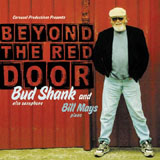
Bud Shank/Bill Mays, Beyond the Red Door (Jazzed Media, 2007) Photo Credits
The Hermosa Lighthouse (which still exists) closed in the mid-'60s, Howard then opened the Redondo Beach Lighthouse which was active for a few years. For a complete history get a copy of the new DVD about the Lighthouse by Ken Koenig. It is good and it is correct.
I put together, in the early '90s, a version if the Lighthouse All Stars. It was a group of eight players and was too expensive for most concert promoters. In addition, Shorty Rogers assumed it was his band which created many internal problems.
AAJ: During this time too, you were also fronting your own smaller ensembles (quartet). Was this your first go at being sole leader of a group? Did you experience any resentment from your other gig?
BS: I left the Lighthouse in January 1956 to form my own quartet with Claude Williamson, Don Prell and Chuck Flores. We stayed together (with a couple of changes) until 1959, I think.
AAJ: Your band cut some albums for Pacific Jazz, you also did a movie soundtrack during this time The Barefoot Adventure, (Pacific Jazz, 1961), the recording of which was slightly unorthodox. Was this your first soundtrack?
BS: I made several LPs with this group. I did two surfing movie scores: Slippery When Wet (World Pacific, 1960) and The Barefoot Adventure. The producer/director/narrator was Bruce Brown. The only thing "unorthodox about it was that the narration was done live along with the tape of the music soundtrack. It was later put on a "sound stripe on 35 mm film. They are now on video tape.
AAJ: Although not always cited as such, you were among the first to fuse jazz with Brazilian music. How had you come to the music? It seems like once the Brazilian fever took off, everybody was cutting a samba album. Did this eventually turn you off the music? In the late 1980s you went back to Brazilian music on the album Tomorrow's Rainbow (Contemporary, 1988). What dictates when you revisit a musical style or play with former cohorts?
BS: My interest in Brazilian music started with my association with Laurindo Almeida of the Kenton Orchestra. Later, in 1953 or '54, Harry Babasin (bassist) came up with the idea of adding a saxophonist to a trio he had with Laurindo and drummer Roy Harte, thus the Laurindo Almeida Quartet. Years later, Ray Brown and I started the THE L.A. 4. My interest in the music of Brazil has been ever-increasing. I was in Brazil in 1966, 2004, 2006 and am returning in September of 2007.
AAJ: Aside from being one of the first to get into Brazilian music, you were also one of the first to throw world music into the mix. You did some things with Indian music and Ravi Shankar. What were the factors in the decision to delve into the then untested world music waters? What was the reaction of fans and critics? Looking back on those albums now, what is your own assessment?
BS: Other than the association with Laurindo, the other "explorations I took—with Kimi Eto (Japan) and Ravi Shankar (India) were the idea of Dick Bock of Pacific Jazz Records. The reaction of fans and critics was one of confusion. To them, a jazz musician should only play jazz music. Curiosity and versatility were not acceptable in those days. 
AAJ: You had called the mid-'60s-to-'70s "The Dark Ages in California for lack of performance opportunities. You and a handful of resourceful others found work in television and movie soundtracks. Was there ever any thought of leaving the States like some of your peers (Ben Webster, Thad Jones, Dexter Gordon)?
BS: That period led to many east coast musicians moving to Europe. There were also several established musicians who chose to escape into the world of chemicals. Then there was a group of us that chose another part of the music business, known somewhat distastefully at that time by several music critics as "studio music. But first we had to prove that we were capable and properly equipped (woodwinds, flugelhorns, extra percussion instruments) to do this kind of work.
Up until the end of 1959, with the appearance of Hank Mancini and the Peter Gunn TV show, jazz musicians (with a couple of exceptions) were banned from doing movie and TV work. This was a result of the somewhat antiquated assumption that jazz guys couldn't read and lacked the discipline to work with what in those times were essentially symphony orchestras. We fixed that. By the mid-'60s a large part of the film scores were written by writers with jazz roots and played by jazz musicians. By this time all of us had families, house payments, car payments, etc. We had responsibilities. Crying about the lack of jobs and recording doesn't pay the rent. We had to do something and we did .
AAJ: There seems to be some revisionist history in regards to what the scene was like during this time. How long did the drought actually last?
BS: This period had an evasive beginning and an evasive ending. Sort of slipped in and slipped out. To me it lasted about ten years. Ray, Shelly and I slipped back in with THE L.A. 4 in 1974.
AAJ: The THE L.A. 4was co-founded by you and bassist Ray Brown. Longtime collaborator Laurindo Almeida (guitar) and Shelly Manne (drums) filled the other two slots. Given the climate of the times, was what you played and recorded different than it would have been had pop/rock not been dominating the marketplace and the attention of the nation's youth?
BS: THE L.A. 4 has been classified by whomever has been self-ordained to create labels as "chamber jazz. I guess that is what it was. It was three jazz guys and a classical guitarist tossed together, mixed well and we accepted whatever came out. There were no predetermined goals to contend with. It surprisingly was accepted by a lot of jazz fans that had been left behind during the '60s and '70s.
AAJ: One hears about certain musicians—John Coltrane comes easily to mind—who, when not recording or performing, were still all about the music. Ray Brown was a good golfer, what do you do to relax, any activities unrelated to your muse?
BS: In the late 1950s I found myself so wrapped up in music that I felt that I was no longer a person. I had few friends; my first wife had left me. Something had to be done.
By the early '60s I had acquired a sailboat. Although it was not a racing boat I raced it anyway. I soon bought a bigger and faster series of boats. In 1972 I bought a "stripped out 42-foot sailboat from Morgan Yacht Company. The crew and I finished building it in Marina Del Rey. It was super-light and very fast. I raced it very successfully until 1975 and then converted it to a pleasure or "cruising boat. I sold it in around 1980, ending my sailing career.
Subsequently I returned to collecting and showing older Porsches. I still do this on a smaller scale.
AAJ: During the '70s you worked on a soundtrack with Duke Ellington, who asked you to join the band. You said no because of previous commitments. How great was the temptation?
BS: The decision was made because of my then-wife's medical problems.
AAJ: You have worked on a staggering variety of projects. Every sized ensemble one can imagine, movie soundtracks, backing up singers (Mel Tormé, Frank Sinatra, Margaret Whiting) and even a commissioned concert for jazz-alto by The Royal Philharmonic. Do you have a preferred situation in which to perform? Obviously each situation requires a specific mindset, but have you found you are called upon for your signature style/sound or for an ability to seamlessly blend in?
BS: When I was doing studio and recording work I was frequently called for the recording sessions because of my ability to play behind singers—to fill in the "gaps. I did a lot in the '50s with Marty Paich behind Sammy Davis, Mel Tormé with Pete, and behind June Christy. But that had nothing to do with the concerto composed by Manny Alban. That was me and only me. Did I really make a recording with Margaret Whiting? Amazing! Versatility and discipline are two of the most important aspects of being a studio musician. However I was one of the few guys left alone to be myself. Most studio sax players have different mouthpieces, etc, so they can sound like whatever the leader wants. I was always hired to be me.
AAJ: When one reads many biographies and memoirs, anecdotes about are anecdotes about "dream jam sessions which were never caught on tape are constantly encountered. I imagine you must have participated in your share.
BS: Yes, but I don't remember where or when or why!
AAJ: Along with Billy Taylor and Jackie McLean, your name comes to mind as one of jazz's great educators. You were affiliated for twenty-plus years with the Bud Shank Port Townsend festival/workshop before they acrimoniously let you go (2004). Understandably this would leave a bad taste in anyone's mouth. Have you headed any clinics anywhere else since?
BS: No. But I do a lot of master classes at schools.
AAJ: I have always maintained that there is a direct line of artistic descendance from some of the modern classical composers and certain forward-thinking composer/musicians in jazz. The trance-inducing discordance of The Art Ensemble of Chicago to some of the music for percussion and orchestra by Lou Harrison is not that far a leap. You did a project in the '80s, Lost Cathedral, released by ITM in 1995, which is described as sound painting for quartet, percussion and recorded tape. This is very similar to the types of works envisioned by Edgar Varèse (1883-1965) and Alexander Scriabin (1872-1915).
Everything played by the musicians in the cistern was improvised. Everything done at the concert was either indicated by musical notation or text. It had one additional performance at the Cornish Institute of Music and Arts in Seattle a few months after the original performance. It is now available on the internet with a new title The Awakening (New Edition, 2006). The record company is in Germany.
AAJ: Your body of work is spread out over many labels of various sizes. Unlike some, there is no uniform law on which labels offer up your best works. Did not being affiliated with one label offer you more artistic freedom? Has this been a conscious decision or just the way it worked out?
BS: Well at least I've been able to keep new records out there and available (sometimes!). Record labels come and go. It just worked out this way.
AAJ: Sonny Rollins has started his own label and is offering up recordings of live dates he played at Ronnie Scott's (in London). Woody Shaw's son is doing the same thing, as is Zoot Sim's widow [the excellent Zoot Suite (High Note, 2007) is her first release]. Have you ever thought of going down that road?
BS: I have no plans to start my own record label. However, we are at this time expanding our sales of current and older CDs and LPs on our website www.budshankalto.com . Beyond the Red Door (Jazz Media, 2007), my latest CD is available here and from the record company. I have the US distribution rights to two CDs and a DVD done in Brazil last December. A DVD about my life is being prepared now for release in early 2008. It will also be on our website.
AAJ: Do you listen to your own albums or private recordings of gigs?
BS: No!
AAJ: I have a few favorites which I constantly go back to and will spend the rest of my life listening to, but there is also a definite thrill to discovering someone new and exploring their work. Do you still listen to some of the original artists who got your juices flowing, Artie Shaw etc?
BS: No! The past is back there. The future is straight ahead.  AAJ: You have a new album coming out, a duo with pianist Bill Mays. Will this be a live recording? What dictates which of your projects become albums? Has new technology made any impact on the how and whys of your recording?
BS: Beyond the Red Door was recorded in New York City in May, 2007. The particular studio was chosen because Bill Mays loved the piano. Me too!
AAJ: Where can fans keep updated on your latest projects and appearances?
BS: At the website www.budshankalto.com, and through a newsletter published there that my wife Linda puts out quarterly.
AAJ: Even with the advent of the internet, online shopping, podcasts, and an ever shrinking world where you can buy a Chu Berry CD by PDA while sitting in the Luxembourg Gardens, jazz has become marginalized. Now more than ever, it has been pushed aside by number-crunchers and a youth-oriented culture. Is there a cure-all? I don't know, but please keep doing what you do so well. It has been a pleasure.
BS: The art form we know as jazz music, like many other things, is changing rapidly. We are losing jazz clubs and jazz radio stations, jazz record labels and true jazz festivals. Are there any real ones left to speak of? I am old enough to have survived a lot of "dry spells and periods of change. But nothing like this. Many doomsayers are predicting the end of our art form as we know it. I am not among them. I have my answer, but changes as large as we're seeing now can frequently be very good—shaking out the dust, the dark clouds and the bull-shitters. We can only hope.
Selected Discography:
Bud Shank/Bill Cooper, Mosaic Select 10: Bud Shank and Bob Cooper (Mosaic, 2006)
Bud Shank, After You, Jeru (Fresh Sound, 1999)
Bud Shank, The Lost Cathedral (ITM, 1995)
Bud Shank Sextet, New Gold (Candid, 1995)
Bud Shank Sextet, Plays Harold Arlen (Jimco, 1996)
Bud Shank/Kenny Barron, I Told You So (Candid, 1992)
Bud Shank/Marco Silva, Tomorrow's Rainbow (Contemporary, 1992)
Bud Shank/Lou Levy, Lost in the Stars: Bud Shank and Lou Levy Play the Sinatra Songbook (Fresh Sound, 1990)
Frank Morgan with the Bud Shank Quintet, Quiet Fire (Contemporary, 1987)
Bud Shank, At Jazz Alley (Contemporary/OJC, 1986)
Bud Shank Quartet, This Bud's For You (32 Jazz, 1984)
Shorty Rogers/Bud Shank, Yesterday, Today and Forever (Concord, 1983)
Bud Shank/Shorty Rogers, California Concert (Contemporary/OJC, 1985)
The L.A. 4, Executive Suite The L.A. 4, Montage (Concord, 1981)
Bud ShankExplorations 1980 (Concord, 1980)
The L.A. 4, Zaca (Concord, 1980) Bud Shank, Heritage (Concord, 1978)
Kimio Eto, Koto and Flute (World Pacific, 1960)
Bud Shank, Slippery When Wet (World Pacific, 1960)
Laurindo Almeida with Bud Shank, Brazilliance, Vol. 3 (World Pacific, 1958)
Laurindo Almeida with Bud Shank, Brazilliance, Vol. 2 (World Pacific, 1958)
Laurindo Almeida with Bud Shank, Brazilliance, Vol. 1 (World Pacific, 1953)
First and Third Photos: Elizabeth Becker, courtesy of Bud Shank
Second Photo: Ron Hudson
Fourth Photo: Ian Polakoff, courtesy of Bud Shank
< Previous
Restless
Comments

Tags
For the Love of Jazz
 All About Jazz has been a pillar of jazz since 1995, championing it as an art form and, more importantly, supporting the musicians who create it. Our enduring commitment has made "AAJ" one of the most culturally important websites of its kind, read by hundreds of thousands of fans, musicians and industry figures every month.
You Can Help
To expand our coverage even further and develop new means to foster jazz discovery and connectivity we need your help. You can become a sustaining member for a modest $20 and in return, we'll immediately hide those pesky ads plus provide access to future articles for a full year. This winning combination will vastly improve your AAJ experience and allow us to vigorously build on the pioneering work we first started in 1995. So enjoy an ad-free AAJ experience and help us remain a positive beacon for jazz by making a donation today.

Giveaway

Days remaining: 4