Home » Jazz Articles » Live Review » Historic Quartet: Cecil Taylor and Anthony Braxton at Ro...
Historic Quartet: Cecil Taylor and Anthony Braxton at Royal Festival Hall, London

Mutual respect was evidenced by how the MO of each of the two main protagonists was loosened to accommodate the other in a collective discourse that cohered better than we had any right to expect
Royal Festival Hall
London, England
July 8, 2007
Given that both Cecil Taylor and Anthony Braxton have both lasted the course and been almost promiscuous in their wide-ranging associations, it was something of a surprise that they had never played together before Sunday's historic engagement at London's Royal Festival Hall. Neither man should need any introduction to AAJ readers: their groundbreaking achievements and voluminous discographies speak for themselves. In spite of his 360 plus compositions, Braxton regularly takes time out in freely improvised settings. Nonetheless, it was unclear how he would fit into Taylor's soundworld. The quartet was completed by William Parker on bass and Tony Oxley on percussion and electronics, reuniting Taylor's 1990's "Feel Trio." Braxton had also played with both before: with Oxley on his Seven Compositions (Trio) 1989 (HatHut, 1990) recording, and more recently with Parker in a series of free jazz trios in various Italian venues.
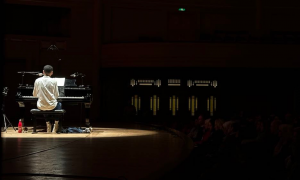
After a short but lively opening set by the young British group Polar Bear, the darkened stage rustled with unseen percussion and, at first wordless, vocalizations. Soon, Tony Oxley appeared and stationed himself behind his customized drum kit to commence a gentle tattoo. After further poetic declamations, Cecil Taylor entered theatrically from stage left and zig-zagged to his place at the piano.
The ritual opening developed with balletic grace into a delicately fractured melody accompanied by Oxley's patented off-kilter clatterings, pausing, then restarting in a leisurely flow. Oxley's textural gestures were pitched to match the piano's rippling tracery, as well as the occasional squalls when all thoughts of the pianist's 78 years vanished as his hands literally blurred while sweeping up and down the keyboard. Yet there was a restrained, almost meditative feel to the duet, with ample space for both players.
Curiously, Taylor twice paused during the duet to select sheets from the scores atop the piano, leading to natural breaks in the proceedings, which became increasingly more energetic. Any compositional signposts must have been suitably oblique as there was no discernible effect upon the ensuing structures that evolved through an incremental layering of ideas.
As the intensity increased, Oxley upped the ante, sweeping round his kit in a circular motion. The percussionist was intently responsive, adjusting his dynamics to complement Taylor's lead. The pianist juxtaposed passages of the utmost delicacy with storming monolithic blocks of sound, becoming increasingly insistent, indeed tumultuous, in places, pounding and crashing like an avalanche—and then suddenly quietening, as if it had never happened, for a delicate finish. I found the whole 39-minute duet entrancing, one of the most moving performances on Taylor's part and worth the price of admission alone.
But that was by no means all that the cost of admission offered. As the applause faded after Oxley and Taylor left the stage, William Parker strolled on stage for a solo bass extravaganza. Parker has recorded several solo bass records, and it was a treat to hear him in full experimental mode. His bowed harmonics, while bending the strings and simultaneously plucking the bass string with his thumb, formed a recurring motif as he developed and explored a stream of ideas. A series of quiet pizzicato notes signalled the close after some 13 minutes of fertile exploration.
We had heard a lot of music, but not a note from Anthony Braxton. If I hadn't seen him bring his saxophones on stage earlier, I would have been panicking by now, even concluding he wasn't going to appear at all. Then finally there they all were: the full quartet came onstage and without any introduction launched into the construction of a ruminative improv soundscape. Oxley set up an electronic burbling while Braxton alternated resonant growls with altissimo squeals on contralto clarinet. Parker contributed koto-like plucks and arco slashes as Taylor manipulated the piano's strings for an intriguing opening section. More familiar territory prevailed after some six minutes, when Braxton switched to sopranino saxophone and Taylor moved onto the keyboard. The saxophonist released some of his pent up energy with a fearsome passage of circular breathing, unfurling sinuous lines over the muscular accompaniment, with Taylor darting at the keys and Parker's bass promptings particularly forceful.
Although music stands were positioned next to each band member, there was no evidence of the musicians availing themselves of a score, as all the proceedings seemed created in the moment, the four-way conversation ebbing and flowing over the course of a continuous 36-minute piece. Taylor regarded Braxton intently, as the lead switched between them, with Braxton's alto taking a guttural turn in response to a passage of crashing pianistics, or to Taylor's shimmering lines echoing a long wavering line by Braxton. Mutual respect was evidenced by how the MO of each of the two protagonists was loosened to accommodate the other in a collective discourse that cohered better than we had any right to expect. The rhythm pairing played a full part in sculpting the performance too. Oxley melded a procession of percussive textures into a stumbling rhythm, sparked by Parker's pulsing bass, adding the forward momentum.
Braxton played almost non-stop, switching between alto, soprano and sopranino saxophones and running the gamut from his trademark high-velocity intervallic leaping runs, leavened by lyrical cries, to vocalised growling and wavering squeaks. Occasionally he would stand with eyes closed, rocking gently and nodding his head as he listened before selecting the most appropriate horn for his re-entry. Hard-blowing passages were contrasted with sparser sections of surprising tenderness, with Parker's arco work especially noteworthy. Oxley's electronic washes sometimes added a ghostly fifth voice in the quieter pastoral interludes. However, the energy levels rose towards the end, with Braxton's sopranino wail piercing the blow -out crescendo, Taylor jabbing at hyper speed above a wall of sound from Oxley, until a series of insistent stabs from the pianist signalled the conclusion and elicited an eruption of applause from an ecstatic Royal Festival Hall.
Braxton and Taylor embraced, and then all four joined in a bow before leaving the stage. The historic first-time meeting had more than lived up to its billing, and my suspicion that it would not get off the ground had proved unfounded. If there was any shortcoming, it was the brevity of the full quartet's segment. However, even that small disappointment was tempered by the magisterial duet between Taylor and Oxley, which was an evening's entertainment by itself. The show was recorded by BBC Radio 3, and so may yet see the light of day as an official release. Are you listening Mr Feigin?
About Cecil Taylor

Tags
PREVIOUS / NEXT
Become a Sustaining Member

Since 1995, All About Jazz has championed jazz as an art form and supported the musicians who create it. Over three decades, it has grown into one of the world's leading jazz resources, serving hundreds of thousands of readers, musicians, presenters and industry professionals each month.
Help Build the Future of All About Jazz
Your support helps us continue building All About Jazz for the next generation—expanding our editorial coverage, preserving jazz history, developing new community features and creating better ways to discover the music and the people behind it.
Become a sustaining member for as little as $20 per year and you'll immediately enjoy an ad-free experience along with access to subscriber features and future articles for a full year.
Together, we're not simply sustaining All About Jazz—we're building its future. Thank you for being part of the journey.