Home » Jazz Articles » Live Review » Cecil Taylor, Anthony Braxton, Ornette Coleman in London
Cecil Taylor, Anthony Braxton, Ornette Coleman in London

Royal Festival Hall
London, England
July 8-9, 2007
Cecil Taylor Trio with Anthony Braxton
On June 8th, the Royal Festival Hall opened its doors again after a two-year refurbishment costing about £111m ($222m). Since then, its program has included classical music from the resident orchestras, and the rock and pop of Jarvis Cocker's Meltdown season, but no jazz... until now. When fans saw the artists scheduled for these two concerts, the four-week wait to hear jazz in the new auditorium seemed as nothing. A small price in exchange for line-ups that were mouth-watering indeed. Even historic.
Astonishingly—given their combined age of 140 years, and the parallel courses their music has followed—this was the first time Cecil Taylor and Anthony Braxton had appeared in the same group. (They famously appeared here on a double bill—but not together—in November 2004, when it was agreed by all that Braxton stole the show.) Before this show, there was much speculation about why they had never played together... and whether they could. Well, what followed soon put a stop to that sort of talk. The music was stunning, better than most of us could have dreamed.
Cecil Taylor's last few appearances in London have been rather underwhelming, and that 2004 show included too much poetry and dance, leading to mockery from some sections of the audience. Tonight was very different: his piano playing was focused, taut and lean, more straight-ahead than it has been for years (which is not to say it was straightforward, of course!). At times, it sounded like an avant-garde variant of stride piano. (One punter was heard to say, "His piano tonight reminds me of Nina Simone. An odd comparison, but it did make sense!)
An opening duo between Taylor and drummer Tony Oxley revealed the years that they have played together and the understanding that they have developed—an object lesson in tight sympathetic improvisation, with Oxley shadowing the piano, commenting, interjecting and goading, demonstrating that he is the perfect drummer for Taylor. After an engrossing solo bass set from William Parker that explored the instrument's outer limits, the full quartet appeared.
Playing a prolonged improvisation, the quartet was an ensemble of four equals, each member vital to the success of the whole. Opening with a thrillingly dense free-form swirl of sound, structure gradually emerged from it, like life from a primordial swamp. Taylor and Braxton sounded like they were made for each other: neither dominated, each being prepared to sit out or play a supportive role while the other was in the spotlight, but when they both let rip simultaneously, the creative sparks really flew.
Down the years, Taylor has played with some superb saxophonists—Steve Lacy, Sam Rivers, Jimmy Lyons, Carlos Ward, Evan Parker quickly spring to mind—and has arguably produced his best music with them. Braxton's use of circular breathing to sustain repeated phrases or single notes added drama and tension to the music, a fine example of instant composition. The piece built and built steadily, coming to a dramatic climax, finished off by crashing chords from Taylor that definitely signaled the end. Cue prolonged applause.
Two thoughts: I can't wait for this set to be released on disc as soon as possible. (Leo?) And I hope that Taylor and Braxton play and record together as much as possible, making up for lost time—preferably with Parker and Oxley too.
Ornette Coleman Group
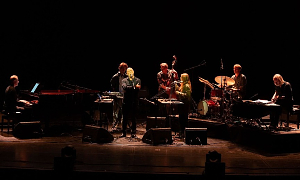
The following night, July 9, Ornette Coleman played, probably the only jazz musician who could generate the same buzz of expectation as Taylor & Braxton. True to form, Coleman surprised and delighted us. We were expecting a return of the two-bass quartet that visited The Barbican two years ago—the line-up that recorded the stunning Sound Grammar album. As the band was announced and took the stage one by one, we could see this wasn't a rehash: "On bass—Charnett Moffatt; on bass—Tony Falanga; on bass— Al McDowell; on drums—Denardo Coleman; on saxophone, trumpet and violin—Ornette Coleman. Yes, three bassists. It was soon apparent that the three were going to fulfil very different, complementary roles: Falanga largely played arco, providing a solid foundation; Moffatt was more exploratory, using pedals extensively, notably wah-wah; McDowell played bass guitar, but often in the upper register, sounding more like a rhythm guitarist than a bassist.
The overall sound was radically different from Sound Grammar—far more like vintage Prime Time. The younger Coleman clearly relished the presence of McDowell. Drums kept up a constantly varying driving rhythmic pattern, as Denardo and McDowell traded ideas and phases throughout. Visually, the percussionist was the focus of attention, dressed in a white suit, on a raised plinth, surrounded by the bassists.
In contrast, the leader was (untypically) soberly dressed. Although frail as he took to the stage, once he started playing he sounded strong and fresh, displaying no obvious effects of his recent health scare. His saxophone playing was as dominant as ever, and as moving. Material selected for the program represented his entire career—including "Turnaround," an appearance of the once ubiquitous "Dancing In Your Head riff, and an encore of "Lonely Woman." But the selection was almost incidental to the performance: Coleman was riveting throughout, the entire performance coherent and without flat spots. Interludes on trumpet and violin were well integrated with the saxophone, providing commentary and shading that complemented the primary instrument's inventions. Again, a standing ovation; again, thoroughly deserved.
Two great nights that welcomed jazz back to the RFH in a fittingly historic way. (And the place sounded good too—in fact, better than ever. £111m well spent!)
Photo Credit
John Eyles
Tags
PREVIOUS / NEXT


Become a Sustaining Member

Since 1995, All About Jazz has championed jazz as an art form and supported the musicians who create it. Over three decades, it has grown into one of the world's leading jazz resources, serving hundreds of thousands of readers, musicians, presenters and industry professionals each month.
Help Build the Future of All About Jazz
Your support helps us continue building All About Jazz for the next generation—expanding our editorial coverage, preserving jazz history, developing new community features and creating better ways to discover the music and the people behind it.
Become a sustaining member for as little as $20 per year and you'll immediately enjoy an ad-free experience along with access to subscriber features and future articles for a full year.
Together, we're not simply sustaining All About Jazz—we're building its future. Thank you for being part of the journey.