Home » Jazz Articles » Bailey's Bundles » Art Pepper: Two Previously Unreleased and Outstanding Albums
Art Pepper: Two Previously Unreleased and Outstanding Albums
 Arthur Edward Pepper, Jr. (1925 -1982) desired the title of "greatest alto saxophonist in the world." Such an ambition might be considered by the uninitiated to have been either naive or intensely egocentric, for Pepper's contemporaries on the axe included Charlie Parker, Johnny Hodges and Paul Desmond. But Pepper had more staying power than any of them, and all the while developed his unique and personal sound. Along with Desmond and Lee Konitz, he was among the few small-combo saxophonists able to sculpt a personal style despite the ubiquity of Parker's influence.
 Pepper's solo career can be divided into three main eras. His early period was from 1950 to 1960, when he recorded widely for Savoy, Blue Note and Contemporary. It saw the release of the truly legendary recordings, Art Pepper Meets The Rhythm Section (Contemporary, 1957) and Art Pepper + Eleven: Modern Jazz Classics (Contemporary, 1959). Pepper's early tone was cool: dry-ice with impeccable intonation and vibrato. This early period ended with Pepper walking out of the Contemporary recording studio November 25, 1960 (after recording Intensity) and into the beginning of multiple prison stays. It would be 15 years before Pepper would again lead a serious combo in the studio.
Pepper's middle period—roughly 1960 to 1975—was a fallow time characterized by multiple prison and drug rehabilitation stays. His playing was powerfully affected by saxophonist John Coltrane, an influence heard
Pepper's final period was "der Götterdammerung" of the jazz life. After the release of Living Legend (Contemporary, 1975), he emerged reconstructed and impassioned. Living Legend was followed by The Trip (Contemporary, 1976), No Limit (Contemporary, 1977), and the famous first (1977) East Coast recordings at the Village Vanguard. Pepper later left Contemporary for Galaxy Records where he produced his famous Maiden Voyage Sessions (1981) , his strings recording, Winter Moon (1980) and his final duets with his favorite pianist George Cables, Goin' Home (1982) and Tête-à-Tête (1982). Pepper's live performances from the late 1970s until his death were characterized by devastatingly emotional playing. He recorded and performed in an almost exclusively quartet format with musicians with whom he shared a special empathy.
Pepper's widow, Laurie Pepper, has released on her new label, Widow's Taste, two previously unreleased live sets recorded at the end of Pepper's life, including his final performance barely two weeks before his death. More unreleased material is promised to follow. These releases represent significant additions to jazz in general and to Art Pepper's legacy in particular.
 Art Pepper
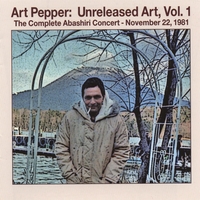
 Art Pepper: Unreleased Art, Volume 1 -The Complete Abashiri Concert -November 22, 1981
Widow's Taste
2006
During his late 1970s renaissance, Pepper was wildly popular in Japan, touring and recording there several times. Much of this work is documented on the 16-CD set Art Pepper -The Complete Galaxy Recordings. Pepper's appearance at Abashiri, Japan in November 1981 would be his last trip there. The recording was made from the soundboard directly to analog cassette tape by a local engineer, chosen by Laurie Pepper to do the job because he proved more reliable than other engineers she encountered. The taping begins with pianist George Cable in mid-solo on the 1979 Pepper original "Landscape." The sound is fractional but clears up nicely, improved further in the digital transfer.
The concert repertoire is very much in keeping with Pepper's book in his late period. The bulk of the pieces were associated with his return to the music scene in 1975. These include the aforementioned "Landscape," 1976's soul jazz workout "Red Car," the recently composed 3/4 blues, "Road Waltz," and the staggering "For Freddie" (divided because the recording cassette tape had to be turned over). Pepper did retain older standards in his book including "Besame Mucho," the recently added "Goodbye, and the rarely played (by Pepper) "Body And Soul."
Pepper could slay any ballad and does with "Body and Soul what he consistently had done in the past with "Over The Rainbow," recasting the famous melody in that fragile place between the head and the heart. Pepper remarks on the recording that this performance "was one of the nicest things I ever played in my life. Indeed. Pepper had recorded Monk's "Rhythm-A-Ning as early as 1960, revisiting it many times. Here, Pepper treats it as his own, displaying his splendid eloquence in the bop vernacular. His bop original "Straight Life, hinged here with "Goodbye, represent the most intense performances on the disc. This is surely Pepper heard at his pristine best.
Pepper's renaissance performances, particularly those from the 1970s (and in particular at The Village Vanguard) were characterized by cathartic explosions of pathos. The experience for Pepper and audience alike was akin to a "burning bush experience. By the time of the Abashiri Concert, Pepper had relaxed into a more comfortable performance, but still accented with emotive intensity, as in his second solo on "Road Waltz. This working quartet was the one best suited to Pepper, header by his "Mr. Beautiful George Cables and pinned down with bassist David Williams and another Pepper favorite, drummer Carl Burnett. The group's simpatico is palpable, perhaps reaching a critical mass of cooperation that Pepper had never enjoyed previously. That alone makes this unreleased material such a special gift.
 Art Pepper
 Art Pepper: Unreleased Art, Volume 2 -The Last Concert May 30, 1982 Kool Jazz Festival Kennedy Center, Washington D.C.
Widow's Taste
2007
Pepper's last recorded performance took place on May 30, 1982 at the Kool Jazz Festival, Kennedy Center, Washington, DC. Before taking the stage, Pepper understood that he had 70 minutes during which to perform. He and his wife Laurie, per their habit, discussed the pieces to be performed before the show. Through a miscommunication, Pepper was allowed only 60 minutes in which to perform. Disappointed and angry, he nevertheless performed brilliantly. In his late creative period, Pepper would play as if every performance was to be his last one. This time it was.
The recording is acceptable—with the caveats that the piano and saxophone are a bit behind the drums and bass in the mix—as the performance was being prepared for broadcast over the Voice Of America. By this time Cables, Pepper's favorite pianist, had left for a job with Sarah Vaughan and Laurie Pepper selected the very successful Roger Kellaway to replace him. Kellaway had more in common with Pepper pianist Milcho Leviev than Cables, providing an interesting contrast. The performance opens with the Pepper original "Landscape, a favorite vehicle for the saxophonist after he introduced it into his book in 1979. The piece well illustrates Pepper's affinity for complex charts. Everyone solos, Pepper and bassist David Williams being the most compelling. Kellaway has a shaky start, working out the kinks as the song warms.
The Last Concert includes plenty of Pepper stage banter in his introduction to his "Ophelia. This mid-tempo ballad, full of life and breath, is the product of a superb jazz mind that gives his compositions an immediate ambience that can only be defined as jazz. Forget genre and subgenre. "Ophelia accomplishes for Pepper what "Pilgrimage did for the late Michael Brecker 25 years later—the music saying, "this is what jazz is all about.
"Mambo Koyama, another Pepper original, possesses a complex Latin head that put the saxophonist years ahead of the Latin jazz resurgence of the mid-1990s. Pepper blows his heart out in solo, playing long convoluted lines after the staccato introductory passage. The song evolves into a soul jazz-inspired serenade with waves of crescendos. Pepper follows the white-hot with the ballad-cool, playing one of his favorite concert pieces, "Over The Rainbow. Playing with the quartet and not solo, as he often did, Pepper made his impassioned plea sincerely, as he always did when playing this song.
The final song, "When You're Smiling, Pepper played on clarinet and dedicated to saxophonist Zoot Sims, whom he had known in the old days. The song opens as a duet with Williams just as Pepper had done with his Village Vanguard "Anthropology and bassist George Mraz. Like saxophonist Lester Young, Pepper never over did it on clarinet, but when he did play the instrument, it was magic. Kellaway turns in his most inspiring performance of the show, going well over the top and dragging the band with him. There is no more fitting way to remember Art Pepper than this performance of "When You're Smiling. It is so good that there is more to come.
Tracks and Personnel
Art Pepper: Unreleased Art, Volume 1
Tracks: Landscape; Besame Mucho; Red Car; Goodbye; Straight Life; Road Waltz; For Freddie (part 1); For Freddie (part 2); Body And Soul; Talk; Rhythm-A-Ning; Blues Encore (inc.).
Personnel: Art Pepper: alto saxophone; George Cables: piano; David Williams: bass; Carl Burnett: drums.
Art Pepper: Unreleased Art, Volume 2
Tracks: Landscape; Talk; Ophelia; Talk; Mambo Koyama; Over The Rainbow; Talk; When You're Smiling.
Personnel: Art Pepper: alto saxophone; Roger Kellaway: piano; David Williams: bass; Carl Burnett: drums.
About Art Pepper

Tags
PREVIOUS / NEXT
Become a Sustaining Member

Since 1995, All About Jazz has championed jazz as an art form and supported the musicians who create it. Over three decades, it has grown into one of the world's leading jazz resources, serving hundreds of thousands of readers, musicians, presenters and industry professionals each month.
Help Build the Future of All About Jazz
Your support helps us continue building All About Jazz for the next generation—expanding our editorial coverage, preserving jazz history, developing new community features and creating better ways to discover the music and the people behind it.
Become a sustaining member for as little as $20 per year and you'll immediately enjoy an ad-free experience along with access to subscriber features and future articles for a full year.
Together, we're not simply sustaining All About Jazz—we're building its future. Thank you for being part of the journey.