Home » Jazz Articles » Book Review » Bossa Nova: The Story of the Brazilian Music That Seduce...
Bossa Nova: The Story of the Brazilian Music That Seduced the World

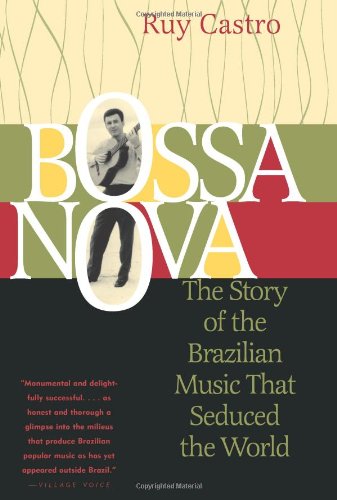 Ruy Castro
Bossa Nova: The Story of the Brazilian Music That Seduced the World
A Capella Press
ISBN: 1556524943
To virtually all Americans, the words "bossa nova" are synonymous with Brazilian jazz. More specifically, they immediately trigger memories of bossa nova's greatest American hit, "The Girl From Ipanema." When Creed Taylor introduced Astrud Gilberto's version of the song to American audiences in 1964, he had no idea what kind of lasting impact it would have. He had no idea that Getz/Gilberto would come to define Brazilian music for American audiences. Forever.
The idea that bossa nova represents Brazilian popular music is all wrong. And all right. It represents the pinnacle of the country's influence on the world's music, the inauguration of an era when tunes like "The Girl From Ipanema" and "Desafinado" would become jazz standards. Hell, even Frank Sinatra did a whole record with Antonio Carlos Jobim! (So what if Jobim had to forsake his piano for a guitar. You play with the Chairman, you play by his rules.) Unfortunately, the rest of the world stood by deaf as Brazilian music moved on in the '60s and beyond. Only nostalgic old farts play bossa nova in Brazil today. Or so they say.
Brazilian muse Ruy Castro takes on this distinctive musical tree in Bossa Nova, going from its deepest roots to its most distant branches. That may sound like a cursory exaggeration, but it's completely true. Castro is a total freak, compulsive about details and obsessive about drawing every line in the big picture:
I think it important to note that I listened to all the recordings mentioned in the text...
Yeah, yeah. But in the process of his exposition, you find yourself increasingly drawn into the deeply personal nature of the music. He might make a point of correcting errors on record sleeves, but he's also got a brilliant sense of humor.
This review has the goal of orienting readers to the general flow of the story, revealing unexpected events and offering Castro's take whenever possible. American listeners who followed bossa nova most likely followed João Gilberto, the clear-cut cult hero of this book. And despite the rich cast of characters woven together in this fabric, one man stands out. So the review will not stray far from the center. But back to the story.
I. Roots
Castro appreciates the tastes of young people in Brazil in the late '40s, when the children of bossa nova were growing up. Frank Sinatra is indeed the subject of several jibes along the course of this story. Some of the founders of bossa nova, oddly enough, were members of Rio's "Sinatra-Farney Fan Club," born in 1949. Membership required a fanatical zeal for Frank Sinatra and Dick Farney, monetary dues, and the ability (at least in a relative sense) to play an instrument or sing. To these young people, Sinatra's only flaw was that he was not Brazilian. Parenthetically, Castro remarks:
Those who are less than a hundred years old might not believe it, but Frank Sinatra was a sex symbol in those days. He was also so thin that when he walked around on stage with the microphone in his hand—he was one of the first singers to do this—he had to be careful not to disappear behind the cord.
As time went on, some of these amateurs developed the ability to sing in tune, even improvise jazz over changes. João Donato, a card-carrying member of the Sinatra-Farney Fan Club, strayed when he also joined the Dick Haymes-Lucio Alves Fan Club. It was no small thing. The rivalry between America's undisputed king of song (Sinatra) and Brazil's first cult singer (Alves) was so strong that when Alves paid a visit to the rival club, he left with an army of young people behind his back sticking out their tongues and pinning their thumbs on their noses.
Donato, however, had the right idea. When he later met the guitarist João Gilberto, both of them immediately stood shellshocked: they looked like twins.
II. Deviants
Donato went on to become one of the heroes of the movement. Gilberto, of course, became its leader (whether willing, eager, or able is a different matter). The collision is meaningful, though, because it represents a clash of musical cultures that would later resolve, rather forcefully, in one direction. Castro speaks later about Roberto Menescal and Carlinhos Lyra, two influential musicians who sold their product to a niche market:
The two of them were also the benficiaries of a virus that took hold of many parents at that time: that of forcing their children to study the accordion with the nationally famous professor Mario Mascarenhas. In order to escape this terrible fate, youngsters bargained with their good grades in school, or with their regular church attendance, and extracted permission from their parents to learn the guitar.
Needless to say, the guitar was not exactly hip with the older generation. (Speaking from personal experience, I can testify that the average age of polka fans exceeds the average life expectancy, and so this comes as no surprise.) The guitar represented idleness, sloth, and sin. Over time, hundreds of young girls joined these classes, along with a few token boys. (Apparently there was sex appeal involved. No surprise. Remember, this is Brazil.)
In 1958, a common obsession united those young men: to free themselves from the accordion and take up the guitar, which, incidentally, would make them much more popular with girls. They all believed that their chances with members of the opposite sex would increase if they could only duplicate what they heard on certain records they played until they wore out...
While spoken in jest, this point about the guitar is no small thing.
When João Gilberto bumped into his cosmic twin João Donato in Rio, he had recently gotten off the plane from Bahia. He was a country bumpkin come to the big city to join Os Garotos da Lua (The Boys From The Moon), a vocal group whose ousted leader just couldn't sing loud enough. In those days, Gilberto sang with "considerable volume," which was exactly what Os Garotos needed. (How ironic, given the softness of the voice for which he became famous.) Os Garotos gave him a platform, and they introduced him to reefer. He also played the guitar.
In those days, João Gilberto was one of the biggest slackers in the business—continually out of money, staying with friends (or even acquaintances) for as long as they would tolerate him. He had a remarkable ability to show up late for performances, or not even show at all. He would disappear for days, only to return as if nothing had happened. The continual cycle eventually got to him, and he shipped out of Rio for rehabilitation. He stayed with relatives, where he did not emerge from his room for days on end (when he wasn't lingering in the bathroom for hours). He went to see psychiatrists (who couldn't find much wrong). He quit smoking.
But mostly, he played the guitar and sang. When he got back to Rio, he was a new man. Of course, Rio was a new place, too. But as Gilberto made his rounds and connected with the music scene, people found he had come up with something exciting. It wasn't exciting in any obvious way—after all, he had started singing very softly, riding freely over the tempo of the music. His chordal guitar playing had a light, understated rhythm. But it worked. And it reflected a lot of the sounds that his musical community had cultivated for years.
At the same time, Antonio Carlos (Tom) Jobim had developed his own career as a composer, arranger, and pianist. His lifestyle concept was diametrically opposite to Gilberto's: he had a day job, requiring regular attendance, arranging for a recording company called Continental. He, together with Vinicius de Moraes, put together the music for Black Orpheus, a musical that eventually became a play and a movie—in 1958, winning the Palme d'Or and an Oscar.
One night Jobim teamed up with his neighbor, Newton Mendonca—both suffering from a serious degree of inebriation—to write a bossa nova classic: "Desafinado" (Off-Key). Ronaldo Boscoli supplied the lyrics. It was an inside joke, a difficult tune with lighthearted words. Nobody could sing it right, except for a select few. One of them was João Gilberto. This was the same man who exclaimed,
"In Brazil, even the canaries sing off-key."
He had perfect pitch. João Gilberto's quiet and fluid singing was actually quite controversial at the time:
João Gilberto's singing style, hitherto unknown, was what sparked discussions. Those who were tone-deaf asked sincerely, "But is he really off-key?," which usually generated an answer that was as ridiculous as the question: "Are you crazy? The man has the hearing of someone with tuberculosis!"
(A common myth at the time posited that victims of tuberculosis actually had superior hearing and perfect pitch. That little piece of information is very helpful in piecing the story together.)
III. Bossa Nova

Jobim, Mendonca, and Gilberto would team up for the emerging star's first record, Chega de Saudade (No More Blues, 1959), along with poet-diplomat Vinicius de Moraes—who composed the title track, along with Jobim. A hard sell to a record store chain triggered the album's release, and it was followed by the record that came to define bossa nova in Brazil: O amor, o sorriso e a flor (Love, a Smile, and a Flower, 1960).
Bossa nova, a term coined under obscure circumstances in 1958, became so popular it was used by salesmen and musicians of all stripes. It just seemed a hip name for things. "Bossa nova," contrary to common understanding does not mean "new beat ":
The word bossa, at least, was far from new, having been used by musicians since the days of yore to define someone who played or sang differently. Veteran singer Cyro Monteiro, for example, had a lot of bossa.
And so bossa nova was a very big thing.
IV. A nucleus
It came, and it represented a lightness of tone that young Brazilians needed after years of samba-canção, music with lyrics like "I'm lost/He doesn't love me/He never told me/And now I am alone in the world." One of the hits of 1952 was noir journalist Antonio Maria's "Ningum me ama" (Nobody Loves Me). And so on and so forth. This was some pretty melacholy stuff, so the concept of Love, a Smile, and a Flower was like a fresh breeze off the shore. A show with that name was one of a handful of collective performances by the stars of the movement. It was eagerly received by hordes of young people.
Bossa nova started out as a nucleus of musicians in Rio who made music more for each other than for their audiences—most frequently consisting of chatty, glass-clinking bar patrons—whose sole role was to pay the bills. Once they found an audience, the music began to explode. The main movers in bossa nova built upon their collective reputation with a series of festival-like performances, but the biggest one they found was held at Carnegie Hall in November of 1962. And along with Tom Jobim, João Gilberto was its biggest star. His new wife, Astrud, came along in her marital capacity but not as a musician. The show was a high water point in terms of visibility, but not really all that special musically. But in the end that didn't matter.
V. The Girl
"The Girl From Ipanema" is "Garota de Ipanema" in Brazilian, referring to the beachside community (Ipanema) that was home to part of the bossa nova nucleus:
As for the famous girl, [Tom] Jobim and Vinicius [de Moraes] did in fact see her as they sat in the Veloso bar, during the winter of 1962—not just once, but several times, and not always on her way to the beach but also her way to school, to the dressmaker, and even to the dentist. Mostly because Heloisa Eneida Menezes Paes Pinto, better known as Helo, who was eighteen years of age, five feet, eight inches tall, with green eyes and long, flowing black hair, lived in Rua Montenegro aned was already the object of much admiration among patrons of the Veloso, where she would frequently stop to buy cigarettes for her mother—and leave to a cacophony of wolf-whistles.
So obviously the song was very inspired. The musical creation of Jobim and Vinicius went out on record in January, 1963, and the beauty was strangely moved:
The girl, Helo, whistled the song daily on her way to the beach, without realizing she had been its inspiration.
Of course, she eventually figured it out. After a prolonged period of restraint, Helo did the obvious thing. She posed for the Brazilian Playboy in 1987.
But, you know, twenty-five years isn't exactly twenty-five days.
VI. Success and the implosion
American listeners oblivious to this entire situation were digging Hel's tribute song, released as a single by Creed Taylor in 1964 after spending a judicious period of time in his drawer. At the original recording session of Getz/Gilberto, João Gilberto clued Stan Getz into the lyrical elasticity of bossa nova (once he had been adequately lubricated). His (then-) wife Astrud Gilberto also sang. The original version of "The Girl From Ipanema" featured both Gilbertos' voices, but subsequent attention in the studio deleted João's part, making the tune shorter (and more radio-friendly)—thus launching the fragile voice of Astrud Gilberto into millions of ears. The full-length Getz/Gilberto came out shortly thereafter, and it remains the biggest bossa nova record in American history.
But ironically, by the time bossa nova was achieving its greatest worldwide popularity, the movement had already begun to fall apart at home. Lured by opportunity, money, freedom, or escape, the movers and shakers had vaporized. Those who remained seemed divided along political, aesthetic, and personal lines to the point where the music lost its center. Castro dutifully tells the story of the beginning of the end, but it's quite clear that he's lost interest by this point. He's an author bent on drama and excitement, and the decline of an empire is hardly fodder for that engine.
Without a nucleus, upon which bossa nova had always depended for its viability, the music lost its broad appeal. Rifts between groups (and their leaders) broke things in half, and between record label infighting and the fickle audience in Brazil, time moved on. Samba, the heart and soul of Brazilian music as we know it, had much more momentum than this particular offshoot. Rock-n-roll (in its Brazilian flavor) rose along with varieties of country music; singers began returning to themes other than Love, Smiles, and Flowers.
The big stars who emerged from bossa nova went on to pursue extended careers. Both Gilbertos (married no more) made beautiful records, as did Tom Jobim. A huge number of other musicians have picked up the threads and woven many beautiful songs. Those who carried the torch in Brazil understood that bossa nova's status as a popular music had come to its proper conclusion.
As a nostalgic touch, the familiar lyricism has its place. There are still plenty of musicians building on the tradition. But instead of thousands of screaming young fans, the audience of bossa nova has grown older. And wiser, presumably.
That's the story in a nutshell. Ruy Castro has his obsessions and his idiosyncrasies, but he certainly does tell an interesting story. It revolves around Gilberto and Jobim, but he does not hesitate to talk about other composers and performers who made independent statements in their own right. He places the music within a meaningful context—temporally, culturally, and socially. And his compulsive obsession with details is matched by a similar devotion to narrative—which, in many cases comes down to friendly, chatty, armchair storytelling.
It's hard to find flaws in Bossa Nova if you approach the book with the right attitude. It contains 335 dense pages (plus discography, glossary, and index) of bossa nova. The level of detail is very high. So obviously this is a tome to be taken seriously.
Unfortunately the author did not see fit to include recording or release dates in his discography, which renders finding this information a historical undertaking in itself. That's a shame, and the biggest objective flaw of the book.
But at the same time, the narrative runs through its breadth of lives and experiences in a way that seems fluid and natural, tying lots of loose ends together. And, of course, as amply illustrated above, it's just plain fun to read. [Check out Castro's story about how Gilberto's cat "Gato" (meaning "Cat") fell off the balcony to his death during a recording session. The cause of death was never ruled accidental.]
Note: this edition represents the paperback version of Lysa Salsbury's translation of Castro's original Brazilian version. Whatever controversy may surround the translation is completely lost on this reviewer. Sorry.
Related Links
IPG Books
Paradise In Brazil
Building a Jazz Library: Bossa Nova
Brazilian Jazz Reader Recommendations
Tags
PREVIOUS / NEXT


Become a Sustaining Member

Since 1995, All About Jazz has championed jazz as an art form and supported the musicians who create it. Over three decades, it has grown into one of the world's leading jazz resources, serving hundreds of thousands of readers, musicians, presenters and industry professionals each month.
Help Build the Future of All About Jazz
Your support helps us continue building All About Jazz for the next generation—expanding our editorial coverage, preserving jazz history, developing new community features and creating better ways to discover the music and the people behind it.
Become a sustaining member for as little as $20 per year and you'll immediately enjoy an ad-free experience along with access to subscriber features and future articles for a full year.
Together, we're not simply sustaining All About Jazz—we're building its future. Thank you for being part of the journey.