Home » Jazz Articles » Live Review » Punktfest 06 - Kristiansand, Norway - Day One, August 24, 2006
Punktfest 06 - Kristiansand, Norway - Day One, August 24, 2006

It's a long trip from Ottawa, Canada to Kristiansand, Norway, the home of Punktfest 06—over fifteen hours, including stopovers. But the trip is worth taking, even before getting into the unique flavor of Punktfest, now in its second year. Situated on the southernmost tip of Norway, Kristiansand is home to approximately 75,000 people- -a small place by North American standards. The city, which is scenically breathtaking as it winds its way around the coast, is an intriguing combination of old and new.
But what's immediately clear when driving from its small airport to the Clarion Hotel Ernst (which acts as "festival central" for the days leading up to and including Punkt's three-day run) is how culturally rich it is. And that is by no means an accident.
Chapter Index
- Cultiva
- Punkt and Beyond
- Fiona Talkington
- Lars Danielsson
- Anne Marie Almedal
- Bugge Wesseltoft
- Eivind Aarset's Electronique Noire
- Hakon Kornstad
- Sidsel Endresen
- Anja Garbarek
- Food
- Wibutee
Cultiva
"There is a very special thing in my hometown called Cultiva," explains Jan Bang, who, along with Erik Honoré, came up with the idea of Punktfest. "There was a very smart guy who worked as advisor to the region, next to the mayor. He thought, 'What if we sell half of the electricity work, invest the money and take all the interest to support culture within the community?' So that's what they did. They sold it for billions of kroners—a lot of money—and the interest goes into an fund, for working with culture in the region. The relationship between Cultiva and Punkt is very close."
Bang and Honoré are well-known as producers, samplers and remixers—not just on the Norwegian scene, but increasingly on the world stage. Bang has been strongly associated with the improvising scene for some time, while Honoré—a friend since both were in their teens—has worked more in the pop/rock scene and with singer/songwriters. Bang is a key member of trumpeter Nils Petter Molvaer's group— part of the Norwegian nu jazz scene that blends intrepid improvisation with ideas more commonly found in ambient music and electronica.
But both Bang and Honoré have worked with Molvaer in the studio, as well as artists abroad, like British singer/songwriter David Sylvian. Regardless of the musical context, Bang and Honoré have been not only instrumental in expanding the sonic palette of the artists with whom they've worked, but they have helped to redefine the very definition of a remix. And Punktfest is a very special festival, because it places their sonic innovations front and center.
This year the Punktfest lineup included notable Norwegians like Molvaer, guitarist Eivind Aarset, drummer Audun Kleive, turntablist DJ Strangefruit and his Mungolian Jetset project, singers Sidsel Endersen and Anja Garbarek. But it also brought in international artists like British drummer Bill Bruford, Dutch pianist Michiel Borstlap and Austrian guitarist Fennez.
The Norwegian artists are obviously essential, but they're only a part of what makes Punktfest unique. "It's based on how I've been working the last ten years in a live situation," explains Bang, "with sampling of musicians, cutting things up and sending it back; using whatever instrument gets into my sampler. Sampling each instrument in a live situation with other musicians, it's sort of a system. Erik and I thought, 'Why not make a festival where we could sample concerts?'"
Punkt and Beyond
Punktfest takes place in two rooms at Kristiansand's Agder Teater. From 5 pm until midnight during the festival's three-day run (August 24- 26), live performances lasting approximately fifty minutes apiece take place on alternating hours in the main theater, which seats around five hundred people. While these shows are going on, they are being recorded. After each show, live remixes and/or additional performances take place in an adjoining area called the Alfaroom—where live performers are also involved, interacting and improvising with the remixes shaped by Bang, Honoré and others.
"The Alfaroom accommodates approximately two hundred people," Bang says. "Very intimate. Last year it really worked because it created this intimate relationship between the audience and the performer." Most of what happens in the Alfaroom takes the form of remixes, but there will also be performances by the Ang/Norwegian collaboration Food, singer Anne Marie Almedal (from the 1990s group Velvet Belly), and a collaboration between Bang and free jazz saxophonist Frode Gjerstad. The live remixes last about twenty minutes, and concerts in the Alfaroom go about 45 minutes.
And so—and with very specific intent—it's possible to see everything at Punktfest, moving between the main theater and the Alfaroom. "We thought that it would be very important not to disturb the concerts with people leaving," Bang says. Equally, while improvisation is a significant element of the festival, it's very intentionally notcalled a jazz festival, because as broad-scoped as jazz is today, Punktfest's reach is even broader. This year's event includes the premiere of WARP (Wagner Reloaded Project), where a large group of artists remix, reinvent and reinterpret music by Wagner.
If the concept of a festival that revolves around the immediate interaction between live performance and remix is innovative, so too is the idea that Punktfest can be portable. The more conceptual nature of this interaction that means Punktfest could become a brand which could be taken on the road. Plans exist already, in fact, to do just that. "In 2011 there is a new concert house being built in Kristiansand," explains Bang, "and we'll move in and make Punktfest bigger. But Punkt could happen anywhere."
"Punkt means point in English. It's a point in the world, and it could happen anywhere, but it's happened here. But with the essence of the festival being about live remixes, it could happen anywhere. Punkt has been invited to participate in the opening of a new cultural center in London, on the site where King's Cross burned down a few years ago. We'll have Punktfest in Kristiansand in August, 2008 and then again in November in London—but, being a joint venture, with a different lineup.
"We've also been approached by people in Germany. My goal is to work in Europe and do collaborations with different festivals, but ultimately also in the US and Canada. It's very open structurally, because based on live remixes whatever you put in you get out; so it's very transparent."
Fiona Talkington
The opening day at Punktfest 06 featured seven separate performances, one live remix and a late-night club date with Pal "DJ Strangefruit" Nyhus; it's easy to see why this festival defies categorization. It kicked off, as it did last year, with a brief combination of improvised music and spoken word. Last year it was Norwegian poetry; this year, Fiona Talkington from the BBC was asked to open the festival, and she brought together Molvaer and an imaginative grouping of four percussionists—Thomas Strønen, Audun Kleive, Jon Christensen and Bill Bruford.
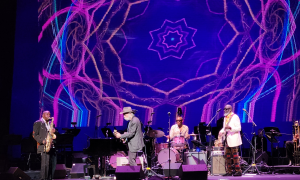
Bruford and Christensen played on more or less traditional kits, but Strønen and Kleive combined acoustic percussion with electronics, and Molvaer realized his remarkable ability to stretch the definition of what a trumpet can sound like. This brief but inspired performance also demonstrated Punktfest's attention to presentation, providing the first inkling of the outstanding lighting used throughout the evening in the main theater. More than simply casting illumination on the stage, the lighting flowed with the music, creating patterns on three white backdrops that divided the rear of the stage.
Talkington selected Shakespeare for her performance, bringing the concept of nature and its strength and beauty to life. The four percussionists worked more within texture than discrete rhythm; Molvaer was out front building layers of sound that were at times soft and appealing, other times jagged.
Lars Danielsson
After a short pause to reset the stage, Swedish bassist Lars Danielsson came out with a quartet that included Jan Bang, Jon Christensen and, on piano and accordion, Bugge Wesseltoft. Those familiar with Wesseltoft's groove-centric "New Conception of Jazz" series on his own Jazzland label would be surprised at how easily he can adapt to a situation like this, which emphasized free improv. While pulses would emerge periodically, there were just as many periods of rhythmic stasis, where the group sound was more about texture and the evolution of melody within an elastic time sense.
Opening with solo bass, Danielsson's lyrical lines were almost immediately transformed by Bang's real-time sampling into more ambient territory. The idea of live sampling is to feed the signal back to the original performer(s) in order to provoke a new kind of interaction. It requires imagination and a completely open mind, where the samples are treated as equal instrumental partners, and it was clear that Danielsson's ears were wide open to Bang's choices.
Wesseltoft entered, playing sparsely at first, but gradually building towards a more defined, albeit spontaneously conceived series of gentle chord changes, again sampled and fed back to the overall audioscape by Bang. Over the years Christensen has moved farther away from overt time, and his performance here was no exception, with an emphasis on texture and punctuation. But when Bang put forward a deep, defined heartbeat-like pulse, Christensen's reaction, rather than moving clearly with it, was to fill in the cracks as the piece morphed from spacious ambience to a more solid groove.
While each member of Danielsson's quartet emerged into the spotlight at times, this performance was not about individual soloing. Instead, it was a truly collaborative effort where egos were kept in check; the entire performance became something akin to a conversation, albeit an often strange but beautiful one. However, as the piece built from peaceful tranquility to greater turbulence, it became clear that Christensen and Wesseltoft were the two players who provided the greatest sense of drama. Danielsson alternated from an anchoring role to a more thematic one, while Bang continued to feed assorted snippets, often processed, to the rest of the group. At the same time, he contributed new sonic ideas from his large base of source material.
The second piece began again with Danielsson solo, but this time he created his own loops, which formed a basic pulse over which he layered a warm arco theme. Bang fed back samples that sounded as if they came from the first piece. Some critics attack the use of samplers and other technology as too mechanistic, but one need only see Bang in performance to realize that these tools can be completely organic, comprising an instrument in its own right. Even using prerecorded samples, but the imagination required to know the technology so intimately that it becomes second nature—just like any instrument—is what separates those who merely dabble from those who use the technology to take the music in a new direction.
But Bang wasn't the only one who was stretching the limits. At one point, Danielsson alternated between playing a strong melody and tapping the bridge of his bass, and here a clearer form began to evolve. Some players in more conventional jazz settings prefer the term spontaneous composition to free improvisation. What made Danielsson's set so remarkable was that, as open-ended as it was, there was always a sense of purpose, a palpable feeling of four focused musicians who were trying to take the music to a place that, while not clearly defined at the outset, gradually became so.
Anne Marie Almedal
Moving to the Alfaroom, the first performance was by singer Anne Marie Almedal. Seated on a stool, Almedal was surrounded by her group, including guitarist/pianist Nicholas Sillitoe, guitarist Rolf Kristensen and Sigrun Tara Overland, who played autoharp (a miniature harp) and provided Almedal with strong backing vocals. The all-acoustic group contrasts with Almedal's work with the pop-oriented Velvet Belly, which released a number of records from the mid-1990s until 2003, winning a Norwegian Grammy.
That Almedal's singer/songwriting and folk music aesthetic should immediately follow Danielsson's improvisational set is proof of the diversity of Punktfest. It also demonstrates the community sense of the festival. Almedal has worked with Bang—in fact, the real unifying link connecting all the artists here is that they have intersected, at different times, with Bang and/or Honoré. In some ways Punktfest is like the Canadian FIMAV festival in Victoriaville, where there's no genre-typing. But this event can be differentiated by the ever-broadening connections between the artists, as well as the ongoing cross-pollination among them.
While Almedal's music fits squarely into the folk realm, her flexible voice and Overland's vocal support made the set. At times singing more conventional harmonies, Overland was often the "X" factor, using her voice in unpredictable ways to create unusual textures and singing lines that wrapped around and intertwined with Almedal's, rather than merely supporting them. Kristensen switched between a number of acoustic guitars, each with a distinctive voice. While he rarely took a defined solo, he played a broader role as colorist to Sillitoe, who was often the rhythmic and chordal anchor for the group.
Bugge Wesseltoft
Back in the main theater, Bugge Wesseltoft brought together a number of artists who record for his Jazzland label. The performance, called "Jazzland Community," again emphasized again how so many of the Norwegian artists at Punkfest intersect in a variety of contexts.
Wesseltoft began solo on the grand piano with his back to the crowd. He may not have the virtuosic abilities of Keith Jarrett, but he's equally capable of bringing forth compositional ideas in a completely spontaneous way. After a few minutes of building his ideas on piano, Wesseltoft reached into the instrument, hitting the strings to create a rhythm that he looped, creating a pulse that began to evolve as the piece progressed. Wesseltoft, like so many other the Norwegian artists, seamlessly integrates technological ideas. Rather than there being an artificial dichotomy between acoustic and electric concepts, artists like Wesseltoft bring them together organically. Reductionists might complain that this integration dilutes the music, when in fact it makes it stronger and increases its potential.
Wesseltoft continued to build his solo by adding a variety of sampled sounds, including a deep bass pulse that was felt in the gut as much as it was heard, singing into the piano mic and looping that, as well as sampling his piano and feeding that back into the mix, created a remarkable aural and visual landscape. It's hard to believe that so much sound, and with such an organized sense of purpose, could be created by just one person.
Eivind Aarset's Electronique Noire
Towards the end of Wesseltoft's segment, he was joined by bassist Marius Reksjo, drummer Wetle Holte and guitarist Eivind Aarset—the three players comprising Aarset's group Electronique Noire. As a more insistent groove emerged, Wesseltoft left the stage, allowing Aarset's trio to cover material from his Jazzland discography. In many ways, Aarset has replaced Terje Rypdal as the guitarist of choice in the Norwegian community, working with everyone from neoclassicist Ketil Bjørnstad to Nils Petter Molvær, bassist Arild Andersen and percussionist Marilyn Mazur.
The eureka moment for Aarset came a few years ago, when he was doing a session with Wesseltoft where he was told not to play conventional rhythm guitar or solos. Rather than considering this a restriction, Aarset viewed it as an opportunity to work towards a new, more textural role for guitar, and took advantage of a wide variety of technologies to process his sound and fashion it into one of the most un- guitar-like sounds on the planet. Even when he does resort to something that sounds more like an electric guitar, it's usually in the context of a richer atmosphere. And when he resorts to more aggressive noise, it never sounds random or lacks a clear purpose.
In addition to a powerful drum sound, Holte also added programming to the mix; so between himself, Aarset's immense arsenal of sonic manipulation devices, and Reksjo's earthy anchor, there was an incredibly dense sound coming from such a small group. But while it was dense, it was rarely chaotic or jagged. The rhythms ranged from an almost hip-hop pattern, but in an atmospheric context— and, at times, a deep lyricism—that distanced it completely from the urban American form.
It's interesting, in fact, to see how similar technology can be used so differently by musicians from different cultures. Holte may have been playing a hip-hop-inspired rhythm, but Reksjo's fluid bass lines created an entirely different vibe. And while Aarset's writing has form, it's more like a skeleton that the entire trio can flesh out in an improvisational approach.
Hakon Kornstad
As the set evolved seamlessly, Aarset's trio was joined by Holte's band mate in Wibutee, saxophonist Hakon Kornstad. Wibutee's more structured approach is clearly an area that Kornstad wants to explore, but here he demonstrated an incredible array of extended techniques—once again showing just how far an instrument can be stretched. Tonguing to create a percussive sound, delivering remarkable multiphonics, placing the bell of the horn against his leg à la John Zorn—these are just a few of the techniques Kornstad brings to the table. He may not possess serious "jazz chops" by more rigid definitions—but, as is the case with most of the artists performing here, who cares? While he doesn't play like any icons from the tradition, it's clear that Kornstad has heard jazz artists considered to be essential roots. Rather than regurgitating the same ideas, Kornstad applies them to his own melodic concept in a way that's no less distinctive.
As Aarset and the trio left the stage, Kornstad remained on his own, building a solo that revolved around a simple I-IV-I-V series of changes. Kornstad made them personal by applying multiphonics to create harmonies that suggested even richer voicings. His technique was unassailable, smoothly shifting back and forth from melodic phrases to the harmonic changes in a way that kept each part in mind, so that it ultimately felt like the two parts were converging.
Sidsel Endresen
After Kornstad left the stage to thunderous applause, singer Sidsel Endresen came on, starting with a solo piece that demonstrated just how far herinstrument could go. Beginning by emulating the wind, but in such a way as to create an impression of harmonic movement, Endersen then began to layer clearer notes on top. Articulated phrases began to emerge, sounding like snippets of conversation—sometimes moving forward, other times sounding like they were going backwards. The variety of textures she was able to create without processing of any kind was remarkable—even sounding at one point like a shakuhachi.
Endresen was then joined onstage by Wesseltoft and Aarset for a version of "Western Wind," from her 2001 Jazzland release, Undertow. As spare as the original was, it was even more spacious. Wesseltoft and Aarset built the the two-chord structure almost imperceptibly, seeming to coalesce; Reksjo, Holte and Kornstad reappeared, one at a time. With a strong pulse emerging, the song morphed into an improvisation where the entire Jazzland Community, now brought together, moved farther and farther away from definition and towards an ending of barely controlled chaos.
In the Alfaroom the first live remix took place, providing a taste of what's to come over the next two days, where a greater number are scheduled. The integration of sampled music and live performance may well be the greatest risk taken by this festival—which, to a large extent, is defined by it. With a live audio/video feed to the bar area of the theater, those who were unable to fit into the room's smaller capacity still had the opportunity to see and hear this innovative idea in action.
Anja Garbarek
Returning to the theater, singer/songwriter Anja Garbarek—the daughter of legendary ECM saxophonist Jan Garbarek—put on the most structured show of the day. Still, the connection to Punktfest was there; Wibutee's Holte and Kornstad recently joined her band to support a tour promoting her new album, Briefly Shaking (EMI, 2005).
Garbarek's voice is bigger than her diminutive size would suggest, and like many of her influences—Kate Bush and Peter Gabriel in particular- -she has a cultivated stage presence.
Hers is highly produced music in a rock/pop vein, but with a deeper sense of feeling and construction than much of the disposable pop of today—especially in North America. It's a distinguishing point between the European and American pop scenes that an artist like this can thrive—she'd likely have a tough time getting heard on most radio stations in North America. Combining some of the technological elements that were so inherently a part of other Punktfest acts, she also defined herself through stories from the dark side and a personna onstage that ranged from soft to abrasive. While her voice was definitive, there were times when she used it as a more integrated part of the action, rather than riding atop it.
The lighting for all the main theater acts was stunning, but Garbarek's was clearly tailored to the arc of her show, building to a peak where lights began to flash out over the audience. The five-piece band included, along with Kornstad and Holte, a keyboardist, guitarist and bassist/guitarist, so there were plenty of layers going on behind her. Structured? Yes. Accessible? Yes. But Garbarek is a significant voice on the Scandinavian avant-pop scene, and the fact that she's had little exposure in North America is criminal.
Food
The last time that the Anglo/Norwegian collective Food released an album— Last Supper(Rune Grammofon, 2005)—it was still a quartet, but for last night's show in the Alfaroom, Food became the duo of Thomas Strønen and British saxophonist Iain Ballamy. In many respects the duo is the most flexible and responsive kind of collaboration, because with only two people involved, the lines of communication are clearer, and the players have a greater ability to react on an intimate level. While the absence of trumpeter Arve Henriksen was initially disappointing, Strønen and Ballamy proved the value of interaction in a duo setting, and their performance here was actually stronger than the way they sounded on their brief North American tour a couple of years back with the full quartet.
Strønen had far fewer acoustic percussion instruments than the last time around, where he seemed to be surrounded by all manner of instruments big and small. With other projects like Humcrush (Rune Grammofon), Strønen has moved more towards the area of sonic manipulation. There may have only been two people onstage last night, but the sound was at times much bigger.
Like Jan Bang, Strønen provides firm evidence that the concepts of sampling and sound manipulation are not necessarily mechanistic, but can be highly personal, suggesting that those who don't consider the approach both musical and on equal footing with more conventional instruments need to pause and reconsider. Strønen's intimate understanding of the technology meant that he was able to create layers of sound and rhythms with which Ballamy could interact. Ballamy also used some processing of his own (on tenor and soprano saxophones and flute), but he was also being sampled by Strønen, who then fed his reprocessed ideas back in the form of loops.
While the overall concept was abstract and freewheelingly improvisational, Ballamy was remarkably lyrical. Their approach rarely became aggressive, and this may have been the most accessible music Food has ever made, although it didn't compromise the adventurous exploration that has been a signature from the start. Stilll, Strønen was capable of edgier surprises. Towards the end of the single long improvisation, he switched from the tiny sticks—which drew some reference to British drummer Tony Oxley's sound—to normal sticks, punctuating the music loudly at times.
For a 45-minute set that had no preconception, the chemistry that Ballamy and Strønen shared made for moments—serendipitous, perhaps—where their coming together was uncanny. Early in the set, the two seemed to stop on a dime; Strønen then triggered a drum program and Ballamy picked up on it instantaneously. Further evidence that pure improvisation need not be amorphous or lack a collective sense of development.
Wibutee
Wibutee finished out the evening's events at the Agder Teater with a show that was similar to the one they performed in Ottawain June. But while the group's core trio—woodwind multi- instrumentalist/keyboardist/electronic manipulator/occasional vocalist Hakon Kornstad, drummer/drum programmer/electronic manipulator Wetle Holte and guitarist/keyboardist/programmer/electronic manipulator Rune Brondbo—was fleshed out to a quartet in Ottawa with the addition of bassist/guitarist Tor Egil Kreken, they performed this show in their usual live quintet form with Eyvind Andreas, also on guitar.
While the group had to squeeze tight to fit onto the small stage in Ottawa, they had the room they needed to stretch out at the Agder Teater. They were also able to use more extensive lighting and smoke that was either unavailable (in the case of the lighting) or prohibited by law (in the case of the smoke) in Ottawa, making the set a far more complete experience. They focused on material from Sweet Mental (Sonne Disk, 2006) and Playmachine(Jazzland, 2004), and experiencing this group on home turf was far more exciting.
It was also a different experience seeing Kornstad and Holte appearing elsewhere throughout the evening. That makes Wibutee's rock stance and more structured format—which still leaves plenty of room for interpretation—even more evident as a clear choice, and only one of many that these artists make. More so than most locales in North America; when Jan Bang speaks about community, it's no hyperbole.
Some people might look at the Norwegian scene as incestuous, but that would be an unfair dismissal. These artists have come together under a variety of situations, and they're both broad enough to work within them and distinctive enough in their musical personalities to retain them, regardless of context.
After experiencing over seven hours of nearly continuous music, one might think that my ears would need a rest. But in the case of Punktfest, the experience just heightened my anticipation for the concerts and live remixes planned for day two: singer Hanne Hukkelberg, saxophonist Karl Seglem, the duos of drummer Bill Bruford/pianist Michiel Boorstlap and saxophonist Frode Gjerstad/Jan Bang, a double concert featuring Bugge Wesseltoft solo and WARP (the Wagner Reloaded Project), singer Mari Boine and Austrian guitarist Fennesz.
Photo Credit
John Kelman
< Previous
Absolute Freedom
Comments
Tags
For the Love of Jazz
 All About Jazz has been a pillar of jazz since 1995, championing it as an art form and, more importantly, supporting the musicians who create it. Our enduring commitment has made "AAJ" one of the most culturally important websites of its kind, read by hundreds of thousands of fans, musicians and industry figures every month.
You Can Help
To expand our coverage even further and develop new means to foster jazz discovery and connectivity we need your help. You can become a sustaining member for a modest $20 and in return, we'll immediately hide those pesky ads plus provide access to future articles for a full year. This winning combination will vastly improve your AAJ experience and allow us to vigorously build on the pioneering work we first started in 1995. So enjoy an ad-free AAJ experience and help us remain a positive beacon for jazz by making a donation today.

Giveaway

Eligible winners: 15
Days remaining: 11
Days remaining: 11