Home » Jazz Articles » Live Review » White Night Music Marathon in Tel Aviv
White Night Music Marathon in Tel Aviv

Enav Cultural Center
Tel Aviv, Israel
June 29, 2006
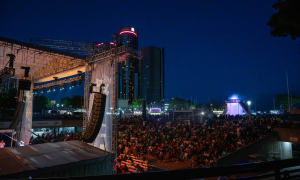
Ten hours of music, dozens of musicians from Israel and Europe, and lots of intriguing music. That's the story in a nutshell of the second mini-compacted Israeli version of the Vision Festival, Tel Aviv's White Night, a tribute to the Bauhus heritage of this seaside cultural capital of Israel.
The first set presented bass and electronics player Jean Claude Jones in three outfits. Jones opened in a duo with cellist Yuval Messner, and the two moved between tribal African rhythms, using their instruments and bows as percussion instruments, to more atmospheric drones.
Than Jones introduced his new trio, the Temperamental Interactive Trio, with baritone sax player Steve Horenstein, a close associate of innovative trumpeter Bill Dixon, and laptop player Loic Kessous, who has just released its debut disc, Raw and the Cooked (Kadima Collective, 2006). The trio's music synthesizes early sound experiments and motives pioneered by Dixon with modern minimalist soundscapes that have become so common on the hiss-like releases by the American Erstwhile and European For 4 Ears labels, where the divisions between acoustic sources, electronic, and sampled and processed sources are totally blurred. This short set provided only a glimpse into this raging, challenging sound lab.
One of the early highlights of this night was the meeting between Jones and English dancer Julyen Hamilton, now based in Spain. Hamilton collaborated last year with Jones for the first time and was eager to expand this experience (he had earlier collaborated with Dutch masters like drummers Han Bennink and bassist Wilbert de Joode). At the last second he asked Lithuanian drummer Arkady Gutesman to join for this set.

The outcome was spectacular. Hamilton was a kind of secular shaman, telling multiple stories through various characters at the same time with his dancing body, spicing them with humor. He had a great sense of rhythm and flux, and he communicated and responded so quickly to Jones' and Gutesman's every nuance. They were transfixed by Hamilton's moves and focused on paralleling his imagination with sounds, Jones buzzing his bass strings with spirited touches and Gutesman using his brushes to generate whirlwinds around his custom-made cymbals. Simply incredible.
Clarinetist Harlod Rubin hosted Danish pianist Olga Magieres from the Danish free improv combo Skraep for a an inventive duo that included an ironic and insightful reading of a Polish poem about an aging man missing his long gone love. Israeli saxophonist Albert Beger introduced three new pieces for his trio with bassist Gabby Meir and drummer Yoav Zohar, all inspired by spiritual sources like the writings of G.I. Gurdjieff, and all based on rolling syncopated beats that were built into explosive moments.
White Night debuted a new ad-hoc trio with pianist Slava Ganelin, Irish guitarist Mark O'Leary and Gutesman, a regular collaborator of Ganelin. The pianist interlocked immediately with O'Leary, who chose to produce soft tones and angular lines from his guitar during most of the forty minute improvisation, rarely pushing into more extrovert playing, referring more to King Crimson's Robert Fripp and the Mahavishnu Orchestra's John McLaughlin in their more contemplative moments, than to traditional jazz guitar playing.
 Ganelin expanded O'Leary's stratospheric forays into intense symphonic voyages, enjoying the inventive and subtle ideas of Gutesman, one of the most under-recognized drummers on the European continent. The sharpness of O'Leary and Gutesman's playing saved Ganelin from sliding into the more sentimental side that is so apparent on his latest releases. The two kept Ganelin on his toes, balancing his complex dynamics.
The next set introduced the Polish Kinetic Trio, comprised of two elderly-looking mad professors—Rafal Mazur (acoustic-bowed bass guitar) and Tomas Choloniewski (electronics)—and the clownish percussionist and saxophonist Marek Choloniewski. Their improvised music was engaging and full of humor. They piled up sounds like church bells, Middle Eastern frame drums, African and Australian traditional native instruments, lots of gibberish, and occasional dances into various sound salads, but in a way that sounded and looked almost logical.
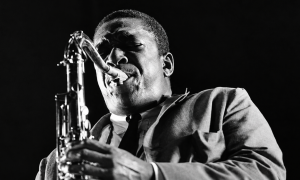
The main guest of this marathon was Danish-American sax legend John Tchicai, who resides now in France. Prior to his arrival, in an interview to the Israeli Daily Haaretz, he said that his lasting impression of the recording of John Coltrane's Ascension, 41 years ago, was "the master's modesty." Well, it seems that he still carries that lesson. He still has that investigative, deep sax tone, and now even enjoys singing, but he radiates the same kind of master's modesty as Coltrane did.
Tchicai was accompanied by pianist John Bostock and the young drummer Noam David, a Steve Horenstein disciple. He introduced his original piece, "Berlin Wall," written "before their wall fell down," relating it to the Israeli Separation Wall, and that was the only political statement throughout this marathon. He continued with "Monk's Dream," adding his own lyrics to Monk's standard:
Whenever the night brings a dream along
and whether the past, present or future holds on
all you can ever ask for, is learning the dream
that takes you out of your mind
He concluded with a heartfelt and lyrical interpretation of a composition by the late South African bassist Johnny Dyani, a former collaborator.
The Tel Aviv Art Ensemble devoted itself to two totally compositional approaches. Maya Dunietz's composition played with the normative conception of watching and listening to a concert, scattering the Ensemble players around the hall. They all played while facing the walls, than in couples and trios until they crowded around the vibes of Zvi Joffe. Horenstein's composition was based around Noam David's drumming pattern and featured highly disciplined and precise role games by most of the ensemble players.
Maybe due to insufficient rehearsal, or perhaps just unripe ideas, the two compositions sounded like academic exercises, failing to expose the potential of this Ensemble. Horenstein's composition for his sax trio with Tchicai and Beger, augmented by O'Leary, David and percussionist Jeffrey Kovalsky, was more interesting. The uncompromising personalities of Tchicai and Beger added jagged edges to Horenstein's angry shouts on the baritone sax.
Israeli saxophonist Assif Tsahar has been honing his skills as a drummer lately. After playing with some of the greatest drummers today, it is clear that he has done his homework. He knows how to create useful dynamics and a solid groove, as well as how to push a band. He was accompanied by pianist Daniel Sarid, who soon got into an inspired Cecil Taylor-like rolling clusters mode, and bassist Shmil Frankel, who played diligently all over the instrument. Their short set emphasized the close affinity and immediate interplay of all the members of this ad-hoc trio.
The duo of Ariel Shibolet on soprano sax and Yoram Lachish on oboe featured two different and complementary attitudes. Shibolet's playing is much more muscular. His mastery of circular breathing methods added more and more layers to his playing, echoing and commenting on his ideas. On the other hand, Lachish's playing was more ethereal and fragmented, but always attentive to Shibolet's cues.
This long night concluded with one of the first performances by the new Chameleon Trio—Dvir Katz (flute) and Nitai Levi (clarinets), both swirled around the assured playing of Ora Boasson-Horev (bass). Their two pieces featured influences from modern music, chamber jazz and some snippets from progressive rock. Their patient and serious dedication to the music, as well as some inspired playing by all three players, captivated the attention of the audience and was a beautiful ending for this enchanting evening.
See Ronen Hirsch's photos of White Night on the web.
Photo Credit
Kabilio
Tags
PREVIOUS / NEXT

Become a Sustaining Member

Since 1995, All About Jazz has championed jazz as an art form and supported the musicians who create it. Over three decades, it has grown into one of the world's leading jazz resources, serving hundreds of thousands of readers, musicians, presenters and industry professionals each month.
Help Build the Future of All About Jazz
Your support helps us continue building All About Jazz for the next generation—expanding our editorial coverage, preserving jazz history, developing new community features and creating better ways to discover the music and the people behind it.
Become a sustaining member for as little as $20 per year and you'll immediately enjoy an ad-free experience along with access to subscriber features and future articles for a full year.
Together, we're not simply sustaining All About Jazz—we're building its future. Thank you for being part of the journey.