Home » Jazz Articles » Live Review » Tatsuya Yoshida vs. Slava Ganelin and Albert Beger
Tatsuya Yoshida vs. Slava Ganelin and Albert Beger

Hed Club
Tel Aviv, Israel
June 25, 2006
"You can not survive playing like Yoshida for long," Israeli saxophonist Albert Beger told me while watching the first few minutes of Japanese drummer Tatsuya Yoshida's solo concert, "Ruins Alone." But Yoshida, the founder of the seminal avant duo the Ruins and a close collaborator with other iconoclasts, such as Japanese multi-instrumentalist Keiji Haino, saxophonist John Zorn (in his Painkiller trio), Japanese pianist Masabumi Kikuchi (in his now-defunct Slash Trio) and Japanese pianist Satoko Fujii (in her quartet and as a duo), and lately with pianist Sylvie Courvoisier, showed no signs of collapsing.
Yoshida is indeed a force of nature. He plays harder and faster than any drummer, or, thinking again, any improvising musician that I have seen, and he has developed a singular way of playing the drums. He races around his drum kit, never leaving his sticks and infrequently playing the cymbals, and never stops.
His drumming features an encyclopedic knowledge of the progressive rock from the late '60s and early '70s, and he can condense into a short bar quotes from the repertoires of Emerson, Lake & Palmer, King Crimson, Yes, and Gentle Giant—or the veterans of the Canterbury school of progressive rock, such as his favorite drummer, Charles Hayward's band, This Heat, or the vocal styling of another favorite band of Yoshida, French drummer Christian Vander's Magma. But Yoshida spices all these influences with a sharp punky edge, boundless streams of energy, take-no-prisoners attitude and with small doses of eccentric humor. In a short interview before the concert he said that "sometimes I need four people to do all the things that I want to do."

The second part of the concert was something completely different. Israeli pianist and composer came on stage to a set that was supposed to be a duo of Ganelin with Yoshida, but quickly was turned into a battle ground. Yoshida, still charged from the first set, soon began his speedy assault of the drums, leaving Ganelin gasping in attempt to catch up with him. Ganelin, who usually needs a lot of space- in terms of time and breadth of musical expression- lost his way in the simplified and extroverted forms of Yoshida, and tried to color Yoshida muscular drumming with otherworldly washes of his synthesizer. There was one magical moment when Yoshida began to exercise some operatic chants, and Ganelin quickly used this rare moment to develop it into an angelic song, but it lasted only for few seconds.
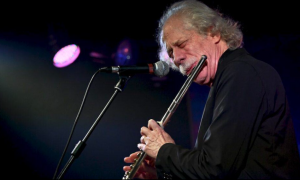
The last part of this concert featured Beger, who joined Yoshida and Ganelin. Beger chose not to grapple Yoshida playing but tried to mold his playing around his playing. He began with heavy blows on his tenor sax, locking with Yoshida patterns, but slowly overpowered Yoshida and pushed him to react and comment to his lines. Yoshida seemed to enjoy this game, and even showed much more restrained, and even gentle playing when Beger switched to the flute, but it was clear that he felt much more relaxed when Beger returned to the tenor sax and accelerated the speed till the final coda. Frustrated Ganelin tried to add some interesting rhythmic motifs, but it was clear that the pairing of him and Yoshida might have been challenging, provocative but certainly, not satisfying.
Visit Tatsuya Yoshida and Albert Beger on the web.
Photo Credit
Auris Media
Tags
PREVIOUS / NEXT
Become a Sustaining Member

Since 1995, All About Jazz has championed jazz as an art form and supported the musicians who create it. Over three decades, it has grown into one of the world's leading jazz resources, serving hundreds of thousands of readers, musicians, presenters and industry professionals each month.
Help Build the Future of All About Jazz
Your support helps us continue building All About Jazz for the next generation—expanding our editorial coverage, preserving jazz history, developing new community features and creating better ways to discover the music and the people behind it.
Become a sustaining member for as little as $20 per year and you'll immediately enjoy an ad-free experience along with access to subscriber features and future articles for a full year.
Together, we're not simply sustaining All About Jazz—we're building its future. Thank you for being part of the journey.