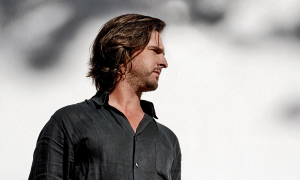
Home » Jazz Articles » Profile » Frank Kimbrough: Important Every Time
Frank Kimbrough: Important Every Time

I usually don
 Moonshine and church music flowed plentifully in backcountry North Carolina in the early '70s when a teenaged Frank Kimbrough saw the Bill Evans Trio on television. Suddenly the link between the young pianist's classical training and rock band elation became strikingly clear.
 "It struck me right away—the perfect combination, the discipline of what I was doing in classical music, but the freedom I was doing with my little rock band. I didn't feel like classical music was me. It wasn't something I wanted to do with my life. I had fun playing with friends, playing rock tunes, picking tunes off the radio... This was the perfect combination of these things. It took a couple years for that one little thing to sink in.
Eventually it did and Kimbrough set off for the jazz life and survived the bumpy road. He failed a music class at Appalachia State University for "having the audacity to bring an Evans transcript into a jury, though he stunned his theory professor for being the only person in the school's history to ace the ear training test. Two years later he found himself in Washington DC recording a demo tape in Shirley Horn's living room. "Her first words to me were something like 'Chile you sound just like Wynton Kelly.' And we became friends, Kimbrough recalled.
At age 25 the pianist landed in New York and met one of his heroes, Paul Bley, at Danceteria. Soon Kimbrough was hanging out with the older pianist, absorbing vast amounts of knowledge. "I'd sit in a room with him and just listen to him talk for a couple hours and I'd go home and take notes, he said. "It was just so heavy. He's talking about 'play red, play fast, play slow, play blue, play this, but don't do that.'
Nearly 25 years later Kimbrough got the chance to play with Bley. This past May the two shared the stage at Merkin Hall. Though his collection contains 130 Bley records, he didn't listen to any of them for six months before the gig. In fact he didn't even have a plan for the concert.
 "I felt like I was stepping into an elevator shaft, he said. "It was an elevator shaft that I kind of knew but there was nothing safe about it. I've been playing the piano for 45 years. He's been playing the piano for close to 70. So with my experience and his experience added up, how bad could it be?
 One bit of advice taken from all those hours listening was that rehearsals are a waste of time. Of course with groups he plays in like bandleader Maria Schneider's or bassist Ben Allison's, where the music is complex and composed, rehearsals are vital. But with a duo, a trio or playing solo, when the music's success comes from high levels of spontaneity, he'd rather not waste that initial essence.
"I usually don't touch the instrument unless I'm working, he explained. "That way, every time you sit down to play, it's important. You never get into a situation where you're just sleepwalking through the gig. Music should be a living, breathing thing. Maybe you put yourself into a situation sometimes where you might be terrified. You might be one millimeter from failure. That's alright because in those situations you're very present.
Kimbrough played solo piano at The Village Corner on Bleeker Street for five years. Trudging around the neighborhood in the '80s he encountered bored, alcoholic pianists at every turn. "They would drink all night and play the same tunes, he recalled. "I vowed never to do that. Kimbrough learned a new tune every night by favorites like Annette Peacock or Herbie Nichols. He learned hundreds of new tunes, developing discipline, a fierce devotion to spontaneity and an improvisational prowess apparent in each of the 14 albums released as a leader, including his most recent disc Play (Palmetto, 2006).
Joined by bassist Masa Kamaguchi, and another big influence, drummer Paul Motian, the trio recorded all ten tracks in five hours with no rehearsals. "Most of the music I write is pretty simple, he said. "It's usually one page and I hire musicians whose judgment I trust. If you're playing simple tunes and you trust the people you're working with, that's all that's really required.
Armed with a stack of music, the group chose the songs that day. Two Motian tunes—"Conception Vessel and "Play"—made the cut, joined by eight Kimbrough originals that take their inspiration mostly from friends and other musicians. He wrote "Lucent for his great friend Jim Luce who books the Caramoor Festival. "The Spins he realized is a tune he'd like to have played with Steve Lacy.
"It's really nice when you have a musician that has given his life for the music and never really compromised, people like Lacy, Motian, Bley, Dewey Redman [whose quartet he plays in]. They represent something to aspire to. It's hard to draw a line through someone's career and say 'wow this cat has been there for 50 years and never sold out.' It's nice to respect that and give these cats a little props.
 In 1994 Kimbrough helped expose one of his favorite composers by forming the Herbie Nichols Project, an outgrowth of the Jazz Composers Collective (JCC), which he founded with Allison in 1992.
 "It was outside the lines we had drawn for [the Collective] because the idea was to do our original music, but we decided it would be a good idea, he said. The project resulted in three recordings, tours to Europe and a grant for publicity. The most remarkable outcome was all the different groups the Collective spawned. Kimbrough alone played in 20 different bands related to the Collective.
Six months after forming the JCC, he joined Schneider's group. "You know how life sometimes dumps something in your lap once in a while? That was one of the greatest, he said. "Not only did it put me in proximity to this incredible music, but all the musicians that I've met on that gig in 13 years.
Thrilled yet terrified, the meticulously written music contrasted with most of the stuff he immersed himself in at that time. "It was very composed and written out and I didn't want to screw it up because I was playing with all these cats who were first call studio cats and they walk in and just nail it. I didn't want to embarrass myself. I was really terrified the first rehearsal. But things settled in and it's been great. I remember playing a concert in Paris where I thought they were going to shake the building down. People were clapping and stomping and yelling, it almost brought everybody in the band to tears.
Schneider considers Kimbrough one of the most important members of her group. "He knows where to leave space, she said. "He's very sensitive. He wraps himself around each soloist and takes care to go in the direction they're going and is really supportive. I hear things he plays and think 'Oh God if only I could write that.' Sometimes he'll finish an introduction and I'll think 'I don't even want to hear my music after that. It's over. Lets just end with that.'
 Kimbrough also plays regularly in a group with his wife, singer Maryanne deProphetis and trumpet player Ron Horton. "As an accompanist, he is unsurpassed, Horton said. "His sensitivity to a melodic instrument is a wonderful support. And as a soloist he's almost always on fire.
 Despite Kimbrough's sassy willfulness and blue-eyed Appalachian charm, his band mates agree that he's got it together. And Bley can't blame him for not coming prepared for their gig in May. "He said to me 'You mean after all this time you haven't even thought about what you want to do?' Kimbrough recalled. "And I said 'nope.' He said 'why not?' I just looked at him and laughed and said 'because I knew it wouldn't matter.' And we both just broke up into hysterical laughter.
Selected Discography
Frank Kimbrough, Play (Palmetto, 2006)
Frank Kimbrough, Lullabluebye (Palmetto, 2004)
Maria Schneider, Concert in the Garden (ArtistShare, 2004)
Herbie Nichols Project, Dr. Cyclop's Dream (Black Saint, 1999)
Frank Kimbrough, Quickening (OmniTone, 1998)
Frank Kimbrough, Lonely Woman (Mapleshade, 1988)
Photo Credit:
Jimmy Katz
< Previous
Everybody's Song Volumes 1/2
Next >
Focus
Comments

Tags
For the Love of Jazz
 All About Jazz has been a pillar of jazz since 1995, championing it as an art form and, more importantly, supporting the musicians who create it. Our enduring commitment has made "AAJ" one of the most culturally important websites of its kind, read by hundreds of thousands of fans, musicians and industry figures every month.
You Can Help
To expand our coverage even further and develop new means to foster jazz discovery and connectivity we need your help. You can become a sustaining member for a modest $20 and in return, we'll immediately hide those pesky ads plus provide access to future articles for a full year. This winning combination will vastly improve your AAJ experience and allow us to vigorously build on the pioneering work we first started in 1995. So enjoy an ad-free AAJ experience and help us remain a positive beacon for jazz by making a donation today.Near


Giveaway

Eligible winners: 15
Days remaining: 5
Days remaining: 5