Home » Jazz Articles » Album Review » Paul Motian Trio 2000 + One: On Broadway, Vol. 4: Or The...
Paul Motian Trio 2000 + One: On Broadway, Vol. 4: Or The Paradox of Continuity

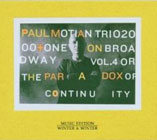
Are these interpretations best thought of as serious, minimalist "performances," or as illuminating "deconstructions" of musical texts that have become obscured by over familiarity and cluttered settings? Both Potter and Martin, whose vocal quality is reminiscent of Broadway star Bernadette Peters, provide ample evidence for the former conclusion, with strong and complete readings of the material.
In fact, Chris Potter's intimate knowledge of the songs and singular command of his instrument (no saxophonist is more effective at connecting the upper and lower registers of the horn) practically insure that no stone is left unturned in mining the melodic-harmonic possibilities inherent in this material. On the other hand, Kikuchi's insertion of the occasional melodic fragment as a departure point, together with his insistent use of the sostenuto pedal, moves his tracks toward atonality and abstraction, though on neither "Never Let Me Go" (second version) nor "I Loves You Porgy" can he deter Potter from referencing the songs' melodic and chordal sequences in their totality.
When Kikuchi has the tune all to himself, as in "Last Night When We Were Young," the effect of the non-musical vocalizations with which he accompanies himself is frankly eerie, as though he were a medium "channeling" the song rather than performing it. In fact, I'm reminded of the dead man who, in Kurosawa's film classic Rashomon, is ultimately called upon to speak the truth about his own death through the use of a medium. Just as the jury in Kurosawa's film learns that even dead men can lie, the listener of Kikuchi's interpretation of Harold Arlen's song may have serious doubts about the source of its inspiration.
As for the rhythm section, Motian maintains meter but eschews a conventional two-beat feel as well as 4/4 swing, preferring to punctuate and highlight movement rather than establish and articulate it. Grenadier's role complements the leader's approach, though in most measures he is careful to place one of his notes on, or close to, the downbeat.
Each of the tracks has something to offer, whether as a revelation or a reminder of songs that, over the course of Broadway's lengthening history, have become part not only of Motian's experience but also of public consciousness. At the same time, the somewhat limited textures and repetitious tempos of this 66-minute program will most likely discourage some listeners' attempts to digest it in a single sitting. In fact, from the opening "The Last Dance" to the closing "How Long Has This Been Going On?" there's an unmistakable sense of entropy, as though Motian's answer to the finale's question is an unmistakable "too long." The paradox, then, is that these tired tunes continue to receive periodic resurrections—in spite of and because of retirement parties such as this.
Track Listing
The Last Dance; Tea for Two; In a Shanty in Old Shanty Town; Never Let Me Go; Never Let Me Go (2); Folks Who Live on the Hill; Everything Happens to Me; Last Night When We Were Young; Born to be Blue; Brother Can You Spare a Dime; I Loves You Porgy; You're Getting to be a Habit with Me; How Long Has This Been Going On.
Personnel

Paul Motian
drumsPaul Motian: drums; Chris Potter: saxophone; Larry Grenadier: bass; Masabumi Kikuchi, piano; Rebecca Martin: vocals.
Album information
Title: On Broadway, Vol. 4: Or The Paradox of Continuity | Year Released: 2006 | Record Label: Winter & Winter
About Paul Motian
Tags
PREVIOUS / NEXT

Become a Sustaining Member

Since 1995, All About Jazz has championed jazz as an art form and supported the musicians who create it. Over three decades, it has grown into one of the world's leading jazz resources, serving hundreds of thousands of readers, musicians, presenters and industry professionals each month.
Help Build the Future of All About Jazz
Your support helps us continue building All About Jazz for the next generation—expanding our editorial coverage, preserving jazz history, developing new community features and creating better ways to discover the music and the people behind it.
Become a sustaining member for as little as $20 per year and you'll immediately enjoy an ad-free experience along with access to subscriber features and future articles for a full year.
Together, we're not simply sustaining All About Jazz—we're building its future. Thank you for being part of the journey.