Home » Jazz Articles » Extended Analysis » Soft Machine: Soft Machine: Grides
Soft Machine: Soft Machine: Grides

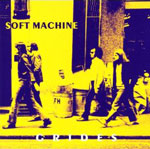 Soft Machine
 Grides
Cuneiform
2006
1970 was a banner year for the Soft Machine. Their profile amongst the European avant-garde jazz and psychedelic rock communities was raised by a headline-grabbing gig at the Proms, the British music establishment's annual celebration of, in the main, classical and symphonic composition and performance. The Proms was particularly notable for the fright the Softs' audience caused, and the fact that even Wyatt was not allowed in at first because he looked a bit "scummy." The group were also between record dates, with Third in the can and Fourth in process. But by the end of the year, they were touring much less than in previous seasons, and the word was that their gigs were fairly rote (perhaps not surprising, considering how fixed their sets were, as many bootlegs from the period attest).
By this time, the classic quartet of alto saxophonist Elton Dean, organist/electric pianist Mike Ratledge, bassist Hugh Hopper and drummer Robert Wyatt was usually fleshed out in the studio (and at a few concerts) by other musicians—saxophonists Lyn Dobson, Alan Skidmore and Gary Windo augmented Dean, and trombonist Nick Evans and trumpeter Marc Charig (like Dean, culled from Keith Tippett's group) sometimes joined too. Classically-trained bassist Roy Babbington, who later appeared in Tippett's Ovary Lodge, often complemented Hopper's electric delay with fierce arco antics.
Needless to say, the live and studio Softs were different beasts altogether. As interesting as Third, Fourth and Fifth (with drummers Phil Howard and John Marshall replacing Wyatt) are, they lack the lean fire of recordings like Grides. Taped in concert, on October 25, 1970 at Amsterdam's Concertgebouw, the music was enthusiastically received by a large audience. Ratledge's organ solos, while as fuzzed-out and technically all over the map as one would expect, are full of glitchy crackle and feedback (maybe something about playing in the home city of the Waisvisz crackle-box), making his work a far surlier endeavor than in other, cleaner settings.
As layered and repetitious as these solos are, Ratledge's work shows a profound similarity with Terry Riley's low-end, feedback-organ fantasias, though it is perhaps a tenser and more schizoid variant. Coupled with Hopper's pliant bass, often swinging between poles of clarity and grunge, and Dean's effect-enhanced alto and saxello playing (he often utilized contact mikes in concert), the feeling is of time-spanned and layered ascending modes, psychedelic feedback and plasticized rhythmic undertow. And then Wyatt's drums kick in...
It took me a while to see how Wyatt's percussive approach fit with the Soft Machine as the group developed into a minimalism and free jazz-inspired, psychedelic rock unit. Phil Howard's distracted timekeeping and John Marshall's ham-fisted sashays often seemed to fit perfectly with where the Softs were going, but then again Marshall's cleanliness didn't provide the tension that Wyatt's presence possessed. Wyatt is in no way flashy, but he's also not all that precise, except when he absolutely needs to be (which is usually when the rest of the band is in danger of hyper-indulgence).
In this incarnation of the group, see-saw effects between several poles—composition and freedom, swing and stasis, clarity and muddy dissonance—are both ragged and ultimately seamless, and Wyatt helps build up the tension. In "Virtually, as patented rock snare crack emerges in lock-step alongside Dean's buzzing harmonics and the Hopper-Ratledge stew, Wyatt's conviction and ability to push the whole thing forward is clearly apparent. "Teeth is anthemic, with the same hammering Wyatt, while Dean and Ratledge expand and contract the velocity, and the piece contains Dean's most intense solo of the disc (it just about had me yelling)—an obvious result of Wyatt's constant upping of the rhythmic ante.
Agitated freedom certainly had its place in the group's work. Dean's "Neo-Caliban Grides — a slashing stew of trumpet, alto, bass and drums on his self-titled 1971 CBS recording (with Charig, Howard, Babbington and Neville Whitehead; reissued on Cuneiform)—is given the Soft Machine treatment, with a brief collective improvisation leading into deft, long-and-short organ-alto lines over an ambiguous Wyatt drum surge. Ratledge's organ solo extends into feedback as rhythm falls away, Wyatt playing Sunny Murray-like chatter as Hopper delves into frenzied distance. The piece is indicative of the Softs' position at the time—improvisational cohesion ultimately pulled apart by four very different approaches to the music, an uneasy back-and-forth between isolated uncertainty and collective genius.
1971 found Wyatt nearly gone from the band as his compositions had long been pushed out of the performances—though when he was lucky, he was able to perform lengthy vocal improvisations mid-set. These often served to break up the Ratledge juggernaut and added a profoundly weird edge to the proceedings. The bonus DVD, recorded for West German NDR-TV's Beat Club, features one of these interludes in full form midway through a short Softs set. Usually appearing as part of "Esther's Nose Job, here the disturbed scatting finds its way into "Eamonn Andrews.
Films of the Softs from this period are extremely rare, so the DVD is a major treat for collectors and fans. Not only do we get to see the band cook in its prime, but we get to see them in vivid psychedelic colors, with superimposed and manipulated band shots showing on a screen behind the group. Dated as the technology may be, it actually works well with the music, and one can only assume similar effects were put to use in the band's live gigs. Context is key; far be it that a band as consistently at odds with itself and its apparent parameters as the Soft Machine should find itself consigned to a musicological time capsule.
Tracks
CD: Facelift; Virtually; Out-Bloody-Rageous; Neo-Caliban Grides; Teeth; Slightly All The Time; Eamonn Andrews; Esther's Nose Job; Slightly All The Time/Noisette.
DVD: Neo-Caliban Grides; Out-Bloody-Rageous; Vocal Improvisation; Eamonn Andrews; All White.
Personnel
Elton Dean: alto saxophone, saxello, electric piano; Mike Ratledge: electric organ, electric piano; Hugh Hopper: electric bass; Robert Wyatt: percussion and voice.
Track Listing
(CD): Facelift; Virtually; Out-Bloody-Rageous; Neo-Caliban Grides; Teeth; Slightly All the Time; Eamonn Andrews; Esther
Personnel

Soft Machine
band / ensemble / orchestraElton Dean: alto saxophone, saxello, electric piano; Mike Ratledge: electric organ, electric piano; Hugh Hopper: electric bass; Robert Wyatt: percussion and voice
Album information
Title: Soft Machine: Grides | Year Released: 2006 | Record Label: Cuneiform Records
About Soft Machine
Tags
PREVIOUS / NEXT

Become a Sustaining Member

Since 1995, All About Jazz has championed jazz as an art form and supported the musicians who create it. Over three decades, it has grown into one of the world's leading jazz resources, serving hundreds of thousands of readers, musicians, presenters and industry professionals each month.
Help Build the Future of All About Jazz
Your support helps us continue building All About Jazz for the next generation—expanding our editorial coverage, preserving jazz history, developing new community features and creating better ways to discover the music and the people behind it.
Become a sustaining member for as little as $20 per year and you'll immediately enjoy an ad-free experience along with access to subscriber features and future articles for a full year.
Together, we're not simply sustaining All About Jazz—we're building its future. Thank you for being part of the journey.